
|
시장보고서
상품코드
2019251
천연 계면활성제 시장 비즈니스 기회, 성장요인, 업계 동향 분석 및 예측(2026-2035년)Natural Surfactant Market Opportunity, Growth Drivers, Industry Trend Analysis, and Forecast 2026 - 2035 |
||||||

세계의 천연 계면활성제 시장은 2025년에 225억 달러로 평가되었고, CAGR 5.5%로 성장하여 2035년까지 381억 달러에 이를 것으로 추정되고 있습니다.
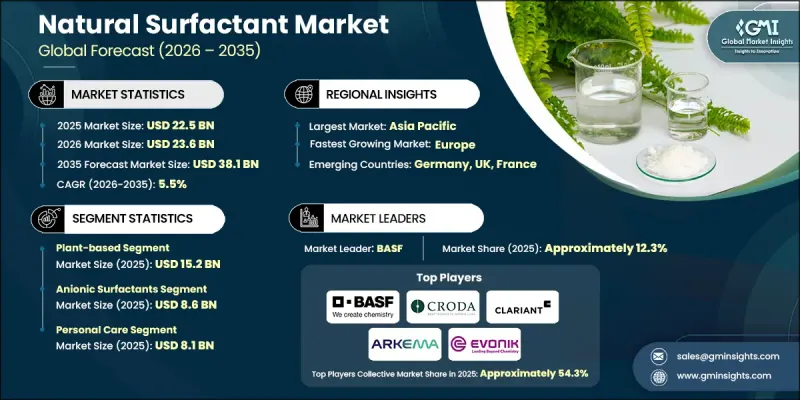
시장 확대는 소비자의 환경 인식이 높아지고 생분해성 및 지속 가능한 방식으로 조달된 원료에 대한 수요가 증가함에 따라 주도되고 있습니다. 퍼스널케어, 청소, 식음료 및 산업 분야의 제조업체들은 기존의 석유화학 유래 대체품에서 천연 계면활성제로 전환하는 추세를 보이고 있습니다. 이러한 전환은 기업의 지속가능성에 대한 노력과 환경 친화적인 솔루션을 권장하는 엄격한 규제 프레임워크에 의해 뒷받침되고 있습니다. 식음료 업계는 클린 라벨 및 안전 요구 사항을 충족시키기 위해 유화제, 안정제, 분산제로 이러한 원료를 채택하고 있으며, 가공을 최소화한 제품에 대한 소비자의 선호는 더 많은 수요를 촉진하고 있습니다. 마찬가지로, 퍼스널케어 및 화장품 기업들도 피부 친화적이고, 황산염이 없고, 성분 표시가 명확한 제품을 제공하기 위해 식물 유래 저자극성 계면활성제를 도입하고 있으며, 이는 시장 성장을 주도하고 있습니다. 다양한 응용 분야에서 천연 계면활성제의 채택이 확대되고 있는 것은 지속 가능한 산업 및 소비재 개발에서 천연 계면활성제의 역할이 확대되고 있음을 보여줍니다.
| 시장 범위 | |
|---|---|
| 개시 연도 | 2025년 |
| 예측 기간 | 2026-2035년 |
| 개시 연도 시장 규모 | 225억 달러 |
| 예측액 | 381억 달러 |
| CAGR | 5.5% |
식물 유래 계면활성제 시장은 재생 가능한 자원이라는 점, 접근성, 비용 효율성, 그리고 지속가능성 목표에 부합한다는 점에서 2025년 152억 달러에 달할 것으로 예측됩니다. 식물성 기름, 당류 원료 및 코코넛 오일에서 추출한 성분은 퍼스널케어, 가정용 세제 및 산업용 제제에 널리 사용되고 있습니다. 반면, 동물성 계면활성제는 규제상의 제약과 비건 및 동물실험을 하지 않는 제품에 대한 소비자 수요 증가로 인해 틈새 시장으로 제한되어 있습니다.
음이온 계면활성제 부문은 세제, 샴푸, 산업용 세정제에 필수적인 우수한 세정력, 유화력, 발포력으로 인해 2025년 86억 달러를 차지할 것으로 예측됩니다. 또한, 비이온성 계면활성제는 퍼스널케어, 농업, 산업용 제제에서 우수한 안정성, 저자극성, 상용성을 제공하여 그 적용 범위가 확대되고 있기 때문에 빠르게 채택되고 있습니다.
북미 천연 계면활성제 시장은 2025년 55억 달러 규모에 달할 것으로 예측됩니다. 이 지역의 성장은 퍼스널케어, 홈케어, 산업용 세정 분야에서 친환경적이고 생분해성 제품을 선호하는 소비자 트렌드에 힘입어 성장세를 보이고 있습니다. 미국은 엄격한 환경 규제, 높은 소비자 의식, 그리고 높은 수준의 화학제품 생산 능력으로 시장을 주도하고 있습니다. 캐나다 시장은 천연 화장품과 식물 유래 제품의 보급이 확대되면서 성장하고 있으며, 생명공학 및 발효 기술을 기반으로 한 계면활성제 생산에 대한 투자가 이 지역의 성장세를 더욱 부추기고 있습니다.
자주 묻는 질문
목차
제1장 조사 방법과 범위
제2장 주요 요약
제3장 업계 인사이트
제4장 경쟁 구도
제5장 시장 추산 및 예측 : 소스별, 2022-2035
제6장 시장 추산 및 예측 : 제품별, 2022-2035
제7장 시장 추산 및 예측 : 용도별, 2022-2035
제8장 시장 추산 및 예측 : 지역별, 2022-2035
제9장 기업 개요
LSH 26.05.08The Global Natural Surfactant Market was valued at USD 22.5 billion in 2025 and is estimated to grow at a CAGR of 5.5% to reach USD 38.1 billion by 2035.
The market expansion is driven by heightened environmental awareness among consumers and the rising demand for biodegradable and sustainably sourced ingredients. Manufacturers across personal care, cleaning, food and beverage, and industrial sectors are increasingly shifting to natural surfactants over conventional petrochemical alternatives. This transition is supported by corporate sustainability initiatives and stringent regulatory frameworks that favor eco-friendly solutions. The food and beverage industry is adopting these ingredients as emulsifiers, stabilizers, and dispersants to meet clean-label and safety requirements, while consumer preference for minimally processed products fuels demand further. Likewise, personal care and cosmetics companies are incorporating plant-based, mild surfactants to provide skin-friendly, sulfate-free, and transparent formulations, driving market growth. The increasing adoption of natural surfactants across diverse applications underscores their expanding role in sustainable industrial and consumer product development.
| Market Scope | |
|---|---|
| Start Year | 2025 |
| Forecast Year | 2026-2035 |
| Start Value | $22.5 Billion |
| Forecast Value | $38.1 Billion |
| CAGR | 5.5% |
The plant-based surfactants segment reached USD 15.2 billion in 2025, due to their renewable nature, wide availability, cost-effectiveness, and alignment with sustainability goals. Vegetable oils, sugar-based feedstocks, and coconut oil derivatives are commonly used across personal care, household cleaning, and industrial formulations. In contrast, animal-derived surfactants are limited to niche applications due to regulatory constraints and rising consumer demand for vegan and cruelty-free products.
The anionic surfactants segment accounted for USD 8.6 billion in 2025 due to their superior cleansing, emulsifying, and foaming abilities, essential in detergents, shampoos, and industrial cleaning products. Nonionic surfactants are also witnessing rapid adoption as they offer excellent stability, mildness, and compatibility across personal care, agricultural, and industrial formulations, expanding their application scope.
North America Natural Surfactant Market generated USD 5.5 billion in 2025. The region's expansion is fueled by consumer preference for eco-friendly and biodegradable products in personal care, home care, and industrial cleaning applications. The United States leads due to strong environmental regulations, consumer awareness, and advanced chemical production capabilities. Canada's market is growing as natural cosmetics and plant-based product adoption rise, while investments in biotechnology and fermentation-based surfactant production further support regional momentum.
Key players in the Global Natural Surfactant Market include Clariant, Dow, Evonik Industries, Arkema Group, Stepan Company, WHEATOLEO, BASF, Croda International, Innovative Chemical Technologies, Kao Corporation, and SEPPIC. Companies in the Natural Surfactant Market are strengthening their presence by investing in R&D to develop bio-based and sustainable products with enhanced performance and compatibility across applications. Strategic partnerships with agricultural and biotechnology firms enable access to renewable feedstocks and innovative fermentation processes. Firms focus on product diversification to cater to personal care, food, and industrial segments while meeting regulatory compliance and eco-certification standards. Expanding global manufacturing capacity and leveraging digital platforms for marketing and distribution improve reach. Additionally, companies emphasize transparency, sustainability messaging, and educational campaigns to build consumer trust and differentiate their offerings in a competitive market.
Table of Contents
Chapter 1 Methodology & Scope
- 1.1 Market scope and definition
- 1.2 Research design
- 1.2.1 Research approach
- 1.2.2 Data collection methods
- 1.3 Data mining sources
- 1.3.1 Global
- 1.3.2 Regional/Country
- 1.4 Base estimates and calculations
- 1.4.1 Base year calculation
- 1.4.2 Key trends for market estimation
- 1.5 Primary research and validation
- 1.5.1 Primary sources
- 1.6 Forecast model
- 1.7 Research assumptions and limitations
Chapter 2 Executive Summary
- 2.1 Industry 360° synopsis
- 2.2 Key market trends
- 2.2.1 Regional
- 2.2.2 Source
- 2.2.3 Product
- 2.2.4 Application
- 2.3 TAM Analysis, 2026-2035
- 2.4 CXO perspectives: Strategic imperatives
- 2.4.1 Executive decision points
- 2.4.2 Critical success factors
- 2.5 Future Outlook and Strategic Recommendations
Chapter 3 Industry Insights
- 3.1 Industry ecosystem analysis
- 3.1.1 Supplier Landscape
- 3.1.2 Profit Margin
- 3.1.3 Value addition at each stage
- 3.1.4 Factor affecting the value chain
- 3.1.5 Disruptions
- 3.2 Industry impact forces
- 3.2.1 Growth drivers
- 3.2.1.1 Growing consumer preference for eco-friendly products
- 3.2.1.2 Expanding applications in food and beverage sector
- 3.2.1.3 Rising demand in personal care and cosmetics industries
- 3.2.2 Industry pitfalls and challenges
- 3.2.2.1 High production costs
- 3.2.2.2 Limited availability of raw materials
- 3.2.3 Market opportunities
- 3.2.3.1 Expansion of Biosurfactant Production through Biotechnology
- 3.2.3.2 Rising Demand for Sustainable Ingredients in Personal Care and Home Care Products
- 3.2.1 Growth drivers
- 3.3 Growth potential analysis
- 3.4 Regulatory landscape
- 3.4.1 North America
- 3.4.2 Europe
- 3.4.3 Asia Pacific
- 3.4.4 Latin America
- 3.4.5 Middle East & Africa
- 3.5 Porter's analysis
- 3.6 PESTEL analysis
- 3.7 Price trends
- 3.7.1 By region
- 3.7.2 Product type
- 3.8 Future market trends
- 3.9 Technology and Innovation Landscape
- 3.9.1 Current technological trends
- 3.9.2 Emerging technologies
- 3.10 Patent Landscape
- 3.11 Trade statistics (HS code) (Note: the trade statistics will be provided for key countries only)
- 3.11.1 Major importing countries
- 3.11.2 Major exporting countries
- 3.12 Sustainability and environmental aspects
- 3.12.1 Sustainable practices
- 3.12.2 Waste reduction strategies
- 3.12.3 Energy efficiency in production
- 3.12.4 Eco-friendly initiatives
Chapter 4 Competitive Landscape, 2025
- 4.1 Introduction
- 4.2 Company market share analysis
- 4.2.1 By region
- 4.2.1.1 North America
- 4.2.1.2 Europe
- 4.2.1.3 Asia Pacific
- 4.2.1.4 LATAM
- 4.2.1.5 MEA
- 4.2.1 By region
- 4.3 Company matrix analysis
- 4.4 Competitive analysis of major market players
- 4.5 Competitive positioning matrix
- 4.6 Key developments
- 4.6.1 Mergers & acquisitions
- 4.6.2 Partnerships & collaborations
- 4.6.3 New product launches
- 4.6.4 Expansion plans
Chapter 5 Market Estimates and Forecast, By Source, 2022 - 2035 (USD Billion) (Kilo Tons)
- 5.1 Key trends
- 5.2 Plant-based
- 5.3 Animal-based
- 5.4 Microbial/Fermentation-based
Chapter 6 Market Estimates and Forecast, By Product, 2022 - 2035 (USD Billion) (Kilo Tons)
- 6.1 Key trends
- 6.2 Anionic surfactants
- 6.3 Cationic surfactants
- 6.4 Nonionic surfactants
- 6.5 Amphoteric surfactants
Chapter 7 Market Estimates and Forecast, By Application, 2022 - 2035 (USD Billion) (Kilo Tons)
- 7.1 Key trends
- 7.2 Personal Care
- 7.3 Industrial and Institutional Cleaning
- 7.4 Agriculture
- 7.5 Pharmaceuticals
- 7.6 Oilfield Chemicals
- 7.7 Others (Textile, food & Beverage)
Chapter 8 Market Estimates and Forecast, By Region, 2022 - 2035 (USD Billion) (Kilo Tons)
- 8.1 Key trends
- 8.2 North America
- 8.2.1 U.S.
- 8.2.2 Canada
- 8.3 Europe
- 8.3.1 Germany
- 8.3.2 UK
- 8.3.3 France
- 8.3.4 Spain
- 8.3.5 Italy
- 8.3.6 Rest of Europe
- 8.4 Asia Pacific
- 8.4.1 China
- 8.4.2 India
- 8.4.3 Japan
- 8.4.4 Australia
- 8.4.5 South Korea
- 8.4.6 Rest of Asia Pacific
- 8.5 Latin America
- 8.5.1 Brazil
- 8.5.2 Mexico
- 8.5.3 Rest of Latin America
- 8.6 Middle East and Africa
- 8.6.1 Saudi Arabia
- 8.6.2 South Africa
- 8.6.3 UAE
- 8.6.4 Rest of Middle East and Africa
Chapter 9 Company Profiles
- 9.1 BASF
- 9.2 Dow
- 9.3 Croda International
- 9.4 Clariant
- 9.5 Stepan Company
- 9.6 Kao Corporation
- 9.7 WHEATOLEO
- 9.8 Arkema Group
- 9.9 Evonik Industries
- 9.10 Innovative Chemical Technologies
- 9.11 SEPPIC