

|
시장보고서
상품코드
2027451
플렉서블 일렉트로닉스용 전도성 폴리머 : 시장 기회, 성장 촉진요인, 업계 동향 분석 및 예측(2026-2035년)Conductive Polymers in Flexible Electronics Market Opportunity, Growth Drivers, Industry Trend Analysis, and Forecast 2026 - 2035 |
||||||

세계의 플렉서블 일렉트로닉스용 전도성 폴리머 시장 규모는 2025년에 8억 5,500만 달러로 평가되었고 CAGR 7.1%를 나타내 2035년까지 17억 달러에 이를 것으로 예측됩니다.
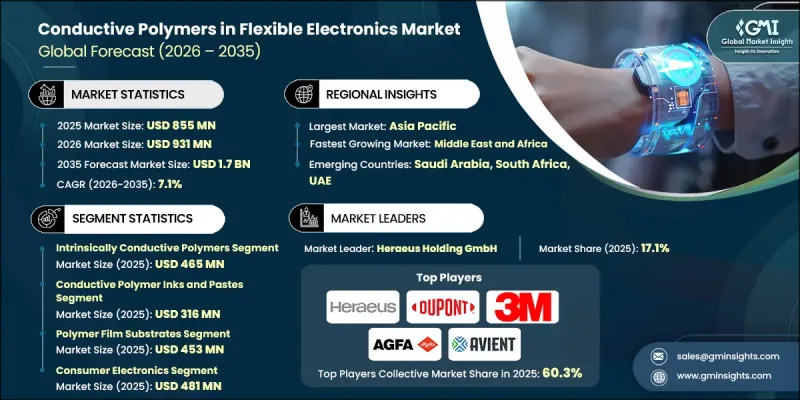
전도성 폴리머가 차세대 전자 시스템의 핵심 재료로 인식됨에 따라 이 산업은 꾸준히 성장하고 있습니다. 이러한 재료는 전기 전도성과 기계적 적응성을 겸비하고, 변형이 발생해도 성능을 유지할 수 있습니다. 구조적 유연성으로 인해 현대 용도의 진화하는 설계 요구 사항을 충족하는 가볍고 적응력이 뛰어난 전자 솔루션을 개발할 수 있습니다. 주요 장점 중 하나는 전기적 특성을 조절할 수 있다는 점으로, 화학적 조성 변경 및 도핑 기술을 통해 전도성을 정밀하게 제어할 수 있다는 점입니다. 이러한 유연성을 통해 다양한 전자 부품에 통합할 수 있으며, 다기능 디바이스 아키텍처를 지원할 수 있습니다. 또한, 전도성 폴리머는 확장성이 뛰어나고 비용 효율적인 제조 공정이 가능하여 대량 생산에 적합합니다. 넓은 면적의 응용 분야를 위해 설계된 가공 방법은 재료 사용량과 에너지 효율을 최적화하면서 일관성을 보장합니다. 시장에서는 재료의 지속적인 발전과 효율적이고 적응력이 뛰어난 전자 시스템에 대한 수요 증가로 인해 플렉서블 일렉트로닉스의 혁신을 뒷받침하는 첨단 재료 솔루션으로 전환하고 있습니다.
| 시장 범위 | |
|---|---|
| 시작 연도 | 2025년 |
| 예측 기간 | 2026-2035년 |
| 개시 연도 시장 규모 | 8억 5,500만 달러 |
| 예측액 | 17억 달러 |
| CAGR | 7.1% |
2025년 고유 전도성 폴리머 부문 시장 규모는 4억 6,500만 달러에 달했습니다. 추가적인 전도성 필러 없이도 고유한 전기 전도성을 발휘할 수 있기 때문에 가볍고 유연한 재료 성능이 요구되는 용도에 매우 적합합니다. 이러한 폴리머는 장치의 신뢰성을 유지하기 위해 일관된 전도성과 균일한 구조적 특성이 필수적인 첨단 전자 시스템에 널리 활용되고 있습니다.
전도성 폴리머 잉크 및 페이스트 부문은 2025년 3억 1,600만 달러 시장 규모를 기록했으며, 전도성 필름 및 시트와 함께 주요 제품 카테고리로 부상하고 있습니다. 이러한 소재 형태는 유연하고 확장 가능한 제조 기술과의 친화력으로 인해 시장의 빠른 성장에 기여하고 있습니다. 이들은 성능의 일관성을 유지하면서 전자 부품의 효율적인 제조를 지원하고 있습니다. 반면, 필름 및 시트는 구조적 안정성과 균일한 전기적 성능을 제공하기 때문에 내구성이 요구되는 응용 분야에서 가치가 있습니다. 그러나 반복적인 기계적 응력 하에서 전도성을 유지하고 서로 다른 재료 표면 사이의 강한 접착력을 확보하는 것은 여전히 중요한 기술적 과제로 남아 있습니다.
북미의 플렉서블 일렉트로닉스용 전도성 폴리머 시장은 2025년 1억 4,500만 달러에서 2035년 2억 9,950만 달러로 성장할 것으로 예상되어 견조한 성장세를 나타낼 것으로 전망됩니다. 이 지역은 잘 구축된 기술 생태계와 첨단 전자 기술 혁신에 대한 관심이 높아지는 혜택을 누리고 있습니다. 미국의 지속적인 발전은 막대한 연구 투자와 신흥 전자 기술에 대한 집중적인 투자로 뒷받침되고 있으며, 여러 고부가가치 분야의 보급 확대에 기여하고 있습니다.
자주 묻는 질문
목차
제1장 조사 방법과 범위
제2장 주요 요약
제3장 업계 인사이트
제4장 경쟁 구도
제5장 시장 추산 및 예측 : 폴리머 유형별(2022-2035년)
제6장 시장 추산 및 예측 : 제품 형태별(2022-2035년)
제7장 시장 추산 및 예측 : 제품 형태별(2022-2035년)
제8장 시장 추산 및 예측 : 최종 이용 산업별(2022-2035년)
제9장 시장 추산 및 예측 : 지역별(2022-2035년)
제10장 기업 개요
KTH 26.05.20The Global Conductive Polymers in Flexible Electronics Market was valued at USD 855 million in 2025 and is estimated to grow at a CAGR of 7.1% to reach USD 1.7 billion by 2035.
The industry is witnessing steady expansion as conductive polymers gain recognition as a core material in next-generation electronic systems. These materials combine electrical conductivity with mechanical adaptability, allowing them to maintain performance under deformation. Their structural flexibility enables the development of lightweight and adaptable electronic solutions, supporting evolving design requirements across modern applications. A key advantage lies in their tunable electrical characteristics, with modifications in chemical composition or doping techniques enabling precise control of conductivity. This flexibility enables integration across a wide range of electronic components while supporting multifunctional device architectures. Additionally, conductive polymers are compatible with scalable and cost-efficient production processes, making them suitable for high-volume manufacturing. Processing methods designed for large-area applications ensure consistency while optimizing material usage and energy efficiency. The market reflects a growing shift toward advanced material solutions that support innovation in flexible electronics, driven by continuous material advancements and increasing demand for efficient and adaptable electronic systems.
| Market Scope | |
|---|---|
| Start Year | 2025 |
| Forecast Year | 2026-2035 |
| Start Value | $855 Million |
| Forecast Value | $1.7 Billion |
| CAGR | 7.1% |
The intrinsically conductive polymers segment accounted for USD 465 million in 2025. Their ability to deliver inherent electrical conductivity without requiring additional conductive fillers makes them highly suitable for applications that demand lightweight and flexible material performance. These polymers are widely utilized in advanced electronic systems where consistent conductivity and uniform structural properties are essential for maintaining device reliability.
The conductive polymer inks and pastes segment generated USD 316 million in 2025, emerging as a major product category alongside conductive films and sheets. These material forms are contributing to rapid market growth due to their compatibility with flexible and scalable fabrication techniques. They support efficient manufacturing of electronic components while maintaining performance consistency. At the same time, films and sheets provide structural stability and uniform electrical performance, making them valuable across applications requiring durability. However, maintaining conductivity under repeated mechanical stress and ensuring strong adhesion across different material surfaces remain key technical considerations.
North America Conductive Polymers in Flexible Electronics Market is expected to grow from USD 145 million in 2025 to USD 299.5 million by 2035, reflecting a strong growth outlook. The region benefits from a well-established technological ecosystem and an increasing focus on advanced electronic innovation. Ongoing developments in the United States are supported by significant research investments and a strong emphasis on emerging electronic technologies, contributing to broader adoption across multiple high-value sectors.
Key companies operating in the Conductive Polymers in Flexible Electronics Market include DuPont de Nemours, Inc., 3M Company, SABIC, Celanese Corporation, Covestro AG, Avient Corporation, Agfa-Gevaert N.V., Heraeus Holding GmbH, Lubrizol Corporation, RTP Company, Premix Oy, and KEMET Corporation. Companies in the Conductive Polymers in Flexible Electronics Market are focusing on strengthening their market position through innovation, collaboration, and expansion strategies. Significant investments in research and development are aimed at improving conductivity, durability, and material flexibility to meet evolving industry requirements. Strategic partnerships with technology developers are enabling faster integration of advanced materials into next-generation electronic systems. Firms are also expanding their production capabilities and geographic reach to address rising global demand. Customization of material solutions for specific applications is becoming increasingly important for differentiation. Additionally, companies are enhancing supply chain efficiency and leveraging scalable manufacturing techniques to optimize costs while maintaining consistent product quality and performance standards.
Table of Contents
Chapter 1 Methodology & Scope
- 1.1 Market scope and definition
- 1.2 Research design
- 1.2.1 Research approach
- 1.2.2 Data collection methods
- 1.3 Data mining sources
- 1.3.1 Global
- 1.3.2 Regional/Country
- 1.4 Base estimates and calculations
- 1.4.1 Base year calculation
- 1.4.2 Key trends for market estimation
- 1.5 Primary research and validation
- 1.5.1 Primary sources
- 1.6 Forecast model
- 1.7 Research assumptions and limitations
Chapter 2 Executive Summary
- 2.1 Industry 360° synopsis
- 2.2 Key market trends
- 2.2.1 Polymer Type
- 2.2.2 Product Form
- 2.2.3 Substrate Type
- 2.2.4 End Use Industry
- 2.2.5 Regional
- 2.3 TAM Analysis, 2026-2035
- 2.4 CXO perspectives: Strategic imperatives
- 2.4.1 Executive decision points
- 2.4.2 Critical success factors
- 2.5 Future outlook and strategic recommendations
Chapter 3 Industry Insights
- 3.1 Industry ecosystem analysis
- 3.1.1 Supplier landscape
- 3.1.2 Profit margin
- 3.1.3 Value addition at each stage
- 3.1.4 Factor affecting the value chain
- 3.1.5 Disruptions
- 3.2 Industry impact forces
- 3.2.1 Growth drivers
- 3.2.1.1 Rising demand for wearable devices
- 3.2.1.2 Advancements in printing and coating technologies
- 3.2.1.3 Increasing adoption of foldable and stretchable displays
- 3.2.2 Industry pitfalls and challenges
- 3.2.2.1 Lower conductivity than metals
- 3.2.2.2 Limited long-term stability
- 3.2.3 Market opportunities
- 3.2.3.1 Next-generation wearable electronics
- 3.2.3.2 Hybrid polymer-nanomaterial devices
- 3.2.3.3 Conductive polymers can enable smart packaging solutions
- 3.2.1 Growth drivers
- 3.3 Growth potential analysis
- 3.4 Regulatory landscape
- 3.4.1 North America
- 3.4.2 Europe
- 3.4.3 Asia Pacific
- 3.4.4 Latin America
- 3.4.5 Middle East & Africa
- 3.5 Porter's analysis
- 3.6 PESTEL analysis
- 3.7 Technology and innovation landscape
- 3.7.1 Current technological trends
- 3.7.2 Emerging technologies
- 3.8 Price trends
- 3.8.1 By region
- 3.8.2 By product type
- 3.9 Future market trends
- 3.10 Technology and innovation landscape
- 3.10.1 Current technological trends
- 3.10.2 Emerging technologies
- 3.11 Patent landscape
- 3.12 Trade statistics (HS code)
- 3.12.1 Major importing countries
- 3.12.2 Major exporting countries
- 3.13 Sustainability and environmental aspects
- 3.13.1 Sustainable practices
- 3.13.2 Waste reduction strategies
- 3.13.3 Energy efficiency in production
- 3.13.4 Eco-friendly initiatives
- 3.14 Carbon footprint consideration
Chapter 4 Competitive Landscape, 2025
- 4.1 Introduction
- 4.2 Company market share analysis
- 4.2.1 By region
- 4.2.1.1 North America
- 4.2.1.2 Europe
- 4.2.1.3 Asia Pacific
- 4.2.1.4 LATAM
- 4.2.1.5 MEA
- 4.2.1 By region
- 4.3 Company matrix analysis
- 4.4 Competitive analysis of major market players
- 4.5 Competitive positioning matrix
- 4.6 Key developments
- 4.6.1 Mergers & acquisitions
- 4.6.2 Partnerships & collaborations
- 4.6.3 New product launches
- 4.6.4 Expansion plans
Chapter 5 Market Estimates and Forecast, By Polymer Type, 2022-2035 (USD Million) (Kilo Tons)
- 5.1 Key trends
- 5.2 Intrinsically conductive polymers
- 5.2.1 PEDOT / PEDOT:PSS
- 5.2.2 Polyaniline (PANI)
- 5.2.3 Polypyrrole (PPy)
- 5.2.4 Other intrinsically conductive polymers
- 5.3 Extrinsically conductive polymers
- 5.3.1 Carbon-based fillers (CNT, Graphene, Carbon Black)
- 5.3.2 Metal-based fillers (Silver, Copper)
Chapter 6 Market Estimates and Forecast, By Product Form, 2022-2035 (USD Million) (Kilo Tons)
- 6.1 Key trends
- 6.2 Conductive polymer inks and pastes
- 6.2.1 Inkjet-compatible inks
- 6.2.2 Screen printing pastes
- 6.3 Conductive polymer films and sheets
- 6.4 Conductive polymer dispersions and solutions
- 6.5 Conductive polymer composites and compounds
Chapter 7 Market Estimates and Forecast, By Product Form, 2022-2035 (USD Million) (Kilo Tons)
- 7.1 Key trends
- 7.2 Polymer film substrates
- 7.2.1 PET substrates
- 7.2.2 Polyimide substrates
- 7.2.3 Other polymer film substrates
- 7.3 Textile and fiber substrates
- 7.4 Paper and cellulose substrates
- 7.5 Elastomeric substrates
- 7.6 Metal foil substrates
Chapter 8 Market Estimates and Forecast, By End Use Industry, 2022-2035 (USD Million) (Kilo Tons)
- 8.1 Key trends
- 8.2 Consumer electronics
- 8.3 Healthcare and medical devices
- 8.4 Automotive and transportation
- 8.5 Industrial and manufacturing
- 8.6 Retail and logistics
- 8.7 Energy and utilities
- 8.8 Defense and aerospace
- 8.9 Other industries
Chapter 9 Market Estimates and Forecast, By Region, 2022-2035 (USD Million) (Kilo Tons)
- 9.1 Key trends
- 9.2 North America
- 9.2.1 U.S.
- 9.2.2 Canada
- 9.3 Europe
- 9.3.1 Germany
- 9.3.2 UK
- 9.3.3 France
- 9.3.4 Spain
- 9.3.5 Italy
- 9.3.6 Rest of Europe
- 9.4 Asia Pacific
- 9.4.1 China
- 9.4.2 India
- 9.4.3 Japan
- 9.4.4 Australia
- 9.4.5 South Korea
- 9.4.6 Rest of Asia Pacific
- 9.5 Latin America
- 9.5.1 Brazil
- 9.5.2 Mexico
- 9.5.3 Argentina
- 9.5.4 Rest of Latin America
- 9.6 Middle East and Africa
- 9.6.1 Saudi Arabia
- 9.6.2 South Africa
- 9.6.3 UAE
- 9.6.4 Rest of Middle East and Africa
Chapter 10 Company Profiles
- 10.1 3M Company
- 10.2 Agfa-Gevaert N.V.
- 10.3 Avient Corporation
- 10.4 Celanese Corporation
- 10.5 Covestro AG
- 10.6 DuPont de Nemours, Inc.
- 10.7 Heraeus Holding GmbH
- 10.8 KEMET Corporation
- 10.9 Lubrizol Corporation
- 10.10 Premix Oy
- 10.11 RTP Company
- 10.12 SABIC


