

|
시장보고서
상품코드
2027458
이소스테아린산 : 시장 기회, 성장 촉진요인, 업계 동향 분석 및 예측(2026-2035년)Isostearic Acid Market Opportunity, Growth Drivers, Industry Trend Analysis, and Forecast 2026 - 2035 |
||||||

세계의 이소스테아린산 시장은 2025년에 3억 2,740만 달러로 평가되었고 CAGR 7%를 나타내 2035년까지 6억 4,370만 달러에 이를 것으로 추정되고 있습니다.
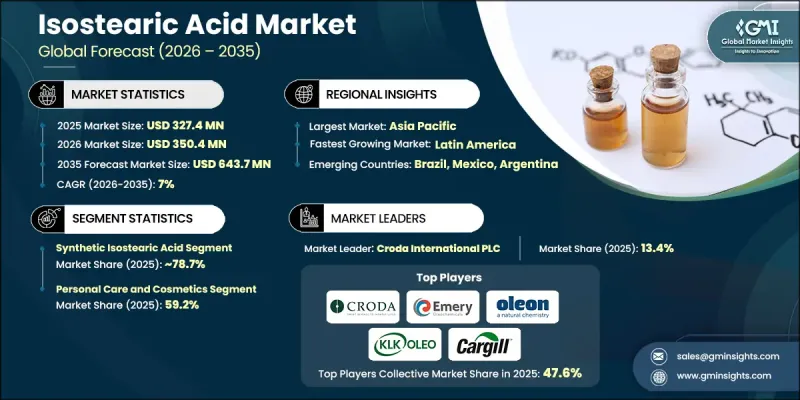
퍼스널케어, 제약 및 산업 분야에서 식물 유래의 지속 가능한 원료에 대한 수요가 증가함에 따라 이소스테아린산 산업은 지속적으로 성장하고 있습니다. 시장 성장은 재생 가능한 원료로의 전환과 환경 친화적인 생산 방식으로의 전환에 의해 촉진되고 있습니다. 일반적으로 식물 유래 원료를 부분 수소화하여 얻은 이소스테아린산은 환경 친화적인 제형과 궁합이 잘 맞아 점점 더 선호되고 있습니다. 컨디셔닝 효과와 보습 특성으로 피부 및 헤어 케어 제품에 사용하기에 매우 적합하며, 화학적 안정성으로 인해 다양한 조건에서 성능이 요구되는 산업용 윤활유에 적용될 수 있습니다. 웰빙과 지속 가능한 소비에 대한 소비자의 인식이 높아지면서 제품 수요가 더욱 증가하고 있습니다. 도시화와 소득수준의 상승으로 퍼스널케어에 대한 지출이 가속화되고 있는 신흥국에서는 성장 기회가 특히 크다고 할 수 있습니다. 그러나 생산 비용이 합성 대체품보다 여전히 높기 때문에 시장은 비용 관련 문제에 직면해 있습니다.
| 시장 범위 | |
|---|---|
| 시작 연도 | 2025년 |
| 예측 기간 | 2026-2035년 |
| 개시 연도 시장 규모 | 3억 2,740만 달러 |
| 예측액 | 6억 4,370만 달러 |
| CAGR | 7% |
합성 이소스테아린산 부문은 2025년 78.7%의 점유율을 차지했으며, 2035년까지 연평균 6.7%의 성장률을 나타낼 것으로 전망됩니다. 이 부문은 비용 효율성과 용도에 상관없이 안정적인 성능을 발휘하기 때문에 지속적으로 시장을 독점하고 있습니다. 제조업체들은 특히 퍼스널케어 및 산업 분야에서 균일한 품질이 요구되는 배합에서 안정성과 적합성 때문에 합성 제품에 의존하고 있습니다.
퍼스널케어 및 화장품 부문은 2025년 59.2%로 가장 큰 점유율을 차지했으며, 2026년부터 2035년까지 연평균 6.7%의 성장률을 나타낼 것으로 예측됩니다. 지속 가능하고 고성능의 성분을 찾는 소비자 트렌드가 높아짐에 따라 스킨케어 및 미용 제품 등의 배합에 이소스테아린산이 채택되는 추세입니다. 지속적인 제품 혁신과 취향의 변화가 이 부문의 성장을 뒷받침하고 있습니다.
북미는 2025년 세계 시장 점유율의 28.1%를 차지하며 견조한 성장세를 이어가고 있습니다. 고급 퍼스널케어 제품 및 산업용 제품에 대한 수요 증가와 더불어 친환경 성분에 대한 관심이 높아지면서 이 지역 시장을 형성하고 있습니다. 규제 프레임워크와 지속가능성에 대한 노력은 바이오 대체품으로의 전환을 촉진하고 있으며, 미국은 혁신 주도적인 환경으로 인해 여전히 주요 기여자로 남아있습니다.
자주 묻는 질문
목차
제1장 조사 방법과 범위
제2장 주요 요약
제3장 업계 인사이트
제4장 경쟁 구도
제5장 시장 추산 및 예측 : 유형별(2022-2035년)
제6장 시장 추산 및 예측 : 용도별(2022-2035년)
제7장 시장 추산 및 예측 : 지역별(2022-2035년)
제8장 기업 개요
KTH 26.05.20The Global Isostearic Acid Market was valued at USD 327.4 million in 2025 and is estimated to grow at a CAGR of 7% to reach USD 643.7 million by 2035.
The isostearic acid industry continues to gain traction as demand rises for plant-based and sustainable raw materials across personal care, pharmaceutical, and industrial applications. Market growth is being fueled by a shift toward renewable inputs and environmentally responsible production practices. Isostearic acid, commonly derived through the partial hydrogenation of vegetable-based feedstocks, is increasingly favored due to its compatibility with eco-conscious formulations. Its conditioning and moisture-retaining characteristics make it highly suitable for use in skin and hair formulations, while its chemical stability supports applications in industrial lubricants requiring performance under varying conditions. Expanding consumer awareness around wellness and sustainable consumption is further reinforcing product demand. Growth opportunities are particularly strong in emerging economies where urbanization and rising income levels are accelerating spending on personal care. However, the market faces cost-related challenges, as production expenses remain higher than those associated with synthetic substitutes.
| Market Scope | |
|---|---|
| Start Year | 2025 |
| Forecast Year | 2026-2035 |
| Start Value | $327.4 Million |
| Forecast Value | $643.7 Million |
| CAGR | 7% |
The synthetic isostearic acid segment accounted for 78.7% share in 2025 and is anticipated to grow at a CAGR of 6.7% through 2035. This segment continues to dominate due to its cost-effectiveness and consistent performance across applications. Manufacturers rely on synthetic variants for their stability and suitability in formulations that require uniform quality, particularly in personal care and industrial uses.
The personal care and cosmetics segment held the largest share at 59.2% in 2025 and is forecast to expand at a CAGR of 6.7% during the 2026-2035 period. Rising consumer inclination toward sustainable and high-performance ingredients is driving the incorporation of isostearic acid into formulations such as skincare and beauty products. Continuous product innovation and evolving preferences are supporting segment growth.
North America captured 28.1% of the global market share in 2025 and continues to demonstrate strong growth. Increasing demand for advanced personal care and industrial products, along with a growing focus on environmentally friendly ingredients, is shaping the regional market. Regulatory frameworks and sustainability initiatives are encouraging the transition toward bio-based alternatives, while the U.S. remains a key contributor due to its innovation-driven environment.
Key companies operating in the Global Isostearic Acid Market include Ataman Chemicals, Biosynth, Cargill Inc., Croda International PLC, Emery Oleochemicals, Glentham Life Sciences, Jarchem Industries, KH NeoChem, KLK Oleo, KOKYO ALCOHOL KOGYO, Nissan Chemical Corporation, Oleon, Santa Cruz Biotechnology, and Vantage Specialty Chemicals. Companies in the isostearic acid market are focusing on strategic initiatives to strengthen their competitive positioning and expand their global footprint. Many players are investing in research and development to enhance product performance and develop bio-based alternatives aligned with sustainability trends. Partnerships and collaborations with raw material suppliers are being pursued to secure consistent supply chains and reduce production costs. Firms are also expanding their manufacturing capacities and geographic presence to tap into high-growth regions. Product portfolio diversification remains a key approach, enabling companies to cater to a wider range of applications.
Table of Contents
Chapter 1 Methodology & Scope
- 1.1 Market scope and definition
- 1.2 Research design
- 1.2.1 Research approach
- 1.2.2 Data collection methods
- 1.3 Data mining sources
- 1.3.1 Global
- 1.3.2 Regional/Country
- 1.4 Base estimates and calculations
- 1.4.1 Base year calculation
- 1.4.2 Key trends for market estimation
- 1.5 Primary research and validation
- 1.5.1 Primary sources
- 1.6 Forecast model
- 1.7 Research assumptions and limitations
Chapter 2 Executive Summary
- 2.1 Industry 360° synopsis
- 2.2 Key market trends
- 2.2.1 Regional
- 2.2.2 Type
- 2.2.3 Application
- 2.3 TAM Analysis, 2026-2035
- 2.4 CXO perspectives: Strategic imperatives
- 2.4.1 Executive decision points
Chapter 3 Industry Insights
- 3.1 Industry ecosystem analysis
- 3.1.1 Supplier landscape
- 3.1.2 Profit margin
- 3.1.3 Value addition at each stage
- 3.1.4 Factor affecting the value chain
- 3.1.5 Disruptions
- 3.2 Industry impact forces
- 3.2.1 Growth drivers
- 3.2.2 Industry pitfalls and challenges
- 3.2.3 Market opportunities
- 3.3 Growth potential analysis
- 3.4 Regulatory landscape
- 3.4.1 North America
- 3.4.2 Europe
- 3.4.3 Asia Pacific
- 3.4.4 Latin America
- 3.4.5 Middle East & Africa
- 3.5 Porter’s analysis
- 3.6 PESTEL analysis
- 3.7 Price trends
- 3.7.1 By region
- 3.7.2 By type
- 3.8 Future market trends
- 3.9 Technology and Innovation landscape
- 3.9.1 Current technological trends
- 3.9.2 Emerging technologies
- 3.10 Patent Landscape
- 3.11 Trade statistics (HS code)
- 3.11.1 Major importing countries
- 3.11.2 Major exporting countries
- 3.12 Sustainability and environmental aspects
- 3.12.1 Sustainable practices
- 3.12.2 Waste reduction strategies
- 3.12.3 Energy efficiency in production
- 3.12.4 Eco-friendly initiatives
- 3.13 Carbon footprint consideration
Chapter 4 Competitive Landscape, 2025
- 4.1 Introduction
- 4.2 Company market share analysis
- 4.2.1 By region
- 4.2.1.1 North America
- 4.2.1.2 Europe
- 4.2.1.3 Asia Pacific
- 4.2.1.4 LATAM
- 4.2.1.5 MEA
- 4.2.1 By region
- 4.3 Company matrix analysis
- 4.4 Competitive analysis of major market players
- 4.5 Competitive positioning matrix
- 4.6 Key developments
- 4.6.1 Mergers & acquisitions
- 4.6.2 Partnerships & collaborations
- 4.6.3 New Product Launches
- 4.6.4 Expansion Plans
Chapter 5 Market Estimates and Forecast, By Type, 2022-2035 (USD Million) (Kilo Tons)
- 5.1 Key trends
- 5.2 Synthetic isostearic acid
- 5.3 Natural isostearic acid
Chapter 6 Market Estimates and Forecast, By Application, 2022-2035 (USD Million) (Kilo Tons)
- 6.1 Key trends
- 6.2 Personal care & cosmetics
- 6.2.1 Skin care
- 6.2.2 Hair care
- 6.2.3 Makeup
- 6.2.4 Other personal care
- 6.3 Chemical esters
- 6.3.1 Emollients & emulsifiers
- 6.3.2 Surfactants & detergents
- 6.3.3 Plasticizers
- 6.3.4 Other specialty esters
- 6.4 Lubricants & greases
- 6.4.1 Automotive lubricants
- 6.4.2 Industrial lubricants
- 6.4.3 Specialty greases
- 6.5 Textile
- 6.5.1 Textile softeners & finishes
- 6.5.2 Textile lubricants & spinning oils
- 6.5.3 Dyeing & printing auxiliaries
- 6.5.4 Other textile processing aids
- 6.6 Others
Chapter 7 Market Estimates and Forecast, By Region, 2022-2035 (USD Million) (Kilo Tons)
- 7.1 Key trends
- 7.2 North America
- 7.2.1 U.S.
- 7.2.2 Canada
- 7.3 Europe
- 7.3.1 Germany
- 7.3.2 UK
- 7.3.3 France
- 7.3.4 Spain
- 7.3.5 Italy
- 7.3.6 Rest of Europe
- 7.4 Asia Pacific
- 7.4.1 China
- 7.4.2 India
- 7.4.3 Japan
- 7.4.4 Australia
- 7.4.5 South Korea
- 7.4.6 Rest of Asia Pacific
- 7.5 Latin America
- 7.5.1 Brazil
- 7.5.2 Mexico
- 7.5.3 Argentina
- 7.5.4 Rest of Latin America
- 7.6 Middle East and Africa
- 7.6.1 Saudi Arabia
- 7.6.2 South Africa
- 7.6.3 UAE
- 7.6.4 Rest of Middle East and Africa
Chapter 8 Company Profiles
- 8.1 Ataman Chemicals
- 8.2 Biosynth
- 8.3 Cargill Inc.
- 8.4 Croda International PLC
- 8.5 Emery Oleochemicals
- 8.6 Glentham Life Sciences
- 8.7 Jarchem Industries
- 8.8 KH NeoChem
- 8.9 KLK Oleo
- 8.10 KOKYO ALCOHOL KOGYO
- 8.11 Nissan Chemical Corporation
- 8.12 Oleon
- 8.13 Santa Cruz Biotechnology
- 8.14 Vantage Specialty Chemicals


