
|
시장보고서
상품코드
2027478
밀 전분 : 시장 기회, 성장 촉진요인, 업계 동향 분석 및 예측(2026-2035년)Wheat Starch Market Opportunity, Growth Drivers, Industry Trend Analysis, and Forecast 2026 - 2035 |
||||||

세계의 밀 전분 시장은 2025년에 45억 달러로 평가되었고, 2035년까지 연평균 복합 성장률(CAGR) 3.3%를 나타내 63억 달러에 이를 것으로 추정되고 있습니다.
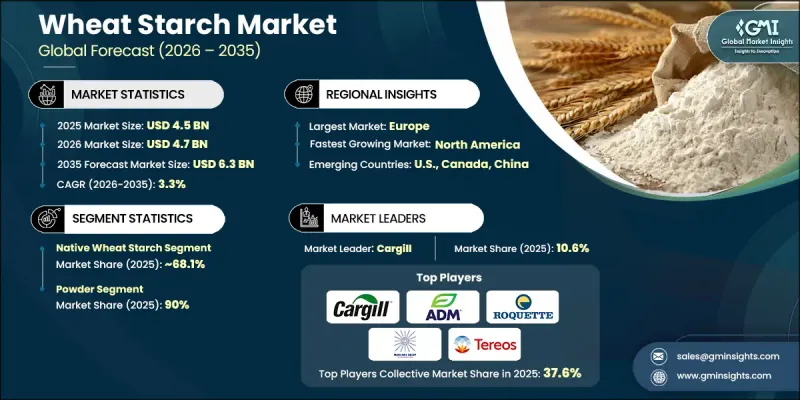
시장의 성장은 식음료, 의약품, 포장 관련 용도 등 다양한 산업 분야에서 수요가 증가함에 따라 뒷받침되고 있습니다. 밀 전분은 증점, 결합, 겔화 등의 기능성으로 인해 널리 이용되고 있으며, 다양한 제조 공정에서 중요한 원료로 사용되고 있습니다. 최근 몇 년 동안 시장은 혁신 중심의 응용 분야로 전환하고 있으며, 클린 라벨 및 글루텐 프리 제품 개발에 점점 더 많은 관심을 기울이고 있습니다. 가공 기술의 발전으로 추출 및 정제 방법이 크게 개선되어 더 높은 품질과 안정된 제품을 생산하고 있습니다. 각 업체들은 제품의 차별화를 꾀하고 업무 효율성을 높이기 위해 연구개발에 많은 투자를 하고 있습니다. 효소 변형 전분, 하이브리드 전분 솔루션과 같은 새로운 혁신으로 인해 밀 전분의 적용 범위가 확대될 것으로 예측됩니다. 또한, 식습관의 변화와 건강한 식습관에 대한 관심이 높아지면서 수요에 영향을 미치고 있으며, 특히 소비자들이 현대인의 영양학적 기대에 부합하는 대체 식품을 찾는 경향이 강해지고 있습니다. 또한, 편의성을 중시하는 식품의 인기가 높아진 것도 시장의 꾸준한 성장에 기여하고 있습니다.
| 시장 규모 | |
|---|---|
| 시작 연도 | 2025년 |
| 예측 기간 | 2026-2035년 |
| 개시 연도 시장 규모 | 45억 달러 |
| 예측액 | 63억 달러 |
| CAGR | 3.3% |
천연 밀 전분 부문은 2025년 68.1%의 점유율을 차지했으며, 2035년까지 연평균 3.5%의 성장률을 나타낼 것으로 전망됩니다. 시장은 크게 천연전분과 가공전분으로 나뉘는데, 천연전분은 천연 유래 성분과 기능적 성능으로 인해 확고한 지위를 유지하고 있습니다. 질감과 점도를 향상시키는 능력은 특히 클린 라벨을 지향하는 응용 분야에서 채택을 촉진하고 있습니다.
분말 부문은 취급, 보관 및 운송의 용이성을 바탕으로 2025년 90%의 점유율을 차지했습니다. 분말 밀 전분은 다재다능하고 생산 공정에 효율적으로 통합할 수 있어 다양한 산업 분야에서 널리 선호되고 있습니다. 식감과 안정성을 향상시키는 일관된 성능은 그 폭넓은 활용을 더욱 촉진하고 있습니다.
북미의 밀 전분 시장은 2025년 13억 달러 규모에 달했으며, 2026년부터 2035년까지 연평균 3.5%의 성장률을 나타낼 것으로 예측됩니다. 지역적 수요는 클린 라벨과 건강 지향적 제품에 대한 소비자의 관심 증가에 의해 주도되고 있습니다. 식품 가공 부문의 성장과 지속적인 제품 혁신이 시장 확대를 뒷받침하고 있습니다. 또한, 확립된 규제 프레임워크도 일관된 품질 기준의 유지와 시장 안정화에 기여하고 있습니다.
자주 묻는 질문
목차
제1장 조사 방법과 범위
제2장 주요 요약
제3장 업계 인사이트
제4장 경쟁 구도
제5장 시장 추산 및 예측 : 유형별(2022-2035년)
제6장 시장 추산 및 예측 : 형태별(2022-2035년)
제7장 시장 추산 및 예측 : 용도별(2022-2035년)
제8장 시장 추산 및 예측 : 지역별(2022-2035년)
제9장 기업 개요
KTH 26.05.20The Global Wheat Starch Market was valued at USD 4.5 billion in 2025 and is estimated to grow at a CAGR of 3.3% to reach USD 6.3 billion by 2035.
Growth in the market is supported by rising demand across multiple industries, including food and beverage, pharmaceuticals, and packaging-related applications. Wheat starch is widely utilized due to its functional properties, such as thickening, binding, and gelling, which make it a key ingredient in a variety of production processes. Over time, the market has shifted toward innovation-driven applications, with increasing emphasis on clean-label and gluten-free product development. Advancements in processing technologies have significantly improved extraction and refinement methods, resulting in higher-quality and more consistent products. Companies are investing heavily in research and development to enhance product differentiation and improve operational efficiency. Emerging innovations, including enzyme-modified and hybrid starch solutions, are expected to expand the application scope of wheat starch. Additionally, changing dietary preferences and the growing inclination toward healthier eating habits are influencing demand, particularly as consumers seek alternatives aligned with modern nutritional expectations. The increasing popularity of convenience-oriented food products is also contributing to the steady growth of the market.
| Market Scope | |
|---|---|
| Start Year | 2025 |
| Forecast Year | 2026-2035 |
| Start Value | $4.5 Billion |
| Forecast Value | $6.3 Billion |
| CAGR | 3.3% |
The native wheat starch segment accounted for 68.1% share in 2025 and is anticipated to grow at a CAGR of 3.5% through 2035. The market is broadly categorized into native and modified starch types, with native starch maintaining a strong position due to its natural composition and functional performance. Its ability to enhance texture and consistency has driven its adoption, particularly in applications aligned with clean-label preferences.
The powdered segment held a 90% share in 2025, supported by its ease of handling, storage, and transportation. Powdered wheat starch is widely preferred across various industries for its versatility and efficient integration into production processes. Its consistent performance in improving texture and stability further reinforces its widespread use.
North America Wheat Starch Market accounted for USD 1.3 billion in 2025 and is expected to grow at a CAGR of 3.5% between 2026 and 2035. Regional demand is being driven by increasing consumer focus on clean-label and health-oriented products. Growth in the food processing sector, along with ongoing product innovation, continues to support market expansion. A well-established regulatory framework also contributes to maintaining consistent quality standards and fostering market stability.
Key companies operating in the Global Wheat Starch Market include Cargill, ADM, AGRANA, Roquette Freres, Tereos Starch & Sweeteners, Crespel & Deiters Group, Lantmannen Biorefineries, Manildra Group, MGP Ingredients, Inc., Sedamyl, Kroner-Starke GmbH, Japan Corn Starch Co., Ltd., and Anhui Ante Food Co., Ltd. Companies in the Wheat Starch Market are strengthening their market presence through continuous innovation, strategic partnerships, and expansion into emerging markets. Many players are focusing on developing advanced starch variants with improved functionality and enhanced application versatility. Investments in modern processing technologies are helping improve product quality and production efficiency. Firms are also aligning their offerings with clean-label and health-focused trends to meet evolving consumer demands. Expanding distribution networks and strengthening supply chain capabilities are key strategies to ensure consistent product availability. Additionally, companies are emphasizing research and development to create customized solutions for various end-use industries, enabling long-term growth and competitive differentiation.
Table of Contents
Chapter 1 Methodology & Scope
- 1.1 Market scope and definition
- 1.2 Research design
- 1.2.1 Research approach
- 1.2.2 Data collection methods
- 1.3 Data mining sources
- 1.3.1 Global
- 1.3.2 Regional/Country
- 1.4 Base estimates and calculations
- 1.4.1 Base year calculation
- 1.4.2 Key trends for market estimation
- 1.5 Primary research and validation
- 1.5.1 Primary sources
- 1.6 Forecast model
- 1.7 Research assumptions and limitations
Chapter 2 Executive Summary
- 2.1 Industry 360° synopsis
- 2.2 Key market trends
- 2.2.1 Regional
- 2.2.2 Type
- 2.2.3 Form
- 2.2.4 Application
- 2.3 TAM Analysis, 2026-2035
- 2.4 CXO perspectives: Strategic imperatives
Chapter 3 Industry Insights
- 3.1 Industry ecosystem analysis
- 3.1.1 Supplier landscape
- 3.1.2 Profit margin
- 3.1.3 Value addition at each stage
- 3.1.4 Factor affecting the value chain
- 3.1.5 Disruptions
- 3.2 Industry impact forces
- 3.2.1 Growth drivers
- 3.2.1.1 Rising demand for processed & convenience foods
- 3.2.1.2 Growth of gluten-free & clean-label product trends
- 3.2.1.3 Expanding pharmaceutical excipient applications
- 3.2.2 Industry pitfalls and challenges
- 3.2.2.1 Fluctuating raw material (wheat) prices & supply volatility
- 3.2.2.2 Intense competition from corn, potato & tapioca starches
- 3.2.3 Market opportunities
- 3.2.3.1 Biodegradable packaging & bioplastics revolution
- 3.2.3.2 Organic & Non-GMO wheat starch development
- 3.2.1 Growth drivers
- 3.3 Growth potential analysis
- 3.4 Regulatory landscape
- 3.4.1 North America
- 3.4.2 Europe
- 3.4.3 Asia Pacific
- 3.4.4 Latin America
- 3.4.5 Middle East & Africa
- 3.5 Porter's analysis
- 3.6 PESTEL analysis
- 3.7 Price trends
- 3.7.1 By region
- 3.7.2 By type
- 3.8 Future market trends
- 3.9 Technology and innovation landscape
- 3.9.1 Current technological trends
- 3.9.2 Emerging technologies
- 3.10 Patent Landscape
- 3.11 Trade statistics (HS code)
- 3.11.1 Major importing countries
- 3.11.2 Major exporting countries
- 3.12 Sustainability and environmental aspects
- 3.12.1 Sustainable practices
- 3.12.2 Waste reduction strategies
- 3.12.3 Energy efficiency in production
- 3.12.4 Eco-friendly initiatives
- 3.13 Carbon footprint consideration
Chapter 4 Competitive Landscape, 2025
- 4.1 Introduction
- 4.2 Company market share analysis
- 4.2.1 By region
- 4.2.1.1 North America
- 4.2.1.2 Europe
- 4.2.1.3 Asia Pacific
- 4.2.1.4 LATAM
- 4.2.1.5 MEA
- 4.2.1 By region
- 4.3 Competitive analysis of major market players
- 4.4 Competitive positioning matrix
- 4.5 Key developments
- 4.5.1 Mergers & acquisitions
- 4.5.2 Partnerships & collaborations
- 4.5.3 New Product Launches
- 4.5.4 Expansion Plans
Chapter 5 Market Estimates and Forecast, By Type, 2022-2035 (USD Billion) (Kilo Tons)
- 5.1 Key trends
- 5.2 Native wheat starch
- 5.3 Modified wheat starch
Chapter 6 Market Estimates and Forecast, By Form, 2022-2035 (USD Billion) (Kilo Tons)
- 6.1 Key trends
- 6.2 Powder
- 6.3 Liquid
Chapter 7 Market Estimates and Forecast, By Application, 2022-2035 (USD Billion) (Kilo Tons)
- 7.1 Key trends
- 7.2 Food & beverages
- 7.2.1 Bakery products
- 7.2.2 Dairy products
- 7.2.3 Processed foods
- 7.2.4 Confectionery
- 7.2.5 Others
- 7.3 Pharmaceuticals
- 7.3.1 Tablet binders & disintegrants
- 7.3.2 Capsule coatings
- 7.3.3 Others
- 7.4 Paper & pulp
- 7.5 Cosmetics & personal care
- 7.5.1 Skincare products
- 7.5.2 Hair care products
- 7.5.3 Makeup & color cosmetics
- 7.6 Textiles
- 7.7 Adhesives
- 7.8 Others
Chapter 8 Market Estimates and Forecast, By Region, 2022-2035 (USD Billion) (Kilo Tons)
- 8.1 Key trends
- 8.2 North America
- 8.2.1 U.S.
- 8.2.2 Canada
- 8.3 Europe
- 8.3.1 Germany
- 8.3.2 UK
- 8.3.3 France
- 8.3.4 Spain
- 8.3.5 Italy
- 8.3.6 Rest of Europe
- 8.4 Asia Pacific
- 8.4.1 China
- 8.4.2 India
- 8.4.3 Japan
- 8.4.4 Australia
- 8.4.5 South Korea
- 8.4.6 Rest of Asia Pacific
- 8.5 Latin America
- 8.5.1 Brazil
- 8.5.2 Mexico
- 8.5.3 Argentina
- 8.5.4 Rest of Latin America
- 8.6 Middle East and Africa
- 8.6.1 Saudi Arabia
- 8.6.2 South Africa
- 8.6.3 UAE
- 8.6.4 Rest of Middle East and Africa
Chapter 9 Company Profiles
- 9.1 ADM
- 9.2 AGRANA
- 9.3 Anhui Ante Food Co., Ltd.
- 9.4 Cargill
- 9.5 Crespel & Deiters Group
- 9.6 Japan Corn Starch Co., Ltd.
- 9.7 Kroner-Starke GmbH
- 9.8 Lantmannen Biorefineries
- 9.9 Manildra Group
- 9.10 MGP Ingredients, Inc.
- 9.11 Roquette Freres
- 9.12 Sedamyl
- 9.13 Tereos Starch & Sweeteners