|
시장보고서
상품코드
2027518
폐수 처리 에어레이터 : 시장 기회, 성장 촉진요인, 업계 동향 분석 및 예측(2026-2035년)Wastewater Treatment Aerators Market Opportunity, Growth Drivers, Industry Trend Analysis, and Forecast 2026 - 2035 |
||||||

세계의 폐수 처리 에어레이터 시장은 2025년에 23억 달러로 평가되었고 CAGR 5%를 나타내 2035년까지 38억 달러에 이를 것으로 추정되고 있습니다.
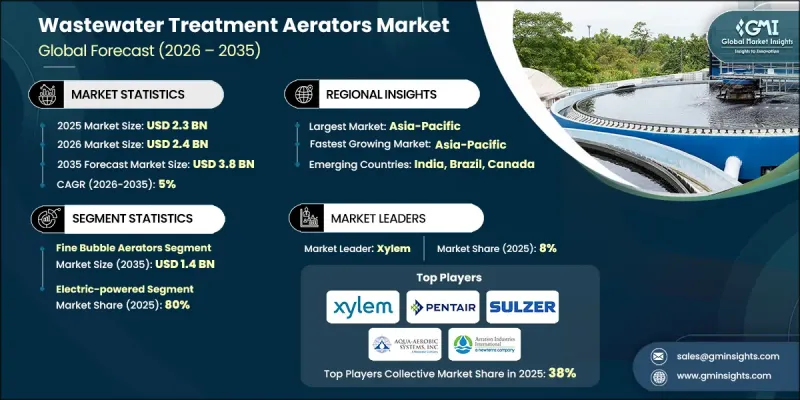
시장 성장은 공정 제어 자동화에 대한 관심 증가와 폐수 품질을 규제하는 환경 규제의 강화로 뒷받침되고 있습니다. 산업계와 지자체는 컴플라이언스 기준을 충족하고 운영 성능을 향상시키기 위해 효율적이고 정밀한 에어레이션 시스템을 우선적으로 도입하고 있습니다. 동시에, 물 기술 분야 전반의 통합이 진행됨에 따라 기업들이 제품 포트폴리오를 확장하고 운영 역량을 강화하기 위해 인수를 추진하면서 혁신이 가속화되고 있습니다. 이러한 추세는 재료, 시스템 효율성 및 전반적인 성능 향상에 기여하고 있습니다. 또한, 효과적인 폐수 관리가 여전히 필수적인 여러 최종 용도 분야에서도 수요가 증가하고 있습니다. 또한, 인프라 현대화 및 디지털 통합으로의 전환은 차세대 폭기 시스템의 도입을 촉진하고 있습니다. 처리 시설이 높은 효율을 유지하면서 에너지 사용을 최적화하는 것을 목표로 하는 가운데, 첨단 폭기 장치는 환경 및 경제적 목표를 달성하는 데 필수적인 구성 요소로 부상하고 있습니다.
| 시장 범위 | |
|---|---|
| 시작 연도 | 2025년 |
| 예측 기간 | 2026-2035년 |
| 개시 연도 시장 규모 | 23억 달러 |
| 예측액 | 38억 달러 |
| CAGR | 5% |
고정 속도 작동과 높은 유지 보수 요구 사항이 높은 기존의 기계식 에어레이터는 점차 기술적으로 진보된 시스템으로 대체되고 있습니다. 최신 에어레이터에는 디지털 모니터링 기능이 내장되어 있어 성능 향상과 운전 안정화를 실현하고 있습니다. 스마트 센서, IoT 지원 연결성 및 가변 주파수 드라이브(VFD)의 통합을 통해 폐수 조건이 변동하는 경우에도 용존 산소 농도를 정확하게 제어할 수 있습니다. 이러한 혁신은 에너지 절약과 시스템 최적화에 크게 기여하고 있으며, 첨단 에어레이터는 전체 시장 확대에 중요한 요소로 작용하고 있습니다.
미세 기포 에어레이터 시장은 2025년에 8억 달러를 기록했으며, 2035년에는 14억 달러에 달할 것으로 예측됩니다. 이 부문은 산소 확산을 촉진하는 수많은 미세 기포를 방출하여 높은 산소 전달 효율을 실현하고 있으며, 강한 추진력을 보이고 있습니다. 효율성 향상은 에너지 소비 감소로 이어지며, 이러한 시스템은 현대의 처리 시설에 매우 매력적인 시스템입니다. 첨단 멤브레인 기술을 통해 정밀도와 내구성이 더욱 향상되어 장기적으로 안정적인 성능을 보장합니다. 이러한 특성으로 인해 미세기포 에어레이터는 처리 효과를 위해 안정적인 산소 농도 유지가 필수적인 용도에 특히 적합합니다.
2025년 기준, 전동식 부문은 80%의 점유율을 차지했습니다. 이러한 선도적인 위치는 신뢰할 수 있는 성능, 강력한 출력 능력, 대규모 처리 작업에 사용되는 중앙 집중식 제어 시스템과의 완벽한 통합을 통해 뒷받침됩니다. 이 에어레이터는 효율성, 내구성 및 확장성의 균형을 이루며, 일관되고 신뢰할 수 있는 성능이 요구되는 대규모 시설에서 선호되는 선택이 되고 있습니다.
미국의 폐수 처리 에어레이터 시장은 2025년 88.43%의 점유율을 차지하며 압도적인 지위를 유지했습니다. 이 지역의 성장은 수질에 대한 높은 기준을 요구하는 엄격한 규제 프레임워크에 의해 크게 뒷받침되고 있습니다. 하수 인프라에 대한 투자 증가와 산업 활동의 확대는 고급 폭기 솔루션에 대한 수요를 더욱 촉진하고 있습니다. 또한, 디지털 모니터링 및 자동화 기술 채택이 확대됨에 따라 고성능 폭기 시스템의 필요성이 증가하고 있으며, 이는 시장의 지속적인 확대에 기여하고 있습니다.
자주 묻는 질문
목차
제1장 조사 방법과 범위
제2장 주요 요약
제3장 업계 인사이트
제4장 경쟁 구도
제5장 시장 추산 및 예측 : 제품 유형별(2022-2035년)
제6장 시장 추산 및 예측 : 전력별(2022-2035년)
제7장 시장 추산 및 예측 : 용도별(2022-2035년)
제8장 시장 추산 및 예측 : 유통 채널별(2022-2035년)
제9장 시장 추산 및 예측 : 지역별(2022-2035년)
제10장 기업 개요
KTH 26.05.20The Global Wastewater Treatment Aerators Market was valued at USD 2.3 billion in 2025 and is estimated to grow at a CAGR of 5% to reach USD 3.8 billion by 2035.
Market growth is supported by the increasing emphasis on automated process control and stricter environmental regulations governing wastewater discharge quality. Industries and municipalities are prioritizing efficient and precise aeration systems to meet compliance standards and improve operational performance. At the same time, rising consolidation across the water technology sector is accelerating innovation, as companies pursue acquisitions to broaden their product portfolios and strengthen operational capabilities. These developments are contributing to advancements in materials, system efficiency, and overall performance. Demand is also being reinforced across multiple end-use sectors, where effective wastewater management remains critical. In addition, the shift toward modernized infrastructure and digital integration is driving the adoption of next-generation aeration systems. As treatment facilities aim to optimize energy use while maintaining high efficiency, advanced aerators are emerging as essential components in achieving both environmental and economic objectives.
| Market Scope | |
|---|---|
| Start Year | 2025 |
| Forecast Year | 2026-2035 |
| Start Value | $2.3 Billion |
| Forecast Value | $3.8 Billion |
| CAGR | 5% |
Conventional mechanical aerators, with fixed-speed operation and high maintenance requirements, are increasingly being replaced by technologically advanced systems. Modern aerators incorporate digital monitoring capabilities that enable improved performance and operational consistency. The integration of smart sensors, IoT-enabled connectivity, and Variable Frequency Drives allows for accurate regulation of dissolved oxygen levels, even under fluctuating wastewater conditions. These innovations contribute significantly to energy savings and system optimization, making advanced aerators a key factor in overall market expansion.
The fine bubble aerators segment generated USD 800 million in 2025 and is expected to reach USD 1.4 billion by 2035. This segment is gaining strong traction due to its high oxygen transfer efficiency, achieved through the release of numerous small bubbles that enhance oxygen diffusion. The improved efficiency supports reduced energy consumption, making these systems highly attractive for modern treatment facilities. Advanced membrane technologies further enhance precision and durability, ensuring consistent long-term performance. These features make fine bubble aerators particularly suitable for applications where maintaining stable oxygen levels is critical for treatment effectiveness.
The electric-powered segment held 80% share in 2025. Its leading position is driven by dependable performance, strong output capabilities, and seamless integration with centralized control systems used in large-scale treatment operations. These aerators offer a balanced combination of efficiency, durability, and scalability, making them a preferred choice for extensive installations requiring consistent and reliable performance.
United States Wastewater Treatment Aerators Market accounted for 88.43% share in 2025, maintaining a dominant position. Growth in this region is largely supported by strict regulatory frameworks that enforce high standards for water quality. Increasing investment in wastewater infrastructure, along with expanding industrial activities, is further driving demand for advanced aeration solutions. Additionally, the growing adoption of digital monitoring and automation technologies is reinforcing the need for high-performance aeration systems, contributing to sustained market expansion.
Key players operating in the Global Wastewater Treatment Aerators Market include Aeration Industries International, Aqua Aerobic Systems, Envirotech Systems, GE Water & Process Technologies, Hach Company, Hydroflo Pumps, Koch Membrane Systems, Nijhuis Industries, Pentair, Severn Trent Services, SPX Corporation, SUEZ Water Technologies & Solutions, Sulzer, Tetra Tech, and Xylem. Companies in the Wastewater Treatment Aerators Market are focusing on technological innovation, strategic partnerships, and capacity expansion to strengthen their competitive position. They are investing in advanced aeration technologies that incorporate automation, smart monitoring, and energy-efficient designs to meet evolving industry requirements. Collaborations and acquisitions are being used to expand product offerings and enhance global reach. Market participants are also prioritizing research and development to improve system performance and durability. In addition, companies are aligning their solutions with regulatory standards and sustainability goals to address growing environmental concerns.
Table of Contents
Chapter 1 Methodology and Scope
- 1.1 Market scope and definition
- 1.2 Research design
- 1.2.1 Research approach
- 1.2.2 Data collection methods
- 1.3 Data mining sources
- 1.3.1 Global
- 1.3.2 Regional/Country
- 1.4 Base estimates and calculations
- 1.4.1 Base year calculation
- 1.4.2 Key trends for market estimation
- 1.5 Primary research and validation
- 1.5.1 Primary sources
- 1.6 Forecast model
- 1.7 Research assumptions and limitations
Chapter 2 Executive Summary
- 2.1 Industry 360° synopsis
- 2.2 Key market trends
- 2.2.1 Regional
- 2.2.2 Product Type
- 2.2.3 Power Source
- 2.2.4 End User
- 2.2.5 Distribution Channel
- 2.3 CXO perspectives: Strategic imperatives
- 2.3.1 Key decision points for industry executives
- 2.3.2 Critical success factors for market players
- 2.4 Future outlook and strategic recommendations
Chapter 3 Industry Insights
- 3.1 Industry ecosystem analysis
- 3.1.1 Supplier landscape
- 3.1.2 Profit margin
- 3.1.3 Value addition at each stage
- 3.1.4 Factor affecting the value chain
- 3.2 Industry impact forces
- 3.2.1 Growth drivers
- 3.2.1.1 Labor shortages & remote operations
- 3.2.1.2 Stricter effluent standards & energy mandates
- 3.2.2 Industry pitfalls & challenges
- 3.2.2.1 High integration complexity
- 3.2.2.2 Risks related to data privacy & cybersecurity
- 3.2.3 Opportunities
- 3.2.3.1 Rising demand for Aeration-as-a-Service (AaaS)
- 3.2.3.2 Shift toward circular economy & resource recovery
- 3.2.1 Growth drivers
- 3.3 Growth potential analysis
- 3.4 Future market trends
- 3.5 Technology and innovation landscape
- 3.5.1 Current technological trends
- 3.5.2 Emerging technologies
- 3.6 Price trends
- 3.6.1 By region
- 3.6.2 By Product type
- 3.7 Regulatory landscape
- 3.7.1 Standards and compliance requirements
- 3.7.2 Regional regulatory frameworks
- 3.7.3 Certification standards
- 3.8 Trade Data Analysis (Driven by Primary Research)
- 3.8.1 Import/Export Volume & Value Trends (Driven by Primary Research) (2022-2025)
- 3.8.2 Key Trade Corridors & Tariff Impact (Driven by Primary Research)
- 3.9 Porter's analysis
- 3.10 PESTEL analysis
- 3.11 Impact of AI & Generative AI on the Market
- 3.11.1 AI-Driven Disruption of Existing Business Models
- 3.11.2 GenAI Use Cases & Adoption Roadmap by Segment
- 3.12 Distribution Infrastructure & Channel Penetration Landscape (Driven by Primary Research)
- 3.12.1 Channel Coverage by Region & Format (Modern vs. Traditional Trade) (Driven by Primary Research)
- 3.12.2 Last-Mile Infrastructure Gaps & Emerging Channel Shifts (Driven by Primary Research)
Chapter 4 Competitive Landscape, 2025
- 4.1 Introduction
- 4.2 Company market share analysis
- 4.2.1 By region
- 4.2.1.1 North America
- 4.2.1.2 Europe
- 4.2.1.3 Asia Pacific
- 4.2.1.4 Latin America
- 4.2.1.5 Middle East and Africa
- 4.2.1 By region
- 4.3 Company matrix analysis
- 4.4 Competitive analysis of major market players
- 4.5 Competitive positioning matrix
- 4.6 Key developments
- 4.6.1 Mergers & acquisitions
- 4.6.2 Partnerships & collaborations
- 4.6.3 New product launches
- 4.6.4 Expansion plans
Chapter 5 Market Estimates & Forecast, By Product Type, 2022 - 2035 (USD Billion) (Thousand Units)
- 5.1 Key trends
- 5.2 Diffused aerator
- 5.3 Mechanical aerator
- 5.4 Surface aerator
- 5.5 Fine bubble aerator
- 5.6 Others (coarse bubble aerator, etc.)
Chapter 6 Market Estimates & Forecast, By Power Source, 2022 - 2035 (USD Billion) (Thousand Units)
- 6.1 Key trends
- 6.2 Electric-powered
- 6.3 Solar powered
Chapter 7 Market Estimates & Forecast, By End-use, 2022 - 2035 (USD Billion) (Thousand Units)
- 7.1 Key trends
- 7.2 Municipal
- 7.3 Industrial
- 7.4 Others (agricultural, etc.)
Chapter 8 Market Estimates & Forecast, By Distribution Channel, 2022 - 2035 (USD Billion) (Thousand Units)
- 8.1 Key trends
- 8.2 Direct
- 8.3 Indirect
Chapter 9 Market Estimates and Forecast, By Region, 2022 - 2035 (USD Billion) (Thousand Units)
- 9.1 Key trends
- 9.2 North America
- 9.2.1 U.S.
- 9.2.2 Canada
- 9.3 Europe
- 9.3.1 Germany
- 9.3.2 UK
- 9.3.3 France
- 9.3.4 Italy
- 9.3.5 Spain
- 9.4 Asia Pacific
- 9.4.1 China
- 9.4.2 Japan
- 9.4.3 India
- 9.4.4 Australia
- 9.4.5 South Korea
- 9.5 Latin America
- 9.5.1 Brazil
- 9.5.2 Mexico
- 9.5.3 Argentina
- 9.6 Middle East and Africa
- 9.6.1 South Africa
- 9.6.2 Saudi Arabia
- 9.6.3 UAE
Chapter 10 Company Profiles
- 10.1 Aeration Industries International
- 10.2 Aqua Aerobic Systems
- 10.3 Envirotech Systems
- 10.4 GE Water & Process Technologies
- 10.5 Hach Company
- 10.6 Hydroflo Pumps
- 10.7 Koch Membrane Systems
- 10.8 Nijhuis Industries
- 10.9 Pentair
- 10.10 Severn Trent Services
- 10.11 SPX Corporation
- 10.12 SUEZ Water Technologies & Solutions
- 10.13 Sulzer
- 10.14 Tetra Tech
- 10.15 Xylem