|
시장보고서
상품코드
2027540
반려동물 알레르기 치료 : 시장 기회, 성장 촉진요인, 업계 동향 분석 및 예측(2026-2035년)Pet Allergy Treatment Market Opportunity, Growth Drivers, Industry Trend Analysis, and Forecast 2026 - 2035 |
||||||

세계의 반려동물 알레르기 치료 시장은 2025년에 23억 달러로 평가되었고 CAGR 7.2%를 나타내 2035년까지 46억 달러에 이를 것으로 추정되고 있습니다.
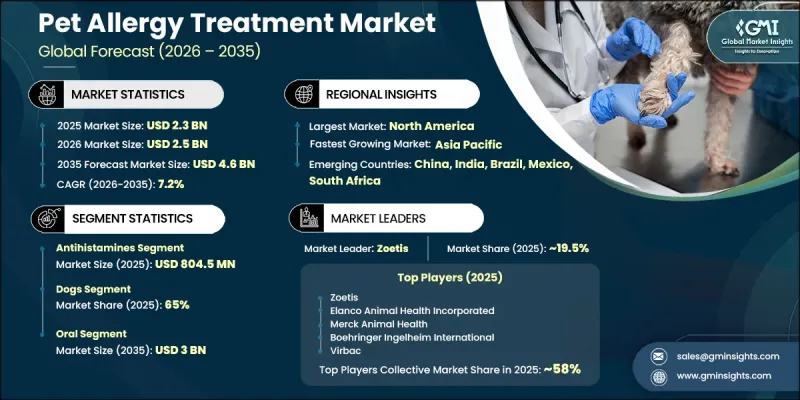
시장 확대는 반려동물 보호자들의 조기 발견과 적시 치료에 대한 인식이 높아진 데다 수의학에 대한 접근성 향상에 힘입어 성장세를 이어가고 있습니다. 수의학의 발전, 특히 치료법의 혁신과 진단 정확도 향상은 치료 성과를 지속적으로 향상시키고 치료법의 보급을 촉진하고 있습니다. 반려동물 알레르기 치료는 동물에게 영향을 미치는 광범위한 알레르기 증상을 관리하고 억제하도록 설계되었습니다. 이러한 솔루션에는 반려동물의 건강과 삶의 질을 향상시키기 위한 다양한 의약품 및 치료 접근법이 포함되어 있습니다. 치료되지 않은 알레르기가 장기적인 건강에 미치는 영향에 대한 반려동물 보호자들의 이해가 높아지면서 효과적인 치료법에 대한 수요가 크게 증가하고 있습니다. 또한, 시장에서는 장기요양 솔루션으로의 전환이 진행되고 있으며, 혁신적인 치료법이 주목을 받고 있습니다. 예방의료에 대한 인식이 지속적으로 높아지는 것도 제품의 수용성을 더욱 강화하며 지속적인 시장 성장을 뒷받침하고 있습니다. 수의학 인프라 및 제품 개발에 대한 투자 증가도 반려동물 알레르기 치료 시장의 전반적인 확대에 기여하고 있습니다.
| 시장 범위 | |
|---|---|
| 시작 연도 | 2025년 |
| 예측 기간 | 2026-2035년 |
| 개시 금액 | 23억 달러 |
| 예측 금액 | 46억 달러 |
| CAGR | 7.2% |
항히스타민제 부문은 2025년 8억 4,500만 달러 시장 규모를 기록했습니다. 이러한 장점은 동물의 알레르기성 질환에 대한 주요 치료 옵션으로 널리 채택되고 있는 데 기인합니다. 이 약물은 빠른 증상 완화 효과와 우수한 안전성 프로파일로 인해 자주 권장되는 약물입니다. 투여 방법의 다양성과 다양한 제형으로 쉽게 구할 수 있다는 점도 강력한 시장 수요를 더욱 부추기고 있습니다. 경증에서 중등도의 알레르기 반응에 대처할 수 있는 이러한 치료법은 지속적인 사용과 상업적 성공에 크게 기여하고 있습니다.
2025년, 반려견 부문은 65%의 점유율을 차지했습니다. 이 부문의 성장은 반려동물로서의 반려견에 대한 수요 증가와 반려견 의료에 대한 지출 증가에 힘입어 성장하고 있습니다. 반려동물 양육률 증가와 동물 건강에 대한 인식이 높아진 것이 이러한 추세의 주요 요인으로 작용하고 있습니다. 반려견의 알레르기 질환 발생률 증가는 전문적인 치료법에 대한 수요를 더욱 가속화시키고 있습니다. 또한, 경제 상황의 개선과 고급 및 표적화 된 제품의 가용성 증가는 예측 기간 동안 이 부문의 확장을 계속 지원할 것입니다.
북미의 반려동물 알레르기 치료 시장은 2025년에 41.8%의 점유율을 차지했으며 2035년까지 연평균 6.8%의 성장률을 나타낼 것으로 예측됩니다. 이 지역은 높은 반려동물 보유율과 반려동물 복지에 대한 관심 증가로 탄탄한 입지를 유지하고 있습니다. 수의학에 대한 막대한 지출과 업계를 선도하는 기업의 존재가 시장 우위에 기여하고 있습니다. 첨단 치료 솔루션의 조기 도입과 반려동물 건강에 대한 높은 인식이 이 지역의 성장을 더욱 촉진하고 있습니다. 잘 구축된 수의학 생태계와 더불어 반려동물 의료 서비스에 대한 광범위한 수용은 북미 시장에서의 리더십을 지속적으로 강화하고 있습니다.
자주 묻는 질문
목차
제1장 조사 방법과 범위
제2장 주요 요약
제3장 업계 인사이트
제4장 경쟁 구도
제5장 시장 추산 및 예측 : 약제 클래스별(2022-2035년)
제6장 시장 추산 및 예측 : 반려동물 유형별(2022-2035년)
제7장 시장 추산 및 예측 : 투여 경로별(2022-2035년)
제8장 시장 추산 및 예측 : 유통 채널별(2022-2035년)
제9장 시장 추산 및 예측 : 지역별(2022-2035년)
제10장 기업 개요
KTH 26.05.20The Global Pet Allergy Treatment Market was valued at USD 2.3 billion in 2025 and is estimated to grow at a CAGR of 7.2% to reach USD 4.6 billion by 2035.
Market expansion is supported by increasing awareness among pet owners regarding early detection and timely treatment, along with improved access to veterinary care. Advancements in veterinary science, particularly in treatment innovation and diagnostic accuracy, continue to enhance therapeutic outcomes and drive adoption. Pet allergy treatments are designed to manage and control a broad range of allergic conditions affecting animals. These solutions include various pharmaceutical and therapeutic approaches aimed at improving pet health and quality of life. Growing understanding among pet owners about the long-term health implications of untreated allergies has significantly increased demand for effective treatment options. The market is also witnessing a shift toward long-term care solutions, with innovative therapies gaining traction. Preventive healthcare awareness continues to rise, further strengthening product acceptance and supporting sustained market growth. Increasing investments in veterinary healthcare infrastructure and product development are also contributing to the overall expansion of the pet allergy treatment market.
| Market Scope | |
|---|---|
| Start Year | 2025 |
| Forecast Year | 2026-2035 |
| Start Value | $2.3 Billion |
| Forecast Value | $4.6 Billion |
| CAGR | 7.2% |
The antihistamines segment captured USD 804.5 million in 2025. This dominance is driven by their widespread adoption as a primary treatment option for allergic conditions in animals. These medications are frequently recommended due to their effectiveness in providing quick symptom relief and their favorable safety profile. Their versatility in administration and accessibility across various formats further supports strong market demand. The ability of these treatments to address mild to moderate allergic responses contributes significantly to their continued usage and commercial success.
The dogs segment held a 65% share in 2025. Growth in this segment is fueled by the increasing preference for dogs as companion animals and rising spending on their healthcare. Higher pet ownership rates, combined with greater awareness of animal health, are key contributors to this trend. The growing incidence of allergic conditions among dogs further accelerates demand for specialized treatments. Additionally, improving economic conditions and the availability of advanced, targeted products continue to support segment expansion over the forecast period.
North America Pet Allergy Treatment Market represents 41.8% share in 2025 and is expected to grow at a CAGR of 6.8% through 2035. The region maintains a strong position due to high levels of pet ownership and increasing emphasis on pet well-being. Significant expenditure on veterinary healthcare and the presence of leading industry participants contribute to market dominance. Early adoption of advanced treatment solutions and strong awareness regarding pet health conditions further drive regional growth. A well-developed veterinary ecosystem, along with widespread acceptance of pet healthcare services, continues to reinforce North America's leadership in the market.
Key companies operating in the Pet Allergy Treatment Market include Antech Diagnostics, Boehringer Ingelheim International, Ceva Sante Animale, Dechra, Elanco, IDEXX Laboratories, Merck Animal Health, Neogen Corporation, Nextmune, PetIQ, Provetica, Vetoquinol, Virbac, and Zoetis. Companies in the Pet Allergy Treatment Market are actively enhancing their market position through continuous innovation and strategic expansion initiatives. They focus on developing advanced therapeutic solutions that improve treatment effectiveness and long-term outcomes. Investment in research and development remains a priority to introduce novel products and improve diagnostic capabilities. Strategic collaborations and partnerships enable companies to broaden their geographic presence and strengthen distribution networks. Businesses are also emphasizing digital integration and data-driven veterinary solutions to enhance service delivery. Expansion of production capabilities and localized manufacturing helps improve supply efficiency. Additionally, companies are focusing on customer engagement, education, and preventive care awareness to build brand loyalty and sustain long-term growth.
Table of Contents
Chapter 1 Methodology and Scope
- 1.1 Market scope and definition
- 1.2 Research approach
- 1.3 Quality commitments
- 1.3.1 GMI AI policy and data integrity commitment
- 1.3.1.1 Source consistency protocol
- 1.3.1 GMI AI policy and data integrity commitment
- 1.4 Research trail and confidence scoring
- 1.4.1 Research trail components
- 1.4.2 Scoring components
- 1.5 Data collection
- 1.5.1 Partial list of primary sources
- 1.6 Data mining sources
- 1.6.1 Paid sources
- 1.6.1.1 Sources, by region
- 1.6.1 Paid sources
- 1.7 Base estimates and calculations
- 1.7.1 Revenue share analysis
- 1.7.2 Base year calculation
- 1.8 Forecast model
- 1.9 Research transparency addendum
- 1.9.1 Source attribution framework
- 1.9.2 Quality assurance metrics
- 1.9.3 Our commitment to trust
Chapter 2 Executive Summary
- 2.1 Industry 360° synopsis
- 2.2 Key market trends
- 2.2.1 Regional trends
- 2.2.2 Drug class trends
- 2.2.3 Pet type trends
- 2.2.4 Route of administration trends
- 2.2.5 Distribution channel trends
- 2.3 CXO perspectives: Strategic imperatives
Chapter 3 Industry Insights
- 3.1 Industry ecosystem analysis
- 3.2 Industry impact forces
- 3.2.1 Growth drivers
- 3.2.1.1 Rising prevalence of pet allergies
- 3.2.1.2 Availability of over-the-counter (OTC) medications
- 3.2.1.3 Increasing pet ownership and rising veterinary expenditures
- 3.2.1.4 Advancements in veterinary dermatology
- 3.2.2 Industry pitfalls and challenges
- 3.2.2.1 Side effects of medications
- 3.2.2.2 Increasing adoption of natural or home-based remedies
- 3.2.3 Market opportunities
- 3.2.3.1 Expansion in emerging markets
- 3.2.3.2 Development of personalized treatments
- 3.2.1 Growth drivers
- 3.3 Regulatory landscape
- 3.3.1 North America
- 3.3.1.1 U.S.
- 3.3.1.2 Canada
- 3.3.2 Europe
- 3.3.3 Asia Pacific
- 3.3.1 North America
- 3.4 Technology/innovation landscape
- 3.4.1 Current technologies
- 3.4.2 Emerging technologies
- 3.5 Pipeline analysis (Driven by Primary Research)
- 3.6 Pricing analysis (Driven by Primary Research)
- 3.7 Future market trends
- 3.8 Impact of AI & generative AI on the market
- 3.9 Porter’s analysis
- 3.10 PESTEL analysis
Chapter 4 Competitive Landscape, 2025
- 4.1 Introduction
- 4.2 Company market share analysis
- 4.3 Company matrix analysis
- 4.4 Competitive analysis of major market players
- 4.5 Competitive positioning matrix
- 4.6 Key developments
- 4.6.1 Merger and acquisition
- 4.6.2 Partnership and collaboration
- 4.6.3 New product launches
- 4.6.4 Expansion plans
Chapter 5 Market Estimates and Forecast, By Drug Class, 2022 - 2035 ($ Mn)
- 5.1 Key trends
- 5.2 Antihistamines
- 5.3 Corticosteroids
- 5.4 Immunotherapy
- 5.5 Other drug classes
Chapter 6 Market Estimates and Forecast, By Pet Type, 2022 - 2035 ($ Mn)
- 6.1 Key trends
- 6.2 Dogs
- 6.3 Cats
- 6.4 Rabbits
- 6.5 Other pet types
Chapter 7 Market Estimates and Forecast, By Route of Administration, 2022 - 2035 ($ Mn)
- 7.1 Key trends
- 7.2 Oral
- 7.3 Parenteral
- 7.4 Topical
Chapter 8 Market Estimates and Forecast, By Distribution Channel, 2022 - 2035 ($ Mn)
- 8.1 Key trends
- 8.2 Veterinary hospital pharmacies
- 8.3 Retail pharmacies
- 8.4 Online pharmacies
Chapter 9 Market Estimates and Forecast, By Region, 2022 - 2035 ($ Mn)
- 9.1 Key trends
- 9.2 North America
- 9.2.1 U.S.
- 9.2.2 Canada
- 9.3 Europe
- 9.3.1 Germany
- 9.3.2 UK
- 9.3.3 France
- 9.3.4 Italy
- 9.3.5 Spain
- 9.3.6 Netherlands
- 9.4 Asia Pacific
- 9.4.1 China
- 9.4.2 Japan
- 9.4.3 India
- 9.4.4 Australia
- 9.4.5 South Korea
- 9.5 Latin America
- 9.5.1 Brazil
- 9.5.2 Mexico
- 9.5.3 Argentina
- 9.6 Middle East and Africa
- 9.6.1 South Africa
- 9.6.2 Saudi Arabia
- 9.6.3 UAE
Chapter 10 Company Profiles
- 10.1 Antech Diagnostics
- 10.2 Boehringer Ingelheim International
- 10.3 Ceva Sante Animale
- 10.4 Dechra
- 10.5 Elanco
- 10.6 IDEXX Laboratories
- 10.7 Merck Animal Health
- 10.8 Neogen Corporation
- 10.9 Nextmune
- 10.10 PetIQ
- 10.11 Provetica
- 10.12 Vetoquinol
- 10.13 Virbac
- 10.14 Zoetis