

|
시장보고서
상품코드
2027544
텍스타일 난연제 : 시장 기회, 성장 촉진요인, 업계 동향 분석 및 예측(2026-2035년)Textile Flame Retardants Market Opportunity, Growth Drivers, Industry Trend Analysis, and Forecast 2026 - 2035 |
||||||

세계의 텍스타일 난연제 시장은 2025년에 48억 달러로 평가되었고 CAGR 7.3%를 나타내 2035년까지 96억 달러에 이를 것으로 추정되고 있습니다.
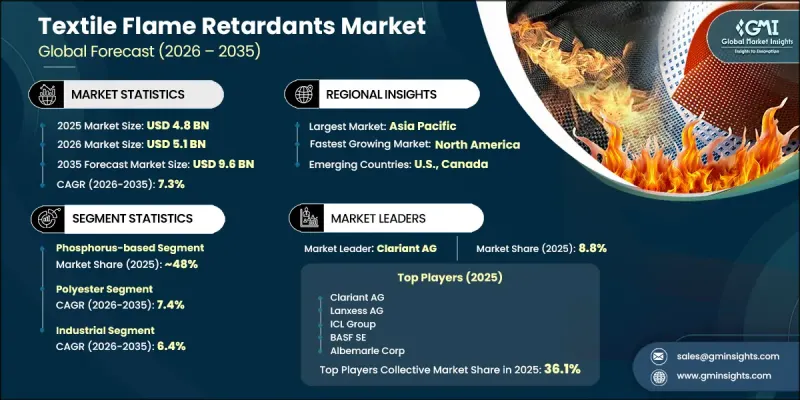
시장 확대는 기존 할로겐 화합물에서 보다 지속 가능하고 친환경적인 대체품으로 전환하는 배합 기술의 큰 변화로 인해 주도되고 있습니다. 환경 규제 강화와 업계 전반의 지속가능성에 대한 관심이 높아지면서 인계 및 질소계 난연제 시스템의 채택 확대가 가속화되고 있습니다. 난연성 섬유에 대한 수요는 화재 안전 기준 준수가 매우 중요한 산업 환경에서 특히 높습니다. 에너지, 화학, 제조 등의 분야에서는 작업자의 안전 확보와 업무상 위험 감소를 위해 보호용 섬유가 필수적이기 때문에 그 사용이 활발하게 이루어지고 있습니다. 주요 경제권의 활발한 인프라 개발 활동도 제품 채택을 더욱 촉진하고 있습니다. 북미와 유럽 등 선진 지역에서는 산업 활동을 규제하는 엄격한 안전 기준과 규제 프레임워크가 도입을 주도하고 있습니다. 한편, 라틴아메리카, 중동 및 아프리카 등 신흥 지역에서도 화재 안전 및 보호용 섬유 제품의 용도에 대한 인식이 계속 높아짐에 따라 도입이 점차 증가하고 있습니다. 또한, 직물 처리 및 화학 성분의 지속적인 기술 발전으로 난연 솔루션의 내구성, 효율성 및 환경 적합성이 향상되고 있습니다.
| 시장 범위 | |
|---|---|
| 시작 연도 | 2025년 |
| 예측 기간 | 2026-2035년 |
| 개시 금액 | 48억 달러 |
| 예측 금액 | 96억 달러 |
| CAGR | 7.3% |
폴리에스테르 부문은 2025년 40%의 점유율을 차지했으며, 2026년부터 2035년까지 연평균 복합 성장률(CAGR) 7.4%로 성장할 것으로 전망됩니다. 폴리에스테르와 면직물은 여전히 의류, 인테리어, 산업 분야에서 가장 널리 사용되는 섬유 소재이며, 난연 처리에 대한 강한 수요를 주도하고 있습니다. 특히 면계 섬유는 내화성을 실현하기 위해 화학적 처리가 필요하기 때문에 난연 솔루션의 주요 적용 분야가 되었습니다. 섬유 제조의 지속적인 성장과 안전 기준의 강화는 이러한 섬유 유형에 대한 수요를 더욱 촉진하고 있습니다.
산업 응용 분야는 2025년 12억 달러에 달했으며, 2035년까지 연평균 6.4%의 성장률로 23억 달러에 달할 것으로 전망됩니다. 에너지 시설, 화학 처리 공장, 생산 기지 등의 산업 환경에서는 엄격한 노동 안전 기준으로 인해 수요가 증가하고 있습니다. 난연성 섬유는 화재 관련 위험을 줄이기 위해 보호복과 안전 장비에 널리 사용되고 있습니다. 국방 관련 용도도 크게 기여하고 있으며, 고위험 환경에서 인원의 안전을 강화하기 위해 설계된 보호복, 장비, 내장재 등에 사용되고 있습니다.
북미의 텍스타일 난연제 시장은 2026년부터 2035년까지 연평균 복합 성장률(CAGR) 7%를 나타낼 것으로 예측됩니다. 이 지역은 이미 확립된 화재 안전 규정과 더불어 에너지, 국방, 항공, 공공 안전 등 각 분야에서 보호용 섬유 제품에 대한 강력한 산업 수요의 혜택을 누리고 있습니다. 미국은 엄격한 노동 안전 기준과 고위험 산업에서 난연성 섬유 제품을 광범위하게 채택하여 지역 내 소비를 주도하고 있습니다. 작업장 안전과 규제 준수에 대한 관심이 높아지면서 이 지역 전체에서 꾸준한 시장 성장세가 지속되고 있습니다.
자주 묻는 질문
목차
제1장 조사 방법과 범위
제2장 주요 요약
제3장 업계 인사이트
제4장 경쟁 구도
제5장 시장 추산 및 예측 : 제품 유형별(2022-2035년)
제6장 시장 추산 및 예측 : 섬유 소재별(2022-2035년)
제7장 시장 추산 및 예측 : 최종 사용자별(2022-2035년)
제8장 시장 추산 및 예측 : 지역별(2022-2035년)
제9장 기업 개요
KTH 26.05.20The Global Textile Flame Retardants Market was valued at USD 4.8 billion in 2025 and is estimated to grow at a CAGR of 7.3% to reach USD 9.6 billion by 2035.
Market expansion is driven by a significant transition in formulation technologies, moving away from conventional halogen-based compounds toward more sustainable and environmentally safer alternatives. The growing adoption of phosphorus-based and nitrogen-based flame retardant systems is gaining strong momentum due to tightening environmental regulations and rising sustainability concerns across industries. Demand for flame-retardant textiles is particularly strong in industrial environments where fire safety compliance is critical. Heavy usage is observed across sectors such as energy, chemicals, and manufacturing, where protective textiles are essential for worker safety and operational risk mitigation. Strong infrastructure development activities across major economies are further supporting product adoption. Developed regions such as North America and Europe continue to lead adoption due to stringent safety standards and regulatory frameworks governing industrial operations. At the same time, emerging regions such as Latin America and the Middle East & Africa are gradually increasing adoption as awareness of fire safety and protective textile applications continues to grow. Ongoing technological advancements in fabric treatment and chemical formulations are also improving the durability, efficiency, and environmental compatibility of flame-retardant solutions.
| Market Scope | |
|---|---|
| Start Year | 2025 |
| Forecast Year | 2026-2035 |
| Start Value | $4.8 Billion |
| Forecast Value | $9.6 Billion |
| CAGR | 7.3% |
The polyester segment accounted for a 40% share in 2025 and is projected to grow at a CAGR of 7.4% during 2026 to 2035. Polyester and cotton fabrics remain the most widely used textile materials across apparel, home furnishings, and industrial applications, driving strong demand for flame-retardant treatments. Cotton-based textiles in particular require chemical enhancement to achieve fire resistance, making them a key application area for flame-retardant solutions. Continuous growth in textile manufacturing and rising safety requirements are further supporting demand across these fabric types.
The industrial application segment reached USD 1.2 billion in 2025 and is projected to reach USD 2.3 billion by 2035, growing at a CAGR of 6.4%. Industrial environments, including energy facilities, chemical processing plants, and production units, generate strong demand due to strict occupational safety standards. Flame-retardant textiles are widely used in protective clothing and safety equipment to reduce fire-related risks. Defense-related applications also contribute significantly, with usage in protective uniforms, equipment, and interior materials designed to enhance personnel safety in high-risk environments.
North America Textile Flame Retardants Market is expected to grow at a CAGR of 7% during 2026-2035. The region benefits from well-established fire safety regulations and strong industrial demand for protective textiles across sectors such as energy, defense, aviation, and public safety. The United States leads regional consumption due to strict occupational safety standards and widespread adoption of flame-resistant textiles across high-risk industries. Increasing emphasis on workplace safety and regulatory compliance continues to drive steady market growth across the region.
Key companies operating in the Global Textile Flame Retardants Market include Clariant AG, Lanxess AG, ICL Group, Albemarle Corporation, BASF SE, Thor Group, Daihachi Chemical Industry Co., Ltd., Italmatch Chemicals, Shandong Moris Tech Co., Ltd., Jinan Taixing Fine Chemicals Co., Ltd., Greenchemicals S.r.l., and Presafer (Qingyuan) Phosphor Chemical Co., Ltd. Companies in the Textile Flame Retardants Market are focusing on strengthening their market position through the development of eco-friendly chemical formulations, expansion of production capacities, and continuous research and development initiatives. Manufacturers are increasingly shifting toward halogen-free solutions, particularly phosphorus- and nitrogen-based compounds, to align with environmental regulations and sustainability goals. Strategic collaborations with textile manufacturers and industrial end users are helping companies expand application reach and improve product integration. Investment in advanced chemical engineering and fabric treatment technologies is enhancing product efficiency, durability, and safety performance. Companies are also expanding their global distribution networks to improve market accessibility. In addition, emphasis on regulatory compliance and certification standards is enabling stronger market acceptance. Continuous innovation in sustainable chemistry and customized flame-retardant solutions is further helping companies strengthen competitiveness and long-term market presence across diverse industrial sectors.
Table of Contents
Chapter 1 Methodology & Scope
- 1.1 Research approach
- 1.2 Quality Commitments
- 1.2.1 GMI AI policy & data integrity commitment
- 1.2.1.1 Source consistency protocol
- 1.2.1 GMI AI policy & data integrity commitment
- 1.3 Research Trail & Confidence Scoring
- 1.3.1 Research Trail Components
- 1.3.2 Scoring Components
- 1.4 Data Collection
- 1.4.1 Partial list of primary sources
- 1.5 Data mining sources
- 1.5.1 Paid sources
- 1.5.1.1 Sources, by region
- 1.5.1 Paid sources
- 1.6 Base estimates and calculations
- 1.6.1 Base year calculation for any one approach
- 1.7 Forecast model
- 1.7.1 Quantified market impact analysis
- 1.7.1.1 Mathematical impact of growth parameters on forecast
- 1.7.1 Quantified market impact analysis
- 1.8 Research transparency addendum
- 1.8.1 Source attribution framework
- 1.8.2 Quality assurance metrics
- 1.8.3 Our commitment to trust
Chapter 2 Executive Summary
- 2.1 Industry 360° synopsis
- 2.2 Key market trends
- 2.2.1 Regional
- 2.3 TAM Analysis, 2025-2035
- 2.4 CXO perspectives: Strategic imperatives
Chapter 3 Industry Insights
- 3.1 Industry ecosystem analysis
- 3.1.1 Supplier landscape
- 3.1.2 Profit margin
- 3.1.3 Value addition at each stage
- 3.1.4 Factor affecting the value chain
- 3.1.5 Disruptions
- 3.2 Industry impact forces
- 3.2.1 Growth drivers
- 3.2.2 Industry pitfalls and challenges
- 3.2.3 Market opportunities
- 3.3 Growth potential analysis
- 3.4 Regulatory landscape
- 3.4.1 North America
- 3.4.2 Europe
- 3.4.3 Asia Pacific
- 3.4.4 Latin America
- 3.4.5 Middle East & Africa
- 3.5 Porter’s analysis
- 3.6 PESTEL analysis
- 3.7 Price trends
- 3.7.1 By region
- 3.7.2 By product type
- 3.8 Future market trends
- 3.9 Technology and Innovation landscape
- 3.9.1 Current technological trends
- 3.9.2 Emerging technologies
- 3.10 Patent Landscape
- 3.11 Trade statistics (HS code)
- 3.11.1 Major importing countries
- 3.11.2 Major exporting countries
- 3.12 Sustainability and environmental aspects
- 3.12.1 Sustainable practices
- 3.12.2 Waste reduction strategies
- 3.12.3 Energy efficiency in production
- 3.12.4 Eco-friendly initiatives
Chapter 4 Competitive Landscape, 2025
- 4.1 Introduction
- 4.2 Company market share analysis
- 4.2.1 By region
- 4.2.1.1 North America
- 4.2.1.2 Europe
- 4.2.1.3 Asia Pacific
- 4.2.1.4 LATAM
- 4.2.1.5 MEA
- 4.2.1 By region
- 4.3 Company matrix analysis
- 4.4 Competitive analysis of major market players
- 4.5 Competitive positioning matrix
- 4.6 Key developments
- 4.6.1 Mergers & acquisitions
- 4.6.2 Partnerships & collaborations
- 4.6.3 New Product Launches
- 4.6.4 Expansion Plans
Chapter 5 Market Estimates and Forecast, By Product Type, 2022-2035 (USD Billion) (Kilo Tons)
- 5.1 Key trends
- 5.2 Halogenated
- 5.2.1 Brominated
- 5.2.2 Chlorinated
- 5.3 Phosphorus-based
- 5.3.1 Organic
- 5.3.2 Inorganic
- 5.4 Nitrogen-based
- 5.4.1 Melamine Derivatives
- 5.4.2 Guanidine Compounds
- 5.5 Others (Mineral, Intumescent, Bio-based)
Chapter 6 Market Estimates and Forecast, By Textile Material, 2022-2035 (USD Billion) (Kilo Tons)
- 6.1 Key trends
- 6.2 Polyester
- 6.3 Cotton
- 6.4 Viscose
- 6.5 Nylon 6
- 6.6 Nylon 6,6
- 6.7 Others (Wool, Aramids, Specialty)
Chapter 7 Market Estimates and Forecast, By End User, 2022-2035 (USD Billion) (Kilo Tons)
- 7.1 Key trends
- 7.2 Industrial
- 7.2.1 Oil & Gas
- 7.2.2 Chemical Plants
- 7.2.3 Manufacturing Facilities
- 7.3 Defense
- 7.3.1 Military Uniforms
- 7.3.2 Protective Gear
- 7.3.3 Military Vehicle Interiors
- 7.4 Public Safety & Services
- 7.4.1 Firefighter PPE
- 7.4.2 Police & Law Enforcement
- 7.4.3 Emergency Medical Services
- 7.5 Transportation
- 7.5.1 Aviation
- 7.5.2 Rail
- 7.5.3 Automotive
- 7.5.4 Marine
- 7.6 Household
- 7.6.1 Furniture & Upholstery
- 7.6.2 Bedding & Mattresses
- 7.6.3 Curtains & Draperies
- 7.7 Others (Hospitality, Healthcare, Institutional)
Chapter 8 Market Estimates and Forecast, By Region, 2022-2035 (USD Billion) (Kilo Tons)
- 8.1 Key trends
- 8.2 North America
- 8.2.1 U.S.
- 8.2.2 Canada
- 8.3 Europe
- 8.3.1 Germany
- 8.3.2 UK
- 8.3.3 France
- 8.3.4 Spain
- 8.3.5 Italy
- 8.3.6 Rest of Europe
- 8.4 Asia Pacific
- 8.4.1 China
- 8.4.2 India
- 8.4.3 Japan
- 8.4.4 Australia
- 8.4.5 South Korea
- 8.4.6 Rest of Asia Pacific
- 8.5 Latin America
- 8.5.1 Brazil
- 8.5.2 Mexico
- 8.5.3 Argentina
- 8.5.4 Rest of Latin America
- 8.6 Middle East and Africa
- 8.6.1 Saudi Arabia
- 8.6.2 South Africa
- 8.6.3 UAE
- 8.6.4 Rest of Middle East and Africa
Chapter 9 Company Profiles
- 9.1 Clariant AG
- 9.2 Lanxess AG
- 9.3 ICL Group
- 9.4 Albemarle Corporation
- 9.5 BASF SE
- 9.6 Thor Group
- 9.7 Daihachi Chemical Industry Co., Ltd.
- 9.8 Italmatch Chemicals
- 9.9 Shandong Moris Tech Co., Ltd.
- 9.10 Jinan Taixing Fine Chemicals Co., Ltd.
- 9.11 Greenchemicals S.r.l.
- 9.12 Presafer (Qingyuan) Phosphor Chemical Co., Ltd.


