

|
시장보고서
상품코드
2027546
진공 압력 스윙 흡착(VPSA) : 시장 기회, 성장 촉진요인, 업계 동향 분석 및 예측(2026-2035년)Vacuum Pressure Swing Adsorption Market Opportunity, Growth Drivers, Industry Trend Analysis, and Forecast 2026 - 2035 |
||||||

세계의 진공 압력 스윙 흡착(VPSA) 시장은 2025년에 36억 달러로 평가되었고 CAGR 7.2%를 나타내 2035년까지 71억 달러에 이를 것으로 예측됩니다.

각 산업 분야에서 에너지 효율과 지속 가능한 운영이 점점 더 중요해지면서 세계의 진공 압력 스윙 흡착(VPSA) 산업은 강력한 추진력을 보이고 있습니다. 첨단 가스 분리 기술에 대한 수요 증가와 주요 기업 간의 투자, 제휴 및 통합 활동의 확대로 인해 가스 분리 기술 도입이 증가하고 있습니다. 흡착제 및 시스템 구성의 지속적인 발전으로 전체 시스템의 성능과 운영상의 유연성이 향상되고 있습니다. 산업 분야에서 보다 에너지 효율적이고 환경 친화적인 솔루션이 요구되는 가운데, 전통적인 가스 제조 기술은 점차 그 우위를 잃어가고 있습니다. VPSA 시스템은 더 적은 에너지 소비로 작동할 수 있을 뿐만 아니라 더 깨끗한 생산 공정을 지원할 수 있기 때문에 바람직한 대안으로 떠오르고 있습니다. 자동화 플랜트 설계의 통합은 운영 효율성 향상과 기계적 부하 감소를 가능하게 하여 시장 성장을 더욱 가속화하고 있습니다. 산업계가 지속 가능한 인프라와 자원 활용의 최적화로 전환하는 가운데, VPSA 기술은 세계 시장에서 현대의 산업용 가스 생산 요건을 지원하는 데 있어 점점 더 중요한 역할을 하고 있습니다.
| 시장 범위 | |
|---|---|
| 시작 연도 | 2025년 |
| 예측 기간 | 2026-2035년 |
| 개시 연도 시장 규모 | 36억 달러 |
| 예측액 | 71억 달러 |
| CAGR | 7.2% |
산소 발생기 부문은 2025년 39.2%의 점유율을 차지했으며, 2035년까지 28억 달러에 달할 것으로 예측됩니다. 산업 분야에서 안정적인 성능을 보장하는 신뢰할 수 있는 고순도 가스 발생 시스템이 선호됨에 따라 이 부문은 계속해서 선도적인 위치를 유지하고 있습니다. 높은 흡착 효율은 전체 에너지 소비를 줄이면서 안정적인 유량을 유지하는 데 중요한 역할을 하며, 비용 효율성 향상 및 지속가능성 목표와도 일치합니다.
2025년 간접 판매 부문은 59%의 점유율을 차지하며 21억 달러의 매출을 기록했습니다. 이 판매 방식은 현지 기술 지원, 설치 서비스, 그리고 고객의 신뢰와 제품 접근성을 높이는 유통망에 대한 접근성 측면에서 가치를 제공한다는 점에서 여전히 널리 선호되고 있습니다.
미국의 진공 압력 스윙 흡착(VPSA) 시장은 지속적인 산업 발전과 탄탄한 인프라 기반에 힘입어 2035년까지 연평균 복합 성장률(CAGR) 7.5%를 나타낼 것으로 예측됩니다. 산업계가 운영을 현대화하고 에너지 최적화를 우선시함에 따라 효율적인 가스 관리 솔루션에 대한 수요는 지속적으로 증가하고 있습니다. VPSA 시스템은 고순도 가스의 안정적인 공급을 보장하기 위해 산업 환경 전반에 걸쳐 광범위하게 사용되고 있으며, 지역 전체의 대규모 운영 요구 사항과 인프라 개발을 지원하고 있습니다.
자주 묻는 질문
목차
제1장 조사 방법과 범위
제2장 주요 요약
제3장 업계 인사이트
제4장 경쟁 구도
제5장 시장 추산 및 예측 : 제품 유형별(2022-2035년)
제6장 시장 추산 및 예측 : 용도별(2022-2035년)
제7장 시장 추산 및 예측 : 용량별(2022-2035년)
제8장 시장 추산 및 예측 : 용도별(2022-2035년)
제9장 시장 추산 및 예측 : 유통 채널별(2022-2035년)
제10장 시장 추산 및 예측 : 지역별(2022-2035년)
제11장 기업 개요
KTH 26.05.20The Global Vacuum Pressure Swing Adsorption Market was valued at USD 3.6 billion in 2025 and is estimated to grow at a CAGR of 7.2% to reach USD 7.1 billion by 2035.
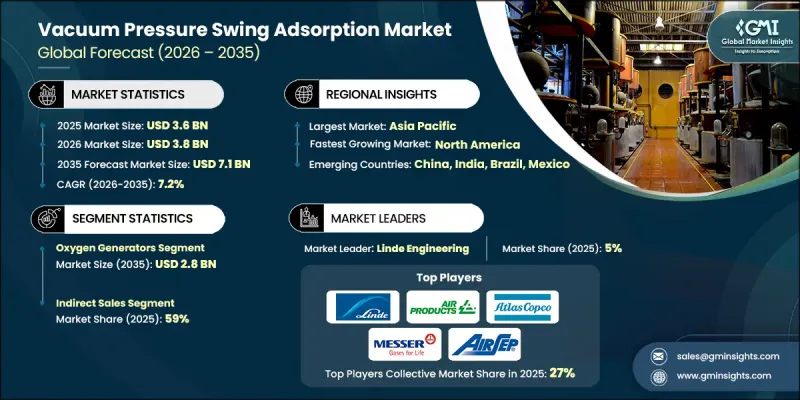
The global vacuum pressure swing adsorption industry is gaining strong momentum as industries increasingly prioritize energy efficiency and sustainable operations. Rising demand for advanced gas separation technologies is driving adoption, supported by growing investments, collaborations, and consolidation activities among leading players. Continuous advancements in adsorbent materials and system configurations are enhancing overall system performance and operational flexibility. Traditional gas production techniques are gradually becoming less favorable as industries seek more energy-efficient and environmentally responsible solutions. VPSA systems are emerging as a preferred alternative due to their ability to operate with lower energy consumption while supporting cleaner production processes. The integration of automated plant designs is further accelerating market growth, enabling improved operational efficiency and reduced mechanical strain. As industries continue to transition toward sustainable infrastructure and optimized resource utilization, VPSA technology is becoming increasingly critical in supporting modern industrial gas generation requirements across global markets.
| Market Scope | |
|---|---|
| Start Year | 2025 |
| Forecast Year | 2026-2035 |
| Start Value | $3.6 Billion |
| Forecast Value | $7.1 Billion |
| CAGR | 7.2% |
The oxygen generators segment accounted for 39.2% share in 2025 and is projected to reach USD 2.8 billion by 2035. This segment continues to dominate as industries favor reliable and high-purity gas generation systems that ensure consistent performance. Strong adsorption efficiency plays a key role in maintaining steady flow rates while reducing overall energy consumption, aligning with cost-efficiency goals and sustainability objectives.
In 2025, the indirect sales segment held a share of 59%, generating USD 2.1 billion. This distribution approach remains widely preferred due to the value it offers in terms of localized technical support, installation services, and access to distribution networks that enhance customer confidence and product accessibility.
U.S. Vacuum Pressure Swing Adsorption Market is growing at a CAGR of 7.5% through 2035, driven by ongoing industrial advancements and a well-established infrastructure base. Demand for efficient gas management solutions continues to rise as industries modernize operations and prioritize energy optimization. VPSA systems are widely utilized across industrial environments to ensure consistent access to high-purity gases, supporting large-scale operational requirements and infrastructure development across the region.
Key companies operating in the Global Vacuum Pressure Swing Adsorption Market include Linde Engineering (Linde plc), Air Products and Chemicals, Atlas Copco AB, Messer Group GmbH, Adsorption Research Inc., NOVAIR (Novair Medical), CAIRE Inc., AirSep Corporation, Oxymat A/S, Valmet Corporation, PKU Pioneer, Chenrui Air Separation, PCI Gases, Precision Medical, and Praxair Technology. Companies in the Vacuum Pressure Swing Adsorption Market are adopting a variety of strategic initiatives to strengthen their competitive position and expand market reach. A primary focus is on continuous innovation in system design and adsorbent technologies to improve efficiency and performance. Organizations are investing in research and development to enhance product capabilities and meet evolving industrial requirements. Strategic partnerships and collaborations are being pursued to expand technological expertise and global presence. Capacity expansion and regional diversification are also key strategies aimed at capturing demand in high-growth markets. In addition, companies are strengthening their distribution networks to improve customer access and after-sales support.
Table of Contents
Chapter 1 Methodology and Scope
- 1.1 Market scope and definition
- 1.2 Research design
- 1.2.1 Research approach
- 1.2.2 Data collection methods
- 1.3 Data mining sources
- 1.3.1 Global
- 1.3.2 Regional/Country
- 1.4 Base estimates and calculations
- 1.4.1 Base year calculation
- 1.4.2 Key trends for market estimation
- 1.5 Primary research and validation
- 1.5.1 Primary sources
- 1.6 Forecast model
- 1.7 Research assumptions and limitations
Chapter 2 Executive Summary
- 2.1 Industry 360° synopsis
- 2.2 Key market trends
- 2.2.1 Regional
- 2.2.2 Product type
- 2.2.3 Operation mode
- 2.2.4 Capacity
- 2.2.5 End-use industry
- 2.2.6 Distribution channel
Chapter 3 Industry Insights
- 3.1 Industry ecosystem analysis
- 3.1.1 Supplier landscape
- 3.1.2 Profit margin
- 3.1.3 Value addition at each stage
- 3.1.4 Factor affecting the value chain
- 3.2 Industry impact forces
- 3.2.1 Growth drivers
- 3.2.1.1 Rising energy costs and efficiency mandates
- 3.2.1.2 Growth in industrial modernization and medical oxygen needs
- 3.2.1.3 Emphasis on environmental sustainability and carbon control
- 3.2.2 Industry pitfalls & challenges
- 3.2.2.1 Logistics and voluminous installation costs
- 3.2.2.2 Adsorbent degradation and structural wear
- 3.2.3 Opportunities
- 3.2.3.1 IoT integration and smart monitoring technology
- 3.2.3.2 Expansion of the automated modular market
- 3.2.1 Growth drivers
- 3.3 Growth potential analysis
- 3.4 Future market trends
- 3.5 Technology and innovation landscape
- 3.5.1 Current technological trends
- 3.5.2 Emerging technologies
- 3.6 Price trends
- 3.6.1 Historical price trend analysis (driven by primary research)
- 3.6.2 Pricing strategy by player type (premium/value/cost-plus) (driven by primary research)
- 3.6.3 Total cost of ownership analysis (CAPEX vs OPEX vs delivered gas)
- 3.7 Regulatory landscape
- 3.7.1 Standards and compliance requirements
- 3.7.2 Regional regulatory frameworks
- 3.7.3 Certification standards
- 3.8 Porter’s analysis
- 3.9 PESTEL analysis
- 3.10 Trade data analysis (driven by paid database)
- 3.10.1 Import/export volume & value trends
- 3.10.2 Key trade corridors & tariff impact
- 3.10.3 Regional trade balances & self-sufficiency levels
- 3.11 Impact of AI & generative AI on the market
- 3.11.1 AI-driven disruption of existing business models
- 3.11.2 GenAI use cases & adoption roadmap by segment
- 3.11.3 Risks, limitations & regulatory considerations
Chapter 4 Competitive Landscape, 2025
- 4.1 Introduction
- 4.2 Company market share analysis
- 4.2.1 By region
- 4.2.1.1 North America
- 4.2.1.2 Europe
- 4.2.1.3 Asia Pacific
- 4.2.1.4 Latin America
- 4.2.1.5 Middle East and Africa
- 4.2.1 By region
- 4.3 Company matrix analysis
- 4.4 Competitive analysis of major market players
- 4.5 Competitive positioning matrix
- 4.6 Key developments
- 4.6.1 Mergers & acquisitions
- 4.6.2 Partnerships & collaborations
- 4.6.3 New product launches
- 4.6.4 Expansion plans
Chapter 5 Market Estimates & Forecast, By Product Type, 2022 - 2035 (USD Billion) (Thousand Units)
- 5.1 Key trends
- 5.2 Oxygen generators
- 5.3 Nitrogen generators
- 5.4 Hydrogen generators
- 5.5 Carbon dioxide (CO2) generators
- 5.6 Others (Argon, Helium)
Chapter 6 Market Estimates & Forecast, By Operation, 2022 - 2035 (USD Billion) (Thousand Units)
- 6.1 Key trends
- 6.2 Semi-automatic
- 6.3 Automatic
Chapter 7 Market Estimates & Forecast, By Capacity, 2022 - 2035 (USD Billion) (Thousand Units)
- 7.1 Key trends
- 7.2 Up to 50 Nm³/h
- 7.3 50 Nm³/h and 500 Nm³/h
- 7.4 Above 500 Nm³/h
Chapter 8 Market Estimates & Forecast, By End-Use, 2022 - 2035 (USD Billion) (Thousand Units)
- 8.1 Key trends
- 8.2 Healthcare
- 8.3 Industrial
- 8.4 Chemical
- 8.5 Environmental
- 8.6 Oil & gas
- 8.7 Energy & power
- 8.8 Others (food & beverages, metallurgy, etc.)
Chapter 9 Market Estimates & Forecast, By Distribution Channel, 2022 - 2035 (USD Billion) (Thousand Units)
- 9.1 Key trends
- 9.2 Direct
- 9.3 Indirect
Chapter 10 Market Estimates and Forecast, By Region, 2022 - 2035 (USD Billion) (Thousand Units)
- 10.1 Key trends
- 10.2 North America
- 10.2.1 U.S.
- 10.2.2 Canada
- 10.3 Europe
- 10.3.1 Germany
- 10.3.2 UK
- 10.3.3 France
- 10.3.4 Italy
- 10.3.5 Spain
- 10.4 Asia Pacific
- 10.4.1 China
- 10.4.2 Japan
- 10.4.3 India
- 10.4.4 Australia
- 10.4.5 South Korea
- 10.5 Latin America
- 10.5.1 Brazil
- 10.5.2 Mexico
- 10.5.3 Argentina
- 10.6 Middle East and Africa
- 10.6.1 South Africa
- 10.6.2 Saudi Arabia
- 10.6.3 UAE
Chapter 11 Company Profiles
- 11.1 Adsorption Research Inc.
- 11.2 Air Products and Chemicals
- 11.3 AirSep Corporation
- 11.4 Atlas Copco AB
- 11.5 CAIRE Inc.
- 11.6 Chenrui Air Separation
- 11.7 Linde Engineering (Linde plc)
- 11.8 Messer Group GmbH
- 11.9 NOVAIR (Novair Medical)
- 11.10 Oxymat A/S
- 11.11 PCI Gases
- 11.12 PKU Pioneer
- 11.13 Praxair Technology
- 11.14 Precision Medical
- 11.15 Valmet Corporation


