

|
시장보고서
상품코드
2027550
육류용 안정제 : 시장 기회, 성장 촉진요인, 업계 동향 분석 및 예측(2026-2035년)Meat Stabilizer Market Opportunity, Growth Drivers, Industry Trend Analysis, and Forecast 2026 - 2035 |
||||||

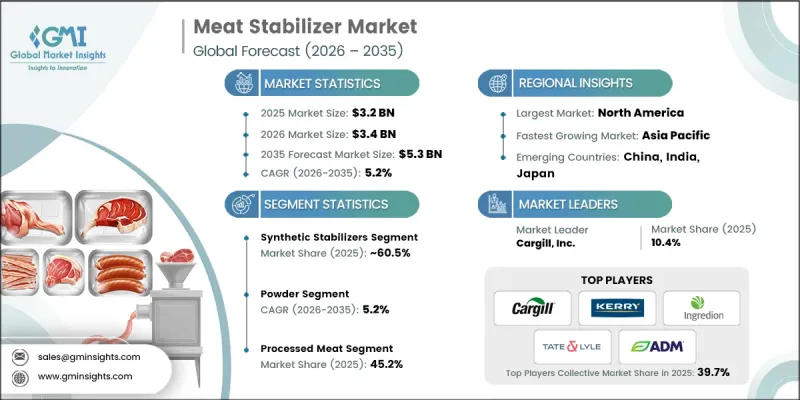
세계의 육류용 안정제 시장은 2025년에 32억 달러로 평가되었고 CAGR 5.2%를 나타내 2035년까지 53억 달러에 이를 것으로 추정되고 있습니다.
육류용 안정제 산업은 외관, 식감 및 전반적인 식경험이 개선된 고품질 육류 제품에 대한 소비자 수요가 증가함에 따라 꾸준히 성장하고 있습니다. 결합제 또는 증량제라고도 불리는 육류용 안정제는 제품의 균일성을 높이고 수분을 유지하며 구조적 안정성을 향상시키는 데 중요한 역할을 합니다. 이러한 성분은 가공 손실을 줄이고 저장 안정성을 향상시키면서 제조업체가 제품의 균일성을 유지하는 데 도움이 됩니다. 그 기능성은 폐기물을 최소화하고 수율을 최적화하여 생산 효율성 향상과 수익성 개선에 기여하고 있습니다. 동시에 소비자는 식감, 맛, 제품의 균일성 향상이라는 혜택을 누리며 만족도를 높일 수 있습니다. 가공식품과 간편식에 대한 수요 증가로 인해 업계 전반에 걸쳐 안정제 채택이 지속적으로 증가하고 있습니다. 또한, 이러한 원료들은 대체 단백질 제품의 배합 성능을 향상시키는데 활용되어 변화하는 식생활 트렌드를 뒷받침하고 있습니다. 육류 가공 부문이 지속적으로 성장함에 따라, 효과적인 고성능 안정화 솔루션에 대한 수요는 전 세계 육류용 안정제 시장 전체에 걸쳐 꾸준히 증가할 것으로 예측됩니다.
| 시장 범위 | |
|---|---|
| 시작 연도 | 2025년 |
| 예측 기간 | 2026-2035년 |
| 개시 연도 시장 규모 | 32억 달러 |
| 예측액 | 53억 달러 |
| CAGR | 5.2% |
2025년에는 합성 안정제가 60.5%의 점유율을 차지했으며, 비용 효율성, 안정적인 성능 및 제품 내구성을 향상시키는 능력으로 인해 2035년까지 연평균 5.3%의 성장률을 나타낼 것으로 예측됩니다. 그러나 천연 유래 및 클린 라벨 원료에 대한 소비자의 선호도 변화가 시장 역학에 영향을 미치고 있습니다. 제조업체들은 변화하는 식품 트렌드와 지속가능성에 대한 기대에 따라 천연 유래 대체품 개발에 대한 투자를 확대되고 있습니다. 업계는 성능 효율성과 규제 준수, 그리고 보다 투명한 원료 솔루션을 원하는 소비자의 요구와 균형을 맞추는 방향으로 점차 전환하고 있습니다.
분말 기반 육류용 안정제 부문은 2025년 55.3%의 점유율을 차지했으며, 2035년까지 연평균 5.2%의 성장률을 나타낼 것으로 예측됩니다. 그 광범위한 사용은 취급의 용이성, 긴 저장 기간 및 높은 비용 효율성에 기인합니다. 분말 형태는 가공의 유연성을 제공하여 제조업체가 다양한 생산 환경에서도 일관된 결과를 얻을 수 있도록 합니다. 안정된 구성과 다양한 배합에 대한 적합성으로 인해 대규모 식품 가공 공정에서 선호되는 선택이 되어 효율적인 제조 관행을 뒷받침하고 있습니다.
북미의 육류용 안정제 시장은 2025년 30.4%의 점유율을 차지했으며, 이는 이 지역의 강력한 수요를 반영합니다. 이 지역의 성장은 가공육 및 즉석 육류 제품의 소비 증가에 의해 주도되고 있습니다. 식품 품질과 안전 기준에 대한 인식이 높아지면서 제조업체들이 첨단 안정화 기술을 채택하고 있습니다. 동시에 클린 라벨과 천연 유래 원료에 대한 수요가 증가함에 따라 기업들은 혁신을 통해 대체 솔루션을 개발하고 있습니다. 프리미엄 및 유기농 육류 제품에 대한 소비자의 선호도 또한 북미 전역 시장 확대를 더욱 촉진하고 있습니다.
자주 묻는 질문
목차
제1장 조사 방법과 범위
제2장 주요 요약
제3장 업계 인사이트
제4장 경쟁 구도
제5장 시장 추산 및 예측 : 제품 유형별(2022-2035년)
제6장 시장 추산 및 예측 : 형태별(2022-2035년)
제7장 시장 추산 및 예측 : 용도별(2022-2035년)
제8장 시장 추산 및 예측 : 지역별(2022-2035년)
제9장 기업 개요
KTH 26.05.20The Global Meat Stabilizer Market was valued at USD 3.2 billion in 2025 and is estimated to grow at a CAGR of 5.2% to reach USD 5.3 billion by 2035.
The meat stabilizers industry is witnessing consistent growth as consumers increasingly demand high-quality meat products with improved appearance, texture, and overall eating experience. Meat stabilizers, also known as binders or extenders, play a critical role in enhancing product consistency, retaining moisture, and improving structural integrity. These ingredients help manufacturers maintain product uniformity while reducing processing losses and improving shelf stability. Their functionality contributes to higher production efficiency and improved profitability by minimizing waste and optimizing yield. At the same time, consumers benefit from better texture, flavor, and product consistency, which enhances satisfaction. The growing demand for processed and convenient food options continues to drive the adoption of stabilizers across the industry. In addition, these ingredients are being utilized to improve formulation performance in alternative protein products, supporting evolving dietary trends. As the processed meat sector continues to expand, the demand for effective and high-performance stabilizing solutions is expected to remain strong across the global meat stabilizer market.
| Market Scope | |
|---|---|
| Start Year | 2025 |
| Forecast Year | 2026-2035 |
| Start Value | $3.2 Billion |
| Forecast Value | $5.3 Billion |
| CAGR | 5.2% |
In 2025, the synthetic stabilizers accounted for 60.5% share and are expected to grow at a CAGR of 5.3% through 2035 owing to their cost efficiency, consistent performance, and ability to enhance product durability. However, shifting consumer preferences toward natural and clean-label ingredients are influencing market dynamics. Manufacturers are increasingly investing in the development of natural alternatives that align with changing dietary trends and sustainability expectations. The industry is gradually moving toward balancing performance efficiency with regulatory compliance and consumer demand for more transparent ingredient solutions.
The powder-based meat stabilizers segment held a share of 55.3% in 2025 and is anticipated to grow at a CAGR of 5.2% through 2035. Their widespread use is attributed to ease of handling, longer shelf life, and cost-effectiveness. Powder formats offer flexibility in processing and allow manufacturers to achieve consistent results across different production environments. Their stable composition and compatibility with various formulations make them a preferred choice in large-scale food processing operations, supporting efficient manufacturing practices.
North America Meat Stabilizer Market accounted for 30.4% share in 2025, reflecting strong regional demand. Growth in this region is driven by increasing consumption of processed and ready-to-eat meat products. Rising awareness of food quality and safety standards is encouraging manufacturers to adopt advanced stabilizing technologies. At the same time, demand for clean-label and naturally derived ingredients is prompting companies to innovate and develop alternative solutions. Consumer preference for premium and organic meat products is further supporting market expansion across North America.
Key companies operating in the Global Meat Stabilizer Market include Cargill, Incorporated, Kerry Group plc, Ingredion Incorporated, Tate & Lyle PLC, Archer Daniels Midland (ADM), Ashland Global Holdings, IFF, Palsgaard A/S, Hydrosol GmbH & Co. KG, Fiberstar, Inc., and Amesi Group. Companies in the Meat Stabilizer Market are strengthening their market presence through innovation, strategic collaborations, and product diversification. They are investing in research and development to create advanced stabilizer solutions that meet evolving consumer demand for clean-label and high-performance ingredients. Partnerships and acquisitions are being used to expand technological capabilities and global reach. Firms are also focusing on sustainable sourcing and production practices to align with environmental expectations. Additionally, companies are enhancing their supply chains, expanding into emerging markets, and offering customized solutions tailored to specific applications, enabling them to improve customer engagement and maintain a competitive edge in the global marketplace.
Table of Contents
Chapter 1 Methodology & Scope
- 1.1 Market scope and definition
- 1.2 Research design
- 1.2.1 Research approach
- 1.2.2 Data collection methods
- 1.3 Data mining sources
- 1.3.1 Global
- 1.3.2 Regional/Country
- 1.4 Base estimates and calculations
- 1.4.1 Base year calculation
- 1.4.2 Key trends for market estimation
- 1.5 Primary research and validation
- 1.5.1 Primary sources
- 1.6 Forecast model
- 1.7 Research assumptions and limitations
Chapter 2 Executive Summary
- 2.1 Industry 360° synopsis
- 2.2 Key market trends
- 2.2.1 Regional
- 2.2.2 Product type
- 2.2.3 Form
- 2.2.4 Application
- 2.3 CXO perspectives: Strategic imperatives
- 2.3.1 Executive decision points
Chapter 3 Industry Insights
- 3.1 Industry ecosystem analysis
- 3.1.1 Supplier landscape
- 3.1.2 Profit margin
- 3.1.3 Value addition at each stage
- 3.1.4 Factor affecting the value chain
- 3.1.5 Disruptions
- 3.2 Industry impact forces
- 3.2.1 Growth drivers
- 3.2.2 Industry pitfalls and challenges
- 3.2.3 Market opportunities
- 3.3 Growth potential analysis
- 3.4 Regulatory landscape
- 3.4.1 North America
- 3.4.2 Europe
- 3.4.3 Asia Pacific
- 3.4.4 Latin America
- 3.4.5 Middle East & Africa
- 3.5 Porter's analysis
- 3.6 PESTEL analysis
- 3.7 Price trends
- 3.7.1 By region
- 3.7.2 By type
- 3.8 Future market trends
- 3.9 Technology and Innovation landscape
- 3.9.1 Current technological trends
- 3.9.2 Emerging technologies
- 3.10 Patent Landscape
- 3.11 Trade statistics (HS code)
- 3.11.1 Major importing countries
- 3.11.2 Major exporting countries
- 3.12 Sustainability and environmental aspects
- 3.12.1 Sustainable practices
- 3.12.2 Waste reduction strategies
- 3.12.3 Energy efficiency in production
- 3.12.4 Eco-friendly initiatives
- 3.13 Carbon footprint consideration
Chapter 4 Competitive Landscape, 2025
- 4.1 Introduction
- 4.2 Company market share analysis
- 4.2.1 By region
- 4.2.1.1 North America
- 4.2.1.2 Europe
- 4.2.1.3 Asia Pacific
- 4.2.1.4 LATAM
- 4.2.1.5 MEA
- 4.2.1 By region
- 4.3 Company matrix analysis
- 4.4 Competitive analysis of major market players
- 4.5 Competitive positioning matrix
- 4.6 Key developments
- 4.6.1 Mergers & acquisitions
- 4.6.2 Partnerships & collaborations
- 4.6.3 New Product Launches
- 4.6.4 Expansion Plans
Chapter 5 Market Estimates and Forecast, By Product Type, 2022-2035 (USD Billion) (Kilo Tons)
- 5.1 Key trends
- 5.2 Natural stabilizers
- 5.2.1 Plant-based
- 5.2.2 Animal-based
- 5.3 Synthetic stabilizers
- 5.3.1 Phosphates
- 5.3.2 Hydrocolloids
- 5.3.3 Others
Chapter 6 Market Estimates and Forecast, By Form, 2022-2035 (USD Billion) (Kilo Tons)
- 6.1 Key trends
- 6.2 Powder
- 6.3 Liquid/solution
- 6.4 Gel/paste
Chapter 7 Market Estimates and Forecast, By Application, 2022-2035 (USD Billion) (Kilo Tons)
- 7.1 Key trends
- 7.2 Processed meat
- 7.2.1 Sausages
- 7.2.2 Meat snacks
- 7.2.3 Frozen processed meat products
- 7.2.4 Cooked and canned meats
- 7.2.5 Hot dogs
- 7.3 Fresh meat
- 7.3.1 Beef
- 7.3.2 Poultry
- 7.3.3 Pork
- 7.4 Ready-to-eat meals
- 7.5 Others
Chapter 8 Market Estimates and Forecast, By Region, 2022-2035 (USD Billion) (Kilo Tons)
- 8.1 Key trends
- 8.2 North America
- 8.2.1 U.S.
- 8.2.2 Canada
- 8.3 Europe
- 8.3.1 Germany
- 8.3.2 UK
- 8.3.3 France
- 8.3.4 Spain
- 8.3.5 Italy
- 8.3.6 Rest of Europe
- 8.4 Asia Pacific
- 8.4.1 China
- 8.4.2 India
- 8.4.3 Japan
- 8.4.4 Australia
- 8.4.5 South Korea
- 8.4.6 Rest of Asia Pacific
- 8.5 Latin America
- 8.5.1 Brazil
- 8.5.2 Mexico
- 8.5.3 Argentina
- 8.5.4 Rest of Latin America
- 8.6 Middle East and Africa
- 8.6.1 Saudi Arabia
- 8.6.2 South Africa
- 8.6.3 UAE
- 8.6.4 Rest of Middle East and Africa
Chapter 9 Company Profiles
- 9.1 Amesi Group
- 9.2 Archer Daniels Midland (ADM)
- 9.3 Ashland Global Holdings
- 9.4 Cargill, Incorporated
- 9.5 Fiberstar, Inc.
- 9.6 Hydrosol GmbH & Co. KG
- 9.7 IFF
- 9.8 Ingredion Incorporated
- 9.9 Kerry Group plc
- 9.10 Palsgaard A/S
- 9.11 Tate & Lyle PLC


