|
시장보고서
상품코드
2027576
압력 제어 장비 : 시장 기회, 성장 촉진요인, 업계 동향 분석 및 예측(2026-2035년)Pressure Control Equipment Market Opportunity, Growth Drivers, Industry Trend Analysis, and Forecast 2026 - 2035 |
||||||

세계의 압력 제어 장비 시장은 2025년에 47억 달러로 평가되었고, 2035년까지 연평균 복합 성장률(CAGR) 2.9%를 나타내 63억 달러에 이를 것으로 추정되고 있습니다.
시장 성장은 석유 및 가스 탐사 및 생산 활동의 가속화로 인해 유정의 건전성과 운영 안전성을 유지하는 것이 매우 중요해짐에 따라 주도되고 있습니다. 압력 제어 시스템은 고압 환경을 관리하고 효율적인 시추 및 채굴 공정을 보장하는 데 있어 매우 중요한 역할을 합니다. 탐사가 더욱 복잡하고 가혹한 환경으로 확장됨에 따라 고급 및 신뢰할 수 있는 장비에 대한 수요는 계속 증가하고 있습니다. 에너지 부문 외에도 화학 처리, 발전, 제조업의 지속적인 산업화도 안정적인 수요의 요인으로 작용하고 있습니다. 이러한 부문에서는 공정의 효율성을 유지하고, 제품의 품질을 안정화하며, 안전 기준을 충족시키기 위해 정밀한 압력 조정이 요구됩니다. 운영 신뢰성에 대한 중요성이 높아지고 세계 에너지 수요 증가와 함께 업스트림 부문 활동과 광범위한 산업 응용 분야를 지원하는 첨단 압력 제어 기술에 대한 투자가 촉진되고 있습니다.
| 시장 범위 | |
|---|---|
| 시작 연도 | 2025년 |
| 예측 기간 | 2026-2035년 |
| 개시 연도 시장 규모 | 47억 달러 |
| 예측액 | 63억 달러 |
| CAGR | 2.9% |
밸브 부문은 2025년 16억 달러 시장 규모를 기록했으며, 2035년까지 연평균 복합 성장률(CAGR) 2.7%를 나타낼 것으로 예측됩니다. 이 부문은 다양한 응용 분야에서 유체의 흐름을 조절하고 안정적인 압력 수준을 유지하는 중요한 기능을 담당하고 있기 때문에 선도적인 위치를 유지하고 있습니다. 밸브는 시스템의 안전을 보장하고, 가동 중단을 방지하며, 고압 환경에서 효율적인 성능을 지원하기 위해 널리 사용되고 있습니다. 내구성, 적응성 및 긴 작동 수명으로 인해 신규 설치 및 유지보수 활동 모두에서 필수적인 구성 요소로 자리 잡았습니다. 강화된 규제 요건과 신뢰할 수 있는 압력 관리 솔루션에 대한 수요 증가는 밸브 시스템에 대한 견조한 수요를 뒷받침하고 있습니다.
와이어라인 압력 제어 장비 부문은 2025년 64.4%의 점유율을 차지했으며, 예측 기간 동안 CAGR 2.8%를 나타낼 것으로 예측됩니다. 이 부문이 선도적인 위치를 차지하고 있는 이유는 정밀한 압력 관리가 필수적인 유정 개입 및 유지보수 작업에서 전문적인 역할을 수행하기 때문입니다. 이 시스템은 고압 조건에서 작동할 수 있도록 설계되었으며, 지하 환경에 안전하게 접근할 수 있도록 설계되었습니다. 효율성, 신뢰성, 유연성으로 인해 복잡한 유정 작업을 관리하는 운영자들이 선호하는 선택이 되어 지속적인 시장 리더십을 유지하고 있습니다.
미국의 압력 제어 장비 시장은 14억 달러 규모이며, 2026년부터 2035년까지 연평균 2.7%의 성장률을 나타낼 것으로 예측됩니다. 이 나라 시장 성장은 광범위한 탐사 및 생산 활동과 더불어 첨단 시추 기술에 대한 지속적인 투자에 의해 뒷받침되고 있습니다. 엄격한 규제 기준과 업무 효율화의 필요성에 따라 신뢰할 수 있는 고성능 압력 제어 시스템에 대한 수요는 더욱 증가하고 있습니다. 자동화 및 원격 제어 장비를 포함한 기술의 발전으로 안전성이 향상되고 다운타임이 감소하고 있습니다. 탄탄한 인프라, 숙련된 노동력, 에너지 개발에 대한 지속적인 투자는 이 지역 시장 전망을 더욱 견고하게 만들고 있습니다.
자주 묻는 질문
목차
제1장 조사 방법과 범위
제2장 주요 요약
제3장 업계 인사이트
제4장 경쟁 구도
제5장 시장 추산 및 예측 : 구성 요소별(2022-2035년)
제6장 시장 추산 및 예측 : 카테고리별(2022-2035년)
제7장 시장 추산 및 예측 : 가격별(2022-2035년)
제8장 시장 추산 및 예측 : 용도별(2022-2035년)
제9장 시장 추산 및 예측 : 최종 용도별(2022-2035년)
제10장 시장 추산 및 예측 : 유통 채널별(2022-2035년)
제11장 시장 추산 및 예측 : 지역별(2022-2035년)
제12장 기업 개요
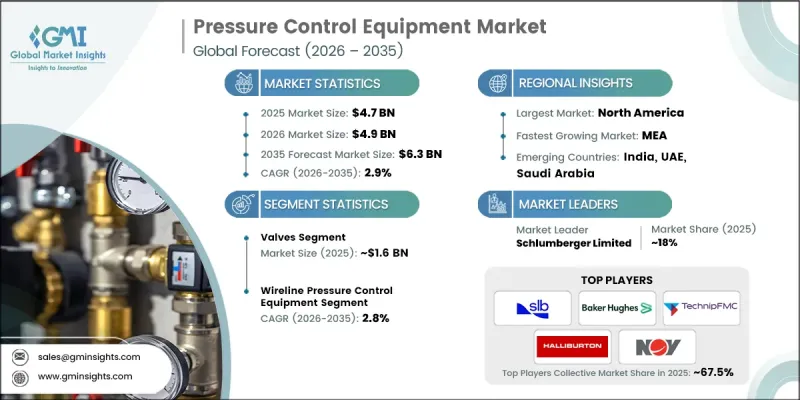
KTH 26.05.20The Global Pressure Control Equipment Market was valued at USD 4.7 billion in 2025 and is estimated to grow at a CAGR of 2.9% to reach USD 6.3 billion by 2035.
Market growth is driven by the increasing pace of oil and gas exploration and production activities, where maintaining well integrity and operational safety is critical. Pressure control systems play a vital role in managing high-pressure environments and ensuring efficient drilling and extraction processes. As exploration expands into more complex and demanding environments, the need for advanced and reliable equipment continues to rise. In addition to the energy sector, ongoing industrialization across chemical processing, power generation, and manufacturing industries is contributing to steady demand. These sectors require precise pressure regulation to maintain process efficiency, ensure product consistency, and meet safety standards. The growing emphasis on operational reliability, combined with rising global energy demand, is encouraging investments in advanced pressure control technologies that support both upstream activities and broader industrial applications.
| Market Scope | |
|---|---|
| Start Year | 2025 |
| Forecast Year | 2026-2035 |
| Start Value | $4.7 Billion |
| Forecast Value | $6.3 Billion |
| CAGR | 2.9% |
The valves segment generated USD 1.6 billion in 2025 and is expected to grow at a CAGR of 2.7% through 2035. This segment maintains a leading position due to its critical function in regulating fluid flow and maintaining stable pressure levels across various applications. Valves are widely used for ensuring system safety, preventing operational disruptions, and supporting efficient performance in high-pressure environments. Their durability, adaptability, and long operational lifespan make them essential components in both new installations and maintenance activities. Increasing regulatory requirements and the need for dependable pressure management solutions continue to support strong demand for valve systems.
The wireline pressure control equipment segment accounted for 64.4% share in 2025 and is projected to grow at a CAGR of 2.8% over the forecast period. This segment dominates due to its specialized role in well intervention and maintenance operations, where precise pressure management is essential. These systems are designed to operate in high-pressure conditions while enabling safe access to subsurface environments. Their efficiency, reliability, and flexibility make them a preferred choice for operators managing complex well operations, contributing to sustained market leadership.
United States Pressure Control Equipment Market accounted for USD 1.4 billion and is expected to grow at a CAGR of 2.7% from 2026 to 2035. Market growth in the country is supported by extensive exploration and production activities, along with continued investment in advanced drilling technologies. The demand for reliable and high-performance pressure control systems is reinforced by strict regulatory standards and the need for operational efficiency. Technological advancements, including automated and remotely operated equipment, are improving safety and reducing downtime. Strong infrastructure, a skilled workforce, and ongoing investments in energy development further strengthen the market outlook in the region.
Key players operating in the Global Pressure Control Equipment Market include Schlumberger Limited, Baker Hughes Company, Halliburton Company, TechnipFMC plc, Aker Solutions ASA, National Oilwell Varco, Weatherford International, The Weir Group PLC, Curtiss-Wright Corporation, Oil States International, Forum Energy Technologies, Dril-Quip, Inc., Hunting PLC, Schneider Electric SE, and Cactus Inc. Companies in the pressure control equipment market are focusing on technological innovation and product enhancement to strengthen their competitive position. Investments in research and development are enabling the creation of advanced systems with improved safety, automation, and operational efficiency. Firms are expanding their global presence through strategic partnerships, collaborations, and acquisitions to access new markets and strengthen distribution networks. Emphasis on compliance with stringent regulatory standards and the development of high-performance equipment ensures reliability and customer trust. Additionally, companies are enhancing after-sales services and maintenance support while integrating digital monitoring and predictive maintenance technologies to improve equipment performance and long-term value.
Table of Contents
Chapter 1 Methodology & Scope
- 1.1 Market scope and definition
- 1.2 Research design
- 1.2.1 Research approach
- 1.2.2 Data collection methods
- 1.3 Data mining sources
- 1.3.1 Global
- 1.3.2 Regional/Country
- 1.4 Base estimates and calculations
- 1.4.1 Base year calculation
- 1.4.2 Key trends for market estimation
- 1.5 Primary research and validation
- 1.5.1 Primary sources
- 1.6 Forecast model
- 1.7 Research assumptions and limitations
Chapter 2 Executive Summary
- 2.1 Industry 360° synopsis
- 2.2 Key market trends
- 2.2.1 Regional
- 2.2.2 Component
- 2.2.3 Category
- 2.2.4 Price Range
- 2.2.5 Application
- 2.2.6 End Use
- 2.2.7 Distribution channel
Chapter 3 Industry Insights
- 3.1 Industry ecosystem analysis
- 3.1.1 Supplier landscape
- 3.1.2 Profit margin
- 3.1.3 Value addition at each stage
- 3.1.4 Factor affecting the value chain
- 3.2 Industry impact forces
- 3.2.1 Growth drivers
- 3.2.1.1 Expansion of oil and gas exploration and production activities
- 3.2.1.2 Growing industrialization across chemical, power, and manufacturing sectors
- 3.2.1.3 Stringent safety and regulatory standards in high-pressure operations
- 3.2.2 Pitfalls & Challenges
- 3.2.2.1 High initial cost of advanced pressure control equipment
- 3.2.2.2 Complex installation and maintenance requirements
- 3.2.3 Opportunities
- 3.2.3.1 Increasing adoption of digital and IoT-enabled pressure monitoring systems
- 3.2.3.2 Growth of renewable energy and alternative fuel industries
- 3.2.1 Growth drivers
- 3.3 Growth potential analysis
- 3.4 Future market trends
- 3.5 Technology and innovation landscape
- 3.5.1 Current technological trends
- 3.5.2 Emerging technologies
- 3.6 Regulatory landscape
- 3.6.1 Standards and compliance requirements
- 3.6.2 Regional regulatory frameworks
- 3.6.3 Certification standards
- 3.7 Porter's analysis
- 3.8 PESTEL analysis
- 3.9 Pricing Analysis (Driven by Primary Research)
- 3.9.1 Historical Price Trend Analysis (Driven by Primary Research)
- 3.9.2 Pricing Strategy by Player Type (Premium / Value / Cost-plus) (Driven by Primary Research)
- 3.9.3 Impact of Raw Material Costs on Equipment Pricing
- 3.10 Trade Data Analysis (Driven by paid data base)
- 3.10.1 Import/Export Volume & Value Trends (Driven by paid data base)
- 3.10.2 Key Trade Corridors & Tariff Impact (Driven by paid data base)
- 3.10.3 Regional Trade Flow Patterns & Export Competitiveness
- 3.11 Impact of AI & Generative AI on the Market
- 3.11.1 AI-Driven Disruption of Traditional Control Systems & Operations
- 3.11.2 GenAI Use Cases & Adoption Roadmap by Industry Segment
- 3.11.3 Risks, Limitations & Regulatory Considerations
- 3.12 Manufacturing Capacity & Production Infrastructure Landscape (Driven by Primary Research)
- 3.13 Installed Manufacturing Capacity by Region & Key Producer (Driven by Primary Research)
- 3.14 Capacity Utilization Rates & Expansion Pipelines (Driven by Primary Research)
Chapter 4 Competitive Landscape, 2025
- 4.1 Introduction
- 4.2 Company market share analysis
- 4.2.1 By Region
- 4.2.1.1 North America
- 4.2.1.2 Europe
- 4.2.1.3 Asia Pacific
- 4.2.1.4 Latin America
- 4.2.1.5 Middle East & Africa
- 4.2.1 By Region
- 4.3 Company matrix analysis
- 4.4 Competitive analysis of major market players
- 4.5 Competitive positioning matrix
- 4.6 Key developments
- 4.6.1 Mergers & acquisitions
- 4.6.2 Partnerships & collaborations
- 4.6.3 New product launches
- 4.6.4 Expansion plans
Chapter 5 Market Estimates & Forecast, By Component, 2022 - 2035, (USD Billion) (Thousand Units)
- 5.1 Key trends
- 5.2 Valves
- 5.3 Control Head
- 5.4 Wellhead Flange
- 5.5 Adapter Flange
- 5.6 Quick Unions
- 5.7 Flexible Hoses
- 5.8 Others
Chapter 6 Market Estimates & Forecast, By Category, 2022 - 2035, (USD Billion) (Thousand Units)
- 6.1 Key trends
- 6.2 Wireline Pressure Control Equipment
- 6.3 Coiled Tubing Pressure Control Equipment
Chapter 7 Market Estimates & Forecast, By Price Range, 2022 - 2035, (USD Billion) (Thousand Units)
- 7.1 Key trends
- 7.2 Low
- 7.3 Medium
- 7.4 High
Chapter 8 Market Estimates & Forecast, By Application, 2022 - 2035, (USD Billion) (Thousand Units)
- 8.1 Key trends
- 8.2 Offshore
- 8.3 Onshore
Chapter 9 Market Estimates & Forecast, By End-Use, 2022 - 2035, (USD Billion) (Thousand Units)
- 9.1 Key trends
- 9.2 Oil & Gas
- 9.3 Chemicals
- 9.4 Energy & Utilities
- 9.5 Manufacturing
- 9.6 Mining
- 9.7 Pulp & Paper
- 9.8 Others
Chapter 10 Market Estimates & Forecast, By Distribution Channel, 2022 - 2035, (USD Billion) (Thousand Units)
- 10.1 Key trends
- 10.2 Direct
- 10.3 Indirect
Chapter 11 Market Estimates & Forecast, By Region, 2022 - 2035, (USD Billion) (Thousand Units)
- 11.1 Key trends
- 11.2 North America
- 11.2.1 U.S.
- 11.2.2 Canada
- 11.3 Europe
- 11.3.1 Germany
- 11.3.2 UK
- 11.3.3 France
- 11.3.4 Italy
- 11.3.5 Spain
- 11.4 Asia Pacific
- 11.4.1 China
- 11.4.2 India
- 11.4.3 Japan
- 11.4.4 South Korea
- 11.4.5 Australia
- 11.5 Latin America
- 11.5.1 Brazil
- 11.5.2 Mexico
- 11.5.3 Argentina
- 11.6 MEA
- 11.6.1 Saudi Arabia
- 11.6.2 UAE
- 11.6.3 South Africa
Chapter 12 Company Profiles
- 12.1 Aker Solutions ASA
- 12.2 Baker Hughes Company
- 12.3 Cactus Inc.
- 12.4 Curtiss-Wright Corporation
- 12.5 Dril-Quip, Inc.
- 12.6 Forum Energy Technologies
- 12.7 Halliburton Company
- 12.8 Hunting PLC
- 12.9 National Oilwell Varco
- 12.10 Oil States International
- 12.11 Schlumberger Limited
- 12.12 Schneider Electric SE
- 12.13 TechnipFMC plc
- 12.14 The Weir Group PLC
- 12.15 Weatherford International