
|
시장보고서
상품코드
2027600
감귤류 농축액 : 시장 기회, 성장 촉진요인, 업계 동향 분석 및 예측(2026-2035년)Citrus Concentrates Market Opportunity, Growth Drivers, Industry Trend Analysis, and Forecast 2026 - 2035 |
||||||

세계의 감귤류 농축액 시장은 2025년에 92억 달러로 평가되었고 CAGR 5.7%를 나타내 2035년까지 160억 달러에 이를 것으로 추정되고 있습니다.
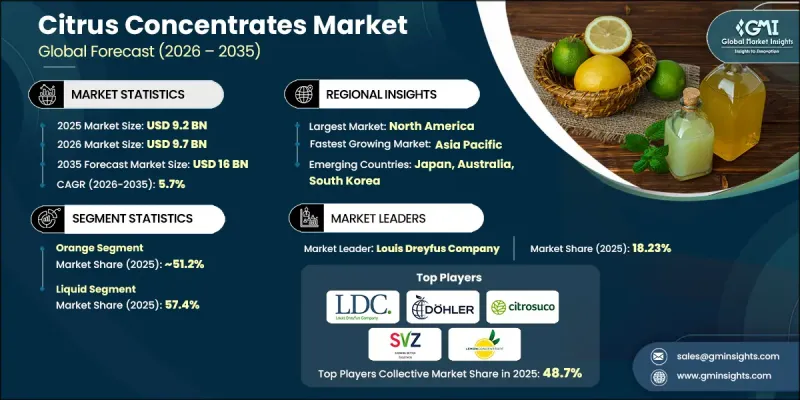
최근 몇 년 동안 소비자의 취향 변화, 가공 기술의 발전, 경제 상황의 변동 등의 영향을 받아 업계는 큰 변화를 겪고 있습니다. 식음료 제품에서 건강과 투명성을 중시하는 소비자들이 늘어나면서 천연 및 유기농 원료에 대한 강한 선호도가 구매 행동을 형성하고 있습니다. 이에 따라 유기농 원료로 만든 감귤류 농축액에 대한 수요가 크게 증가하고 있습니다. 동시에, 광범위한 '클린 라벨' 운동으로 인해 제조업체는 원료 조달, 가공, 성분 구성에 대한 보다 명확한 정보를 제공해야 합니다. 또한, 지속가능성 또한 중요한 초점이 되고 있으며, 기업들은 자원의 효율적인 사용, 배출량 감소, 폐기물 관리 시스템 개선 등 환경 친화적인 노력을 도입하고 있습니다. 환경에 미치는 영향을 최소화하기 위한 포장의 혁신도 시장의 진화에 기여하고 있습니다. 또한, 젊은 소비자층은 이러한 추세를 가속화하는 데 중요한 역할을 하고 있으며, 브랜드에 대해 환경 친화적인 가치관을 요구하고 있습니다. 그 결과, 제품 혁신, 지속가능성에 대한 노력, 그리고 더 건강한 천연 원료에 대한 전 세계 수요 증가와 함께 감귤류 농축액 시장은 지속적으로 성장하고 있습니다.
| 시장 범위 | |
|---|---|
| 시작 연도 | 2025년 |
| 예측 기간 | 2026-2035년 |
| 개시 연도 시장 규모 | 92억 달러 |
| 예측액 | 160억 달러 |
| CAGR | 5.7% |
오렌지 부문은 2025년 51.2%의 점유율을 차지했으며, 2035년까지 연평균 6.3%의 성장률을 나타낼 것으로 예측됩니다. 이 부문은 일관된 맛프로파일과 광범위한 소비자들에게 어필할 수 있고, 다양한 음료 용도에 널리 사용되어 선도적인 지위를 유지하고 있습니다. 건강에 대한 인식이 높아짐에 따라 소비자들은 자연 그대로의 맛과 영양을 겸비한 제품을 점점 더 많이 찾고 있습니다. 또한, 소비자들이 보다 깨끗하고 진짜 같은 재료를 찾는 경향이 높아지면서 유기농 제품의 인기가 높아진 것도 이 부문의 지속적인 성장에 기여하고 있습니다.
2025년 기준, 액체 부문은 57.4%의 점유율을 차지했으며, 이는 편의성, 다양성, 음료 제조에 쉽게 통합할 수 있는 형태에 대한 강한 선호도를 반영합니다. 액체 농축액은 대규모 생산 공정과의 호환성 및 일관된 맛 품질을 제공할 수 있기 때문에 널리 활용되고 있습니다. 한편, 분말 농축액은 건강을 중시하는 소비자와 유통기한 연장 및 보관 간소화를 원하는 제조업체들 사이에서 인기를 끌고 있습니다. 추가 첨가물에 의존하지 않고 농축된 풍미를 제공할 수 있기 때문에 기능성 식품 및 건강 보조 식품에 대한 적용이 증가하고 있으며, 보다 건강한 대안을 찾는 시장 수요의 변화를 뒷받침하고 있습니다.
북미의 감귤류 농축액 시장은 2025년에 28억 달러로 평가되었으며 2026년부터 2035년까지 연평균 6.2% 성장할 것으로 예측됩니다. 이 지역의 성장은 음료 및 가공식품 산업 모두에서 천연 및 유기농 향료 솔루션에 대한 강력한 수요에 의해 주도되고 있습니다. 소비자의 건강에 대한 인식이 높아지고 지속적인 제품 혁신이 결합되어 가격 변동과 공급망 복잡성 등의 어려움에도 불구하고 시장 확장을 뒷받침하고 있습니다. 가공 및 보존 기술의 발전으로 제품의 품질과 효율성이 더욱 향상되어 제조업체는 시장 경쟁력을 유지하면서 변화하는 소비자의 기대에 부응할 수 있게 되었습니다.
자주 묻는 질문
목차
제1장 조사 방법과 범위
제2장 주요 요약
제3장 업계 인사이트
제4장 경쟁 구도
제5장 시장 추산 및 예측 : 제품 유형별(2022-2035년)
제6장 시장 추산 및 예측 : 형태별(2022-2035년)
제7장 시장 추산 및 예측 : 용도별(2022-2035년)
제8장 시장 추산 및 예측 : 유통 채널별(2022-2035년)
제9장 시장 추산 및 예측 : 지역별(2022-2035년)
제10장 기업 개요
KTH 26.05.20The Global Citrus Concentrates Market was valued at USD 9.2 billion in 2025 and is estimated to grow at a CAGR of 5.7% to reach USD 16 billion by 2035.
Industry has undergone a notable transformation in recent years, influenced by evolving consumer preferences, advancements in processing technologies, and shifting economic dynamics. A strong inclination toward natural and organic ingredients is shaping purchasing behavior, as consumers increasingly prioritize health and transparency in food and beverage products. This has significantly boosted demand for citrus concentrates derived from organically sourced raw materials. At the same time, the broader clean-label movement is encouraging manufacturers to provide greater clarity regarding sourcing, processing, and ingredient composition. Sustainability has also emerged as a central focus, with companies adopting environmentally responsible practices such as efficient resource utilization, reduced emissions, and improved waste management systems. Packaging innovation aimed at minimizing environmental impact is further contributing to market evolution. Additionally, younger consumer groups are playing a critical role in accelerating these trends, pushing brands to align with eco-conscious values. As a result, the citrus concentrates market continues to expand through a combination of product innovation, sustainability initiatives, and increasing global demand for healthier, naturally derived ingredients.
| Market Scope | |
|---|---|
| Start Year | 2025 |
| Forecast Year | 2026-2035 |
| Start Value | $9.2 Billion |
| Forecast Value | $16 Billion |
| CAGR | 5.7% |
The orange segment accounted for 51.2% share in 2025 and is expected to grow at a CAGR of 6.3% through 2035. This segment maintains its leading position due to its widespread use across various beverage applications, where it is valued for its consistent flavor profile and broad consumer appeal. Rising health awareness is further supporting demand, as consumers increasingly seek products that deliver natural taste along with perceived nutritional benefits. The growing popularity of organic variants within this segment is also contributing to sustained expansion, as consumers shift toward cleaner and more authentic ingredient options.
The liquid segment held a share of 57.4% in 2025, reflecting a strong preference for formats that offer convenience, versatility, and ease of integration into beverage formulations. Liquid concentrates are widely utilized due to their compatibility with large-scale production processes and their ability to deliver consistent flavor quality. At the same time, powdered concentrates are gaining traction among health-conscious consumers and manufacturers seeking extended shelf life and simplified storage solutions. Their application in functional foods and nutritional products is increasing, as they allow for concentrated flavor delivery without reliance on additional additives, supporting evolving market demands for healthier product alternatives.
North America Citrus Concentrates Market was valued at USD 2.8 billion in 2025 and is expected to grow at a CAGR of 6.2% between 2026 and 2035. Growth in the region is being driven by strong demand for natural and organic flavor solutions across both the beverage and processed food industries. High levels of health awareness among consumers, combined with continuous product innovation, are supporting market expansion despite challenges related to pricing fluctuations and supply chain complexities. Technological advancements in processing and preservation are further enhancing product quality and efficiency, enabling manufacturers to meet changing consumer expectations while maintaining competitiveness in the market.
Key companies operating in the Global Citrus Concentrates Market include AGRANA Beteiligungs AG, Bioven Ingredients, Citrosuco, Citrus and Allied Essences Ltd, Dohler Group, Lemonconcentrate, Louis Dreyfus Company, Nielsen Citrus Products Company, Premier Juices, Rachel's Orchard, Sun Orchard, LLC, and SVZ International BV. Companies in the Citrus Concentrates Market are strengthening their competitive position through a combination of sustainability initiatives, product innovation, and strategic expansion. They are investing in advanced processing technologies to enhance product quality, improve yield efficiency, and maintain natural flavor integrity. Many players are prioritizing sustainable sourcing practices and forming long-term partnerships with growers to ensure consistent supply and traceability. In addition, companies are expanding their product portfolios to include organic and clean-label offerings that align with evolving consumer preferences. Efforts to optimize supply chains and adopt eco-friendly packaging solutions are also gaining importance.
Table of Contents
Chapter 1 Methodology & Scope
- 1.1 Market scope and definition
- 1.2 Research design
- 1.2.1 Research approach
- 1.2.2 Data collection methods
- 1.3 Data mining sources
- 1.3.1 Global
- 1.3.2 Regional/Country
- 1.4 Base estimates and calculations
- 1.4.1 Base year calculation
- 1.4.2 Key trends for market estimation
- 1.5 Primary research and validation
- 1.5.1 Primary sources
- 1.6 Forecast model
- 1.7 Research assumptions and limitations
Chapter 2 Executive Summary
- 2.1 Industry 360° synopsis
- 2.2 Key market trends
- 2.2.1 Regional
- 2.2.2 Product type
- 2.2.3 Form
- 2.2.4 Application
- 2.2.5 Distribution channel
- 2.3 TAM Analysis, 2026-2035
- 2.4 CXO perspectives: Strategic imperatives
Chapter 3 Industry Insights
- 3.1 Industry ecosystem analysis
- 3.1.1 Supplier landscape
- 3.1.2 Profit margin
- 3.1.3 Value addition at each stage
- 3.1.4 Factor affecting the value chain
- 3.1.5 Disruptions
- 3.2 Industry impact forces
- 3.2.1 Growth drivers
- 3.2.1.1 Rising consumer demand for convenience foods & ready-to-drink beverages
- 3.2.1.2 Growing health & wellness trends driving natural ingredients adoption
- 3.2.1.3 Expansion of food & beverage industry in emerging markets
- 3.2.2 Industry pitfalls and challenges
- 3.2.2.1 Fluctuating raw material prices & seasonal supply variations
- 3.2.2.2 Competition from synthetic flavoring alternatives
- 3.2.3 Market opportunities
- 3.2.3.1 Innovation in organic & clean-label citrus concentrates
- 3.2.3.2 Rising demand for functional & fortified beverages
- 3.2.1 Growth drivers
- 3.3 Growth potential analysis
- 3.4 Regulatory landscape
- 3.4.1 North America
- 3.4.2 Europe
- 3.4.3 Asia Pacific
- 3.4.4 Latin America
- 3.4.5 Middle East & Africa
- 3.5 Porter’s analysis
- 3.6 PESTEL analysis
- 3.7 Price trends
- 3.7.1 By region
- 3.7.2 By product type
- 3.8 Future market trends
- 3.9 Technology and innovation landscape
- 3.9.1 Current technological trends
- 3.9.2 Emerging technologies
- 3.10 Patent Landscape
- 3.11 Trade statistics (HS code)
- 3.11.1 Major importing countries
- 3.11.2 Major exporting countries
- 3.12 Sustainability and environmental aspects
- 3.12.1 Sustainable practices
- 3.12.2 Waste reduction strategies
- 3.12.3 Energy efficiency in production
- 3.12.4 Eco-friendly initiatives
- 3.13 Carbon footprint consideration
Chapter 4 Competitive Landscape, 2025
- 4.1 Introduction
- 4.2 Company market share analysis
- 4.2.1 By region
- 4.2.1.1 North America
- 4.2.1.2 Europe
- 4.2.1.3 Asia Pacific
- 4.2.1.4 LATAM
- 4.2.1.5 MEA
- 4.2.1 By region
- 4.3 Competitive analysis of major market players
- 4.4 Competitive positioning matrix
- 4.5 Key developments
- 4.5.1 Mergers & acquisitions
- 4.5.2 Partnerships & collaborations
- 4.5.3 New Product Launches
- 4.5.4 Expansion Plans
Chapter 5 Market Estimates and Forecast, By Product Type, 2022-2035 (USD Billion) (Kilo Tons)
- 5.1 Key trends
- 5.2 Orange
- 5.2.1 Sweet orange (valencia, navel)
- 5.2.2 Blood orange
- 5.3 Lemon
- 5.3.1 Eureka & lisbon
- 5.3.2 Meyer lemon
- 5.4 Grapefruit
- 5.4.1 White grapefruit
- 5.4.2 Pink & red grapefruit
- 5.5 Mandarin
- 5.6 Tangerine
- 5.7 Others
Chapter 6 Market Estimates and Forecast, By Form, 2022-2035 (USD Billion) (Kilo Tons)
- 6.1 Key trends
- 6.2 Liquid
- 6.3 Powder
Chapter 7 Market Estimates and Forecast, By Application, 2022-2035 (USD Billion) (Kilo Tons)
- 7.1 Key trends
- 7.2 Beverages
- 7.2.1 Juices & juice drinks
- 7.2.2 Carbonated soft drinks
- 7.2.3 Alcoholic beverages (cocktails, flavored spirits)
- 7.2.4 Functional & sports drinks
- 7.3 Bakery & confectionery
- 7.3.1 Bakery products
- 7.3.2 Confectionery & candies
- 7.4 Dairy products
- 7.4.1 Yogurt & cultured dairy
- 7.4.2 Ice cream & frozen desserts
- 7.4.3 Flavored milk & milk beverages
- 7.5 Sauces, dressings, and condiments
- 7.6 Cosmetics and personal care products
- 7.6.1 Skincare products
- 7.6.2 Haircare products
- 7.6.3 Fragrances & perfumes
- 7.7 Others
Chapter 8 Market Estimates and Forecast, By Distribution Channel, 2022-2035 (USD Billion) (Kilo Tons)
- 8.1 Key trends
- 8.2 Business-to-business (B2B)
- 8.3 Business-to-consumer (B2C)
- 8.4 Others
Chapter 9 Market Estimates and Forecast, By Region, 2022-2035 (USD Billion) (Kilo Tons)
- 9.1 Key trends
- 9.2 North America
- 9.2.1 U.S.
- 9.2.2 Canada
- 9.3 Europe
- 9.3.1 Germany
- 9.3.2 UK
- 9.3.3 France
- 9.3.4 Spain
- 9.3.5 Italy
- 9.3.6 Rest of Europe
- 9.4 Asia Pacific
- 9.4.1 China
- 9.4.2 India
- 9.4.3 Japan
- 9.4.4 Australia
- 9.4.5 South Korea
- 9.4.6 Rest of Asia Pacific
- 9.5 Latin America
- 9.5.1 Brazil
- 9.5.2 Mexico
- 9.5.3 Argentina
- 9.5.4 Rest of Latin America
- 9.6 Middle East and Africa
- 9.6.1 Saudi Arabia
- 9.6.2 South Africa
- 9.6.3 UAE
- 9.6.4 Rest of Middle East and Africa
Chapter 10 Company Profiles
- 10.1 AGRANA Beteiligungs AG
- 10.2 Bioven Ingredients
- 10.3 Citrosuco
- 10.4 Citrus and Allied Essences Ltd
- 10.5 Dohler Group
- 10.6 Lemonconcentrate
- 10.7 Louis Dreyfus Company
- 10.8 Nielsen Citrus Products Company
- 10.9 Premier Juices
- 10.10 Rachel's Orchard
- 10.11 Sun Orchard, LLC
- 10.12 SVZ International BV