|
시장보고서
상품코드
2027611
비건 케이싱 : 시장 기회, 성장 촉진요인, 업계 동향 분석 및 예측(2026-2035년)Vegan Casing Market Opportunity, Growth Drivers, Industry Trend Analysis, and Forecast 2026 - 2035 |
||||||

세계의 비건 케이싱 시장은 2025년에 45억 달러로 평가되었고 CAGR 7.8%를 나타내 2035년까지 95억 달러에 이를 것으로 추정되고 있습니다.
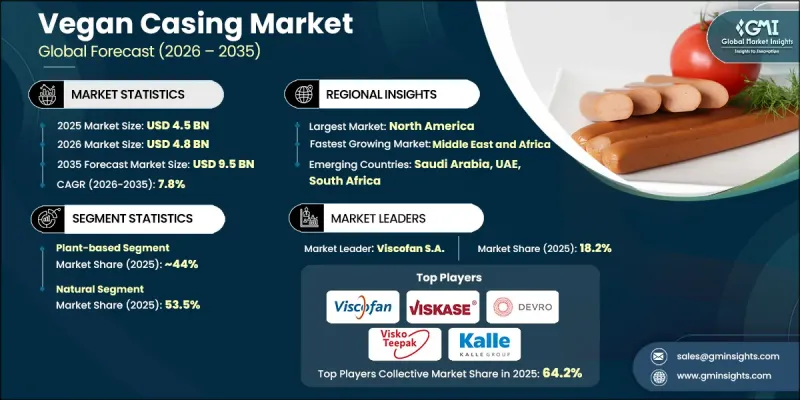
기존 동물성 재료로 만들어진 소시지 케이싱을 대체할 식물성 대체품에 대한 수요가 증가함에 따라 시장은 꾸준히 확대되고 있습니다. 비건 케이싱은 셀룰로오스, 알긴산, 전분 등 식물성 원료를 사용하여 제조되며, 동물에게 해를 끼치지 않고(크루얼티 프리) 지속 가능한 식품 솔루션을 찾는 소비자의 선호도가 높아지는 추세에 발맞추어 비건 케이싱을 출시하게 되었습니다. 건강 의식, 환경 문제, 윤리적 고려에 힘입어 비건과 채식주의자로의 라이프 스타일 전환이 시장 성장에 큰 영향을 미치고 있습니다. 또한, 식물성 식품 산업의 급속한 발전으로 인해 제품의 품질과 성능을 향상시키는 혁신적인 원료에 대한 강력한 수요가 발생하고 있습니다. 지속가능성에 대한 인식이 높아짐에 따라 제조업체들은 친환경적인 생산 방식과 재생 가능한 원료를 사용하도록 장려하고 있습니다. 소비자들이 식품의 출처와 환경에 미치는 영향에 대해 더 많이 알게 됨에 따라, 시장은 클린 라벨 제품이나 책임감 있는 방식으로 생산된 제품으로 전환하고 있습니다. 이러한 요인들은 식품 기술의 발전과 함께 비건 케이싱을 보다 광범위한 식물성 식품 생태계에서 중요한 구성 요소로 자리매김하고 있습니다.
| 시장 범위 | |
|---|---|
| 시작 연도 | 2025년 |
| 예측 기간 | 2026-2035년 |
| 개시 연도 시장 규모 | 45억 달러 |
| 예측액 | 95억 달러 |
| CAGR | 7.8% |
식물 유래 부문은 2025년 44%의 점유율을 차지했으며, 2035년까지 연평균 복합 성장률(CAGR) 7.5%를 나타낼 것으로 예측됩니다. 이 부문은 육류 대체 식품 및 식물성 식품에 대한 수요 증가로 인해 지속적으로 성장하고 있습니다. 식물 유래 재료로 개발된 케이싱은 식품 용도에 필요한 기능성을 유지하면서 지속 가능하고 윤리적인 솔루션을 제공합니다. 육류 대체품의 제품 혁신을 뒷받침하는 이 회사의 능력은 특히 식습관이 식물성 식품 소비 패턴으로 진화하는 가운데 세계 시장에서의 채택을 확대하는 데 기여하고 있습니다.
2025년 기준, 천연 소재 부문은 53.5%의 점유율을 차지했으며, 이는 최소한의 가공을 거친 클린 라벨 원료에 대한 소비자의 강한 선호를 반영합니다. 식물 유래의 천연 원료는 합성 소재의 대안으로 점점 더 많은 인기를 얻고 있습니다. 이러한 소재를 통해 제조업체는 지속가능성, 투명성, 건강 지향적 소비에 대한 소비자의 기대에 부합하는 제품을 개발할 수 있습니다. 식품 기술이 발전함에 따라 천연 원료는 원하는 질감, 내구성 및 성능 표준을 달성하는 데 중요한 역할을 하고 있으며, 고품질 비건 케이싱의 지속적인 개발에 필수적인 역할을 하고 있습니다.
북미의 비건 케이싱 시장은 2025년 17억 달러로 평가되었고, 2026년부터 2035년까지 연평균 7.4% 성장할 것으로 예측됩니다. 이 지역의 성장은 지속 가능한 식품 관행에 대한 인식이 높아지고 건강한 식생활 선택에 대한 선호도가 높아짐에 따라 주도되고 있습니다. 식물성 가공식품에 대한 수요 증가는 제조업체의 혁신을 촉진하고 제품 라인업을 확장하는 데 도움을 주고 있습니다. 또한, 탄탄한 소매 인프라와 유통망이 비건 케이싱의 보급을 뒷받침하고 있으며, 지역 전체에서 비건 케이싱의 꾸준한 시장 확장을 가능하게 하고 있습니다.
자주 묻는 질문
목차
제1장 조사 방법과 범위
제2장 주요 요약
제3장 업계 인사이트
제4장 경쟁 구도
제5장 시장 추산 및 예측 : 유형별(2022-2035년)
제6장 시장 추산 및 예측 : 소스별(2022-2035년)
제7장 시장 추산 및 예측 : 제품별(2022-2035년)
제8장 시장 추산 및 예측 : 형태별(2022-2035년)
제9장 시장 추산 및 예측 : 최종 용도별(2022-2035년)
제10장 시장 추산 및 예측 : 용도별(2022-2035년)
제11장 시장 추산 및 예측 : 지역별(2022-2035년)
제12장 기업 개요
KTH 26.05.20The Global Vegan Casing Market was valued at USD 4.5 billion in 2025 and is estimated to grow at a CAGR of 7.8% to reach USD 9.5 billion by 2035.
The market is expanding steadily as demand rises for plant-based alternatives to conventional sausage casings, which have traditionally been derived from animal-based materials. Vegan casings are manufactured using plant-derived ingredients such as cellulose, alginate, and starch, aligning with the increasing consumer preference for cruelty-free and sustainable food solutions. The shift toward vegan and vegetarian lifestyles, driven by health awareness, environmental concerns, and ethical considerations, is significantly influencing market growth. In addition, the rapid evolution of the plant-based food industry is creating strong demand for innovative ingredients that enhance product quality and performance. Growing awareness of sustainability is encouraging manufacturers to adopt eco-friendly production methods and renewable raw materials. As consumers become more informed about food sourcing and environmental impact, the market is witnessing a transition toward clean-label and responsibly produced products. These factors, combined with advancements in food technology, are positioning vegan casings as a key component in the broader plant-based food ecosystem.
| Market Scope | |
|---|---|
| Start Year | 2025 |
| Forecast Year | 2026-2035 |
| Start Value | $4.5 Billion |
| Forecast Value | $9.5 Billion |
| CAGR | 7.8% |
The plant-based segment accounted for 44% share in 2025 and is expected to grow at a CAGR of 7.5% through 2035. This segment continues to gain traction due to increasing demand for meat alternatives and plant-based food products. Casings developed from plant-derived materials offer a sustainable and ethical solution while maintaining the functional properties required for food applications. Their ability to support product innovation in meat alternatives is contributing to their growing adoption across global markets, particularly as dietary preferences continue to evolve toward plant-based consumption patterns.
The natural segment held a share of 53.5% in 2025, reflecting strong consumer preference for minimally processed and clean-label ingredients. Natural raw materials sourced from plant origins are becoming increasingly popular as alternatives to synthetic options. These materials enable manufacturers to develop products that align with consumer expectations for sustainability, transparency, and health-conscious consumption. As food technology advances, natural ingredients are playing a critical role in achieving desired texture, durability, and performance standards, making them essential for the continued development of high-quality vegan casings.
North America Vegan Casing Market was valued at USD 1.7 billion in 2025 and is anticipated to grow at a CAGR of 7.4% from 2026 to 2035. Growth in the region is being driven by increasing awareness of sustainable food practices and a rising preference for healthier dietary choices. The demand for plant-based processed food products is encouraging manufacturers to innovate and expand their product offerings. Additionally, strong retail infrastructure and distribution networks are supporting the widespread adoption of vegan casings, enabling consistent market expansion across the region.
Key companies operating in the Global Vegan Casing Market include Devro plc, Euroduna Food Ingredients GmbH, Futamura Chemical Co. Ltd., Hybricol, Kalle GmbH, and PROMAR Sp. z o.o., Ruitenberg Ingredients B.V., Soreal, Viscofan S.A., Viskase Companies Inc., and ViskoTeepak. Companies in the Global Vegan Casing Market are strengthening their competitive position through innovation, sustainability initiatives, and strategic collaborations. They are investing in research and development to create advanced plant-based materials that improve product performance, durability, and texture. Many players are focusing on sourcing renewable raw materials and implementing eco-friendly manufacturing processes to meet growing environmental expectations. Partnerships with food manufacturers are helping expand application areas and accelerate product adoption. In addition, companies are enhancing their distribution channels and expanding into emerging markets to increase their global presence. Customization of products to meet specific client requirements and continuous improvement in quality standards are further enabling companies to differentiate themselves and maintain long-term growth.
Table of Contents
Chapter 1 Methodology & Scope
- 1.1 Market scope and definition
- 1.2 Research design
- 1.2.1 Research approach
- 1.2.2 Data collection methods
- 1.3 Data mining sources
- 1.3.1 Global
- 1.3.2 Regional/Country
- 1.4 Base estimates and calculations
- 1.4.1 Base year calculation
- 1.4.2 Key trends for market estimation
- 1.5 Primary research and validation
- 1.5.1 Primary sources
- 1.6 Forecast model
- 1.7 Research assumptions and limitations
Chapter 2 Executive Summary
- 2.1 Industry 360° synopsis
- 2.2 Key market trends
- 2.2.1 Regional
- 2.2.2 Type
- 2.2.3 Source
- 2.2.4 Product
- 2.2.5 Form
- 2.2.6 End use
- 2.2.7 Application
- 2.3 TAM Analysis, 2026-2035
- 2.4 CXO perspectives: Strategic imperatives
Chapter 3 Industry Insights
- 3.1 Industry ecosystem analysis
- 3.1.1 Supplier landscape
- 3.1.2 Profit margin
- 3.1.3 Value addition at each stage
- 3.1.4 Factor affecting the value chain
- 3.1.5 Disruptions
- 3.2 Industry impact forces
- 3.2.1 Growth drivers
- 3.2.1.1 Rising consumer demand for plant-based food products
- 3.2.1.2 Growing awareness of environmental & ethical concerns
- 3.2.1.3 Technological advancements in plant-based material science
- 3.2.2 Industry pitfalls and challenges
- 3.2.2.1 High production costs compared to traditional casings
- 3.2.2.2 Limited scalability & production capacity constraints
- 3.2.3 Market opportunities
- 3.2.3.1 Emerging markets in Asia Pacific & Latin America
- 3.2.3.2 Strategic partnerships between food processors & casing manufacturers
- 3.2.1 Growth drivers
- 3.3 Growth potential analysis
- 3.4 Regulatory landscape
- 3.4.1 North America
- 3.4.2 Europe
- 3.4.3 Asia Pacific
- 3.4.4 Latin America
- 3.4.5 Middle East & Africa
- 3.5 Porter's analysis
- 3.6 PESTEL analysis
- 3.7 Price trends
- 3.7.1 By region
- 3.7.2 By type
- 3.8 Future market trends
- 3.9 Technology and innovation landscape
- 3.9.1 Current technological trends
- 3.9.2 Emerging technologies
- 3.10 Patent Landscape
- 3.11 Trade statistics (HS code)
- 3.11.1 Major importing countries
- 3.11.2 Major exporting countries
- 3.12 Sustainability and environmental aspects
- 3.12.1 Sustainable practices
- 3.12.2 Waste reduction strategies
- 3.12.3 Energy efficiency in production
- 3.12.4 Eco-friendly initiatives
- 3.13 Carbon footprint consideration
Chapter 4 Competitive Landscape, 2025
- 4.1 Introduction
- 4.2 Company market share analysis
- 4.2.1 By region
- 4.2.1.1 North America
- 4.2.1.2 Europe
- 4.2.1.3 Asia Pacific
- 4.2.1.4 LATAM
- 4.2.1.5 MEA
- 4.2.1 By region
- 4.3 Competitive analysis of major market players
- 4.4 Competitive positioning matrix
- 4.5 Key developments
- 4.5.1 Mergers & acquisitions
- 4.5.2 Partnerships & collaborations
- 4.5.3 New Product Launches
- 4.5.4 Expansion Plans
Chapter 5 Market Estimates and Forecast, By Type, 2022-2035 (USD Billion) (Kilo Tons)
- 5.1 Key trends
- 5.2 Plant-based
- 5.2.1 Soy protein-based
- 5.2.2 Pea protein-based
- 5.2.3 Wheat protein-based
- 5.2.4 Potato starch-based
- 5.2.5 Other plant proteins
- 5.3 Algae-based
- 5.4 Cellulose-based
Chapter 6 Market Estimates and Forecast, By Source, 2022-2035 (USD Billion) (Kilo Tons)
- 6.1 Key trends
- 6.2 Natural
- 6.3 Synthetic
Chapter 7 Market Estimates and Forecast, By Product, 2022-2035 (USD Billion) (Kilo Tons)
- 7.1 Key trends
- 7.2 Fresh
- 7.3 Processed
Chapter 8 Market Estimates and Forecast, By Form, 2022-2035 (USD Billion) (Kilo Tons)
- 8.1 Key trends
- 8.2 Pre-cut casings
- 8.3 Rolls/sheets
Chapter 9 Market Estimates and Forecast, By End Use, 2022-2035 (USD Billion) (Kilo Tons)
- 9.1 Key trends
- 9.2 Edible casings
- 9.3 Non-edible casings
Chapter 10 Market Estimates and Forecast, By Application, 2022-2035 (USD Billion) (Kilo Tons)
- 10.1 Key trends
- 10.2 Sausages
- 10.3 Hot dogs
- 10.4 Salami
- 10.5 Chorizo
- 10.6 Others
Chapter 11 Market Estimates and Forecast, By Region, 2022-2035 (USD Billion) (Kilo Tons)
- 11.1 Key trends
- 11.2 North America
- 11.2.1 U.S.
- 11.2.2 Canada
- 11.3 Europe
- 11.3.1 Germany
- 11.3.2 UK
- 11.3.3 France
- 11.3.4 Spain
- 11.3.5 Italy
- 11.3.6 Rest of Europe
- 11.4 Asia Pacific
- 11.4.1 China
- 11.4.2 India
- 11.4.3 Japan
- 11.4.4 Australia
- 11.4.5 South Korea
- 11.4.6 Rest of Asia Pacific
- 11.5 Latin America
- 11.5.1 Brazil
- 11.5.2 Mexico
- 11.5.3 Argentina
- 11.5.4 Rest of Latin America
- 11.6 Middle East and Africa
- 11.6.1 Saudi Arabia
- 11.6.2 South Africa
- 11.6.3 UAE
- 11.6.4 Rest of Middle East and Africa
Chapter 12 Company Profiles
- 12.1 Devro plc
- 12.2 Euroduna Food Ingredients GmbH
- 12.3 Futamura Chemical Co. Ltd.
- 12.4 Hybricol
- 12.5 Kalle GmbH
- 12.6 PROMAR Sp. z o.o.
- 12.7 Ruitenberg Ingredients B.V.
- 12.8 Soreal
- 12.9 Viscofan S.A.
- 12.10 Viskase Companies Inc.
- 12.11 ViskoTeepak