|
시장보고서
상품코드
2027626
나노 금속 산화물 : 시장 기회, 성장 촉진요인, 업계 동향 분석 및 예측(2026-2035년)Nano Metal Oxide Market Opportunity, Growth Drivers, Industry Trend Analysis, and Forecast 2026 - 2035 |
||||||

세계의 나노 금속 산화물 시장은 2025년에 63억 달러로 평가되었고 CAGR 6.7%를 나타내 2035년까지 120억 달러에 이를 것으로 추정되고 있습니다.
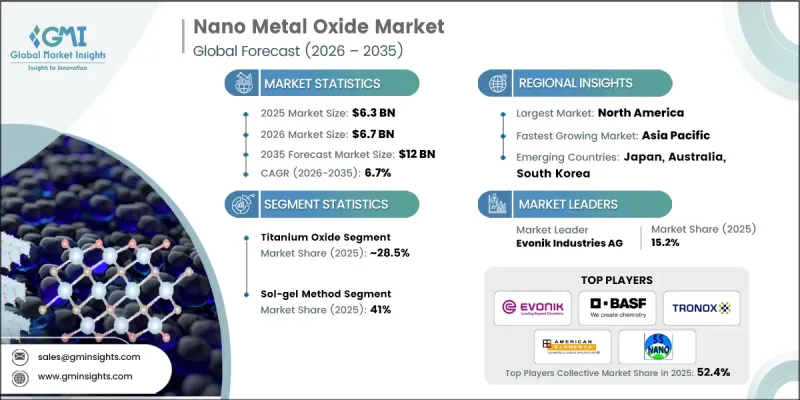
입자 크기가 1-100 나노미터인 나노 금속 산화물은 표면적 증가, 화학적 반응성 향상, 우수한 기계적 강도, 전기전도도 향상, 고도의 광학 특성 등 벌크 재료와는 다른 독특한 특성을 보입니다. 이들 소재는 전자, 헬스케어, 에너지, 화장품, 환경복원 등 다양한 분야에 적용되고 있습니다. 전자 분야에서 나노 금속 산화물은 뛰어난 전도성과 촉매 작용으로 전도성 코팅, 반도체 및 센서 기술에 활용되고 있습니다. 의료 분야에서는 생체 적합성과 정밀한 전달 능력으로 표적 지향적 약물 전달, 생체의학 영상 및 암 치료를 지원하고 있습니다. 태양전지, 연료전지, 촉매 공정 등 에너지 응용 분야에 활용되어 광학 효율과 촉매 효율을 활용하여 에너지 변환 및 저장을 개선하고 세계 재생 에너지 기술의 발전을 지원하고 있습니다.
| 시장 범위 | |
|---|---|
| 시작 연도 | 2025년 |
| 예측 기간 | 2026-2035년 |
| 개시 연도 시장 규모 | 63억 달러 |
| 예측액 | 120억 달러 |
| CAGR | 6.7% |
산화티타늄 부문은 2025년 28.5%의 점유율을 차지했으며, 2035년까지 연평균 5.9%의 성장률을 나타낼 것으로 예측됩니다. 산화티타늄은 반도체 제조 및 태양광 발전 응용을 포함한 전자, 헬스케어, 에너지 산업에서 폭넓게 사용되어 시장에서 확고한 입지를 유지하고 있습니다. 화학적 안정성, 광학적 투명성, 전기적 특성으로 인해 고성능 응용 분야에서 선호되는 선택이 되고 있으며, 다양한 분야에서 지속적인 채택이 이루어지고 있습니다.
2025년에는 졸겔법이 41%의 점유율을 차지했습니다. 이 기술을 통해 제조업체는 입자 크기, 모양, 균일성이 정밀하게 제어된 나노 금속 산화물을 제조할 수 있습니다. 이 공정은 금속 알콕사이드의 가수분해와 축합을 통해 졸을 형성한 후 겔화 및 열처리를 통해 고품질의 산화물 나노입자를 얻을 수 있습니다. 졸루겔 합성을 통해 형태와 구조적 특성을 제어할 수 있기 때문에 용도에 관계없이 일관된 성능을 확보할 수 있으며, 이는 나노 금속 산화물 생산에서 이 방법의 우위를 확고히 하고 있습니다.
북미의 나노 금속 산화물 시장은 2025년에 13억 달러로 평가되었으며 2026년부터 2035년까지 연평균 6.4% 성장할 것으로 예측됩니다. 북미의 성장은 탄탄한 혁신 생태계와 나노소재에 대한 엄격한 규제 프레임워크에 힘입어 첨단 전자, 헬스케어, 에너지 저장 분야가 주도하고 있습니다. 미국은 막대한 연구개발 투자로 이 지역을 주도하고 있으며, 캐나다는 환경 및 산업 나노기술 연구 이니셔티브를 통해 기여하고 있습니다. 이러한 탄탄한 기술 기반은 이 지역이 나노 금속 산화물의 상업적 생산 및 응용 분야에서 경쟁 우위를 유지할 수 있게 해줍니다.
자주 묻는 질문
목차
제1장 조사 방법과 범위
제2장 주요 요약
제3장 업계 인사이트
제4장 경쟁 구도
제5장 시장 추산 및 예측 : 제품 유형별(2022-2035년)
제6장 시장 추산 및 예측 : 제조 방법별(2022-2035년)
제7장 시장 추산 및 예측 : 입자 사이즈별(2022-2035년)
제8장 시장 추산 및 예측 : 용도별(2022-2035년)
제9장 시장 추산 및 예측 : 지역별(2022-2035년)
제10장 기업 개요
KTH 26.05.20The Global Nano Metal Oxide Market was valued at USD 6.3 billion in 2025 and is estimated to grow at a CAGR of 6.7% to reach USD 12 billion by 2035.
Nano metal oxides, with particle sizes ranging from 1 to 100 nanometers, exhibit unique characteristics that differentiate them from their bulk counterparts, including increased surface area, enhanced chemical reactivity, superior mechanical strength, improved electrical conductivity, and advanced optical properties. These materials have found wide-ranging applications across electronics, healthcare, energy, cosmetics, and environmental remediation. In electronics, nano metal oxides are used for conductive coatings, semiconductors, and sensor technologies due to their exceptional conductivity and catalytic behavior. In the medical sector, they support targeted drug delivery, biomedical imaging, and cancer therapies due to their biocompatibility and precision delivery capabilities. Their use in energy applications, including solar cells, fuel cells, and catalytic processes, leverages their optical and catalytic efficiency to improve energy conversion and storage, supporting the advancement of renewable energy technologies worldwide.
| Market Scope | |
|---|---|
| Start Year | 2025 |
| Forecast Year | 2026-2035 |
| Start Value | $6.3 Billion |
| Forecast Value | $12 Billion |
| CAGR | 6.7% |
The titanium oxide segment held 28.5% in 2025 and is expected to grow at a CAGR of 5.9% through 2035. Titanium oxide maintains a strong market presence due to its extensive utilization across electronics, healthcare, and energy industries, including semiconductor fabrication and solar energy applications. Its chemical stability, optical clarity, and electrical properties make it a preferred choice for high-performance applications, driving continuous adoption in multiple sectors.
The sol-gel method accounted for 41% share in 2025. This technique allows manufacturers to produce nano metal oxides with precise particle sizes, shapes, and uniformity. The process involves hydrolysis and condensation of metal alkoxides to form a sol, followed by gelation and thermal treatment, resulting in high-quality oxide nanoparticles. The ability to control morphological and structural features through sol-gel synthesis ensures consistent performance across applications, which has solidified its dominance in nano metal oxide production.
North America Nano Metal Oxide Market was valued at USD 1.3 billion in 2025 and is expected to grow at a CAGR of 6.4% from 2026 to 2035. North America's growth is driven by advanced electronics, healthcare, and energy storage sectors, supported by a robust innovation ecosystem and a stringent regulatory framework for nanomaterials. The U.S. leads the region due to significant research and development investments, while Canada contributes through environmental and industrial nanotechnology research initiatives. This strong technological foundation enables the region to maintain a competitive edge in commercial production and application of nanometal oxides.
Key players operating in the Global Nano Metal Oxide Market include American Elements, SkySpring Nanomaterials Inc., Inframat Advanced Materials LLC, Advanced Nano Products Co. Ltd., Nanostructured & Amorphous Materials Inc., BASF SE, Tronox Holdings plc, Meliorum Technologies Inc., Sakai Chemical Industry Co., Ltd., Evonik Industries AG, NanoComposix Inc., Tayca Corporation, Reinste Nano Ventures Pvt. Ltd., PlasmaChem GmbH, Umicore, Hongwu International Group Ltd., and US Research Nanomaterials Inc. Companies in the Nano Metal Oxide Market are implementing strategies to strengthen their market presence through investment in high-precision manufacturing technologies that ensure particle size consistency, purity, and optimized functional performance. They are expanding regional operations via joint ventures, strategic partnerships, and mergers to access new end-use sectors. R&D efforts are prioritized to develop application-specific formulations for electronics, healthcare, and energy solutions. Firms are also focusing on sustainability by creating eco-friendly production processes and enhancing the recycling of nanomaterials. Supply chain optimization, intellectual property development, and collaboration with research institutions further support market competitiveness, while providing technical services and customized solutions help secure long-term client relationships and maintain a leading position in the global market.
Table of Contents
Chapter 1 Methodology & Scope
- 1.1 Market scope and definition
- 1.2 Research design
- 1.2.1 Research approach
- 1.2.2 Data collection methods
- 1.3 Data mining sources
- 1.3.1 Global
- 1.3.2 Regional/Country
- 1.4 Base estimates and calculations
- 1.4.1 Base year calculation
- 1.4.2 Key trends for market estimation
- 1.5 Primary research and validation
- 1.5.1 Primary sources
- 1.6 Forecast model
- 1.7 Research assumptions and limitations
Chapter 2 Executive Summary
- 2.1 Industry 360° synopsis
- 2.2 Key market trends
- 2.2.1 Regional
- 2.2.2 Grade
- 2.2.3 Form
- 2.2.4 Application
- 2.2.5 End use industry
- 2.2.6 Distribution channel
- 2.3 TAM Analysis, 2026-2035
- 2.4 CXO perspectives: Strategic imperatives
Chapter 3 Industry Insights
- 3.1 Industry ecosystem analysis
- 3.1.1 Supplier landscape
- 3.1.2 Profit margin
- 3.1.3 Value addition at each stage
- 3.1.4 Factor affecting the value chain
- 3.1.5 Disruptions
- 3.2 Industry impact forces
- 3.2.1 Growth drivers
- 3.2.1.1 Growing demand for advanced electronics & semiconductors
- 3.2.1.2 Expansion of energy storage & battery technologies
- 3.2.1.3 Increasing focus on environmental remediation
- 3.2.2 Industry pitfalls and challenges
- 3.2.2.1 High production costs & complex manufacturing processes
- 3.2.2.2 Health & safety concerns related to nanomaterial exposure
- 3.2.3 Market opportunities
- 3.2.3.1 Development of sustainable & green synthesis methods
- 3.2.3.2 Growth potential in cosmetics & personal care sector
- 3.2.1 Growth drivers
- 3.3 Growth potential analysis
- 3.4 Regulatory landscape
- 3.4.1 North America
- 3.4.2 Europe
- 3.4.3 Asia Pacific
- 3.4.4 Latin America
- 3.4.5 Middle East & Africa
- 3.5 Porter's analysis
- 3.6 PESTEL analysis
- 3.7 Price trends
- 3.7.1 By region
- 3.7.2 By product type
- 3.8 Future market trends
- 3.9 Technology and innovation landscape
- 3.9.1 Current technological trends
- 3.9.2 Emerging technologies
- 3.10 Patent Landscape
- 3.11 Trade statistics (HS code)
- 3.11.1 Major importing countries
- 3.11.2 Major exporting countries
- 3.12 Sustainability and environmental aspects
- 3.12.1 Sustainable practices
- 3.12.2 Waste reduction strategies
- 3.12.3 Energy efficiency in production
- 3.12.4 Eco-friendly initiatives
- 3.13 Carbon footprint consideration
Chapter 4 Competitive Landscape, 2025
- 4.1 Introduction
- 4.2 Company market share analysis
- 4.2.1 By region
- 4.2.1.1 North America
- 4.2.1.2 Europe
- 4.2.1.3 Asia Pacific
- 4.2.1.4 LATAM
- 4.2.1.5 MEA
- 4.2.1 By region
- 4.3 Competitive analysis of major market players
- 4.4 Competitive positioning matrix
- 4.5 Key developments
- 4.5.1 Mergers & acquisitions
- 4.5.2 Partnerships & collaborations
- 4.5.3 New Product Launches
- 4.5.4 Expansion Plans
Chapter 5 Market Estimates and Forecast, By Product Type, 2022-2035 (USD Billion) (Kilo Tons)
- 5.1 Key trends
- 5.2 Titanium oxide
- 5.3 Zinc oxide
- 5.4 Aluminum oxide
- 5.5 Copper oxide
- 5.6 Iron oxide
- 5.7 Chromium oxide
- 5.8 Other
Chapter 6 Market Estimates and Forecast, By Production Method, 2022-2035 (USD Billion) (Kilo Tons)
- 6.1 Key trends
- 6.2 Sol-gel method
- 6.3 Hydrothermal method
- 6.4 Precipitation method
- 6.4.1 Co-precipitation
- 6.4.2 Direct precipitation
- 6.5 Chemical vapor deposition (CVD)
- 6.6 Others
Chapter 7 Market Estimates and Forecast, By Particle Size, 2022-2035 (USD Billion) (Kilo Tons)
- 7.1 Key trends
- 7.2 Nanoparticles
- 7.3 Nanorods
- 7.4 Nanotubes
- 7.5 Nanowires
- 7.6 Others
Chapter 8 Market Estimates and Forecast, By Application, 2022-2035 (USD Billion) (Kilo Tons)
- 8.1 Key trends
- 8.2 Electronics & electrical
- 8.2.1 Semiconductors
- 8.2.2 Sensors
- 8.2.3 Display technologies
- 8.2.4 Conductive films
- 8.3 Energy storage & conversion
- 8.3.1 Batteries (li-ion, solid-state)
- 8.3.2 Supercapacitors
- 8.3.3 Solar cells
- 8.3.4 Fuel cells
- 8.4 Catalysis
- 8.5 Healthcare
- 8.6 Cosmetics & personal care
- 8.6.1 Sunscreens
- 8.6.2 Anti-aging products
- 8.6.3 Color cosmetics
- 8.7 Construction
- 8.8 Others
Chapter 9 Market Estimates and Forecast, By Region, 2022-2035 (USD Billion) (Kilo Tons)
- 9.1 Key trends
- 9.2 North America
- 9.2.1 U.S.
- 9.2.2 Canada
- 9.3 Europe
- 9.3.1 Germany
- 9.3.2 UK
- 9.3.3 France
- 9.3.4 Spain
- 9.3.5 Italy
- 9.3.6 Rest of Europe
- 9.4 Asia Pacific
- 9.4.1 China
- 9.4.2 India
- 9.4.3 Japan
- 9.4.4 Australia
- 9.4.5 South Korea
- 9.4.6 Rest of Asia Pacific
- 9.5 Latin America
- 9.5.1 Brazil
- 9.5.2 Mexico
- 9.5.3 Argentina
- 9.5.4 Rest of Latin America
- 9.6 Middle East and Africa
- 9.6.1 Saudi Arabia
- 9.6.2 South Africa
- 9.6.3 UAE
- 9.6.4 Rest of Middle East and Africa
Chapter 10 Company Profiles
- 10.1 Advanced Nano Products Co. Ltd.
- 10.2 American Elements
- 10.3 BASF SE
- 10.4 Evonik Industries AG
- 10.5 Hongwu International Group Ltd.
- 10.6 Inframat Advanced Materials LLC
- 10.7 Meliorum Technologies Inc.
- 10.8 nanoComposix Inc.
- 10.9 Nanophase Technologies Corporation
- 10.10 Nanostructured & Amorphous Materials Inc.
- 10.11 PlasmaChem GmbH
- 10.12 Reinste Nano Ventures Pvt. Ltd.
- 10.13 Sakai Chemical Industry Co., Ltd.
- 10.14 SkySpring Nanomaterials Inc.
- 10.15 Tayca Corporation
- 10.16 Tronox Holdings plc
- 10.17 Umicore
- 10.18 US Research Nanomaterials Inc.