

|
시장보고서
상품코드
2027629
모래 타일 절단기 : 시장 기회, 성장 촉진요인, 업계 동향 분석 및 예측(2026-2035년)Sand Tile Saw Market Opportunity, Growth Drivers, Industry Trend Analysis, and Forecast 2026 - 2035 |
||||||

세계의 모래 타일 절단기 시장은 2025년에 9억 3,240만 달러로 평가되었고 CAGR 4.8%를 나타내 2035년에는 15억 달러에 이를 것으로 추정되고 있습니다.
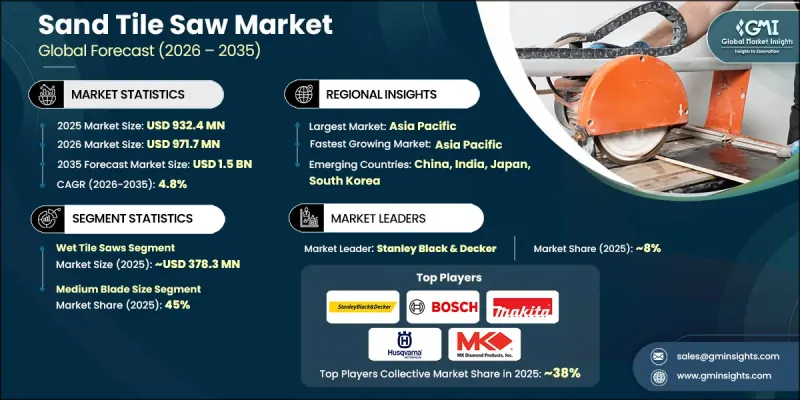
급속한 도시화와 주택 건설 산업의 성장률 상승과 함께 전 세계적으로 모래 타일 절단기에 대한 수요가 증가하고 있습니다. 도시화가 진행됨에 따라 주택, 아파트, 오피스를 건설하기 위한 새로운 공간을 지속적으로 확보할 필요성이 높아지고 있으며, 이에 따라 타일 공사는 인테리어 디자인에서 빼놓을 수 없는 요소로 자리 잡고 있습니다. 사람들은 바닥, 백스플래시, 욕실 리모델링 등에 타일 공사에 투자하고 있습니다. 모래 타일 절단기는 세라믹, 도자기, 석재, 심지어 석재에서도 정확하고 아름다운 절단을 실현합니다. 개발도상국의 중산층 증가는 주택 리모델링 및 개보수에 대한 투자 확대를 의미합니다. 현대의 건축 방식은 고품질 마감을 중시하고 있으며, 이를 위해서는 전문적인 타일 공사가 필요합니다. 주택 리모델링 증가와 더불어 DIY 열풍이 불면서 사람들은 타일 절단기를 직접 구매하기 시작했습니다. 개발도상국의 부동산 건설 증가는 타일톱에 대한 끊임없는 수요를 창출하고 있습니다. 사람들은 낭비를 최소화하고 작업을 완료하기 위해 견고하고 효율적인 타일 절단기를 찾고 있습니다.
| 시장 규모 | |
|---|---|
| 시작 연도 | 2025년 |
| 예측 기간 | 2026-2035년 |
| 개시 연도 시장 규모 | 9억 3,240만 달러 |
| 예측액 | 15억 달러 |
| CAGR | 4.8% |
습식 타일 절단기 시장은 2025년에 3억 7,830만 달러로 평가되었고 2026년부터 2035년까지 연평균 5.1% 성장할 것으로 예측됩니다. 습식 타일 절단기 시장은 우수한 절단 성능, 먼지 억제 및 블레이드 냉각 기능으로 인해 시장을 독점하고 있습니다. 습식 타일 절단기은 물을 사용하여 칼날을 윤활하고 절단 찌꺼기를 제거하기 때문에 절단면이 더 깨끗하고 칼날의 수명이 더 길어집니다. 전문 시공업체는 도자기, 세라믹, 천연석 타일을 정밀하게 절단하기 위해 습식 타일 절단기를 선호합니다. 수냉기능으로 칼날의 과열을 방지하여 난삭재도 연속 절단 작업이 가능합니다. 분진 억제 효과로 작업장 안전성을 향상시키고, 실리카 노출에 대한 건강 규정을 준수할 수 있습니다. 상업용 건축 증가, 전문적인 타일 시공에 대한 수요 증가, 절단 품질에 대한 강조는 습식 타일 절단기의 보급을 촉진하고 있습니다. 정확성, 안전성, 생산성에 대한 기술적 우위를 바탕으로 습식 타일 절단기은 시장에서 주요 부문으로 자리 잡았습니다.
중형 블레이드 부문은 2025년 45%의 점유율을 차지했으며, 2026년부터 2035년까지 연평균 4.9%의 성장률을 나타낼 것으로 전망됩니다. 중형 블레이드 부문은 주거용 및 상업용 타일 커팅 용도에서 다용도로 활용도가 높아 시장을 선도하고 있습니다. 10-14인치 블레이드는 대부분의 표준 타일 사이즈에 대응하며, 휴대성과 취급하기 쉬운 장비 무게를 유지하면서 대부분의 표준 타일 사이즈에 대응합니다. 전문 시공업체들은 절단 능력과 현장 기동성의 균형이 잘 잡힌 중형 톱을 높이 평가했습니다. 이 블레이드 사이즈 범위는 주거 및 상업용 건물 시공에 일반적으로 사용되는 세라믹, 도자기, 천연석 타일에 대응합니다. 중형 톱은 표준 바닥재 및 벽 타일 시공에 충분한 절단 깊이를 제공합니다. 다양한 프로젝트 유형에 대응할 수 있는 다재다능한 장비에 대한 수요가 증가하면서 중형 블레이드 사이즈에 대한 선호도가 높아지고 있습니다. 절단 능력, 휴대성, 광범위한 응용 분야에 대한 적합성이 결합되어 중형 블레이드 톱은 시장에서 주요 부문으로 자리 매김하고 있습니다.
미국의 모래 타일 절단기 시장은 2025년에 2억 1,740만 달러에 달했으며, 2035년까지 연평균 5.2%의 성장률을 나타낼 것으로 예측됩니다. 이 지역 시장 확대는 활발한 건설 활동, 리노베이션 지출 증가, 주택 개조 솔루션에 대한 관심 증가로 뒷받침되고 있습니다. 잘 구축된 유통 채널의 존재와 고급 공구에 대한 강력한 수요가 지속적으로 수요를 견인하고 있으며, 전문 사용자와 일반 소비자 모두 시장의 지속적인 성장에 기여하고 있습니다.
자주 묻는 질문
목차
제1장 조사 방법과 범위
제2장 주요 요약
제3장 업계 인사이트
제4장 경쟁 구도
제5장 시장 추산 및 예측 : 유형별(2022-2035년)
제6장 시장 추산 및 예측 : 블레이드 사이즈별(2022-2035년)
제7장 시장 추산 및 예측 : 출력별(2022-2035년)
제8장 시장 추산 및 예측 : 동력원별(2022-2035년)
제9장 시장 추산 및 예측 : 용도별(2022-2035년)
제10장 시장 추산 및 예측 : 유통 채널별(2022-2035년)
제11장 시장 추산 및 예측 : 지역별(2022-2035년)
제12장 기업 개요
KTH 26.05.20The Global Sand Tile Saw Market was valued at USD 932.4 million in 2025 and is estimated to grow at a CAGR of 4.8% to reach USD 1.5 billion in 2035.
Rapidly increasing rates of urbanization, along with the increasing rate of growth of the residential construction industry, are creating a demand for sand tile saws globally. The increasing rates of urbanization are creating a constant need to find new spaces to build homes, apartments, and offices, where tile work is an essential part of interior design. People are investing in tile work for floors, backsplashes, bathroom remodelling, etc. Sand tile saws help make precise, clean cuts in ceramic, porcelain, and even stone. The increasing number of people in the middle class in developing countries means a rise in investment in home remodelling and renovation. The modern way of constructing buildings focuses on quality finishes, which require professional tile work. The increasing rate of home remodeling, along with the rise of the DIY movement, encourages people to buy tile saws for their own purposes. The increasing rate of real estate construction in developing countries provides a constant demand for tile saws. People require strong, efficient tile saws to get the work done with minimal waste.
| Market Scope | |
|---|---|
| Start Year | 2025 |
| Forecast Year | 2026-2035 |
| Start Value | $932.4 Million |
| Forecast Value | $1.5 Billion |
| CAGR | 4.8% |
The wet tile saws segment accounted for USD 378.3 million in 2025 and is anticipated to grow at a CAGR of 5.1% from 2026 to 2035. The wet tile saws segment dominates the market due to superior cutting performance, dust suppression, and blade cooling capabilities. Wet tile saws use water to lubricate the blade and remove cutting debris, resulting in cleaner cuts and longer blade life. Professional contractors prefer wet saws for precision cutting of porcelain, ceramic, and natural stone tiles. Water cooling prevents blade overheating and enables continuous cutting operations on demanding materials. Dust suppression benefits improve workplace safety and comply with health regulations regarding silica exposure. Growing commercial construction, professional tile installation demand, and emphasis on cutting quality drive the adoption of wet tile saws. The technology's advantages in precision, safety, and productivity position wet tile saws as the leading segment in the market
The medium blade size segment held 45% share in 2025 and is anticipated to grow at a CAGR of 4.9% from 2026 to 2035. The medium blade size segment leads the market due to versatility across residential and commercial tile cutting applications. Blades ranging from 10 to 14 inches accommodate most standard tile sizes while maintaining portability and manageable equipment weight. Professional contractors value medium-sized saws that balance cutting capacity with jobsite mobility. The blade size range handles ceramic, porcelain, and natural stone tiles commonly used in residential and commercial installations. Medium saws provide sufficient cutting depth for standard flooring and wall tile applications. Growing demand for versatile equipment that serves multiple project types drives preference for medium blade sizes. The combination of cutting capacity, portability, and broad application suitability positions medium blade saws as the dominant segment in the market.
United States Sand Tile Saw Market reached USD 217.4 million in 2025 and is expected to grow at a CAGR of 5.2% through 2035. Market expansion in the region is supported by strong construction activity, increased renovation spending, and growing interest in home improvement solutions. The presence of well-established distribution channels and a strong preference for advanced tools continue to drive demand, while both professional users and individual consumers contribute to sustained market growth.
Key companies operating in the Global Sand Tile Saw Market include Makita, Husqvarna, Bosch, Rubi Tools, QEP, MK Diamond, RIDGID, Stanley Black & Decker, Skil, WEN, Dremel, Metabo, Lackmond Products, Felker (Target brand), and DeWalt. Companies in the Sand Tile Saw Market are enhancing their competitive position by focusing on innovation, product efficiency, and strategic expansion. Manufacturers are introducing advanced cutting technologies that improve precision, durability, and user safety. Many players are investing in lightweight and portable designs to meet evolving customer preferences. Expanding distribution networks, including online and offline channels, is helping companies improve accessibility and reach a broader customer base. Strategic partnerships and collaborations are also being adopted to strengthen market presence. Additionally, companies are emphasizing after-sales support, training services, and product customization to build long-term relationships with users. Competitive pricing strategies and continuous product upgrades further enable companies to maintain strong positioning in a highly competitive market landscape.
Table of Contents
Chapter 1 Methodology & Scope
- 1.1 Market scope and definition
- 1.2 Research design
- 1.2.1 Research approach
- 1.2.2 Data collection methods
- 1.3 Data mining sources
- 1.3.1 Global
- 1.3.2 Regional/Country
- 1.4 Base estimates and calculations
- 1.4.1 Base year calculation
- 1.4.2 Key trends for market estimation
- 1.5 Primary research and validation
- 1.5.1 Primary sources
- 1.6 Forecast model
- 1.7 Research assumptions and limitations
Chapter 2 Executive Summary
- 2.1 Industry 360° synopsis
- 2.2 Key market trends
- 2.2.1 Type
- 2.2.2 Blade size
- 2.2.3 Power
- 2.2.4 Power source
- 2.2.5 End user
- 2.2.6 Distribution channel
Chapter 3 Industry Insights
- 3.1 Industry ecosystem analysis
- 3.1.1 Supplier landscape
- 3.1.2 Profit margin
- 3.1.3 Value addition at each stage
- 3.1.4 Factor affecting the value chain
- 3.2 Industry impact forces
- 3.2.1 Growth drivers
- 3.2.1.1 Rapid urbanization and residential construction growth
- 3.2.1.2 Commercial construction and infrastructure development
- 3.2.1.3 Growing DIY home improvement and renovation trends
- 3.2.2 Pitfalls & Challenges
- 3.2.2.1 Competition from alternative cutting technologies
- 3.2.2.2 Economic sensitivity and construction cycle volatility
- 3.2.3 Opportunities
- 3.2.3.1 Technological innovation in cordless and portable systems
- 3.2.3.2 Growing demand for sustainable and eco-friendly building materials
- 3.2.1 Growth drivers
- 3.3 Growth potential analysis
- 3.4 Future market trends
- 3.5 Technology and innovation landscape
- 3.5.1 Current technological trends
- 3.5.2 Emerging technologies
- 3.6 Pricing analysis (driven by primary research)
- 3.6.1 Pricing analysis (driven by primary research)
- 3.6.2 Historical price trend analysis (driven by primary research)
- 3.6.3 Price Variation by material type & application
- 3.7 Regulatory landscape
- 3.7.1 Standards and compliance requirements
- 3.7.2 Regional regulatory frameworks
- 3.7.3 Certification standards
- 3.8 Porter's analysis
- 3.9 PESTEL analysis
- 3.10 Trade data analysis (driven by paid database)
- 3.10.1 Import/export volume & value trends
- 3.10.2 Key trade corridors & tariff impact
- 3.10.3 Regional trade dynamics & cross-border flow
- 3.11 Impact of AI & generative AI on the market
- 3.11.1 AI-driven disruption of manufacturing processes
- 3.11.2 GenAI uses cases (design optimization, predictive maintenance)
- 3.11.3 Risks, limitations & regulatory considerations
Chapter 4 Competitive Landscape, 2025
- 4.1 Introduction
- 4.2 Company market share analysis
- 4.2.1 By Region
- 4.2.1.1 North America
- 4.2.1.2 Europe
- 4.2.1.3 Asia Pacific
- 4.2.1.4 Latin America
- 4.2.1.5 Middle East & Africa
- 4.2.1 By Region
- 4.3 Company matrix analysis
- 4.4 Competitive analysis of major market players
- 4.5 Competitive positioning matrix
- 4.6 Key developments
- 4.6.1 Mergers & acquisitions
- 4.6.2 Partnerships & collaborations
- 4.6.3 New product launches
- 4.6.4 Expansion plans
Chapter 5 Market Estimates & Forecast, By Type, 2022 - 2035, (USD Million) (Thousand Units)
- 5.1 Key trends
- 5.2 Wet tile saws
- 5.3 Dry tile saws
- 5.4 Portable tile saws
- 5.5 Stationary tile saws
Chapter 6 Market Estimates & Forecast, By Blade Size, 2022 - 2035, (USD Million) (Thousand Units)
- 6.1 Key trends
- 6.2 Small (up to 10 inches)
- 6.3 Medium (10 to 14 inches)
- 6.4 Large (over 14 inches)
Chapter 7 Market Estimates & Forecast, By Power, 2022 - 2035, (USD Million) (Thousand Units)
- 7.1 Key trends
- 7.2 Upto 2 HP
- 7.3 2-5HP
- 7.4 Above 5 HP
Chapter 8 Market Estimates & Forecast, By Power Source, 2022 - 2035, (USD Million) (Thousand Units)
- 8.1 Key trends
- 8.2 Electric
- 8.3 Battery operated
- 8.4 Gas operated
Chapter 9 Market Estimates & Forecast, By End-use, 2022 - 2035, (USD Million) (Thousand Units)
- 9.1 Key trends
- 9.2 Residential
- 9.3 Commercial
- 9.4 Industrial
Chapter 10 Market Estimates & Forecast, By Distribution Channel, 2022 - 2035, (USD Million) (Thousand Units)
- 10.1 Key trends
- 10.2 Direct
- 10.3 Indirect
Chapter 11 Market Estimates & Forecast, By Region, 2022 - 2035, (USD Million) (Thousand Units)
- 11.1 Key trends
- 11.2 North America
- 11.2.1 U.S.
- 11.2.2 Canada
- 11.3 Europe
- 11.3.1 Germany
- 11.3.2 UK
- 11.3.3 France
- 11.3.4 Italy
- 11.3.5 Spain
- 11.4 Asia Pacific
- 11.4.1 China
- 11.4.2 India
- 11.4.3 Japan
- 11.4.4 South Korea
- 11.4.5 Australia
- 11.5 Latin America
- 11.5.1 Brazil
- 11.5.2 Mexico
- 11.5.3 Argentina
- 11.6 MEA
- 11.6.1 Saudi Arabia
- 11.6.2 UAE
- 11.6.3 South Africa
Chapter 12 Company Profiles
- 12.1 Bosch
- 12.2 DeWalt
- 12.3 Dremel
- 12.4 Felker (Target brand)
- 12.5 Husqvarna
- 12.6 Lackmond Products
- 12.7 Makita
- 12.8 Metabo
- 12.9 MK Diamond
- 12.10 QEP
- 12.11 RIDGID
- 12.12 Rubi Tools
- 12.13 Skil
- 12.14 Stanley Black & Decker
- 12.15 WEN


