
|
시장보고서
상품코드
2027645
HVAC 밸브 : 시장 기회, 성장 촉진요인, 업계 동향 분석 및 예측(2026-2035년)HVAC Valve Market Opportunity, Growth Drivers, Industry Trend Analysis, and Forecast 2026 - 2035 |
||||||

세계의 HVAC 밸브 시장은 2025년에 171억 달러로 평가되었고, 2035년까지 연평균 복합 성장률(CAGR) 4.7%를 나타내 271억 달러에 이를 것으로 추정되고 있습니다.
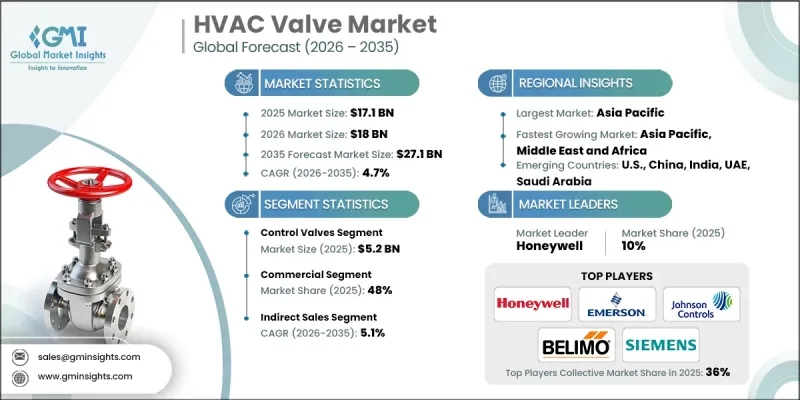
이러한 시장 확대는 에너지 절약형 HVAC 시스템 도입 확대와 주거 및 상업 부문의 건설 활동 증가에 기인합니다. 에너지 소비와 배출량 감소에 대한 관심이 높아지면서 고성능 밸브가 필요한 첨단 HVAC 시스템에 대한 수요가 가속화되고 있습니다. 기술 발전, 특히 HVAC 시스템에 IoT 및 AI의 통합은 실시간 모니터링 및 제어를 가능하게 하여 운영 비용을 절감할 수 있도록 함으로써 시장 성장을 가속하고 있습니다. 또한, 에너지 효율을 촉진하는 정부의 우호적인 정책, 인센티브 및 규제는 최신 HVAC 솔루션의 광범위한 도입을 촉진하고 있습니다. 도시화, 가처분 소득 증가, 스마트 빌딩 자동화 시스템에 대한 수요 증가는 HVAC 밸브 시장을 더욱 견인하고 있으며, 예측 기간 동안 견고한 성장세를 나타낼 것으로 예측됩니다.
| 시장 범위 | |
|---|---|
| 시작 연도 | 2025년 |
| 예측 기간 | 2026-2035년 |
| 개시 연도 시장 규모 | 171억 달러 |
| 예측액 | 271억 달러 |
| CAGR | 4.7% |
2025년 제어 밸브 부문 시장 규모는 52억 달러에 달했으며, 2035년까지 연평균 5.2%의 성장률을 나타낼 것으로 예측됩니다. 제어 밸브는 온도와 압력을 정밀하게 조절하고 전체 시스템의 성능과 에너지 효율을 향상시키기 때문에 현대의 HVAC 시스템에서 필수적인 역할을 하고 있습니다.
상업용 부문은 2025년 48%의 점유율을 차지했으며, 2026년부터 2035년까지 연평균 5%의 성장률을 나타낼 것으로 예측됩니다. 사무실, 소매점, 의료시설 등 상업 공간의 확대로 에너지 효율이 높은 HVAC 시스템에 대한 수요가 증가하고 있습니다. 도시화, 가처분 소득 증가, 스마트 빌딩 시스템으로의 기술 도입이 이 부문의 지속적인 성장을 견인하고 있으며, 홈 오토메이션 트렌드에 따라 고급 HVAC 밸브에 대한 주거용 수요도 지속적으로 증가하고 있습니다.
미국의 HVAC 밸브 시장은 2025년 80%의 점유율을 차지하며 38억 달러 시장 규모를 기록했습니다. 에너지 절약형 HVAC 시스템에 대한 수요, 첨단 빌딩 자동화 기술, 특히 남부 지방의 유리한 기후 조건으로 인해 급속한 확장이 이루어지고 있습니다. 텍사스주, 플로리다주 등의 급속한 도시화와 건설 수요 증가가 미국 시장 발전에 크게 기여하고 있습니다. HVAC 밸브 업계의 주요 기업으로는 키츠, 플로우서브, 슈나이더 일렉트릭, 벨리모, 칼레피, 하니웰, 존슨 컨트롤즈, 오벤트롭, 지멘스 빌딩 테크놀로지스, 타코 컴포트 솔루션, 에머슨, 피셔, KSB, 뉴웨이 밸브, 삼송, 와츠 워터 테크놀로지스 등이 있습니다. 피셔), KSB, 뉴웨이 밸브, 삼성, 와츠 워터 테크놀로지스 등이 있습니다. HVAC 밸브 시장의 각 업체들은 시장에서의 입지와 지위를 강화하기 위해 다양한 전략을 펼치고 있습니다. 각 업체들은 IoT 및 AI 시스템과 연동되는 에너지 효율이 뛰어난 스마트 밸브 솔루션 개발에 주력하고 있습니다. 유통망 확대, HVAC 시스템 통합사업자와의 제휴, 건설사와의 협업을 통해 보다 광범위한 시장 접근이 가능해졌습니다. 고성능, 저보수, 지속 가능한 밸브 제품 연구개발에 대한 투자는 진화하는 에너지 효율 표준에 대응하는 데 도움이 되고 있습니다. 각 회사는 고객 만족도를 높이기 위해 애프터 서비스, 기술 지원 및 맞춤형 솔루션에 중점을 두고 있습니다. 또한, 합병, 인수, 지리적 확장은 장기적으로 시장에서의 발판과 경쟁력을 확보하기 위해 사용되는 중요한 전략입니다.
자주 묻는 질문
목차
제1장 조사 방법과 범위
제2장 주요 요약
제3장 업계 인사이트
제4장 경쟁 구도
제5장 시장 추산 및 예측 : 밸브 유형별(2022-2035년)
제6장 시장 추산 및 예측 : 동작 방식별(2022-2035년)
제7장 시장 추산 및 예측 : 용도별(2022-2035년)
제8장 시장 추산 및 예측 : 최종 사용자별(2022-2035년)
제9장 시장 추산 및 예측 : 유통 채널별(2022-2035년)
제10장 시장 추산 및 예측 : 지역별(2022-2035년)
제11장 기업 개요
KTH 26.05.20The Global HVAC Valve Market was valued at USD 17.1 billion in 2025 and is estimated to grow at a CAGR of 4.7% to reach USD 27.1 billion by 2035.
The market is expanding due to the rising adoption of energy-efficient HVAC systems and increasing construction activities across residential and commercial sectors. Growing emphasis on reducing energy consumption and emissions has accelerated the demand for advanced HVAC systems, which require high-performance valves. Technological advancements, particularly the integration of IoT and AI in HVAC systems, have also fueled market growth, enabling real-time monitoring and control, which reduces operational costs. Additionally, favorable government policies, incentives, and regulations promoting energy efficiency are encouraging widespread adoption of modern HVAC solutions. The combination of urbanization, rising disposable incomes, and demand for smarter building automation systems is further driving the HVAC valve market forward, positioning it in a strong growth phase over the forecast period.
| Market Scope | |
|---|---|
| Start Year | 2025 |
| Forecast Year | 2026-2035 |
| Start Value | $17.1 Billion |
| Forecast Value | $27.1 Billion |
| CAGR | 4.7% |
In 2025, the control valves segment generated USD 5.2 billion and is projected to grow at a CAGR of 5.2% through 2035. Control valves are critical in modern HVAC systems because they allow precise regulation of temperature and pressure, enhancing overall system performance and energy efficiency.
The commercial segment held a 48% share in 2025 and is expected to grow at a CAGR of 5% from 2026 to 2035. Expansion in commercial spaces, including offices, retail environments, and healthcare facilities, is fueling the demand for energy-efficient HVAC systems. Urbanization, higher disposable income, and technological adoption in smart building systems are driving sustained growth in this segment, while residential demand for advanced HVAC valves continues to rise alongside home automation trends.
United States HVAC Valve Market held an 80% share in 2025, generating USD 3.8 billion. Rapid expansion is driven by demand for energy-saving HVAC systems, advanced building automation technologies, and favorable climate conditions, particularly in southern states. Rapid urbanization and construction growth in states like Texas and Florida are significant contributors to the U.S. market's development. Key players in the HVAC Valve Industry include KITZ Corporation, Flowserve, Schneider Electric, Belimo, Caleffi, Honeywell, Johnson Controls, Oventrop, Siemens Building Technologies, Taco Comfort Solutions, Emerson (Fisher), KSB, Neway Valve, Samson, and Watts Water Technologies. Companies in the HVAC Valve Market are implementing multiple strategies to strengthen their presence and market position. They focus on developing energy-efficient and smart valve solutions that integrate with IoT and AI systems. Expansion of distribution networks, partnerships with HVAC system integrators, and collaborations with construction firms allow broader market access. Investment in R&D for high-performance, low-maintenance, and sustainable valve products helps meet evolving energy efficiency standards. Firms emphasize after-sales services, technical support, and customized solutions to enhance customer satisfaction. Additionally, mergers, acquisitions, and geographic expansion are key strategies used to secure a long-term market foothold and competitiveness.
Table of Contents
Chapter 1 Methodology and scope
- 1.1 Research approach
- 1.2 Quality Commitments
- 1.2.1 GMI AI policy & data integrity commitment
- 1.2.1.1 Source consistency protocol
- 1.2.1 GMI AI policy & data integrity commitment
- 1.3 Research Trail & Confidence Scoring
- 1.3.1 Research Trail Components
- 1.3.2 Scoring Components
- 1.4 Data Collection
- 1.4.1 Partial list of primary sources
- 1.5 Data mining sources
- 1.5.1 Paid sources
- 1.5.1.1 Sources, by region
- 1.5.1 Paid sources
- 1.6 Base estimates and calculations
- 1.6.1 Base year calculation for any one approach
- 1.7 Forecast model
- 1.7.1 Quantified market impact analysis
- 1.7.1.1 Mathematical impact of growth parameters on forecast
- 1.7.1 Quantified market impact analysis
- 1.8 Research transparency addendum
- 1.8.1 Source attribution framework
- 1.8.2 Quality assurance metrics
- 1.8.3 Our commitment to trust
Chapter 2 Executive summary
- 2.1 Industry 360° synopsis
- 2.2 Key market trends
- 2.2.1 Regional trends
- 2.2.2 Valve type trends
- 2.2.3 Operation type trends
- 2.2.4 Application trends
- 2.2.5 End user trends
- 2.2.6 Distribution channel trends
Chapter 3 Industry insights
- 3.1 Industry ecosystem analysis
- 3.1.1 Supplier landscape
- 3.1.2 Profit margin
- 3.1.3 Value addition at each stage
- 3.1.4 Factor affecting the value chain
- 3.2 Industry impact forces
- 3.2.1 Growth drivers
- 3.2.2 Industry pitfalls & challenges
- 3.2.3 Opportunities
- 3.3 Growth potential analysis
- 3.4 Regulatory landscape
- 3.4.1 Energy Efficiency Standards (ASHRAE 90.1, EU ErP Directive)
- 3.4.2 Building Codes & Safety Regulations
- 3.4.3 Environmental Compliance (RoHS, REACH)
- 3.5 Major market trends and disruptions
- 3.6 Technological and innovation landscape
- 3.6.1 Emerging technologies
- 3.7 Pricing analysis (Driven by Primary Research)
- 3.7.1 Historical price trend analysis (Driven by Primary Research)
- 3.7.2 Pricing strategy by player type (Premium / Value / Cost-plus) (Driven by Primary Research)
- 3.8 Trade data analysis (Driven by Paid Data Base)
- 3.8.1 Import/export volume & value trends (Driven by Primary Research)
- 3.8.2 Key trade corridors & tariff impact (Driven by Primary Research)
- 3.9 Impact of AI & generative AI on the market
- 3.9.1 AI-driven disruption of existing business models
- 3.9.2 GenAI use cases & adoption roadmap by segment
- 3.9.3 Risks, limitations & regulatory considerations
- 3.10 Porter's analysis
- 3.11 PESTEL analysis
Chapter 4 Competitive landscape, 2025
- 4.1 Introduction
- 4.2 Company market share analysis
- 4.2.1 North America
- 4.2.2 Europe
- 4.2.3 Asia Pacific
- 4.2.4 Latin America
- 4.2.5 MEA
- 4.3 Company matrix analysis
- 4.4 Competitive analysis of major market players
- 4.5 Competitive positioning matrix
- 4.6 Key developments
- 4.6.1 Mergers & acquisitions
- 4.6.2 Partnerships & collaborations
- 4.6.3 New product launches
- 4.6.4 Expansion plans
Chapter 5 Market Estimates & Forecast, By Valve Type, 2022 - 2035 ($Billion, Thousand Units)
- 5.1 Key trends
- 5.2 Ball valves
- 5.3 Globe valves
- 5.4 Butterfly valves
- 5.5 Check valves
- 5.6 Gate valves
- 5.7 Pressure relief valves
- 5.8 Control valves
- 5.9 Solenoid valves
- 5.10 Others (disc valves etc.)
Chapter 6 Market Estimates & Forecast, By Operation Type, 2022 - 2035 ($Billion, Thousand Units)
- 6.1 Key trends
- 6.2 Manual
- 6.3 Pneumatic
- 6.4 Hydraulic
- 6.5 Electric
- 6.6 Smart/connected
Chapter 7 Market Estimates & Forecast, By Application, 2022 - 2035 ($Billion, Thousand Units)
- 7.1 Key trends
- 7.2 Heating systems
- 7.3 Cooling systems
- 7.4 Ventilation systems
- 7.5 District cooling
- 7.6 Refrigeration
Chapter 8 Market Estimates & Forecast, By End User, 2022 - 2035 ($Billion, Thousand Units)
- 8.1 Key trends
- 8.2 Residential
- 8.3 Commercial
- 8.3.1 Office buildings
- 8.3.2 Retail
- 8.3.3 Hospitality
- 8.3.4 Healthcare
- 8.3.5 Others (educational institute etc.)
- 8.4 Industrial
- 8.4.1 Oil and gas
- 8.4.2 Manufacturing
- 8.4.3 Food and beverages
- 8.4.4 Others (pharmaceuticals etc.)
Chapter 9 Market Estimates & Forecast, By Distribution Channel, 2022 - 2035 ($Billion, Thousand Units)
- 9.1 Key trends
- 9.2 Direct sales
- 9.3 Indirect sales
Chapter 10 Market Estimates & Forecast, By Region, 2022 - 2035 ($Billion, Thousand Units)
- 10.1 Key trends
- 10.2 North America
- 10.2.1 U.S.
- 10.2.2 Canada
- 10.3 Europe
- 10.3.1 Germany
- 10.3.2 UK
- 10.3.3 France
- 10.3.4 Spain
- 10.3.5 Italy
- 10.3.6 Netherlands
- 10.4 Asia Pacific
- 10.4.1 China
- 10.4.2 Japan
- 10.4.3 India
- 10.4.4 Australia
- 10.4.5 South Korea
- 10.5 Latin America
- 10.5.1 Brazil
- 10.5.2 Mexico
- 10.5.3 Argentina
- 10.6 MEA
- 10.6.1 South Africa
- 10.6.2 Saudi Arabia
- 10.6.3 UAE
Chapter 11 Company Profiles
- 11.1 Belimo
- 11.2 Caleffi
- 11.3 Emerson (Fisher)
- 11.4 Flowserve
- 11.5 Honeywell
- 11.6 Johnson Controls
- 11.7 KITZ Corporation
- 11.8 KSB
- 11.9 Neway Valve
- 11.10 Oventrop
- 11.11 Samson
- 11.12 Schneider Electric
- 11.13 Siemens Building Technologies
- 11.14 Taco Comfort Solutions
- 11.15 Watts Water Technologies