

|
시장보고서
상품코드
2027648
생파스타 및 생면 : 시장 기회, 성장 촉진요인, 업계 동향 분석 및 예측(2026-2035년)Uncooked Pasta and Noodles Market Opportunity, Growth Drivers, Industry Trend Analysis, and Forecast 2026 - 2035 |
||||||

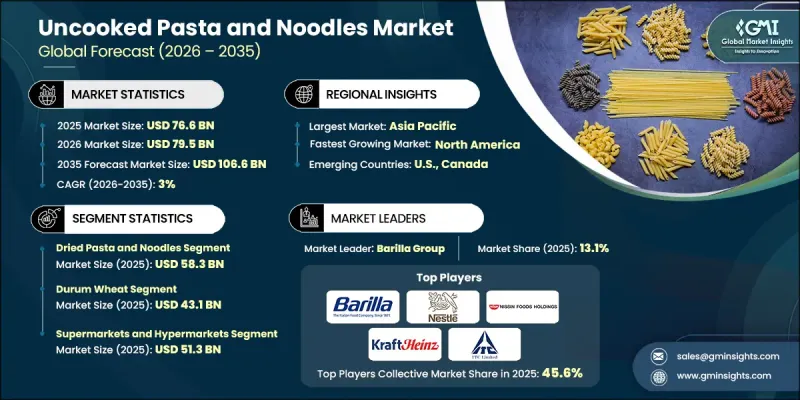
세계의 생파스타 및 생면 시장은 2025년에 766억 달러로 평가되었고 CAGR 3%를 나타내 2035년까지 1,066억 달러에 이를 것으로 추정되고 있습니다.
생파스타 및 생면은 밀가루나 다른 곡물 가루에 물을 섞어 만든 반죽을 기반으로 한 식품으로, 경우에 따라서는 계란이나 소금을 첨가하기도 합니다. 그 후, 성형, 건조하여 보관하거나 신선하게 포장하여 요리용으로 사용하게 됩니다. 이 제품들은 전 세계 요리에서 널리 소비되고 있으며, 파스타는 유럽 식문화와 밀접한 관련이 있고, 면류는 아시아 식문화에 깊이 뿌리를 내리고 있습니다. 건조 형태는 끓일 때까지 단단한 식감을 유지하고 끓이면 부드러워지기 때문에 장기 보관에 적합하고 조리가 간편합니다. 듀럼밀 세몰리나 밀가루는 단백질 함량이 높기 때문에 조리 후 경도와 탄력을 유지하는 데 도움이 되어 파스타 제조에 널리 사용됩니다. 국수는 지역적 취향과 조리법에 따라 쌀가루, 메밀가루 등 다양한 원료를 사용하여 제조되고 있습니다. 건조 공정은 수분 함량 감소, 저장 기간 연장, 미생물 증식 방지에 매우 중요한 역할을 하며, 효율적인 운송과 세계 유통을 지원합니다. 생산 기술의 지속적인 발전으로 업계 전반의 품질 안정성, 가공 효율성, 제품 다양성이 더욱 향상되고 있습니다.
| 시장 범위 | |
|---|---|
| 시작 연도 | 2025년 |
| 예측 기간 | 2026-2035년 |
| 개시 연도 시장 규모 | 766억 달러 |
| 예측액 | 1,066억 달러 |
| CAGR | 3% |
생파스타 및 생면 부문은 2025년 583억 달러에 달했습니다. 이 카테고리는 다른 형태에 비해 보존 기간이 길고, 비용 효율적이며, 보관이 용이하기 때문에 계속해서 시장을 독점하고 있습니다. 편리성과 다용도성으로 인해 가정 요리와 외식 산업에서 없어서는 안 될 식재료가 되었으며, 주거용과 상업용 소비 채널 모두에서 안정적인 수요를 뒷받침하고 있습니다.
듀럼밀 부문은 2025년 431억 달러에 달했습니다. 이 원료는 단백질 함량이 높고 글루텐 형성 능력이 뛰어나 파스타 제조에 널리 사용되어 바람직한 식감과 조리 성능을 제공합니다. 듀럼밀 세몰리나를 거칠게 갈아서 조리 중에도 형태가 유지되는 견고한 구조의 파스타를 생산할 수 있어 전통 파스타 제품 특유의 쫄깃한 식감과 식감을 확보할 수 있습니다.
생파스타 및 생면 시장에서 사업을 전개하고 있는 주요 기업으로는 닛신식품홀딩스, 크래프트 하인즈 컴퍼니, 발라라 그룹, 동양수산, 네슬레, ITC, 유니레버, 캠벨 수프 컴퍼니, 에브로 푸드, 트리하우스 푸드, 데체코, 조비알 푸드, 조비알 푸드 등이 있습니다. 조비알푸드 등을 들 수 있습니다. 생파스타 및 생면 시장에서의 주요 전략은 변화하는 식습관에 대응하기 위해 고단백, 글루텐 프리, 영양 강화 등 배합의 혁신을 통해 제품 포트폴리오를 확장하는 데 중점을 두고 있습니다. 각 제조업체들은 식감의 일관성, 유통기한, 조리 성능을 향상시키기 위해 첨단 생산기술에 대한 투자를 확대되고 있습니다. 소매 및 온라인 채널의 유통망을 전략적으로 확장하여 세계 진출을 강화하고 제품 접근성을 향상시키고 있습니다. 또한, 각 업체들은 경쟁이 치열한 시장에서 자사 제품을 차별화하기 위해 브랜딩과 프리미엄화 전략을 중시하고 있습니다. 외식산업 사업자 및 소매 체인과의 제휴는 판매량 확대와 시장 침투 촉진에 기여하고 있습니다. 또한, 기업들은 곡물의 지속 가능한 조달에 초점을 맞추고, 환경적 기대에 부응하는 동시에 보존성을 높이기 위해 포장 솔루션을 개선하기 위해 노력하고 있습니다. 연구개발(R&D)에 대한 지속적인 투자를 통해 전 세계의 다양한 식문화와 소비자 기호에 대응하기 위해 지역별로 특화된 제품 개발이 더욱 가능해졌습니다.
자주 묻는 질문
목차
제1장 조사 방법과 범위
제2장 주요 요약
제3장 업계 인사이트
제4장 경쟁 구도
제5장 시장 추산 및 예측 : 형태별(2022-2035년)
제6장 시장 추산 및 예측 : 원재료별(2022-2035년)
제7장 시장 추산 및 예측 : 유통 채널별(2022-2035년)
제8장 시장 추산 및 예측 : 지역별(2022-2035년)
제9장 기업 개요
KTH 26.05.20The Global Uncooked Pasta and Noodles Market was valued at USD 76.6 billion in 2025 and is estimated to grow at a CAGR of 3% to reach USD 106.6 billion by 2035.
Uncooked pasta and noodles are dough-based food products prepared from wheat flour or other grain flours blended with water, and in some cases eggs or salt, which are then shaped and preserved through drying or packaged in fresh form for later cooking. These products are widely consumed across global cuisines, with pasta strongly linked to European dietary traditions and noodles deeply rooted in Asian food cultures. The dry form retains a firm structure that softens only after boiling, making it suitable for long-term storage and easy preparation. Durum wheat semolina is widely used in pasta production due to its high protein content, which helps maintain firmness and elasticity after cooking. Noodles are produced using a broader range of raw materials, including rice-based and buckwheat-based flours, depending on regional preferences and culinary practices. The drying process plays a vital role in reducing moisture content, extending shelf life, and preventing microbial growth, while also supporting efficient transportation and global distribution. Ongoing advancements in production technologies are further improving quality consistency, processing efficiency, and product variety across the industry.
| Market Scope | |
|---|---|
| Start Year | 2025 |
| Forecast Year | 2026-2035 |
| Start Value | $76.6 Billion |
| Forecast Value | $106.6 Billion |
| CAGR | 3% |
The dried pasta and noodles segment reached USD 58.3 billion in 2025. This category continues to dominate the market due to its long shelf stability, cost-effectiveness, and ease of storage compared to alternative forms. Its convenience and versatility have made it a staple in household cooking as well as foodservice operations, supporting consistent demand across both residential and commercial consumption channels.
The durum wheat segment reached USD 43.1 billion in 2025. This raw material is widely used in pasta manufacturing due to its high protein content and strong gluten-forming properties, which contribute to desirable texture and cooking performance. The coarse milling of durum wheat semolina enables the production of pasta with a firm structure that holds its shape during cooking, ensuring the characteristic bite and texture associated with traditional pasta products.
The key companies operating in the Uncooked Pasta and Noodles Market include Nissin Foods Holdings, Kraft Heinz Company, Barilla Group, Toyo Suisan Kaisha, Nestle, ITC, Unilever, Campbell Soup Company, Ebro Foods, TreeHouse Foods, De Cecco, and Jovial Foods. Key strategies adopted by companies in the Uncooked Pasta and Noodles Market focus on expanding product portfolios through innovation in ingredient composition, including high-protein, gluten-free, and enriched formulations to meet evolving dietary preferences. Manufacturers are increasingly investing in advanced production technologies to enhance texture consistency, shelf life, and cooking performance. Strategic expansion of distribution networks across retail and online channels is strengthening global reach and improving product accessibility. Companies are also emphasizing branding and premiumization strategies to differentiate offerings in a competitive market. Partnerships with foodservice providers and retail chains are helping to increase volume sales and market penetration. Additionally, firms are focusing on sustainable sourcing of grains and improving packaging solutions to extend shelf stability while aligning with environmental expectations. Continuous investment in R&D is further enabling the development of region-specific product variations to cater to diverse culinary traditions and consumer preferences worldwide.
Table of Contents
Chapter 1 Methodology & Scope
- 1.1 Market scope and definition
- 1.2 Research design
- 1.2.1 Research approach
- 1.2.2 Data collection methods
- 1.3 Data mining sources
- 1.3.1 Global
- 1.3.2 Regional/Country
- 1.4 Base estimates and calculations
- 1.4.1 Base year calculation
- 1.4.2 Key trends for market estimation
- 1.5 Primary research and validation
- 1.5.1 Primary sources
- 1.6 Forecast model
- 1.7 Research assumptions and limitations
Chapter 2 Executive Summary
- 2.1 Industry 360° synopsis
- 2.2 Key market trends
- 2.2.1 Form
- 2.2.2 Raw Material
- 2.2.3 Distribution Channel
- 2.2.4 Regional
- 2.3 TAM Analysis, 2026-2035
- 2.4 CXO perspectives: Strategic imperatives
- 2.5 Future outlook and strategic recommendations
Chapter 3 Industry Insights
- 3.1 Industry ecosystem analysis
- 3.1.1 Supplier landscape
- 3.1.2 Profit margin
- 3.1.3 Value addition at each stage
- 3.1.4 Factor affecting the value chain
- 3.1.5 Disruptions
- 3.2 Industry impact forces
- 3.2.1 Growth drivers
- 3.2.1.1 Increasing demand for affordable staple foods drives market expansion
- 3.2.1.2 Growth in food service and quick-service restaurants boosts bulk consumption
- 3.2.1.3 Rising urban populations support higher packaged food sales
- 3.2.2 Pitfalls/challenge
- 3.2.2.1 Volatile wheat prices pressure manufacturer margins
- 3.2.2.2 Supply chain disruptions affect raw material stability
- 3.2.3 Opportunities
- 3.2.3.1 Long shelf life supports large-scale distribution and exports
- 3.2.3.2 Regional flavor customization can expand consumer base
- 3.2.1 Growth drivers
- 3.3 Growth potential analysis
- 3.4 Regulatory landscape
- 3.4.1 North America
- 3.4.2 Europe
- 3.4.3 Asia Pacific
- 3.4.4 Latin America
- 3.4.5 Middle East & Africa
- 3.5 Porter's analysis
- 3.6 PESTEL analysis
- 3.7 Technology and innovation landscape
- 3.7.1 Current technological trends
- 3.7.2 Emerging technologies
- 3.8 Price trends
- 3.8.1 By region
- 3.8.2 By form
- 3.9 Future market trends
- 3.10 Technology and innovation landscape
- 3.10.1 Current technological trends
- 3.10.2 Emerging technologies
- 3.11 Patent landscape
- 3.12 Trade statistics (HS code)
- 3.12.1 Major importing countries
- 3.12.2 Major exporting countries
- 3.13 Sustainability and environmental aspects
- 3.13.1 Sustainable practices
- 3.13.2 Waste reduction strategies
- 3.13.3 Energy efficiency in production
- 3.13.4 Eco-friendly initiatives
- 3.14 Carbon footprint consideration
Chapter 4 Competitive Landscape, 2025
- 4.1 Introduction
- 4.2 Company market share analysis
- 4.2.1 By region
- 4.2.1.1 North America
- 4.2.1.2 Europe
- 4.2.1.3 Asia Pacific
- 4.2.1.4 LATAM
- 4.2.1.5 MEA
- 4.2.1 By region
- 4.3 Company matrix analysis
- 4.4 Competitive analysis of major market players
- 4.5 Competitive positioning matrix
- 4.6 Key developments
- 4.6.1 Mergers & acquisitions
- 4.6.2 Partnerships & collaborations
- 4.6.3 New product launches
- 4.6.4 Expansion plans
Chapter 5 Market Estimates and Forecast, By Form, 2022-2035 (USD Billion) (Kilo Tons)
- 5.1 Key trends
- 5.2 Dried pasta and noodles
- 5.3 Ambient/canned pasta and noodles
- 5.4 Chilled/frozen pasta and noodles
Chapter 6 Market Estimates and Forecast, By Raw Material, 2022-2035 (USD Billion) (Kilo Tons)
- 6.1 Key trends
- 6.2 Semolina
- 6.3 Flour
- 6.4 Durum wheat
- 6.5 Others
Chapter 7 Market Estimates and Forecast, By Distribution Channel, 2022-2035 (USD Billion) (Kilo Tons)
- 7.1 Key trends
- 7.2 Supermarkets and hypermarkets
- 7.3 Convenience stores
- 7.4 Online retail
- 7.5 Others
Chapter 8 Market Estimates and Forecast, By Region, 2022-2035 (USD Billion) (Kilo Tons)
- 8.1 Key trends
- 8.2 North America
- 8.2.1 U.S.
- 8.2.2 Canada
- 8.3 Europe
- 8.3.1 Germany
- 8.3.2 UK
- 8.3.3 France
- 8.3.4 Spain
- 8.3.5 Italy
- 8.3.6 Rest of Europe
- 8.4 Asia Pacific
- 8.4.1 China
- 8.4.2 India
- 8.4.3 Japan
- 8.4.4 Australia
- 8.4.5 South Korea
- 8.4.6 Rest of Asia Pacific
- 8.5 Latin America
- 8.5.1 Brazil
- 8.5.2 Mexico
- 8.5.3 Argentina
- 8.5.4 Rest of Latin America
- 8.6 Middle East and Africa
- 8.6.1 Saudi Arabia
- 8.6.2 South Africa
- 8.6.3 UAE
- 8.6.4 Rest of Middle East and Africa
Chapter 9 Company Profiles
- 9.1 Barilla Group
- 9.2 Nestle
- 9.3 ITC
- 9.4 Kraft Heinz Company
- 9.5 Unilever
- 9.6 Toyo Suisan Kaisha
- 9.7 Nissin Foods Holdings
- 9.8 Campbell Soup Company
- 9.9 TreeHouse Foods
- 9.10 Ebro Foods
- 9.11 De Cecco
- 9.12 Jovial Foods


