

|
시장보고서
상품코드
2027666
편직기 : 시장 기회, 성장 촉진요인, 업계 동향 분석 및 예측(2026-2035년)Knitting Machines Market Opportunity, Growth Drivers, Industry Trend Analysis, and Forecast 2026 - 2035 |
||||||

세계의 편직기 시장은 2025년에 54억 달러로 평가되었고 CAGR 5.7%를 나타내 2035년까지 94억 달러에 이를 것으로 추정되고 있습니다.
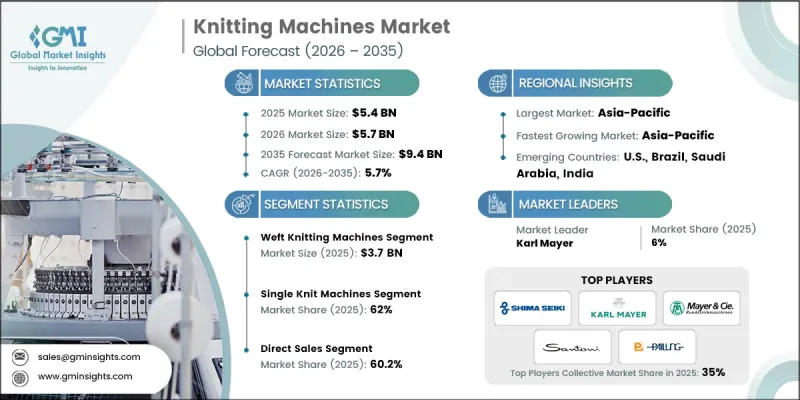
시장 확대는 섬유 산업 전반에 걸쳐 생산 효율성 향상과 원단 품질 향상에 대한 관심이 높아짐에 따라 시장 확대가 이루어지고 있습니다. 각 업체들은 일관된 원단 기준을 유지하면서 보다 빠른 생산을 가능하게 하는 첨단 기계를 우선적으로 도입하고 있습니다. 주요 업계 관계자들간의 제휴 및 인수를 포함한 협업 활동의 확대는 혁신을 가속화하고 제품 개발 역량을 강화하고 있습니다. 이러한 추세는 경쟁 구도를 재편하고 현대화된 생산 시스템 도입을 촉진하고 있습니다. 전통적인 직물 제조 방법은 복잡한 디자인에 대응하고 대규모 생산 요구 사항을 충족시키는 데 한계가 있기 때문에 점차 그 중요성을 잃어가고 있습니다. 대조적으로, 컴퓨터 제어 및 다중 공급 시스템을 갖춘 고급 편직기는 생산 시간과 재료 낭비를 크게 줄입니다. 정확성, 확장성, 비용 효율성을 실현할 수 있는 능력은 섬유 제조 업무 전반에 걸쳐 폭넓은 도입을 촉진하고 있습니다. 고성능 직물에 대한 수요가 지속적으로 증가함에 따라 편직기 시장은 자동화, 유연성, 생산성 향상에 초점을 맞춘 기술 주도형 분야로 진화하고 있습니다.
| 시장 범위 | |
|---|---|
| 시작 연도 | 2025년 |
| 예측 기간 | 2026-2035년 |
| 개시 연도 시장 규모 | 54억 달러 |
| 예측액 | 94억 달러 |
| CAGR | 5.7% |
2025년, 편직기 부문은 시장 점유율의 67.9%를 차지하며 37억 달러 시장 규모를 기록했습니다. 이는 단순한 디자인부터 복잡한 디자인까지 폭넓게 대응하고 다양한 원단 구조를 생산할 수 있는 적응성에 기인합니다. 다양한 생산 요구사항에 효율적으로 대응할 수 있는 능력이 수요를 지속적으로 견인하고 있습니다. 이 부문에서는 2025년 원형 위사 편직기가 시장의 52.1%를 차지했습니다. 이는 연속적인 원단 생산의 효율성과 대량 생산 공정 전반에 걸쳐 품질 일관성을 유지할 수 있는 능력에 힘입은 것입니다.
2025년에는 직접 판매 부문이 60.2%의 점유율을 차지하며 33억 달러 규모에 달했습니다. 이는 기계 조달이 고부가가치 및 맞춤형 특성을 가지고 있기 때문에 구매자는 맞춤형 솔루션을 얻기 위해 제조업체와 직접 상호 작용하는 것을 선호하는 경향이 있습니다. 직접 참여함으로써 기술 요구 사항에 대한 적합성이 향상될 뿐만 아니라 설치 지원, 교육 및 장기 서비스 계약에 대한 접근이 가능해집니다. 이러한 추세는 공급업체가 개별 장비가 아닌 종합적인 생산 솔루션을 제공하는 통합 서비스로의 전환을 반영하고 있습니다.
2025년 미국의 편직기 시장은 82.7%의 점유율을 차지했습니다. 이 지역의 성장은 첨단 섬유 생산에 대한 투자 확대와 자동화 제조 기술의 채택 증가로 뒷받침되고 있습니다. 현지 생산으로의 전환과 고성능 섬유 솔루션에 대한 수요가 최신 편직기 시스템의 도입을 촉진하고 있습니다. 또한, 지속 가능한 제조 방식과 업무 효율성에 대한 집중은 시장 확대의 원동력이 되고 있습니다.
자주 묻는 질문
목차
제1장 조사 방법과 범위
제2장 주요 요약
제3장 업계 인사이트
제4장 경쟁 구도
제5장 시장 추산 및 예측 : 유형별(2022-2035년)
제6장 시장 추산 및 예측 : 니트 유형별(2022-2035년)
제7장 시장 추산 및 예측 : 동작 모드별(2022-2035년)
제8장 시장 추산 및 예측 : 최종 이용 산업별(2022-2035년)
제9장 시장 추산 및 예측 : 유통 채널별(2022-2035년)
제10장 시장 추산 및 예측 : 지역별(2022-2035년)
제11장 기업 개요
KTH 26.05.20The Global Knitting Machines Market was valued at USD 5.4 billion in 2025 and is estimated to grow at a CAGR of 5.7% to reach USD 9.4 billion by 2035.
Market expansion is driven by increasing emphasis on improving production efficiency and enhancing fabric quality across the textile industry. Manufacturers are prioritizing advanced machinery that enables faster output while maintaining consistent fabric standards. Growing collaboration activities, including partnerships and acquisitions among key industry participants, are accelerating innovation and strengthening product development capabilities. These developments are reshaping the competitive landscape and encouraging the adoption of modernized production systems. Traditional fabric manufacturing methods are gradually losing relevance due to their limitations in handling complex designs and large-scale production requirements. In contrast, advanced knitting machines equipped with computerized controls and multi-feed systems significantly reduce production time and material waste. The ability to deliver precision, scalability, and cost efficiency is driving widespread adoption across textile manufacturing operations. As demand for high-performance fabrics continues to grow, the knitting machines market is evolving into a technology-driven sector focused on automation, flexibility, and productivity improvements.
| Market Scope | |
|---|---|
| Start Year | 2025 |
| Forecast Year | 2026-2035 |
| Start Value | $5.4 Billion |
| Forecast Value | $9.4 Billion |
| CAGR | 5.7% |
The weft knitting machines segment accounted for 67.9% share in 2025, generating USD 3.7 billion owing to its adaptability in producing a broad range of fabric structures, supporting both simple and complex designs. Its capability to handle diverse production requirements efficiently continues to drive demand. Within this segment, circular weft knitting machines represented 52.1% of the market in 2025, supported by their efficiency in continuous fabric production and ability to maintain consistency across high-volume manufacturing processes.
The direct sales segment held a 60.2% share in 2025, accounting for USD 3.3 billion, owing to the high-value and customized nature of machinery procurement, where buyers prefer direct interaction with manufacturers for tailored solutions. Direct engagement enables better alignment with technical requirements, as well as access to installation support, training, and long-term service agreements. This trend reflects a shift toward integrated offerings where suppliers provide comprehensive production solutions rather than standalone equipment.
United States Knitting Machines Market accounted for 82.7% share in 2025. Growth in this region is supported by increasing investments in advanced textile production and the rising adoption of automated manufacturing technologies. The shift toward localized production and the demand for high-performance textile solutions are encouraging the use of modern knitting systems. Additionally, the focus on sustainable manufacturing practices and operational efficiency continues to support market expansion.
Key companies operating in the Global Knitting Machines Market include Karl Mayer, Mayer & Cie, Shima Seiki, Lonati, Santoni, Terrot, Orizio, Pai Lung, Fukuhara, Jingwei Textile Machinery, Flying Tiger, Lisky, Hanma (Zhenfu), Lamb, and Tompkins. Companies in the Global Knitting Machines Market are strengthening their competitive position through continuous technological advancement and product innovation. Manufacturers are investing in automation, digital controls, and software integration to enhance machine efficiency and flexibility. Expanding service offerings, including training and maintenance, helps build long-term customer relationships. Strategic collaborations and global distribution expansion are improving market reach. Firms are also focusing on developing energy-efficient and sustainable machinery to meet evolving industry standards. Customization capabilities and integrated production solutions are further enabling companies to address diverse customer needs and maintain a strong foothold in the competitive landscape.
Table of Contents
Chapter 1 Methodology and Scope
- 1.1 Market scope and definition
- 1.2 Research design
- 1.2.1 Research approach
- 1.2.2 Data collection methods
- 1.3 Data mining sources
- 1.3.1 Global
- 1.3.2 Regional/Country
- 1.4 Base estimates and calculations
- 1.4.1 Base year calculation
- 1.4.2 Key trends for market estimation
- 1.5 Primary research and validation
- 1.5.1 Primary sources
- 1.6 Forecast model
- 1.7 Research assumptions and limitations
Chapter 2 Executive Summary
- 2.1 Industry 360° synopsis
- 2.2 Key market trends
- 2.2.1 Regional
- 2.2.2 Type
- 2.2.3 Knit type
- 2.2.4 Mode of operation
- 2.2.5 End use industry
- 2.2.6 Distribution channel
Chapter 3 Industry Insights
- 3.1 Industry ecosystem analysis
- 3.1.1 Supplier landscape
- 3.1.2 Profit margin
- 3.1.3 Value addition at each stage
- 3.1.4 Factor affecting the value chain
- 3.2 Industry impact forces
- 3.2.1 Growth drivers
- 3.2.1.1 Surge in athleisure & sportswear demand
- 3.2.1.2 Automation & industry 4.0 integration
- 3.2.1.3 Reshoring & smart manufacturing
- 3.2.2 Industry pitfalls & challenges
- 3.2.2.1 High CAPEX for advanced machinery
- 3.2.2.2 Volatility in raw material prices
- 3.2.3 Opportunities
- 3.2.3.1 Sustainable "zero-waste" production
- 3.2.3.2 Technical textiles expansion
- 3.2.1 Growth drivers
- 3.3 Growth potential analysis
- 3.4 Future market trends
- 3.5 Technology and innovation landscape
- 3.5.1 Current technological trends
- 3.5.2 Emerging technologies
- 3.6 Price analysis (driven by primary research)
- 3.6.1 Historical price trend analysis
- 3.6.2 Pricing strategy by player type (premium / value / cost-plus)
- 3.6.3 Price variance by machine type & gauge
- 3.6.4 Total cost of ownership analysis
- 3.7 Regulatory landscape
- 3.7.1 Standards and compliance requirements
- 3.7.2 Regional regulatory frameworks
- 3.7.3 Certification standards
- 3.8 Porter's analysis
- 3.9 PESTEL analysis
- 3.10 Trade Data Analysis (Driven by paid database)
- 3.10.1 Import/export volume & value trends by region
- 3.10.2 Key trade corridors & tariff impact
- 3.10.3 Trade flow dynamics (China, Germany, Italy, Japan)
- 3.11 Impact of AI & generative AI on the market
- 3.11.1 AI-driven disruption of traditional knitting operations
- 3.11.2 GenAI use cases & adoption roadmap by segment
- 3.11.2.1 Automated pattern design & customization
- 3.11.2.2 Predictive maintenance & downtime reduction
- 3.11.2.3 Quality control & defect detection
- 3.11.3 Risks, limitations & regulatory considerations
Chapter 4 Competitive Landscape, 2025
- 4.1 Introduction
- 4.2 Company market share analysis
- 4.2.1 By region
- 4.2.1.1 North America
- 4.2.1.2 Europe
- 4.2.1.3 Asia Pacific
- 4.2.1.4 Latin America
- 4.2.1.5 Middle East and Africa
- 4.2.1 By region
- 4.3 Company matrix analysis
- 4.4 Competitive analysis of major market players
- 4.5 Competitive positioning matrix
- 4.6 Key developments
- 4.6.1 Mergers & acquisitions
- 4.6.2 Partnerships & collaborations
- 4.6.3 New product launches
- 4.6.4 Expansion plans
Chapter 5 Market Estimates & Forecast, By Type, 2022 - 2035 (USD Billion) (Thousand Units)
- 5.1 Key trends
- 5.2 Warp knitting machines
- 5.2.1 Raschel warp
- 5.2.2 Tricot warp
- 5.2.3 Others (crochet etc.)
- 5.3 Weft knitting machines
- 5.3.1 Circular
- 5.3.2 Straight bar
- 5.3.3 Others (loop wheel etc.)
Chapter 6 Market Estimates & Forecast, By Knit Type, 2022 - 2035 (USD Billion) (Thousand Units)
- 6.1 Key trends
- 6.2 Single knit
- 6.3 Double knit
Chapter 7 Market Estimates & Forecast, By Mode of Operation, 2022 - 2035 (USD Billion) (Thousand Units)
- 7.1 Key trends
- 7.2 Manual
- 7.3 Semi-automatic
- 7.4 Fully automatic
Chapter 8 Market Estimates & Forecast, By End Use Industry, 2022 - 2035 (USD Billion) (Thousand Units)
- 8.1 Key trends
- 8.2 Automotive textiles
- 8.3 Sports textiles
- 8.4 Apparel textiles
- 8.5 Home textiles
- 8.6 Others (footwear industry etc.)
Chapter 9 Market Estimates & Forecast, By Distribution Channel, 2022 - 2035 (USD Billion) (Thousand Units)
- 9.1 Key trends
- 9.2 Direct sales
- 9.3 Indirect sales
Chapter 10 Market Estimates and Forecast, By Region, 2022 - 2035 (USD Billion) (Thousand Units)
- 10.1 Key trends
- 10.2 North America
- 10.2.1 U.S.
- 10.2.2 Canada
- 10.3 Europe
- 10.3.1 Germany
- 10.3.2 UK
- 10.3.3 France
- 10.3.4 Italy
- 10.3.5 Spain
- 10.4 Asia Pacific
- 10.4.1 China
- 10.4.2 Japan
- 10.4.3 India
- 10.4.4 Australia
- 10.4.5 South Korea
- 10.5 Latin America
- 10.5.1 Brazil
- 10.5.2 Mexico
- 10.5.3 Argentina
- 10.6 Middle East and Africa
- 10.6.1 South Africa
- 10.6.2 Saudi Arabia
- 10.6.3 UAE
Chapter 11 Company Profiles
- 11.1 Flying Tiger
- 11.2 Fukuhara
- 11.3 Hanma (Zhenfu)
- 11.4 Jingwei Textile Machinery
- 11.5 Karl Mayer
- 11.6 Lamb
- 11.7 Lisky
- 11.8 Lonati
- 11.9 Mayer & Cie
- 11.10 Orizio
- 11.11 Pai Lung
- 11.12 Santoni
- 11.13 Shima Seiki
- 11.14 Terrot
- 11.15 Tompkins


