|
시장보고서
상품코드
2038324
승용 전기자동차 시장 : 시장 비즈니스 기회, 성장요인, 업계 동향 분석 및 예측(2026-2035년)Passenger Electric Vehicle Market Opportunity, Growth Drivers, Industry Trend Analysis, and Forecast 2026 - 2035 |
||||||

세계의 승용 전기자동차 시장은 2025년에 7,777억 달러로 평가되었고, CAGR 8.6%로 성장할 전망이며, 2035년까지 1조 7,500억 달러에 이를 것으로 추정되고 있습니다.
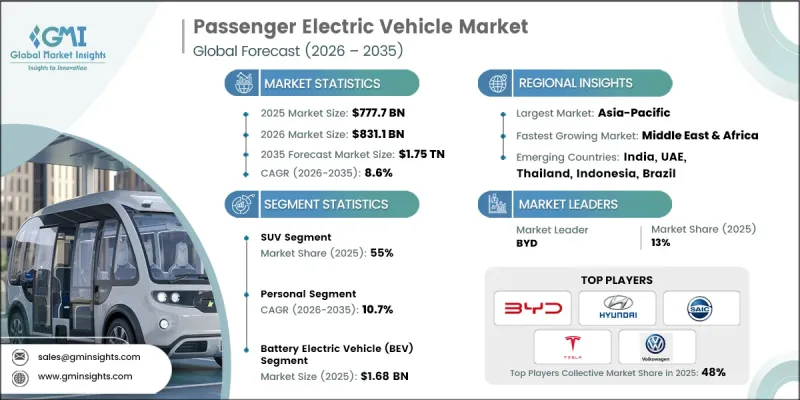
이러한 성장 모멘텀은 배터리 비용의 하락, 차량 성능의 향상, 주요 지역에서의 빠른 충전 인프라 구축에 힘입은 바 큽니다. 자동차 제조업체들은 전용 전기차 플랫폼, 배터리 공급망, 소프트웨어 중심 차량 아키텍처에 대한 투자를 늘리고 있으며, 장기적인 수익이 제한적인 기존 내연기관 기술에 대한 의존도를 낮추고 있습니다. 배출가스 규제에 대한 압박도 이러한 전환을 더욱 가속화하고 있으며, 효율성과 지속가능성에 대한 소비자의 기대가 높아지면서 수요를 더욱 강화하고 있습니다. 배터리 시스템 및 차량 엔지니어링의 지속적인 혁신으로 주행거리, 성능 신뢰성 및 전반적인 소유 경험이 향상되면서 전기 승용차는 미래 모빌리티 생태계의 핵심 구성 요소로 자리매김하고 있습니다.
| 시장 범위 | |
|---|---|
| 개시 연도 | 2025년 |
| 예측 기간 | 2026-2035년 |
| 개시 시점 시장 규모 | 7,777억 달러 |
| 예측 시장 규모 | 1조 7,500억 달러 |
| CAGR | 8.6% |
여러 지역의 정부 규제가 강화되면서 저공해 운송 솔루션으로의 전환이 가속화되고 있습니다. 보조금과 세제 혜택 등 재정적 인센티브는 도입을 촉진하는 데 중요한 역할을 하고 있습니다. 동시에 배터리 기술의 발전으로 에너지 밀도, 비용 효율성 및 전반적인 성능이 향상되어 더 많은 소비자들이 전기자동차를 더 쉽게 이용할 수 있게 되었습니다. 이러한 추세는 경쟁 구도가 심화되고 빠르게 진화하는 시장 상황 형성에 기여하고 있습니다.
승용 전기자동차 시장은 생산 일정과 자재 수급에 영향을 미친 세계 공급망 혼란의 영향도 받고 있습니다. 이러한 문제들로 인해 제조업체들은 현지 조달과 공급망 복원력에 더욱 집중하고 있습니다. 지역 제조 생태계로의 전환은 장기적인 안정성을 강화하고 외부 공급망에 대한 의존도를 낮출 수 있을 것으로 기대됩니다.
SUV 부문은 2025년 55%의 점유율을 차지했으며, 2026-2035년 연평균 9.8%의 성장률을 보일 것으로 전망됩니다. 이 부문은 소비자의 높은 선호도와 제조업체의 유리한 수익률로 인해 지속적으로 성장세를 이어가고 있습니다. 자동차 제조업체들은 변화하는 수요 패턴에 대응하고 수익 잠재력을 극대화하기 위해 전기 SUV 개발에 우선순위를 두고 있으며, 이는 이 부문의 성장을 더욱 촉진하고 있습니다.
개인용 부문은 2025년 82%의 점유율을 차지했으며, 2026-2035년 연평균 복합 성장률(CAGR) 10.7%를 나타낼 것으로 예측됩니다. 가격의 경제성 향상, 모델 선택의 폭 확대, 그리고 정책적 지원책이 개인 소비자의 도입을 촉진하고 있습니다. 운영 비용 절감, 환경 부하 감소, 충전 인프라의 지속적인 개선은 구매 결정에 영향을 미치는 주요 요인으로, 이 부문의 지속적인 성장에 기여하고 있습니다.
중국의 승용 전기차 시장은 2025년 2,849억 달러에 달했으며, 세계 시장에서 확고한 입지를 유지하고 있습니다. 이 나라의 선도적 위치는 광범위한 제조 능력, 거대한 국내 수요 기반 및 국제 시장으로의 전략적 확장에 의해 뒷받침됩니다. 생산 능력과 기술 혁신에 대한 지속적인 투자는 세계 전기자동차 산업을 형성하는 데 있어 중국의 역할을 더욱 강화하고 있습니다.
자주 묻는 질문
목차
제1장 조사 방법 및 범위
제2장 주요 요약
제3장 업계 인사이트
제4장 경쟁 구도
제5장 시장 추산 및 예측 : 차량별(2022-2035년)
제6장 시장 추산 및 예측 : 구동 방식별(2022-2035년)
제7장 시장 추산 및 예측 : 추진력별(2022-2035년)
제8장 시장 추산 및 예측 : 용도별(2022-2035년)
제9장 시장 추산 및 예측 : 가격별(2022-2035년)
제10장 시장 추산 및 예측 : 지역별(2022-2035년)
제11장 기업 개요
AJYThe Global Passenger Electric Vehicle Market was valued at USD 777.7 billion in 2025 and is estimated to grow at a CAGR of 8.6% to reach USD 1.75 trillion by 2035.
Growth momentum is supported by declining battery costs, improved vehicle performance, and the rapid development of charging infrastructure across key regions. Automakers are increasingly allocating investments toward dedicated electric platforms, battery supply chains, and software-centric vehicle architectures, reducing reliance on traditional internal combustion technologies that offer limited long-term returns. Regulatory pressure related to emissions is further accelerating the transition, while evolving consumer expectations around efficiency and sustainability continue to strengthen demand. Continuous innovation in battery systems and vehicle engineering is enhancing driving range, performance reliability, and overall ownership experience, positioning electric passenger vehicles as a central component of the future mobility ecosystem.
| Market Scope | |
|---|---|
| Start Year | 2025 |
| Forecast Year | 2026-2035 |
| Start Value | $777.7 Billion |
| Forecast Value | $1.75 Trillion |
| CAGR | 8.6% |
Government regulations across multiple regions are becoming more stringent, encouraging a shift toward low-emission transportation solutions. Financial incentives, including subsidies and tax benefits, are playing a key role in supporting adoption. At the same time, advancements in battery technologies are improving energy density, cost efficiency, and overall performance, making electric vehicles more accessible to a broader consumer base. These developments are contributing to a more competitive and rapidly evolving market landscape.
The passenger electric vehicle market has also been influenced by disruptions in global supply chains, which have impacted production timelines and material availability. These challenges have encouraged manufacturers to focus more on localized sourcing and supply chain resilience. The transition toward regional manufacturing ecosystems is expected to strengthen long-term stability and reduce dependency on external supply networks.
The SUV segment accounted for 55% share in 2025 and is projected to grow at a CAGR of 9.8% from 2026 to 2035. This segment continues to gain traction due to strong consumer preference and favorable profit margins for manufacturers. Automakers are prioritizing the development of electric SUVs to align with evolving demand patterns and maximize revenue potential, further reinforcing segment growth.
The personal use segment held an 82% share in 2025 and is expected to grow at a CAGR of 10.7% between 2026 and 2035. Increasing affordability, wider model availability, and supportive policy measures are driving adoption among individual consumers. Lower operating costs, reduced environmental impact, and ongoing improvements in charging infrastructure are key factors influencing purchasing decisions, contributing to sustained growth in this segment.
China Passenger Electric Vehicle Market reached USD 284.9 billion in 2025, maintaining a strong position in the global landscape. The country's leadership is supported by its extensive manufacturing capabilities, large domestic demand base, and strategic expansion into international markets. Continuous investments in production capacity and technological innovation are further strengthening its role in shaping the global electric vehicle industry.
Key players operating in the Global Passenger Electric Vehicle Market include Tesla, BYD, Volkswagen, General Motors, Ford, Hyundai, BMW, Mercedes-Benz, SAIC Motor, and Geely. Companies in the Passenger Electric Vehicle Market are reinforcing their competitive position through large-scale investments in research and development, particularly in battery innovation and software integration. They are focusing on expanding electric vehicle portfolios across multiple segments to address diverse consumer needs. Strategic partnerships are being formed to secure battery supply chains and accelerate technological advancements. Manufacturers are also enhancing production capabilities through localized manufacturing to improve efficiency and reduce costs. In addition, companies are strengthening charging infrastructure collaborations and digital ecosystems to improve user experience. Branding strategies emphasize sustainability, performance, and innovation, helping companies attract environmentally conscious consumers while maintaining long-term market relevance.
Table of Contents
Chapter 1 Methodology & Scope
- 1.1 Research approach
- 1.2 Quality Commitments
- 1.2.1 GMI AI policy & data integrity commitment
- 1.2.1.1 Source consistency protocol
- 1.2.1 GMI AI policy & data integrity commitment
- 1.3 Research Trail & Confidence Scoring
- 1.3.1 Research Trail Components
- 1.3.2 Scoring Components
- 1.4 Data Collection
- 1.4.1 Partial list of primary sources
- 1.5 Data mining sources
- 1.5.1 Paid sources
- 1.5.1.1 Sources, by region
- 1.5.1 Paid sources
- 1.6 Base estimates and calculations
- 1.6.1 Base year calculation for any one approach
- 1.7 Forecast
- 1.7.1 Quantified market impact analysis
- 1.7.1.1 Mathematical impact of growth parameters on forecast
- 1.7.1 Quantified market impact analysis
- 1.8 Research transparency addendum
- 1.8.1 Source attribution framework
- 1.8.2 Quality assurance metrics
- 1.8.3 Our commitment to trust
Chapter 2 Executive Summary
- 2.1 Industry 360° synopsis
- 2.2 Key market trends
- 2.2.1 Regional
- 2.2.2 Drive
- 2.2.3 Propulsion
- 2.2.4 Vehicle
- 2.2.5 Application
- 2.2.6 Price
- 2.3 TAM Analysis, 2026-2035
- 2.4 CXO perspectives: Strategic imperatives
Chapter 3 Industry Insights
- 3.1 Industry ecosystem analysis
- 3.1.1 Supplier landscape
- 3.1.1.1 Battery Manufacturer
- 3.1.1.2 Component Supplier
- 3.1.1.3 OEM (Original Equipment Manufacturer)
- 3.1.1.4 Distributor / Dealer
- 3.1.1.5 Battery Manufacturer
- 3.1.1.6 End user
- 3.1.2 Cost structure
- 3.1.3 Profit margin
- 3.1.4 Value addition at each stage
- 3.1.5 Vertical integration trends
- 3.1.6 Disruptors
- 3.1.1 Supplier landscape
- 3.2 Impact on forces
- 3.2.1 Growth drivers
- 3.2.1.1 Strong government incentives, subsidies, and emission regulations
- 3.2.1.2 Continuous decline in battery costs improving EV affordability
- 3.2.1.3 Rapid expansion of public and private charging infrastructure
- 3.2.1.4 Rising environmental awareness and sustainability commitments
- 3.2.2 Industry pitfalls & challenges
- 3.2.2.1 High upfront purchase cost of electric vehicles
- 3.2.2.2 Underdeveloped charging infrastructure in several regions
- 3.2.3 Market opportunities
- 3.2.3.1 Significant untapped growth potential in emerging markets
- 3.2.3.2 Advancements in battery technology and fast charging solutions
- 3.2.1 Growth drivers
- 3.3 Technology trends & innovation ecosystem
- 3.3.1 Current technologies
- 3.3.2 Emerging technologies
- 3.4 Growth potential analysis
- 3.5 Regulatory landscape
- 3.5.1 North America
- 3.5.1.1 Inflation Reduction Act
- 3.5.1.2 Clean Air Act
- 3.5.2 Europe
- 3.5.2.1 European Green Deal
- 3.5.2.2 Euro 7 Emission Standards
- 3.5.3 Asia-Pacific
- 3.5.3.1 New Energy Vehicle (NEV) Credit Policy
- 3.5.3.2 Automotive Industry Standard (AIS) 156
- 3.5.4 Latin America
- 3.5.4.1 Programa Rota 2030
- 3.5.4.2 Mexican NOM Emissions Standards
- 3.5.5 Middle East & Africa
- 3.5.5.1 UAE Net Zero 2050 Strategy
- 3.5.5.2 South Africa Green Transport Strategy
- 3.5.1 North America
- 3.6 Porter's analysis
- 3.7 PESTEL analysis
- 3.8 Patent analysis (Driven by Primary Research)
- 3.9 Pricing Analysis (Driven by Primary Research)
- 3.9.1 Historical Price Trend Analysis
- 3.9.2 Pricing Strategy by Player Type
- 3.10 Capacity & Production Landscape (Driven by Primary Research)
- 3.10.1 Installed Capacity by Region & Key Producer
- 3.10.2 Capacity Utilization Rates & Expansion Pipelines
- 3.11 Trade Data Analysis (Driven by Primary Research)
- 3.11.1 Import/Export Volume & Value Trends
- 3.11.2 Key Trade Corridors & Tariff Impact
- 3.12 Sustainability and environmental aspects
- 3.12.1 Sustainable practices
- 3.12.2 Waste reduction strategies
- 3.12.3 Energy efficiency in production
- 3.12.4 Eco-friendly initiatives
- 3.12.5 Carbon footprint considerations
- 3.13 Impact of AI & generative AI on the market
- 3.13.1 AI-driven disruption of existing business models
- 3.13.2 GenAI use cases & adoption roadmap by segment
- 3.13.3 Risks, limitations & regulatory considerations
- 3.14 Forecast assumptions & scenario analysis (Driven by Primary Research)
- 3.14.1 Base Case - key macro & industry variables driving CAGR
- 3.14.2 Optimistic Scenarios - Favorable Macro and Industry Tailwinds
- 3.14.3 Pessimistic Scenario - Macroeconomic slowdown or industry headwinds
Chapter 4 Competitive Landscape, 2025
- 4.1 Introduction
- 4.2 Company market share analysis
- 4.2.1 North America
- 4.2.2 Europe
- 4.2.3 Asia Pacific
- 4.2.4 Latin America
- 4.2.5 MEA
- 4.3 Competitive analysis of major market players
- 4.4 Competitive positioning matrix
- 4.5 Company Tier Benchmarking
- 4.5.1 Tier Classification Criteria & Qualifying Thresholds
- 4.5.2 Tier Positioning Matrix by Revenue, Geography & Innovation
- 4.6 Key developments
- 4.6.1 Mergers & acquisitions
- 4.6.2 Partnerships & collaborations
- 4.6.3 New product launches
- 4.6.4 Expansion plans and funding
Chapter 5 Market Estimates & Forecast, By Vehicle, 2022 - 2035 ($ Bn, Units)
- 5.1 Key trends
- 5.2 Hatchback
- 5.3 Sedan
- 5.4 SUV
- 5.5 Others
Chapter 6 Market Estimates & Forecast, By Drive , 2022 - 2035 ($ Bn, Units)
- 6.1 Key trends
- 6.2 Front-wheel drive
- 6.3 Rear-wheel drive
- 6.4 All-wheel drive
Chapter 7 Market Estimates & Forecast, By Propulsion, 2022 - 2035 ($ Bn, Units)
- 7.1 Key trends
- 7.2 Battery Electric Vehicle (BEV)
- 7.3 Fuel Cell Electric Vehicle (FCEV)
- 7.4 Plug-in Hybrid Electric Vehicle (PHEV)
Chapter 8 Market Estimates & Forecast, By Application, 2022 - 2035 ($ Bn, Units)
- 8.1 Key trends
- 8.2 Personal
- 8.3 Commercial
Chapter 9 Market Estimates & Forecast By Price, 2022 - 2035 ($ Bn, Units)
- 9.1 Key trends
- 9.2 Entry
- 9.3 Mid-Range
- 9.4 Luxury
Chapter 10 Market Estimates & Forecast, By Region, 2022 - 2035 ($ Bn, Units)
- 10.1 Key trends
- 10.2 North America
- 10.2.1 US
- 10.2.2 Canada
- 10.3 Europe
- 10.3.1 UK
- 10.3.2 Germany
- 10.3.3 France
- 10.3.4 Italy
- 10.3.5 Spain
- 10.3.6 Belgium
- 10.3.7 Netherlands
- 10.3.8 Sweden
- 10.3.9 Russia
- 10.4 Asia Pacific
- 10.4.1 China
- 10.4.2 India
- 10.4.3 Japan
- 10.4.4 Australia
- 10.4.5 Singapore
- 10.4.6 South Korea
- 10.4.7 Vietnam
- 10.4.8 Indonesia
- 10.5 Latin America
- 10.5.1 Brazil
- 10.5.2 Mexico
- 10.5.3 Argentina
- 10.6 MEA
- 10.6.1 South Africa
- 10.6.2 Saudi Arabia
- 10.6.3 UAE
Chapter 11 Company Profiles
- 11.1 Global players
- 11.1.1 Audi
- 11.1.2 BMW
- 11.1.3 Ford
- 11.1.4 General Motors
- 11.1.5 Hyundai
- 11.1.6 Kia
- 11.1.7 Mercedes-Benz
- 11.1.8 Nissan
- 11.1.9 Renault
- 11.1.10 Tesla
- 11.1.11 Toyota
- 11.1.12 Volkswagen
- 11.2 Regional players
- 11.2.1 BYD
- 11.2.2 Chery
- 11.2.3 Geely
- 11.2.4 JAC Motors
- 11.2.5 SAIC Motor
- 11.3 Emerging players
- 11.3.1 Chery Automobile
- 11.3.2 Great Wall Motors
- 11.3.3 Quantum Motors