|
시장보고서
상품코드
2038353
펨테크 시장 : 시장 기회, 성장요인, 업계 동향 분석 및 예측(2026-2035년)Femtech Market Opportunity, Growth Drivers, Industry Trend Analysis, and Forecast 2026 - 2035 |
||||||

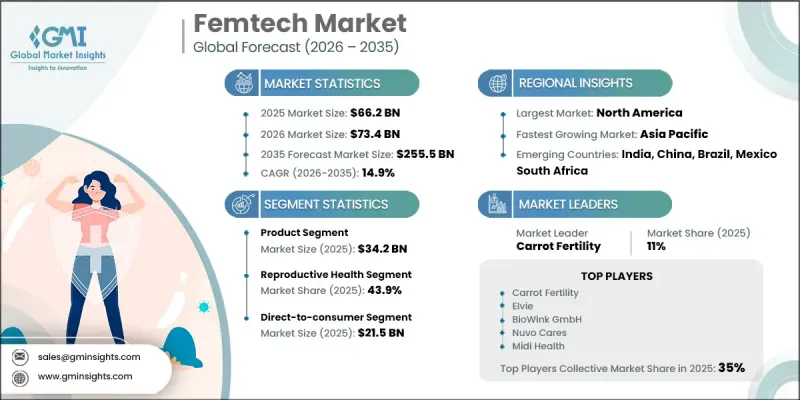
세계의 펨테크 시장은 2025년에 662억 달러로 평가되었고, CAGR 14.9%로 성장할 전망이며, 2035년까지 2,555억 달러에 이를 것으로 예측됩니다.
이러한 시장 확대는 특히 선진국을 중심으로 여성 건강 관리에 디지털 기술이 통합되고 있는 추세에 크게 영향을 받고 있습니다. 스마트폰의 높은 보급률, 인터넷 연결의 광범위한 보급, 그리고 성숙한 디지털 건강 인프라로 인해 여성들은 삶의 다양한 단계에서 자신의 건강을 적극적으로 관리할 수 있게 되었습니다. 생리주기 추적, 임신 계획, 임신 과정 모니터링, 갱년기 지원, 다낭성난소증후군(PCOS) 및 자궁내막증과 같은 만성질환 관리를 위한 모바일 건강 앱, 웨어러블 기기 및 커넥티드 디지털 플랫폼의 채택이 빠르게 증가하고 있습니다. 건강에 대한 인식이 높아지고 개인화된 데이터 기반 헬스케어 접근 방식에 대한 선호도가 높아짐에 따라 선진국에서 시장 침투가 더욱 가속화되고 있습니다. 이러한 디지털 솔루션은 실시간 건강 추적, 예측적 인사이트, 근거에 기반한 추천을 통해 사용자에게 조기 발견, 예방 의료, 치료 효율을 향상시키는 데 도움을 줍니다. 또한 인공지능, 원격의료 서비스, 원격 모니터링 시스템의 통합으로 임상적 의사결정을 개선하는 동시에 기존의 대면 진료에 대한 의존도를 낮추고 있습니다. 지원적인 규제 환경, 디지털 헬스 스타트업에 대한 투자 확대, 가상 의료 제공 모델의 광범위한 수용은 전체 시장의 발전을 촉진하고 있습니다. 의료 시스템이 예방 의료와 환자 중심 치료 모델을 점점 더 중요시하는 가운데, 펨테크 솔루션은 현대 의료 제공의 핵심 요소로 자리 잡고 있으며, 디지털 혁신이 주요 촉진제로서 그 중요성이 더욱 커지고 있습니다.
| 시장 범위 | |
|---|---|
| 개시 연도 | 2025년 |
| 예측 기간 | 2026-2035년 |
| 개시 연도 시장 규모 | 662억 달러 |
| 예측 시장 규모 | 2,555억 달러 |
| CAGR | 14.9% |
생식 건강 부문은 43.9%를 차지했으며, 2025년 291억 달러에 달했습니다. 이 부문은 생리 관리, 불임 치료 지원, 임신 관리, 산후 모니터링, 갱년기 관련 솔루션 등 필수적인 헬스케어 니즈를 폭넓게 다루고 있어 펨테크 시장을 주도하고 있습니다. 이러한 요구는 여성의 일생 동안 반복적으로 발생하기 때문에 모니터링, 예방, 정보에 입각한 의사결정을 지원하는 디지털 건강 도구에 대한 수요가 지속되고 있습니다. 개인화된 예방적 생식 건강 관리에 대한 관심이 높아지면서 이 부문의 성장이 더욱 가속화되고 있습니다. 펨테크 플랫폼은 생리주기 추적, 가임력 최적화, 임신 중 모니터링, 산후 관리 등에 널리 활용되고 있으며, 데이터에 기반한 인사이트를 제공함으로써 사용자가 보다 주체적이고 효율적으로 자신의 생식 건강을 관리할 수 있도록 돕고 있습니다.
D2C(소비자 직접 판매) 부문은 2025년 215억 달러 시장 규모를 창출했습니다. 소비자들이 개인의 필요와 취향에 맞는 헬스케어 솔루션을 점점 더 많이 요구함에 따라 이 분야는 계속 확대되고 있습니다. 펨테크 제공업체들은 D2C 채널을 통해 생리 건강, 가임력 관리, 갱년기 관리, 만성질환 모니터링에 초점을 맞춘 맞춤형 디지털 제품을 제공함으로써 이러한 수요에 대응하고 있습니다. 사용자 생성 건강 데이터를 활용함으로써 각 기업은 지속적으로 솔루션을 개선하고 개인화를 향상시키며, 제품 전반의 효율성을 높여 소비자 만족도와 충성도를 높이는 데 기여하고 있습니다.
2025년 북미의 펨테크 시장은 32.4%의 점유율을 차지했습니다. 이 지역의 성장은 스마트폰, 웨어러블 기술, 첨단 디지털 헬스 플랫폼의 높은 보급률에 힘입어 여성들의 건강 관리를 혁신적으로 변화시키고 있습니다. 펨테크 솔루션은 생리주기 추적, 임신 계획, 임신 과정 모니터링, 갱년기 관리 등에 널리 활용되고 있으며, 지속적인 참여와 건강 인식 향상을 가능하게 합니다. 인공지능(AI)을 활용한 분석, 원격의료 플랫폼, 원격 모니터링 도구의 통합을 통해 보다 개인화된 예방 의료 서비스를 제공합니다. 이러한 기술은 조기 진단을 촉진하고, 잦은 병원 방문의 필요성을 줄이며, 치료 계획의 순응도를 향상시켜 의료 시스템의 효율성을 높이는 데 기여하고 있습니다.
자주 묻는 질문
목차
제1장 조사 방법
제2장 주요 요약
제3장 업계 인사이트
제4장 경쟁 구도
제5장 시장 추산 및 예측 : 유형별(2022-2035년)
제6장 시장 추산 및 예측 : 용도별(2022-2035년)
제7장 시장 추산 및 예측 : 최종 용도별(2022-2035년)
제8장 시장 추산 및 예측 : 지역별(2022-2035년)
제9장 기업 개요
AJY 26.06.11The Global Femtech Market was valued at USD 66.2 billion in 2025 and is estimated to grow at a CAGR of 14.9% to reach USD 255.5 billion by 2035.
The expansion of the market is strongly influenced by the increasing integration of digital technologies into women's healthcare management, particularly across developed economies. High smartphone usage, widespread internet connectivity, and a mature digital health infrastructure are enabling women to actively engage in managing their health across different stages of life. The adoption of mobile health applications, wearable devices, and connected digital platforms is growing rapidly for menstrual tracking, fertility planning, pregnancy monitoring, menopause support, and management of chronic conditions such as PCOS and endometriosis. Rising health awareness and a growing preference for personalized and data-driven healthcare approaches are further accelerating market penetration in advanced economies. These digital solutions are empowering users with real-time health tracking, predictive insights, and evidence-based recommendations that enhance early detection, preventive care, and treatment efficiency. The integration of artificial intelligence, telehealth services, and remote monitoring systems is also improving clinical decision-making while reducing dependence on traditional in-person consultations. Supportive regulatory environments, increasing investment in digital health startups, and broader acceptance of virtual healthcare delivery models are strengthening overall market development. As healthcare systems increasingly prioritize preventive and patient-centric care models, femtech solutions are becoming a core component of modern healthcare delivery, reinforcing the importance of digital innovation as a key growth driver.
| Market Scope | |
|---|---|
| Start Year | 2025 |
| Forecast Year | 2026-2035 |
| Start Value | $66.2 Billion |
| Forecast Value | $255.5 Billion |
| CAGR | 14.9% |
The reproductive health segment held a 43.9%, reaching USD 29.1 billion in 2025. This segment leads the femtech market due to its wide-ranging coverage of essential healthcare needs, including menstruation management, fertility support, pregnancy care, postpartum monitoring, and menopause-related solutions. These needs occur repeatedly throughout a woman's life, ensuring sustained demand for digital health tools that support monitoring, prevention, and informed decision-making. Increasing preference for personalized and preventive reproductive healthcare is further strengthening segment growth. Femtech platforms are widely used for cycle tracking, fertility optimization, prenatal monitoring, and postnatal care, delivering data-backed insights that help users manage their reproductive health more proactively and efficiently.
The direct-to-consumer segment generated USD 21.5 billion in 2025. The segment continues to expand as consumers increasingly demand healthcare solutions tailored to individual needs and preferences. Femtech providers are meeting this demand by offering customized digital products focused on menstrual health, fertility management, menopause care, and chronic condition monitoring through direct-to-consumer channels. By utilizing user-generated health data, companies are continuously refining their solutions, improving personalization, and enhancing overall product effectiveness, which contributes to stronger consumer satisfaction and loyalty.
North America Femtech Market accounted for 32.4% share in 2025. The region's growth is supported by high adoption of smartphones, wearable technologies, and advanced digital health platforms that have transformed women's healthcare management. Femtech solutions are widely applied for menstrual tracking, fertility planning, pregnancy monitoring, and menopause management, enabling continuous engagement and improved health awareness. The integration of artificial intelligence-driven analytics, telehealth platforms, and remote monitoring tools supports more personalized and preventive care delivery. These technologies also facilitate early diagnosis, reduce the need for frequent hospital visits, and improve adherence to treatment plans, contributing to greater efficiency in healthcare systems.
Key players operating in the Global Femtech Industry include Athena Feminine Technologies, Amara Therapeutics, Baby Billy, BioWink GmbH, Carrot Fertility, Cofertility, Conceivable, Inc., Elvie, HeraMED, iSono Health, Midi Health, Minerva Surgical, Nuvo Cares, Sera Prognostics, Trellis Health, and Univfy. Companies in the global femtech market are focusing on expanding digital ecosystems through partnerships with healthcare providers, insurers, and technology firms to enhance service integration. They are investing heavily in artificial intelligence, predictive analytics, and data-driven platforms to improve personalization and clinical accuracy. Product diversification across menstrual health, fertility, pregnancy, and menopause care is being prioritized to address a broader user base. Many players are strengthening their direct-to-consumer models by enhancing mobile app experiences and improving user engagement through personalized recommendations. Strategic funding in digital health startups is supporting innovation and faster market expansion.
Table of Contents
Chapter 1 Research Methodology
- 1.1 Research approach
- 1.2 Quality commitments
- 1.2.1 GMI AI policy & data integrity commitment
- 1.2.1.1 Source consistency protocol
- 1.2.1 GMI AI policy & data integrity commitment
- 1.3 Research trail & confidence scoring
- 1.3.1 Research trail components
- 1.3.2 Scoring components
- 1.4 Data collection
- 1.4.1 Partial list of primary sources
- 1.5 Data mining sources
- 1.5.1 Paid sources
- 1.5.1.1 Sources, by region
- 1.5.1 Paid sources
- 1.6 Base estimates and calculations
- 1.6.1 Base year calculation for any one approach
- 1.7 Forecast model
- 1.7.1 Quantified market impact analysis
- 1.7.1.1 Mathematical impact of growth parameters on forecast
- 1.7.1 Quantified market impact analysis
- 1.8 Research transparency addendum
- 1.8.1 Source attribution framework
- 1.8.2 Quality assurance metrics
- 1.8.3 Our commitment to trust
Chapter 2 Executive Summary
- 2.1 Industry 3600 synopsis
- 2.2 Key market trends
- 2.2.1 Type trends
- 2.2.2 Application trends
- 2.2.3 End Use trends
- 2.2.4 Regional trends
- 2.3 CXO perspectives: Strategic imperatives
Chapter 3 Industry Insights
- 3.1 Industry ecosystem analysis
- 3.2 Industry impact forces
- 3.2.1 Growth drivers
- 3.2.1.1 Usage of digital technology to manage women health in developed countries
- 3.2.1.2 Improving access to women care in remote areas
- 3.2.1.3 Growing awareness regarding women health and wellness in developing countries
- 3.2.1.4 Increasing burden of chronic and infectious diseases among the female population
- 3.2.2 Industry pitfalls and challenges
- 3.2.2.1 Growing investments in femtech industry
- 3.2.2.2 Lack of awareness about femtech products and applications
- 3.2.3 Market opportunities
- 3.2.3.1 Corporate wellness and employer-sponsored programs
- 3.2.1 Growth drivers
- 3.3 Growth potential analysis
- 3.4 Regulatory landscape (Driven by primary research)
- 3.4.1 North America
- 3.4.2 Europe
- 3.4.3 Asia Pacific
- 3.4.4 Latin America
- 3.4.5 Middle East and Africa
- 3.5 Technology landscape (Driven by primary research)
- 3.5.1 Current technological trends
- 3.5.1.1 Wearable and sensor based femtech devices
- 3.5.1.2 Advanced imaging & minimally invasive women’s health technologies
- 3.5.2 Emerging technologies
- 3.5.2.1 Next-generation AI & machine learning
- 3.5.2.2 Digital twin technology for women's health
- 3.5.1 Current technological trends
- 3.6 Future market trends (Driven by primary research)
- 3.7 Impact of AI and Generative AI on the market (Driven by primary research)
- 3.8 Pricing analysis, 2025 (Driven by primary research)
- 3.9 Porter's analysis
- 3.10 PESTEL analysis
Chapter 4 Competitive Landscape, 2025
- 4.1 Introduction
- 4.2 Company market share analysis
- 4.2.1 Global
- 4.2.2 North America
- 4.2.3 Europe
- 4.2.4 Asia Pacific
- 4.3 Company matrix analysis
- 4.4 Competitive analysis of major market players
- 4.5 Competitive positioning matrix
- 4.6 Key developments
- 4.6.1 Mergers and acquisitions
- 4.6.2 Partnerships and collaborations
- 4.6.3 New product launches
- 4.6.4 Expansion plans
Chapter 5 Market Estimates and Forecast, By Type, 2022 - 2035 ($ Mn)
- 5.1 Key trends
- 5.2 Products
- 5.3 Software
- 5.4 Services
Chapter 6 Market Estimates and Forecast, By Application, 2022 - 2035 ($ Mn)
- 6.1 Key trends
- 6.2 Reproductive health
- 6.2.1 Menstrual cycle and fertility
- 6.2.2 Menopause
- 6.3 Pregnancy care
- 6.4 Maternal/post-partum and nursing care
- 6.5 Integrative physical and mental health & overall well-being
- 6.6 Other applications
Chapter 7 Market Estimates and Forecast, By End Use, 2022 - 2035 ($ Mn)
- 7.1 Key trends
- 7.2 Direct-to-consumer
- 7.3 Hospitals
- 7.4 Fertility clinics
- 7.5 Surgical centers
- 7.6 Diagnostic centers
- 7.7 Other end users
Chapter 8 Market Estimates and Forecast, By Region, 2022 - 2035 ($ Mn)
- 8.1 Key trends
- 8.2 North America
- 8.2.1 U.S.
- 8.2.2 Canada
- 8.3 Europe
- 8.3.1 Germany
- 8.3.2 UK
- 8.3.3 France
- 8.3.4 Spain
- 8.3.5 Italy
- 8.3.6 Netherlands
- 8.4 Asia Pacific
- 8.4.1 China
- 8.4.2 Japan
- 8.4.3 India
- 8.4.4 Australia
- 8.4.5 South Korea
- 8.5 Latin America
- 8.5.1 Brazil
- 8.5.2 Mexico
- 8.5.3 Argentina
- 8.6 Middle East and Africa
- 8.6.1 South Africa
- 8.6.2 Saudi Arabia
- 8.6.3 UAE
Chapter 9 Company Profiles
- 9.1 Amara Therapeutics
- 9.2 Athena Feminine Technologies
- 9.3 Baby Billy
- 9.4 BioWink GmbH
- 9.5 Carrot Fertility
- 9.6 Cofertility
- 9.7 Conceivable, Inc.
- 9.8 Elvie
- 9.9 HeraMED
- 9.10 iSono Health
- 9.11 Midi Health
- 9.12 Minerva Surgical
- 9.13 Nuvo Cares
- 9.14 Sera Prognostics
- 9.15 Trellis Health
- 9.16 Univfy