

|
시장보고서
상품코드
2038354
치과용 흡인 시스템 시장 : 시장 기회, 성장요인, 업계 동향 분석 및 예측(2026-2035년)Dental Suction Systems Market Opportunity, Growth Drivers, Industry Trend Analysis, and Forecast 2026 - 2035 |
||||||

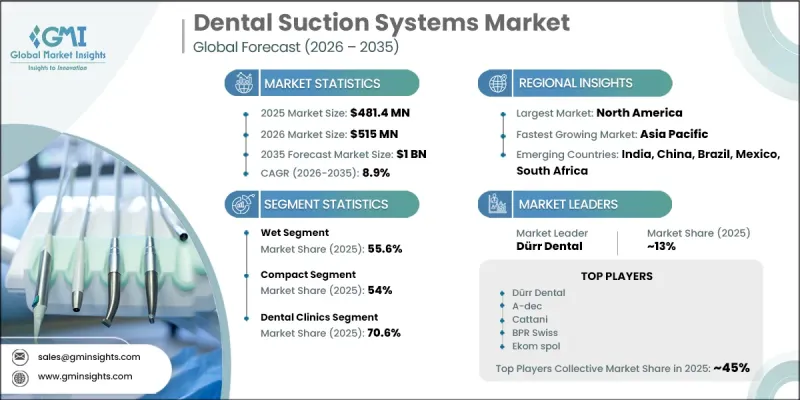
세계의 치과용 흡인 시스템 시장은 2025년에 4억 8,140만 달러로 평가되었고, 2035년까지 연평균 복합 성장률(CAGR) 8.9%로 성장할 전망이며, 10억 달러에 이를 것으로 추정되고 있습니다.
이 시장은 효과적인 치과 폐기물 관리 솔루션에 대한 관심 증가와 치과 시설 전반의 위생 및 감염 관리 기준을 엄격하게 준수하는 추세에 따라 지속적으로 확대되고 있습니다. 환자의 편의성 향상과 치료 경험 개선에 대한 수요 증가도 클리닉과 병원에서의 도입을 더욱 촉진하고 있습니다. 또한, 지속적인 기술 발전은 업계 상황을 새롭게 바꾸고 있으며, 스마트 흡입 장치, 자동 세척 메커니즘, 흡입 효율 향상 등이 업무 성과를 주도하고 있습니다. 디지털 모니터링 시스템 도입으로 흡입 과정과 폐기물 처리 관리가 개선되어 보다 안전하고 효율적인 치과 치료를 지원합니다. 특히 개발도상국의 치과 인프라에 대한 투자 확대도 시장 침투를 촉진하고 있습니다. 전반적으로 이 산업은 효율성, 안전성, 현대화에 중점을 두고 발전하고 있으며, 이는 세계 시장 전체에서 장기적인 성장 모멘텀을 유지할 것으로 예측됩니다.
| 시장 범위 | |
|---|---|
| 개시 연도 | 2025년 |
| 예측 기간 | 2026-2035년 |
| 개시 시점 시장 규모 | 4억 8,140만 달러 |
| 예측 시장 규모 | 10억 달러 |
| CAGR | 8.9% |
2025년 습식 방식은 강력한 흡입력, 경제적인 운영, 중소형 치과에서 광범위한 보급으로 인해 시장 점유율 55.6%를 차지했습니다. 이 시스템은 치과 치료 중 타액, 혈액, 기타 잔여물을 효율적으로 제거하기 위해 연속적인 물의 흐름을 이용하며, 이를 통해 감염 관리를 크게 강화하여 위생적인 진료 환경을 유지합니다. 환자의 안전을 보장하면서 안정적인 성능을 발휘하는 능력으로 치과 의료진들 사이에서 높은 지지를 받고 있습니다. 또한, 습식 흡입 시스템은 다른 기술에 비해 도입 및 유지 관리 비용이 상대적으로 저렴하여 비용 효율적인 선택이 될 수 있습니다. 물을 이용한 작동으로 인한 기계적 마모 감소는 장기적인 유지보수 비용을 더욱 절감하여 지속적인 채택에 기여하고 있습니다.
컴팩트 부문은 2025년 54%의 점유율을 차지했으며, 6억 1,380만 달러 규모에 도달했습니다. 공간 절약형 치과 장비에 대한 수요 증가가 이 부문의 성장을 이끄는 주요 요인으로 작용하고 있습니다. 특히 진료 공간이 한정된 도시 지역에서는 현대 치과에서 과도한 공간을 차지하지 않으면서도 높은 성능을 발휘할 수 있는 컴팩트한 흡인 시스템이 점점 더 선호되고 있습니다. 이러한 시스템들은 장비의 어수선함을 줄이는 동시에 워크플로우의 효율성을 향상시키고, 사용 가능한 진료 공간을 보다 효율적으로 활용할 수 있게 해줍니다. 간소화된 설계로 설치와 통합이 용이하며, 업무 최적화에 중점을 둔 현대 치과 진료소에 매우 적합합니다.
북미의 치과용 흡인 시스템 시장은 2025년 1억 1,120만 달러 규모에 달했습니다. 이 지역, 특히 미국과 캐나다에서는 첨단 치과 기술이 널리 보급되어 있으며, 치과 시설에서 고성능 흡인 시스템 도입이 진행되고 있습니다. 팬데믹 이후 감염 예방과 위생 관리에 대한 인식이 높아지면서 제품 수요가 크게 증가하고 있습니다. 또한, 기존 치과 네트워크와 전문 클리닉의 존재는 기존 장비에서 첨단 자동화된 흡입 시스템으로 교체하는 것을 계속 촉진하고 있으며, 이는 시장 확대를 더욱 가속화시키고 있습니다.
자주 묻는 질문
목차
제1장 조사 방법
제2장 주요 요약
제3장 업계 인사이트
제4장 경쟁 구도
제5장 시장 추산 및 예측 : 유형별(2022-2035년)
제6장 시장 추산 및 예측 : 설계별(2022-2035년)
제7장 시장 추산 및 예측 : 최종 용도별(2022-2035년)
제8장 시장 추산 및 예측 : 지역별(2022-2035년)
제9장 기업 개요
AJY 26.06.11The Global Dental Suction Systems Market was valued at USD 481.4 million in 2025 and is estimated to grow at a CAGR of 8.9% to reach USD 1 billion by 2035.
The market is witnessing expansion due to the rising emphasis on effective dental waste management solutions and strict adherence to hygiene and infection control standards across dental facilities. Growing demand for improved patient comfort and enhanced procedural experiences is further reinforcing adoption across clinics and hospitals. In addition, continuous technological progress is reshaping the industry landscape, with smart suction devices, automated cleaning mechanisms, and improved suction efficiency driving operational performance. The integration of digital monitoring systems enables better control over suction processes and waste handling, supporting safer and more efficient dental procedures. Increasing investments in dental infrastructure, especially across developing regions, are also strengthening market penetration. Overall, the industry is evolving with a strong focus on efficiency, safety, and modernization, which is expected to sustain long-term growth momentum across global markets.
| Market Scope | |
|---|---|
| Start Year | 2025 |
| Forecast Year | 2026-2035 |
| Start Value | $ 481.4 Million |
| Forecast Value | $1 Billion |
| CAGR | 8.9% |
The wet segment accounted for a 55.6% share in 2025, owing to its strong suction capability, economical operation, and wide acceptance in small and mid-sized dental clinics. These systems function by using a continuous water flow to efficiently remove saliva, blood, and other debris during dental procedures, which significantly enhances infection control and maintains a hygienic clinical environment. Their ability to ensure consistent performance while maintaining patient safety has made them highly preferred among dental professionals. Additionally, wet suction systems are relatively more affordable to install and maintain when compared to alternative technologies, making them a cost-efficient choice. Lower mechanical wear due to water-assisted operation further reduces long-term maintenance expenses, contributing to their sustained adoption.
The compact segment held a 54% share in 2025 and is projected to generate USD 613.8 million. Rising demand for space-efficient dental equipment is a key factor driving this segment's growth. Modern dental clinics, particularly in urban areas with limited operational space, increasingly favor compact suction systems for their ability to deliver high performance without occupying excessive room. These systems help reduce equipment clutter while improving workflow efficiency and enabling better utilization of available clinic space. Their streamlined design supports easy installation and integration, making them highly suitable for contemporary dental practices focused on operational optimization.
North America Dental Suction Systems Market generated USD 111.2 million in 2025. The region benefits from widespread adoption of advanced dental technologies, particularly across the United States and Canada, where dental facilities are increasingly incorporating high-performance suction systems. Strong emphasis on infection prevention and hygiene management, especially following heightened awareness after the pandemic period, has significantly boosted product demand. Additionally, the presence of well-established dental networks and specialty clinics continues to support the replacement of traditional equipment with advanced and automated suction systems, further accelerating market expansion.
Key players operating in the Global Dental Suction Systems Market include BPR Swiss, Vaniman Manufacturing, TBH GmbH, ROSON Medical Equipment, Ekom spol, Metasys Dental, Dental International, Durr Dental, Cattani, BaseVac Dental, Tangshan UMG Medical Instrument, Prestige Medical, Eurocompress, Ajax Medical Group, and A-dec. Companies in the Dental Suction Systems Market are actively focusing on strengthening their market position through product innovation, technological upgrades, and enhanced system efficiency. Many are investing in smart and automated suction technologies that improve operational precision and reduce maintenance requirements. Strategic partnerships and collaborations with dental clinics and distributors are helping expand geographic reach and customer base. Manufacturers are also prioritizing research and development to introduce energy-efficient and compact designs that cater to modern clinical needs. In addition, competitive pricing strategies, after-sales support services, and customization options are being used to improve customer retention and brand loyalty.
Table of Contents
Chapter 1 Research Methodology
- 1.1 Research approach
- 1.2 Quality commitments
- 1.2.1 GMI AI policy & data integrity commitment
- 1.2.1.1 Source consistency protocol
- 1.2.1 GMI AI policy & data integrity commitment
- 1.3 Research trail & confidence scoring
- 1.3.1 Research trail components
- 1.3.2 Scoring components
- 1.4 Data collection
- 1.4.1 Partial list of primary sources
- 1.5 Data mining sources
- 1.5.1 Paid sources
- 1.5.1.1 Sources, by region
- 1.5.1 Paid sources
- 1.6 Base estimates and calculations
- 1.6.1 Base year calculation for any one approach
- 1.7 Forecast model
- 1.7.1 Quantified market impact analysis
- 1.7.1.1 Mathematical impact of growth parameters on forecast
- 1.7.1 Quantified market impact analysis
- 1.8 Research transparency addendum
- 1.8.1 Source attribution framework
- 1.8.2 Quality assurance metrics
- 1.8.3 Our commitment to trust
Chapter 2 Executive Summary
- 2.1 Industry 3600 synopsis
- 2.2 Key market trends
- 2.2.1 Regional trends
- 2.2.2 Type trends
- 2.2.3 Design trends
- 2.2.4 End use trends
- 2.3 CXO perspectives: Strategic imperatives
Chapter 3 Industry Insights
- 3.1 Industry ecosystem analysis
- 3.2 Industry impact forces
- 3.2.1 Growth drivers
- 3.2.1.1 Increased awareness about oral hygiene and dental health
- 3.2.1.2 Technological advancements in dental suction systems
- 3.2.1.3 Growing aging population leading to higher demand for dental procedures
- 3.2.2 Industry pitfalls and challenges
- 3.2.2.1 Limited access to dental care in developing regions
- 3.2.3 Market opportunities
- 3.2.3.1 Integration of smart and IoT-enabled suction systems
- 3.2.3.2 Increasing demand for portable and mobile dental suction units
- 3.2.1 Growth drivers
- 3.3 Growth potential analysis
- 3.4 Regulatory landscape (Driven by primary research)
- 3.4.1 North America
- 3.4.2 Europe
- 3.4.3 Asia Pacific
- 3.5 Technology landscape
- 3.5.1 Current technological trends
- 3.5.2 Emerging technologies
- 3.6 Future market trends (Driven by primary research)
- 3.7 Porter's analysis
- 3.8 PESTEL analysis
- 3.9 Pricing analysis, 2025
- 3.10 Customer insights (Driven by primary research)
- 3.11 Start-up scenarios (Driven by primary research)
- 3.12 Impact of AI & generative AI on the market
- 3.13 Investment & funding analysis
- 3.14 Gap analysis
Chapter 4 Competitive Landscape, 2025
- 4.1 Introduction
- 4.2 Company matrix analysis
- 4.3 Company market share analysis (Driven by primary research)
- 4.3.1 Global
- 4.3.2 North America
- 4.3.3 Europe
- 4.3.4 Asia Pacific
- 4.4 Competitive positioning matrix
- 4.5 Competitive analysis of major market players
- 4.6 Key developments
- 4.6.1 Mergers & acquisitions
- 4.6.2 Partnerships & collaborations
- 4.6.3 New product launches
- 4.6.4 Expansion plans
Chapter 5 Market Estimates and Forecast, By Type, 2022 - 2035 ($ Mn)
- 5.1 Key trends
- 5.2 Wet
- 5.3 Dry
Chapter 6 Market Estimates and Forecast, By Design, 2022 - 2035 ($ Mn)
- 6.1 Key trends
- 6.2 Compact
- 6.3 Standalone
Chapter 7 Market Estimates and Forecast, By End Use, 2022 - 2035 ($ Mn)
- 7.1 Key trends
- 7.2 Dental clinics
- 7.3 Hospitals
Chapter 8 Market Estimates and Forecast, By Region, 2022 - 2035 ($ Mn)
- 8.1 Key trends
- 8.2 North America
- 8.2.1 U.S.
- 8.2.2 Canada
- 8.3 Europe
- 8.3.1 Germany
- 8.3.2 UK
- 8.3.3 France
- 8.3.4 Spain
- 8.3.5 Italy
- 8.3.6 Netherlands
- 8.4 Asia Pacific
- 8.4.1 China
- 8.4.2 Japan
- 8.4.3 India
- 8.4.4 Australia
- 8.4.5 South Korea
- 8.5 Latin America
- 8.5.1 Brazil
- 8.5.2 Mexico
- 8.5.3 Argentina
- 8.6 Middle East and Africa
- 8.6.1 South Africa
- 8.6.2 Saudi Arabia
- 8.6.3 UAE
Chapter 9 Company Profiles
- 9.1 A-dec
- 9.2 Ajax Medical Group
- 9.3 BaseVac Dental
- 9.4 BPR Swiss
- 9.5 Cattani
- 9.6 Metasys Dental
- 9.7 Dental International
- 9.8 Durr Dental
- 9.9 Ekom spol
- 9.10 Eurocompress
- 9.11 Prestige Medical
- 9.12 ROSON Medical Equipment
- 9.13 Tangshan UMG Medical Instrument
- 9.14 TBH GmbH
- 9.15 Vaniman Manufacturing


