|
시장보고서
상품코드
2038367
중앙 연구소 시장 기회, 성장요인, 업계 동향 분석 및 예측(2026-2035년)Central Lab Market Opportunity, Growth Drivers, Industry Trend Analysis, and Forecast 2026 - 2035 |
||||||

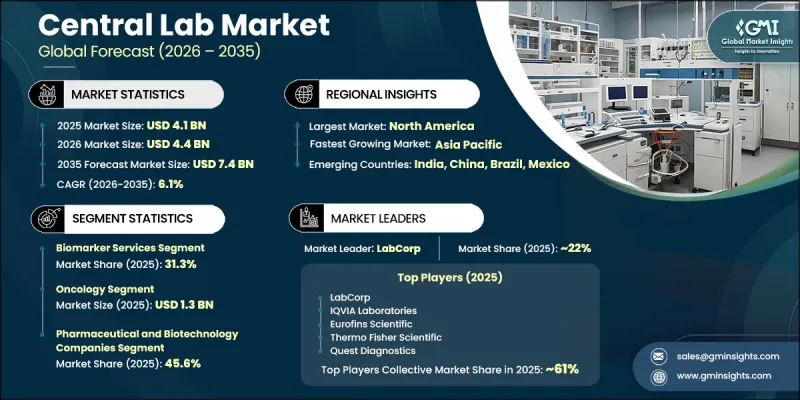
세계의 중앙 연구소 시장은 2025년에 41억 달러로 평가되었고, CAGR 6.1%로 성장할 전망이며, 2035년까지 74억 달러에 이를 것으로 추정되고 있습니다.
이 시장은 전 세계 임상시험 건수 증가, 검사 기술의 지속적인 발전, 생명과학 분야 전반의 R&D 투자 확대에 힘입어 꾸준히 성장하고 있습니다. 병원 및 클리닉의 검사 서비스 아웃소싱 증가도 시장 성장에 크게 기여하고 있습니다. 질병 유병률 증가로 검사 건수가 증가하는 한편, 물류 네트워크의 개선으로 검체 운송이 더욱 신속하고 효율적으로 이루어지고 있습니다. 유전체 검사 및 분자 검사의 확대는 고급 중앙 연구소의 기능에 대한 수요를 더욱 강화시키고 있습니다. 또한, 분산형 임상시험 모델의 채택 확대와 신흥 시장의 세계 임상시험 참여 증가로 인해 표준화된 고품질 검사 인프라에 대한 필요성이 증가하고 있습니다. 자동화 시스템, 고처리량 분석기, 디지털 병리 도구, 첨단 분자 검사 플랫폼 등의 기술 발전으로 업무 효율성, 정확성, 재현성이 크게 향상되었습니다. 이러한 발전은 다기관 임상시험에서 일관된 데이터 품질을 보장하고, 보다 신뢰할 수 있는 의약품 개발 결과를 지원하며, 세계 임상연구에서 중앙 실험실의 전략적 중요성을 높이고 있습니다.
| 시장 범위 | |
|---|---|
| 개시 연도 | 2025년 |
| 예측 기간 | 2026-2035년 |
| 개시 연도 시장 규모 | 41억 달러 |
| 예측 시장 규모 | 74억 달러 |
| CAGR | 6.1% |
2025년에는 의료기관의 진단 및 검사 서비스 아웃소싱이 증가하면서 바이오마커 서비스 부문이 시장 점유율 31.3%를 차지했습니다. 바이오마커 기반 검사는 임상시험에서 환자 분류, 치료 표적 검증, 안전성 모니터링, 치료 반응 평가를 지원함으로써 신약 개발 및 정밀 의학에서 매우 중요한 역할을 하고 있습니다. 분자, 유전자 및 단백질 기반 바이오마커 검사의 채택이 증가함에 따라 표준화된 고정밀 검사 서비스에 대한 수요가 증가하고 있습니다.
2025년 종양학 부문은 13억 달러 시장 규모를 기록했으며, 중앙 연구소 시장의 주요 용도 분야가 되었습니다. 종양학 연구는 유전체 분석 및 조직 기반 평가를 포함한 복잡한 진단 검사에 크게 의존하고 있으며, 시험기관 간 일관성과 정확성을 보장하기 위해서는 중앙 연구소의 지원이 필수적입니다. 표적치료제, 면역치료제, 세포 기반 치료법이 개발됨에 따라 첨단 검사 서비스에 대한 의존도가 더욱 높아지고 있습니다. 중앙 집중식 종양학 검사는 데이터의 신뢰성을 높이고, 환자 선정 과정을 개선하며, 적응형 임상시험 설계를 지원하기 위해 현대의 암 연구 프로그램에 필수적인 요소가 되고 있습니다.
2025년 미국 중앙 연구소 시장 규모는 14억 달러로 평가되었습니다. 이 나라 시장 확대는 질병 유병률 증가로 인한 진단 수요 증가와 검사실 효율성 및 업무 성과 향상을 위한 자동화 도입 확대에 힘입은 바 있습니다. 또한, 맞춤형 의료에 대한 관심이 높아지면서 고급 진단 및 바이오마커 검사 서비스에 대한 수요도 증가하고 있습니다. 정부 및 민간 부문의 생물 의학 연구 및 임상시험에 대한 지속적인 투자가 시장 성장을 더욱 촉진하고 있습니다. 또한, 암, 당뇨병과 같은 만성질환의 부담이 증가함에 따라 종합적인 검사 서비스의 필요성이 증가하고 있으며, 이는 미국 내 중앙검사실 인프라에 대한 지속적인 수요를 뒷받침하고 있습니다.
자주 묻는 질문
목차
제1장 조사 방법
제2장 주요 요약
제3장 업계 인사이트
제4장 경쟁 구도
제5장 시장 추산 및 예측 : 서비스별(2022-2035년)
제6장 시장 추산 및 예측 : 용도별(2022-2035년)
제7장 시장 추산 및 예측 : 최종 용도별(2022-2035년)
제8장 시장 추산 및 예측 : 지역별(2022-2035년)
제9장 기업 개요
AJY 26.06.11The Global Central Lab Market was valued at USD 4.1 billion in 2025 and is estimated to grow at a CAGR of 6.1% to reach USD 7.4 billion by 2035.
The market is experiencing steady expansion driven by the rising number of global clinical trials, continuous advancements in laboratory testing technologies, and increased investment in research and development activities across the life sciences sector. Growing outsourcing of laboratory services by hospitals and clinics is also contributing significantly to market growth. Rising disease prevalence is leading to higher test volumes, while improved logistics networks are enabling faster and more efficient sample transportation. The expansion of genomic and molecular testing is further strengthening demand for advanced central laboratory capabilities. In addition, the increasing adoption of decentralized clinical trial models and the growing participation of emerging markets in global trials are reinforcing the need for standardized, high-quality laboratory infrastructure. Technological improvements such as automation systems, high-throughput analyzers, digital pathology tools, and advanced molecular testing platforms are significantly enhancing operational efficiency, accuracy, and reproducibility. These advancements are ensuring consistent data quality across multi-site clinical studies, supporting more reliable drug development outcomes, and reinforcing the strategic importance of central laboratories in global clinical research.
| Market Scope | |
|---|---|
| Start Year | 2025 |
| Forecast Year | 2026-2035 |
| Start Value | $4.1 Billion |
| Forecast Value | $7.4 Billion |
| CAGR | 6.1% |
The biomarker services segment accounted for 31.3% share in 2025, owing to the increasing outsourcing of diagnostic and testing services by healthcare institutions. Biomarker-based testing plays a critical role in drug development and precision medicine by supporting patient classification, therapeutic target validation, safety monitoring, and treatment response evaluation across clinical trials. The rising adoption of molecular, genetic, and protein-based biomarker testing is increasing the demand for standardized, high-precision laboratory services.
The oncology segment generated USD 1.3 billion in 2025, making it the leading application area within the central lab market. Oncology research relies heavily on complex diagnostic testing, including genomic analysis and tissue-based evaluations, which require centralized laboratory support to ensure consistency and accuracy across trial sites. The growing development of targeted therapies, immunotherapies, and cell-based treatment approaches is further increasing reliance on advanced laboratory services. Centralized oncology testing enhances data reliability, improves patient selection processes, and supports adaptive clinical trial designs, making it essential for modern cancer research programs.
U.S. Central Lab Market was valued at USD 1.4 billion in 2025. Market expansion in the country is supported by rising diagnostic demand driven by increasing disease prevalence and the growing adoption of automation to improve laboratory efficiency and operational performance. Strong emphasis on personalized medicine is also boosting demand for advanced diagnostic and biomarker testing services. Continued investment from both government and private sectors in biomedical research and clinical trials is further strengthening market growth. In addition, the rising burden of chronic conditions such as cancer and diabetes is increasing the need for comprehensive testing services, supporting sustained demand for central laboratory infrastructure across the United States.
Key companies operating in the Global Central Lab Market include Eurofins Scientific, ICON plc, Labcorp, IQVIA Laboratories, Quest Diagnostics, Thermo Fisher Scientific, Parexel International Corporation, Medpace, Inc., Cerba Research, ACM Global Laboratories, BioAgilytix Labs, Frontage Laboratories, LabConnect, Lambda Therapeutic Research, Medicover Integrated Clinical Services (MICS), and Versiti. Companies in the Central Lab Market are focusing on strengthening their market presence through continuous investment in advanced laboratory automation, digital transformation, and high-throughput testing capabilities. Many players are expanding their global laboratory networks to support increasing clinical trial activity across multiple regions. Strategic partnerships with pharmaceutical and biotechnology companies are enabling improved integration into drug development pipelines. Firms are also enhancing their service portfolios by incorporating advanced biomarker testing, genomic analysis, and specialized diagnostic solutions. In addition, companies are prioritizing data management systems and digital platforms to improve accuracy, traceability, and real-time reporting.
Table of Contents
Chapter 1 Research Methodology
- 1.1 Research approach
- 1.2 Quality commitments
- 1.2.1 GMI AI policy & data integrity commitment
- 1.2.1.1 Source consistency protocol
- 1.2.1 GMI AI policy & data integrity commitment
- 1.3 Research trail & confidence scoring
- 1.3.1 Research trail components
- 1.3.2 Scoring components
- 1.4 Data collection
- 1.4.1 Partial list of primary sources
- 1.5 Data mining sources
- 1.5.1 Paid sources
- 1.5.1.1 Sources, by region
- 1.5.1 Paid sources
- 1.6 Base estimates and calculations
- 1.6.1 Base year calculation
- 1.7 Forecast model
- 1.7.1 Quantified market impact analysis
- 1.7.1.1 Mathematical impact of growth parameters on forecast
- 1.7.1 Quantified market impact analysis
- 1.8 Research transparency addendum
- 1.8.1 Source attribution framework
- 1.8.2 Quality assurance metrics
- 1.8.3 Our commitment to trust
Chapter 2 Executive Summary
- 2.1 Industry 360° synopsis
- 2.2 Key market trends
- 2.2.1 Regional trends
- 2.2.2 Services trends
- 2.2.3 Application trends
- 2.2.4 End use trends
- 2.3 CXO perspectives: Strategic imperatives
Chapter 3 Industry Insights
- 3.1 Industry ecosystem analysis
- 3.2 Industry impact forces
- 3.2.1 Growth drivers
- 3.2.1.1 Growing emphasis on outsourcing of testing services
- 3.2.1.2 Technological advancements in testing equipment
- 3.2.1.3 Extensive growth in research and development investments
- 3.2.1.4 Growth in global clinical trials
- 3.2.2 Industry pitfalls and challenges
- 3.2.2.1 Stringent government regulations and compliance
- 3.2.2.2 High operational and infrastructure costs
- 3.2.3 Opportunities
- 3.2.3.1 Integration of AI and advanced analytics
- 3.2.3.2 Expansion into emerging and underserved markets
- 3.2.1 Growth drivers
- 3.3 Growth potential analysis
- 3.4 Regulatory landscape (Driven by Primary Research)
- 3.4.1 North America
- 3.4.2 Europe
- 3.4.3 Asia Pacific
- 3.4.4 Latin America
- 3.4.5 MEA
- 3.5 Technology and innovation landscape
- 3.5.1 Current technological trends
- 3.5.2 Emerging technologies
- 3.6 Future market trends (Driven by Primary Research)
- 3.7 Impact of AI & generative AI on the market (Driven by Primary Research)
- 3.8 Pricing analysis, 2025 (Driven by Primary Research)
- 3.9 Gap analysis
- 3.10 Porter's analysis
- 3.11 PESTEL analysis
- 3.12 Policy outlook
Chapter 4 Competitive Landscape, 2025
- 4.1 Introduction
- 4.2 Company matrix analysis
- 4.3 Company market share analysis (Driven by Primary Research)
- 4.3.1 Global
- 4.3.2 North America
- 4.3.3 Europe
- 4.3.4 Asia Pacific
- 4.4 Competitive analysis of major market players
- 4.5 Competitive positioning matrix
- 4.6 Key developments
- 4.6.1 Mergers & acquisitions
- 4.6.2 Partnerships & collaborations
- 4.6.3 New product launches
- 4.6.4 Expansion plans
Chapter 5 Market Estimates and Forecast, By Services, 2022 - 2035 ($ Mn)
- 5.1 Key trends
- 5.2 Biomarker services
- 5.3 Anatomic pathology/histology
- 5.4 Microbiology services
- 5.5 Specimen management & storage
- 5.6 Genetic services
- 5.7 Other services
Chapter 6 Market Estimates and Forecast, By Application, 2022 - 2035 ($ Mn)
- 6.1 Key trends
- 6.2 Oncology
- 6.3 Neurology
- 6.4 Cardiology
- 6.5 Infectious diseases
- 6.6 Other applications
Chapter 7 Market Estimates and Forecast, By End Use, 2022 - 2035 ($ Mn)
- 7.1 Key trends
- 7.2 Pharmaceutical and biotechnology companies
- 7.3 Academic and research institutes
- 7.4 Other end-users
Chapter 8 Market Estimates and Forecast, By Region, 2022 - 2035 ($ Mn)
- 8.1 Key trends
- 8.2 North America
- 8.2.1 U.S.
- 8.2.2 Canada
- 8.3 Europe
- 8.3.1 Germany
- 8.3.2 UK
- 8.3.3 France
- 8.3.4 Spain
- 8.3.5 Italy
- 8.3.6 Netherlands
- 8.4 Asia Pacific
- 8.4.1 China
- 8.4.2 Japan
- 8.4.3 India
- 8.4.4 Australia
- 8.4.5 South Korea
- 8.5 Latin America
- 8.5.1 Brazil
- 8.5.2 Mexico
- 8.5.3 Argentina
- 8.6 MEA
- 8.6.1 South Africa
- 8.6.2 Saudi Arabia
- 8.6.3 UAE
Chapter 9 Company Profiles
- 9.1 ACM Global Laboratories
- 9.2 BioAgilytix Labs
- 9.3 Cerba Research
- 9.4 Eurofins Scientific
- 9.5 Frontage Laboratories
- 9.6 ICON plc
- 9.7 IQVIA Laboratories
- 9.8 LabConnect
- 9.9 Labcorp
- 9.10 Lambda Therapeutic Research
- 9.11 Medicover Integrated Clinical Services (MICS)
- 9.12 Medpace, Inc.
- 9.13 Parexel International Corporation
- 9.14 Quest Diagnostics
- 9.15 Thermo Fisher Scientific
- 9.16 Versiti