

|
시장보고서
상품코드
2038396
소스, 드레싱, 조미료 시장 : 시장 기회, 성장 요인, 업계 동향 분석 및 예측(2026-2035년)Sauces, Dressings and Condiments Market Opportunity, Growth Drivers, Industry Trend Analysis, and Forecast 2026 - 2035 |
||||||

세계의 소스, 드레싱, 조미료 시장은 2025년에 1,697억 달러로 평가되었고, CAGR 5.4%로 성장할 전망이며, 2035년까지 2,857억 달러에 이를 것으로 추정되고 있습니다.
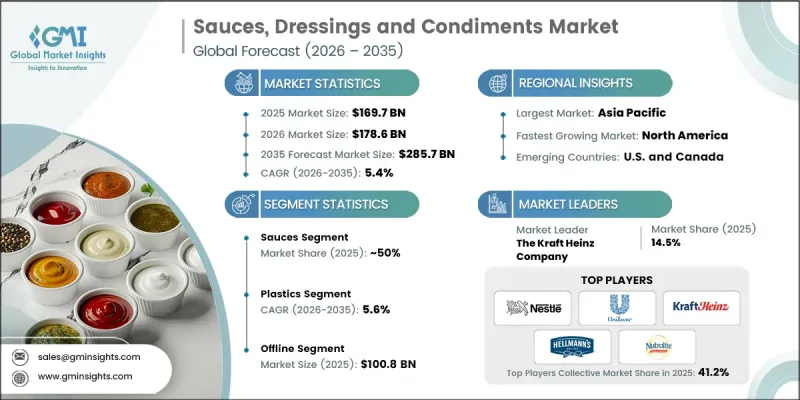
이러한 성장은 클린 라벨 제품, 설탕과 나트륨 함량 감소, 천연 원료 사용 등 건강에 좋은 제품에 대한 강한 수요에 의해 주도되고 있습니다. 소비자들은 건강 지향적인 라이프스타일에 부합하는 프리미엄, 유기농, 비건, 식물성 제품을 점점 더 선호하고 있습니다. 동시에 각 브랜드는 세계 각국의 맛을 접목한 제품, 가정용으로 재해석한 레스토랑식 레시피 등 차별화된 맛의 혁신에 주력하고 있습니다. 특히 젊은 소비자층을 중심으로 세계 각국의 음식에 대한 관심이 높아지면서 이 카테고리의 확장을 더욱 촉진하고 있습니다. 또한, 요리하는 번거로움을 줄이면서 맛을 살리는 편리한 식사 솔루션에 대한 수요 증가도 시장을 견인하고 있습니다. 기능성 소재와 장인정신을 활용한 배합에 초점을 맞춘 제품 혁신을 통해 제조업체는 소매 및 외식 산업 채널 모두에서 더 강력한 브랜드 포지셔닝과 높은 수익률을 달성할 수 있습니다.
| 시장 범위 | |
|---|---|
| 개시 연도 | 2025년 |
| 예측 기간 | 2026-2035년 |
| 개시 연도 시장 규모 | 1,697억 달러 |
| 예측 기간 시장 규모 | 2,857억 달러 |
| CAGR | 5.4% |
소비자의 기호도 현대의 영양 트렌드에 따라 보다 건강한 드레싱을 대체할 수 있는 제품으로 바뀌고 있습니다. 식물성 오일, 견과류 유래 원료, 유제품을 사용하지 않은 베이스를 사용한 제품에 대한 관심이 높아지면서 비건과 플렉시테리언의 식생활에 대한 관심이 높아지고 있습니다. 또한, 소비자들이 일상 식단에서 맛과 건강 효과를 동시에 추구함에 따라 프로바이오틱스 함유, 영양소 강화, 천연 산미증진제 등 기능성을 강화한 제품들이 주목받고 있습니다.
소스 부문은 2025년 50%의 점유율을 차지한 것으로 평가되었으며, 2035년까지 연평균 복합 성장률(CAGR) 5.5%를 나타낼 것으로 예측됩니다. 이 부문은 일반 가정, 음식점, 가공식품 용도 등 다양한 분야에서 활용되고 있어 여전히 압도적인 우위를 유지하고 있습니다. 소스는 전 세계 다양한 요리에 빠질 수 없는 존재이며, 높은 소비 수준에 크게 기여하고 있습니다. 즉석식품에 대한 수요 증가와 다양한 음식 경험에 대한 관심이 높아지면서 이 카테고리의 성장이 더욱 가속화되고 있습니다. 각 제조업체들은 변화하는 소비자의 취향에 맞추어 새로운 맛의 혁신을 도입하여 제품 라인업을 확장하고 있습니다.
오프라인 유통 채널 시장 규모는 2026년 1,008억 달러로 전망되고, 2035년까지 1,629억 달러로, 연평균 5.5% 성장할 것으로 예측됩니다. 오프라인 소매는 여전히 주요 판매 채널로, 매장에서의 상품 선택과 즉각적인 구매 가능성에 대한 소비자의 강한 선호로 인해 여전히 주요 판매 채널로 자리 잡고 있습니다. 슈퍼마켓과 대형마트는 여러 브랜드에 걸친 다양한 상품 라인업을 제공함으로써 카테고리의 인지도를 높이는 데 큰 역할을 하고 있습니다. 대량 구매 옵션과 빈번한 판촉 활동은 반복 구매를 더욱 촉진하고 지속적인 시장 수요의 주요 원동력으로 오프라인 채널의 지위를 확고히 하고 있습니다.
북미 소스, 드레싱 및 조미료 시장은 2026-2035년 연평균 5.5% 성장할 것으로 예측됩니다. 이 지역은 빠르게 변화하는 라이프스타일과 가공식품과 편의식품에 대한 의존도가 높은 성숙한 소비 환경을 특징으로 합니다. 퀵서비스 형태의 식당의 높은 보급률과 프리미엄 제품, 유기농 제품, 클린 라벨 제품에 대한 수요 증가가 시장 트렌드를 형성하고 있습니다. 지속적인 제품 혁신, 맛의 다양성 확대, 강력한 소매 유통망은 이 지역 전체 시장 성장을 더욱 촉진하고 있습니다.
자주 묻는 질문
목차
제1장 조사 방법과 범위
제2장 주요 요약
제3장 업계 인사이트
제4장 경쟁 구도
제5장 시장 추산 및 예측 : 유형별(2022-2035년)
제6장 시장 추산 및 예측 : 포장 소재별(2022-2035년)
제7장 시장 추산 및 예측 : 유통 채널별(2022-2035년)
제8장 시장 추산 및 예측 : 지역별(2022-2035년)
제9장 기업 개요
AJY 26.05.28The Global Sauces, Dressings, and Condiments Market was valued at USD 169.7 billion in 2025 and is estimated to grow at a CAGR of 5.4% to reach USD 285.7 billion by 2035.
Growth is driven by strong demand for healthier formulations featuring clean-label positioning, reduced sugar levels, lower sodium content, and natural ingredient sourcing. Consumers are increasingly favoring premium, organic, vegan, and plant-based offerings that align with wellness-oriented lifestyles. At the same time, brands are focusing on differentiated flavor innovation, including globally inspired taste profiles and restaurant-style recipes adapted for home cooking. Rising experimentation with international cuisines is further fueling category expansion, particularly among younger consumers. The market is also benefiting from increasing demand for convenient meal solutions that simplify cooking while enhancing taste. Product innovation centered on functional ingredients and artisanal formulations is enabling manufacturers to achieve stronger brand positioning and higher margins across both retail and foodservice channels.
| Market Scope | |
|---|---|
| Start Year | 2025 |
| Forecast Year | 2026-2035 |
| Start Value | $169.7 Billion |
| Forecast Value | $285.7 Billion |
| CAGR | 5.4% |
Consumer preferences are also shifting toward healthier dressing alternatives that align with modern nutrition trends. There is growing interest in formulations made with plant-based oils, nut-based ingredients, and dairy-free bases, supporting vegan and flexitarian dietary patterns. Additionally, functional enhancements such as probiotic content, nutrient enrichment, and natural acidity boosters are gaining traction as consumers seek both taste and health benefits in their daily meals.
The sauces segment held a 50% share in 2025 and is expected to grow at a CAGR of 5.5% through 2035. This segment maintains strong dominance due to its widespread usage across households, restaurants, and processed food applications. Sauces are integral to a wide range of global cuisines, contributing significantly to their high consumption levels. Rising demand for ready-to-eat meals and growing popularity of diverse culinary experiences are further accelerating category growth. Manufacturers are expanding their portfolios with new flavor innovations to cater to evolving consumer tastes.
The offline distribution channel accounted for USD 100.8 billion in 2026 and is projected to reach USD 162.9 billion by 2035, growing at a CAGR of 5.5%. Offline retail remains the leading sales channel due to strong consumer preference for in-store product selection and immediate availability. Supermarkets and hypermarkets play a major role in driving category visibility, offering extensive product assortments across multiple brands. Bulk purchasing options and frequent promotional activity further encourage repeat purchases, reinforcing offline channels as a key driver of sustained market demand.
North America Sauces, Dressings, and Condiments Market is expected to grow at a CAGR of 5.5% during 2026-2035. The region represents a mature consumption landscape supported by fast-paced lifestyles and strong reliance on packaged and convenience foods. High penetration of quick-service dining formats and increasing demand for premium, organic, and clean-label products are shaping market trends. Continuous product innovation, expanded flavor offerings, and strong retail distribution networks are further strengthening market growth across the region.
Key companies operating in the Global Sauces, Dressings, and Condiments Market include Nestle, Heinz, Hellmann's, Kissan, Nutralite, Apis India, Kikkoman India, Orchard Lane, Tops, Veeb, and Unilever. Companies in the Sauces, Dressings, and Condiments Market are focusing on product innovation, health-oriented reformulations, and global flavor expansion to strengthen their market position. They are introducing clean-label, low-sugar, and reduced-sodium variants to align with rising wellness trends. Expansion of plant-based and organic product lines is helping brands capture health-conscious consumers. Strategic investments in flavor diversification, including international and fusion-inspired profiles, are supporting differentiation in a competitive market. Companies are also strengthening distribution networks across retail and foodservice channels to improve product accessibility. Digital marketing, influencer partnerships, and brand collaborations are further enhancing consumer engagement. Additionally, packaging innovation and premium positioning strategies are being used to improve shelf appeal and increase brand loyalty across diverse consumer segments.
Table of Contents
Chapter 1 Methodology & Scope
- 1.1 Research approach
- 1.2 Quality Commitments
- 1.2.1 GMI AI policy & data integrity commitment
- 1.2.1.1 Source consistency protocol
- 1.2.1 GMI AI policy & data integrity commitment
- 1.3 Research Trail & Confidence Scoring
- 1.3.1 Research Trail Components
- 1.3.2 Scoring Components
- 1.4 Data Collection
- 1.4.1 Partial list of primary sources
- 1.5 Data mining sources
- 1.5.1 Paid sources
- 1.5.1.1 Sources, by region
- 1.5.1 Paid sources
- 1.6 Base estimates and calculations
- 1.6.1 Base year calculation for any one approach
- 1.7 Forecast model
- 1.7.1 Quantified market impact analysis
- 1.7.1.1 Mathematical impact of growth parameters on forecast
- 1.7.1 Quantified market impact analysis
- 1.8 Research transparency addendum
- 1.8.1 Source attribution framework
- 1.8.2 Quality assurance metrics
- 1.8.3 Our commitment to trust
Chapter 2 Executive Summary
- 2.1 Industry 360° synopsis
- 2.2 Key market trends
- 2.2.1 Regional
- 2.2.2 Type
- 2.2.3 Packaging Material
- 2.2.4 Distribution Channel
- 2.3 TAM Analysis, 2026-2035
- 2.4 CXO perspectives: Strategic imperatives
Chapter 3 Industry Insights
- 3.1 Industry ecosystem analysis
- 3.1.1 Supplier landscape
- 3.1.2 Profit margin
- 3.1.3 Value addition at each stage
- 3.1.4 Factor affecting the value chain
- 3.1.5 Disruptions
- 3.2 Industry impact forces
- 3.2.1 Growth drivers
- 3.2.1.1 Growing demand for convenient, ready-to-use condiments
- 3.2.1.2 Rising interest in global and ethnic flavors
- 3.2.1.3 Shift toward healthier, clean-label products
- 3.2.2 Industry pitfalls and challenges
- 3.2.2.1 Intense competition among global and regional brands
- 3.2.2.2 Fluctuating ingredient costs and supply instability
- 3.2.2.3 Regulatory and labeling compliance requirements
- 3.2.3 Market opportunities
- 3.2.3.1 Growth in plant-based and vegan alternatives
- 3.2.3.2 Expansion through e-commerce and digital distribution
- 3.2.3.3 Development of premium, artisanal, and innovative products
- 3.2.1 Growth drivers
- 3.3 Growth potential analysis
- 3.4 Regulatory landscape
- 3.4.1 North America
- 3.4.2 Europe
- 3.4.3 Asia Pacific
- 3.4.4 Latin America
- 3.4.5 Middle East & Africa
- 3.5 Porter's analysis
- 3.6 PESTEL analysis
- 3.7 Price trends
- 3.7.1 By region
- 3.7.2 By type
- 3.8 Future market trends
- 3.9 Technology and Innovation landscape
- 3.9.1 Current technological trends
- 3.9.2 Emerging technologies
- 3.10 Patent Landscape
- 3.11 Trade statistics (HS code)
- 3.11.1 Major importing countries
- 3.11.2 Major exporting countries
- 3.12 Sustainability and environmental aspects
- 3.12.1 Sustainable practices
- 3.12.2 Waste reduction strategies
- 3.12.3 Energy efficiency in production
- 3.12.4 Eco-friendly initiatives
Chapter 4 Competitive Landscape, 2025
- 4.1 Introduction
- 4.2 Company market share analysis
- 4.2.1 By region
- 4.2.1.1 North America
- 4.2.1.2 Europe
- 4.2.1.3 Asia Pacific
- 4.2.1.4 LATAM
- 4.2.1.5 MEA
- 4.2.1 By region
- 4.3 Company matrix analysis
- 4.4 Competitive analysis of major market players
- 4.5 Competitive positioning matrix
- 4.6 Key developments
- 4.6.1 Mergers & acquisitions
- 4.6.2 Partnerships & collaborations
- 4.6.3 New Product Launches
- 4.6.4 Expansion Plans
Chapter 5 Market Estimates and Forecast, By Type, 2022-2035 (USD Billion) (Kilo Tons)
- 5.1 Key trends
- 5.2 Sauces
- 5.2.1 Tomato-based
- 5.2.2 Soy-based
- 5.2.3 Chili-based
- 5.2.4 Cream-based
- 5.2.5 Others
- 5.3 Dressings
- 5.3.1 Mayonnaise and creamy dressings
- 5.3.2 Yogurt-based dressings
- 5.3.3 Oil-based dressings
- 5.3.4 Others
- 5.4 Condiments
- 5.4.1 Relishes
- 5.4.2 Pickles
- 5.4.3 Others
Chapter 6 Market Estimates and Forecast, By Packaging Material, 2022-2035 (USD Billion) (Kilo Tons)
- 6.1 Key trends
- 6.2 Glass
- 6.3 Plastic
- 6.4 Cartons
- 6.5 Others
Chapter 7 Market Estimates and Forecast, By Distribution Channel, 2022-2035 (USD Billion) (Kilo Tons)
- 7.1 Key trends
- 7.2 Online
- 7.2.1 E-commerce platform
- 7.2.2 Brand websites
- 7.3 Offline
- 7.3.1 Super market
- 7.3.2 Convenient
- 7.3.3 Specialty
- 7.3.4 Others
Chapter 8 Market Estimates and Forecast, By Region, 2022-2035 (USD Billion) (Kilo Tons)
- 8.1 Key trends
- 8.2 North America
- 8.2.1 U.S.
- 8.2.2 Canada
- 8.3 Europe
- 8.3.1 Germany
- 8.3.2 UK
- 8.3.3 France
- 8.3.4 Spain
- 8.3.5 Italy
- 8.3.6 Rest of Europe
- 8.4 Asia Pacific
- 8.4.1 China
- 8.4.2 India
- 8.4.3 Japan
- 8.4.4 Australia
- 8.4.5 South Korea
- 8.4.6 Rest of Asia Pacific
- 8.5 Latin America
- 8.5.1 Brazil
- 8.5.2 Mexico
- 8.5.3 Argentina
- 8.5.4 Rest of Latin America
- 8.6 Middle East and Africa
- 8.6.1 Saudi Arabia
- 8.6.2 South Africa
- 8.6.3 UAE
- 8.6.4 Rest of Middle East and Africa
Chapter 9 Company Profiles
- 9.1 Apis India
- 9.2 Heinz
- 9.3 Hellmann’S
- 9.4 Kikkoman India
- 9.5 Kissan
- 9.6 Nestle
- 9.7 Nutralite
- 9.8 Orchard Lane
- 9.9 Tops
- 9.10 Unilever
- 9.11 Veeba


