
|
시장보고서
상품코드
2038402
열 스트레스 모니터 시장 비즈니스 기회, 성장요인, 업계 동향 분석 및 예측(2026-2035년)Heat Stress Monitor Market Opportunity, Growth Drivers, Industry Trend Analysis, and Forecast 2026 - 2035 |
||||||

세계의 열 스트레스 모니터 시장은 2025년에 7,020만 달러로 평가되었고 CAGR 7.8%로 성장하여 2035년까지 1억 4,800만 달러에 이를 것으로 예측됩니다.
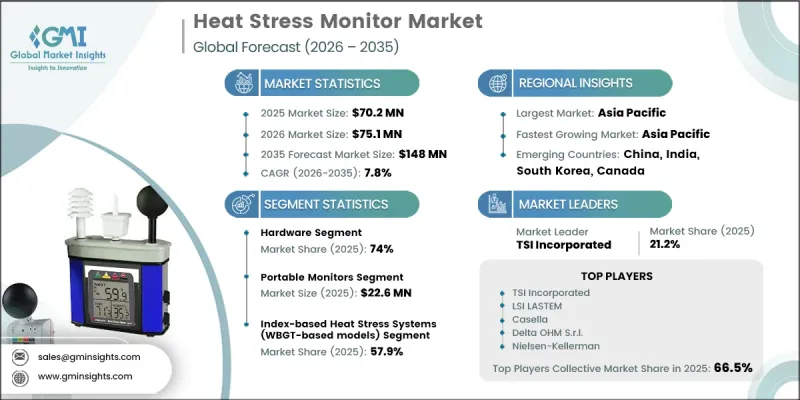
이러한 시장 확대는 각 산업 분야의 근로자 열 안전 규제 강화와 건설 및 광업 현장에서 WBGT(습구 흑구온도) 기반 모니터링 솔루션의 도입 확대에 따른 것입니다. 주요 산업 지역에서 극한의 고온 상태가 빈번하게 발생하면서 실시간 모니터링 시스템에 대한 수요가 더욱 증가하고 있습니다. 웨어러블 기기 및 IoT 지원 기기의 보급으로 환경 및 생리적 상태를 지속적으로 추적할 수 있게 되면서 작업장 안전 대책의 형태가 변화하고 있습니다. 또한, 열 스트레스 모니터링 솔루션이 국방 활동 및 근로자 안전 프로그램에 통합되는 것도 시장 침투를 촉진하고 있습니다. 기후 변화가 심화됨에 따라 근로자들은 장시간 열에 노출될 위험에 노출되어 있으며, 조직은 고도의 완화 조치를 도입해야 합니다. 또한, 제조 및 건설 부문 전반에 걸쳐 열사병 예방 이니셔티브가 확대되면서 제품 채택이 가속화되고 있습니다. 실시간 센싱 기술의 지속적인 발전과 휴대용 및 커넥티드 모니터링 시스템의 결합으로 업무 효율성이 향상되고 산업 전반에 걸쳐 시장 도달 범위가 확대되고 있습니다.
| 시장 범위 | |
|---|---|
| 시작 연도 | 2025년 |
| 예측 기간 | 2026-2035년 |
| 시작 연도 시장 규모 | 7,020만 달러 |
| 예측 규모 | 1억 4,800만 달러 |
| CAGR | 7.8% |
2025년에는 하드웨어 부문이 시장 점유율의 74%를 차지했습니다. 하드웨어 솔루션은 산업 현장에서 정확한 실시간 환경 및 생리적 데이터를 수집하는 데 필수적인 역할을 하기 때문에 열 스트레스 모니터 산업을 주도하고 있습니다. WBGT 미터, 휴대용 모니터링 시스템, 웨어러블 센서 등의 장치는 안전 기준 준수 및 현장의 위험 관리를 위해 널리 활용되고 있습니다. 정확성, 신뢰성 및 산업 안전 및 보건 시스템과의 완벽한 통합을 통해 건설, 광업 및 제조 환경에서 필수적인 존재가 되었습니다.
2025년 휴대용 모니터 부문 시장 규모는 2,260만 달러에 달했습니다. 건설, 석유 및 가스, 광업 등 현장 작업에서 광범위하게 사용되어 강력한 수요를 견인하고 있습니다. 기동성, 신속한 배포 능력, 실시간 데이터 측정 기능으로 역동적이고 위험도가 높은 환경에 매우 적합합니다. 이러한 장치는 즉각적인 안전 판단을 돕고 노동 열 안전 규정 준수를 보장하기 위해 야외 산업 현장에서 높은 보급률을 유지하고 있습니다.
2025년 북미 열 스트레스 모니터 시장은 28.1%의 점유율을 차지했습니다. 이 지역의 성장은 근로자의 열 안전에 초점을 맞춘 규제 강화와 건설, 물류, 제조업을 포함한 각 산업 분야에서 열사병 관련 질환 증가에 의해 뒷받침되고 있습니다. WBGT(습구 흑구 온도) 기반 시스템 및 웨어러블 모니터링 기술의 도입은 미국 및 캐나다 전역에서 꾸준히 확대되고 있습니다. 정부 기관과 민간 조직은 근로자의 안전을 강화하고 열 위험 관리 관행을 개선하기 위해 IoT 지원 모니터링 플랫폼과 실시간 분석 솔루션에 대한 투자를 늘리고 있습니다.
자주 묻는 질문
목차
제1장 조사 방법과 범위
제2장 주요 요약
제3장 업계 인사이트
제4장 경쟁 구도
제5장 시장 추산 및 예측 : 제공별, 2022-2035년
제6장 시장 추산 및 예측 : 제품 유형별, 2022-2035년
제7장 시장 추산 및 예측 : 기술별, 2022-2035년
제8장 시장 추산 및 예측 : 용도별, 2022-2035년
제9장 시장 추산 및 예측 : 지역별, 2022-2035년
제10장 기업 개요
JHS 26.05.29The Global Heat Stress Monitor Market was valued at USD 70.2 million in 2025 and is estimated to grow at a CAGR of 7.8% to reach USD 148 million by 2035.
The market expansion is attributed to stricter occupational heat safety regulations across industries and the increasing deployment of WBGT-based monitoring solutions in construction and mining operations. Rising frequency of extreme heat conditions across major industrial regions is further intensifying demand for real-time monitoring systems. The growing adoption of wearable and IoT-enabled devices is reshaping workplace safety practices by enabling continuous environmental and physiological tracking. Integration of heat stress monitoring solutions into defense operations and workforce safety programs is also strengthening market penetration. Increasing climate variability is exposing workers to prolonged heat exposure risks, driving organizations to adopt advanced mitigation strategies. In addition, expanding implementation of heat illness prevention initiatives across manufacturing and construction sectors is accelerating product adoption. Continuous technological improvements in real-time sensing, combined with portable and connected monitoring systems, are enhancing operational efficiency and broadening market reach across industrial applications.
| Market Scope | |
|---|---|
| Start Year | 2025 |
| Forecast Year | 2026-2035 |
| Start Value | $70.2 Million |
| Forecast Value | $148 Million |
| CAGR | 7.8% |
The hardware segment accounted for 74% share in 2025. Hardware solutions dominate the heat stress monitor industry due to their essential role in capturing accurate real-time environmental and physiological data in industrial settings. Devices such as WBGT meters, portable monitoring systems, and wearable sensors are widely used for safety compliance and on-site risk management. Their precision, reliability, and seamless integration into occupational safety frameworks make them critical across construction, mining, and manufacturing environments.
The portable monitors segment reached USD 22.6 million in 2025. Strong demand is driven by their extensive use in field-based operations such as construction, oil and gas, and mining activities. Their mobility, rapid deployment capability, and real-time data measurement make them highly suitable for dynamic and high-risk environments. These devices support immediate safety decisions and ensure adherence to occupational heat safety regulations, maintaining strong adoption across outdoor industrial applications.
North America Heat Stress Monitor Market accounted for 28.1% share in 2025. The region's growth is supported by rising regulatory enforcement focused on occupational heat safety and increasing cases of heat-related illnesses across industries including construction, logistics, and manufacturing. The adoption of WBGT-based systems and wearable monitoring technologies is expanding steadily across the United States and Canada. Government bodies and private organizations are increasingly investing in IoT-enabled monitoring platforms and real-time analytics solutions to enhance worker safety and improve heat risk management practices.
Key companies operating in the Global Heat Stress Monitor Industry include TSI Incorporated, Sper Scientific, Lutron Electronic Enterprise, Casella, TES Electrical Electronic Corp., Delta OHM S.r.l., AZ Instrument Corp., REED Instruments, Nielsen-Kellerman, Tenmars Electronics, PCE Instruments, LSI LASTEM, Kyoto Electronics Manufacturing, Sato Keiryoki Mfg. Co., Ltd., General Tools & Instruments, and Romteck Australia. Companies in the Heat Stress Monitor Market are focusing on strengthening their market position through continuous product innovation and integration of advanced sensor technologies. Many players are investing in IoT-enabled and wearable monitoring solutions to provide real-time data analytics and improved user safety. Strategic collaborations with industrial organizations are helping expand adoption across high-risk sectors. Firms enhance product portability, accuracy, and durability to meet field requirements in extreme environments. Expansion into emerging markets, along with compliance-driven product development aligned with occupational safety regulations, is further supporting growth.
Table of Contents
Chapter 1 Methodology and Scope
- 1.1 Market scope and definition
- 1.2 Research design
- 1.2.1 Research approach
- 1.2.2 Data collection methods
- 1.3 Data mining sources
- 1.3.1 Global
- 1.3.2 Regional/Country
- 1.4 Base estimates and calculations
- 1.4.1 Base year calculation
- 1.4.2 Key trends for market estimation
- 1.5 Primary research and validation
- 1.5.1 Primary sources
- 1.6 Forecast model
- 1.7 Research assumptions and limitations
Chapter 2 Executive Summary
- 2.1 Industry 360° synopsis, 2022 - 2035
- 2.2 Key market trends
- 2.2.1 Offering trends
- 2.2.2 Product type trends
- 2.2.3 Technology trends
- 2.2.4 Application trends
- 2.2.5 Regional trends
- 2.3 TAM Analysis, 2026-2035
- 2.4 CXO perspectives: Strategic imperatives
Chapter 3 Industry Insights
- 3.1 Industry ecosystem analysis
- 3.1.1 Supplier Landscape
- 3.1.2 Profit Margin
- 3.1.3 Cost structure
- 3.1.4 Value addition at each stage
- 3.1.5 Factor affecting the value chain
- 3.1.6 Disruptions
- 3.2 Industry impact forces
- 3.2.1 Growth drivers
- 3.2.1.1 OSHA heat safety rulemaking accelerating workplace compliance demand
- 3.2.1.2 Rising WBGT monitoring adoption in construction and mining sectors
- 3.2.1.3 Increasing heatwave frequency across United States and India industrial zones
- 3.2.1.4 Defense sector investments in soldier heat strain monitoring systems
- 3.2.1.5 Integration of IoT-enabled wearable heat stress monitors
- 3.2.2 Industry pitfalls and challenges
- 3.2.2.1 High calibration costs for accurate WBGT measurement devices
- 3.2.2.2 Data accuracy issues in wearable physiological sensors
- 3.2.3 Market opportunities
- 3.2.3.1 AI-based predictive heat stress analytics integration
- 3.2.3.2 Smart PPE adoption across logistics and warehousing sectors
- 3.2.1 Growth drivers
- 3.3 Growth potential analysis
- 3.4 Regulatory landscape
- 3.4.1 North America
- 3.4.2 Europe
- 3.4.3 Asia Pacific
- 3.4.4 Latin America
- 3.4.5 Middle East & Africa
- 3.5 Porter's analysis
- 3.6 PESTEL analysis
- 3.7 Technology and Innovation landscape
- 3.7.1 Current technological trends
- 3.7.2 Emerging technologies
- 3.8 Price trends
- 3.8.1 By region
- 3.8.2 By product
- 3.9 Pricing Strategies
- 3.10 Emerging Business Models
- 3.11 Compliance Requirements
- 3.12 Patent and IP analysis
Chapter 4 Competitive Landscape, 2025
- 4.1 Introduction
- 4.2 Company market share analysis
- 4.2.1 By region
- 4.2.1.1 North America
- 4.2.1.2 Europe
- 4.2.1.3 Asia Pacific
- 4.2.1.4 Latin America
- 4.2.1.5 Middle East & Africa
- 4.2.2 Market concentration analysis
- 4.2.1 By region
- 4.3 Competitive benchmarking of key players
- 4.3.1 Financial performance comparison
- 4.3.1.1 Revenue
- 4.3.1.2 Profit margin
- 4.3.1.3 R&D
- 4.3.2 Product portfolio comparison
- 4.3.2.1 Product range breadth
- 4.3.2.2 Technology
- 4.3.2.3 Innovation
- 4.3.3 Geographic presence comparison
- 4.3.3.1 Global footprint analysis
- 4.3.3.2 Service network coverage
- 4.3.3.3 Market penetration by region
- 4.3.4 Competitive positioning matrix
- 4.3.4.1 Leaders
- 4.3.4.2 Challengers
- 4.3.4.3 Followers
- 4.3.4.4 Niche players
- 4.3.5 Strategic outlook matrix
- 4.3.1 Financial performance comparison
- 4.4 Key developments
- 4.4.1 Mergers and acquisitions
- 4.4.2 Partnerships and collaborations
- 4.4.3 Technological advancements
- 4.4.4 Expansion and investment strategies
- 4.4.5 Digital transformation initiatives
- 4.5 Emerging/ startup competitors landscape
Chapter 5 Market Estimates and Forecast, By Offering, 2022 - 2035 (USD Million)
- 5.1 Key trends
- 5.2 Hardware
- 5.3 Software & analytics
- 5.4 Services
Chapter 6 Market Estimates and Forecast, By Product Type, 2022 - 2035 (USD Million)
- 6.1 Key trends
- 6.2 Fixed/area monitors
- 6.3 Portable monitors
- 6.4 Wearable monitors
Chapter 7 Market Estimates and Forecast, By Technology, 2022 - 2035 (USD Million)
- 7.1 Key trends
- 7.2 Environmental heat stress monitoring systems
- 7.3 Physiological heat strain monitoring systems
- 7.4 Index-based heat stress systems (WBGT-based models)
Chapter 8 Market Estimates and Forecast, By Application, 2022 - 2035 (USD Million)
- 8.1 Key trends
- 8.2 Manufacturing
- 8.3 Construction
- 8.4 Oil & Gas
- 8.5 Energy & Utilities
- 8.6 Mining
- 8.7 Agriculture
- 8.8 Military & Defense
- 8.9 Sports & Athletics
- 8.10 Healthcare & Research
Chapter 9 Market Estimates and Forecast, By Region, 2022 - 2035 (USD Million)
- 9.1 Key trends
- 9.2 North America
- 9.2.1 U.S.
- 9.2.2 Canada
- 9.3 Europe
- 9.3.1 Germany
- 9.3.2 UK
- 9.3.3 France
- 9.3.4 Spain
- 9.3.5 Italy
- 9.4 Asia Pacific
- 9.4.1 China
- 9.4.2 India
- 9.4.3 Japan
- 9.4.4 Australia
- 9.4.5 South Korea
- 9.5 Latin America
- 9.5.1 Brazil
- 9.5.2 Mexico
- 9.5.3 Argentina
- 9.6 Middle East and Africa
- 9.6.1 South Africa
- 9.6.2 Saudi Arabia
- 9.6.3 UAE
Chapter 10 Company Profiles
- 10.1 Global Key Players
- 10.1.1 TSI Incorporated
- 10.1.2 Delta OHM S.r.l.
- 10.1.3 LSI LASTEM
- 10.1.4 Casella
- 10.2 Regional key players
- 10.2.1 North America
- 10.2.1.1 Nielsen-Kellerman
- 10.2.1.2 REED Instruments
- 10.2.1.3 Sper Scientific
- 10.2.1.4 General Tools & Instruments
- 10.2.2 Asia Pacific
- 10.2.2.1 AZ Instrument Corp.
- 10.2.2.2 TES Electrical Electronic Corp.
- 10.2.2.3 Tenmars Electronics
- 10.2.2.4 Sato Keiryoki Mfg. Co., Ltd.
- 10.2.2.5 Kyoto Electronics Manufacturing
- 10.2.2.6 Lutron Electronic Enterprise
- 10.2.3 Europe
- 10.2.3.1 PCE Instruments
- 10.2.1 North America
- 10.3 Niche Players/Disruptors
- 10.3.1 Romteck Australia