|
시장보고서
상품코드
2038412
효모 추출물 시장 비즈니스 기회, 성장요인, 업계 동향 분석 및 예측(2026-2035년)Yeast Extract Market Opportunity, Growth Drivers, Industry Trend Analysis, and Forecast 2026 - 2035 |
||||||

세계의 효모 추출물 시장은 2025년에 26억 달러로 평가되었고 CAGR 5.5%로 성장하여 2035년까지 45억 달러에 이를 것으로 예측됩니다.
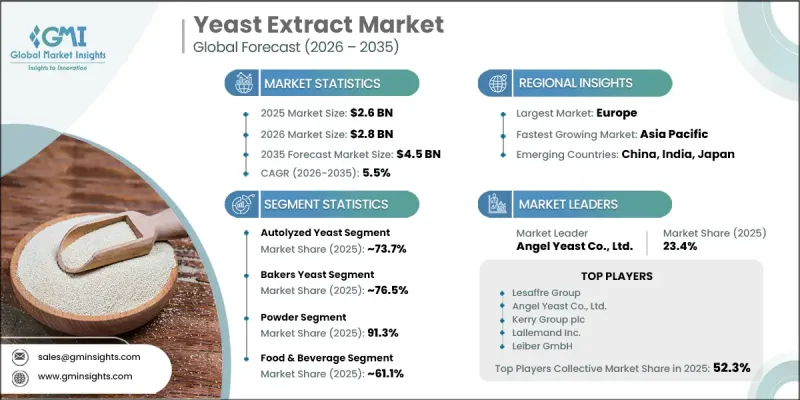
음료 및 식품 제조업체와 제약회사들이 천연 향미증진제 및 영양이 풍부한 원료에 대한 의존도를 높이면서 이 산업은 꾸준히 성장하고 있습니다. 효모 추출물은 강한 감칠맛, 높은 단백질 함량, 면역계 및 소화기 계통 지원과 같은 기능성 건강 효과로 널리 알려져 있으며, 이는 클린 라벨 제품 및 기능성 영양 제품에 대한 수요 증가와 일치합니다. 그 용도는 염장식품, 스낵, 음료, 반려동물사료, 의약품 제제 등 다양한 분야로 계속 확대되고 있습니다. 최소한의 가공을 거친 식물성 원료에 대한 소비자의 선호도가 높아지면서 시장 확대에 더욱 박차를 가하고 있습니다. 식품 분야에서 효모 추출물은 인스턴트 식품, 조미료 블렌드, 식물성 대체 식품의 맛을 향상시키는 데 사용되며, 영양 강화에도 기여합니다. 제약 분야에서는 비타민 제제 및 배양 배지로 활용되고 있으며, 건강 지향적 용도에서 그 중요성이 높아지고 있습니다. 또한 가공 및 제제 기술의 발전으로 제품의 안정성, 맛의 농도, 기능성이 향상되어 전 세계 보급을 더욱 촉진하고 있습니다.
| 시장 범위 | |
|---|---|
| 시작 연도 | 2025년 |
| 예측 기간 | 2026-2035년 |
| 시작 연도 시장 규모 | 26억 달러 |
| 예측 규모 | 45억 달러 |
| CAGR | 5.5% |
2025년에는 자동화 효모 부문이 시장 점유율의 73.7%를 차지했고, 2035년까지 연평균 5.6%의 성장률을 보일 것으로 예측됩니다. 효모 세포를 아미노산, 펩타이드 및 풍미 성분으로 분해하는 제어된 자가 소화 과정을 통해 생산되기 때문에 이 부문이 선도적인 위치를 차지하고 있습니다. 특히 제조업체들이 천연 유래 원료와 투명성을 중시하는 클린 라벨 배합으로 계속 전환하고 있어 수프, 소스, 스낵용 조미료에서 천연 향미 증강제로 널리 사용되고 있습니다.
빵용 효모 부문은 2025년 76.5%의 점유율을 차지했고, 2026년부터 2035년까지 연평균 복합 성장률(CAGR) 5.5%를 나타낼 것으로 예측됩니다. 이 부문은 주로 표준화된 제조 공정과 비용 효율성에 힘입어 사카로마이세스 세레비시에(Saccharomyces cerevisiae)의 광범위한 활용에 의해 주도되고 있습니다. 빵 제품, 스낵 제조, 영양 보충제 배합에 널리 응용되고 있습니다. 발효 과정에서 얻어지는 맥주 효모도 비타민 B군, 단백질, 미네랄이 풍부하게 함유되어 있어 영양보충제 및 기능성 식품의 주요 원료로 각광받고 있습니다.
북미 효모 추출물 시장은 2025년 21.6%의 점유율을 차지했습니다. 이 지역 시장 확대는 음료 및 식품 산업 전반에서 천연, 클린 라벨, 기능성 식품 원료에 대한 수요 증가에 힘입은 바 큽니다. 소비자들은 점점 더 건강한 식습관, 식물성 식품, 천연 향미 증강제를 선택하고 있으며, 이는 효모 추출물의 사용을 가속화하고 있습니다. 식물성 단백질 제품의 인기 상승과 외식업계의 맛과 풍미 혁신에 대한 관심이 높아지면서 수요가 더욱 증가하고 있습니다. 또한, 영양보충제 산업의 성장과 건강기능식품의 소비 증가도 이 지역 시장 성장을 뒷받침하고 있습니다.
자주 묻는 질문
목차
제1장 조사 방법과 범위
제2장 주요 요약
제3장 업계 인사이트
제4장 경쟁 구도
제5장 시장 추산 및 예측 : 기술별, 2022-2035년
제6장 시장 추산 및 예측 : 원료별, 2022-2035년
제7장 시장 추산 및 예측 : 형태별, 2022-2035년
제8장 시장 추산 및 예측 : 용도별, 2022-2035년
제9장 시장 추산 및 예측 : 지역별, 2022-2035년
제10장 기업 개요
JHS 26.05.29The Global Yeast Extract Market was valued at USD 2.6 billion in 2025 and is estimated to grow at a CAGR of 5.5% to reach USD 4.5 billion by 2035.
The industry is gaining steady momentum as food and beverage manufacturers and pharmaceutical companies increasingly rely on natural flavor enhancers and nutrient-rich ingredients. Yeast extracts are widely recognized for delivering a strong umami profile, high protein content, and functional health benefits such as immune system and digestive support, aligning well with the growing demand for clean-label and functional nutrition products. Their application continues to broaden across savory foods, snacks, beverages, pet nutrition, and pharmaceutical formulations. Rising consumer preference for minimally processed, plant-derived ingredients is further reinforcing market expansion. In food applications, yeast extracts are used to enhance taste in ready-to-eat meals, seasoning blends, and plant-based alternatives, while also supporting nutritional enrichment. In pharmaceuticals, they are utilized in vitamin formulations and culture media, strengthening their importance in health-focused applications. Technological improvements in processing and formulation are also enhancing product stability, flavor intensity, and functional performance, further supporting global adoption.
| Market Scope | |
|---|---|
| Start Year | 2025 |
| Forecast Year | 2026-2035 |
| Start Value | $2.6 Billion |
| Forecast Value | $4.5 Billion |
| CAGR | 5.5% |
The autolyzed yeast segment accounted for 73.7% share in 2025 and is projected to grow at a CAGR of 5.6% through 2035. This segment leads due to its production through a controlled self-digestion process that breaks down yeast cells into amino acids, peptides, and flavor compounds. It is widely used as a natural flavor enhancer in soups, sauces, and snack seasonings, particularly as manufacturers continue shifting toward clean-label ingredient formulations that prioritize natural sourcing and transparency.
The Baker's yeast segment held a 76.5% share in 2025 and is expected to grow at a CAGR of 5.5% during 2026-2035. The segment is primarily driven by its widespread use of Saccharomyces cerevisiae, supported by standardized production processes and cost efficiency. It is extensively applied in bakery products, snack manufacturing, and nutritional formulations. Brewer's yeast, derived from fermentation processes, is also valued for its rich composition of B-vitamins, proteins, and minerals, making it a key ingredient in dietary supplements and functional food applications.
North America Yeast Extract Market accounted for a 21.6% share in 2025. The region's expansion is supported by increasing demand for natural, clean-label, and functional food ingredients across the food and beverage sectors. Consumers are increasingly adopting healthier dietary choices, plant-based food options, and natural taste enhancers, which is accelerating yeast extract usage. The growing popularity of plant-based protein products and the rising focus on savory flavor innovation in the foodservice sector further strengthen demand. In addition, the expanding nutraceutical industry and rising consumption of dietary supplements continue to support regional market growth.
Major players operating in the Global Yeast Extract Industry include: AB Mauri, Agrano GmbH & Co. KG, Angel Yeast Co., Ltd., Biorigin (Zilor), Kerry Group plc, Kohjin Life Sciences Co., Ltd., Kothari Fermentation & Biochem, Lallemand Inc., Leiber GmbH, Lesaffre Group, Ohly (ABF Ingredients), Oriental Yeast Co., Ltd., PAULA Ingredients, Thai Foods International, and Titan Biotech Limited. Companies in the Global Yeast Extract Market are focusing on expanding production capacity, strengthening fermentation technologies, and enhancing strain development to improve yield and flavor quality. Many players are investing in R&D to create clean-label and high-performance yeast extract variants tailored for plant-based and reduced-sodium formulations. Strategic partnerships with food manufacturers and pharmaceutical firms are being used to secure long-term supply agreements and application development projects. Firms are also expanding geographically through distribution networks and localized production facilities to improve supply chain efficiency. Sustainability initiatives, including waste valorization and energy-efficient fermentation processes, are becoming central to operations.
Table of Contents
Chapter 1 Methodology & Scope
- 1.1 Market scope and definition
- 1.2 Research design
- 1.2.1 Research approach
- 1.2.2 Data collection methods
- 1.3 Data mining sources
- 1.3.1 Global
- 1.3.2 Regional/Country
- 1.4 Base estimates and calculations
- 1.4.1 Base year calculation
- 1.4.2 Key trends for market estimation
- 1.5 Primary research and validation
- 1.5.1 Primary sources
- 1.6 Forecast model
- 1.7 Research assumptions and limitations
Chapter 2 Executive Summary
- 2.1 Industry 360° synopsis
- 2.2 Key market trends
- 2.2.1 Regional
- 2.2.2 Technology
- 2.2.3 Source
- 2.2.4 Form
- 2.2.5 Application
- 2.3 TAM Analysis, 2026-2035
- 2.4 CXO perspectives: Strategic imperatives
- 2.4.1 Executive decision points
Chapter 3 Industry Insights
- 3.1 Industry ecosystem analysis
- 3.1.1 Supplier landscape
- 3.1.2 Profit margin
- 3.1.3 Value addition at each stage
- 3.1.4 Factor affecting the value chain
- 3.1.5 Disruptions
- 3.2 Industry impact forces
- 3.2.1 Growth drivers
- 3.2.2 Industry pitfalls and challenges
- 3.2.3 Market opportunities
- 3.3 Growth potential analysis
- 3.4 Regulatory landscape
- 3.4.1 North America
- 3.4.2 Europe
- 3.4.3 Asia Pacific
- 3.4.4 Latin America
- 3.4.5 Middle East & Africa
- 3.5 Porter's analysis
- 3.6 PESTEL analysis
- 3.7 Price trends
- 3.7.1 By region
- 3.7.2 By type
- 3.8 Future market trends
- 3.9 Technology and Innovation landscape
- 3.9.1 Current technological trends
- 3.9.2 Emerging technologies
- 3.10 Patent Landscape
- 3.11 Trade statistics (HS code)
- 3.11.1 Major importing countries
- 3.11.2 Major exporting countries
- 3.12 Sustainability and environmental aspects
- 3.12.1 Sustainable practices
- 3.12.2 Waste reduction strategies
- 3.12.3 Energy efficiency in production
- 3.12.4 Eco-friendly initiatives
- 3.13 Carbon footprint consideration
Chapter 4 Competitive Landscape, 2025
- 4.1 Introduction
- 4.2 Company market share analysis
- 4.2.1 By region
- 4.2.1.1 North America
- 4.2.1.2 Europe
- 4.2.1.3 Asia Pacific
- 4.2.1.4 LATAM
- 4.2.1.5 MEA
- 4.2.1 By region
- 4.3 Company matrix analysis
- 4.4 Competitive analysis of major market players
- 4.5 Competitive positioning matrix
- 4.6 Key developments
- 4.6.1 Mergers & acquisitions
- 4.6.2 Partnerships & collaborations
- 4.6.3 New Product Launches
- 4.6.4 Expansion Plans
Chapter 5 Market Estimates and Forecast, By Technology, 2022-2035 (USD Billion) (Kilo Tons)
- 5.1 Key trends
- 5.2 Autolyzed yeast
- 5.3 Hydrolyzed yeast
Chapter 6 Market Estimates and Forecast, By Source, 2022-2035 (USD Billion) (Kilo Tons)
- 6.1 Key trends
- 6.2 Bakers yeast
- 6.3 Brewers yeast
- 6.4 Torula yeast
Chapter 7 Market Estimates and Forecast, By Form, 2022-2035 (USD Billion) (Kilo Tons)
- 7.1 Key trends
- 7.2 Powder
- 7.3 Paste
Chapter 8 Market Estimates and Forecast, By Application, 2022-2035 (USD Billion) (Kilo Tons)
- 8.1 Key trends
- 8.2 Food & beverages
- 8.2.1 Soups & broths
- 8.2.1.1 Ready-to-eat soups
- 8.2.1.2 Soup bases and bouillon
- 8.2.1.3 Instant noodle soups
- 8.2.2 Savory applications & seasonings
- 8.2.2.1 Condiments & sauces
- 8.2.2.2 Seasoning blends & flavor enhancers
- 8.2.2.3 Savory snack coatings
- 8.2.3 Meat & seafood products
- 8.2.3.1 Processed meat products
- 8.2.3.2 Plant-based meat alternatives
- 8.2.3.3 Seafood processing
- 8.2.4 Dairy & dairy alternatives
- 8.2.4.1 Cheese & cheese products
- 8.2.4.2 Plant-based cheese alternatives
- 8.2.4.3 Dairy spreads & dips
- 8.2.5 Bakery products
- 8.2.5.1 Bread & rolls
- 8.2.5.2 Biscuits & crackers
- 8.2.5.3 Specialty baking ingredients
- 8.2.6 Beverages
- 8.2.6.1 Plant-based beverages
- 8.2.6.2 Functional beverages
- 8.2.6.3 Vegetable & fruit juices
- 8.2.7 Prepared & convenience foods
- 8.2.7.1 Ready meals & frozen foods
- 8.2.7.2 Baby food & infant nutrition
- 8.2.7.3 Other convenience foods
- 8.2.1 Soups & broths
- 8.3 Animal feed
- 8.3.1 Poultry feed
- 8.3.2 Swine feed
- 8.3.3 Ruminant feed
- 8.3.4 Aquaculture feed
- 8.3.5 Pet food & treats
- 8.4 Pharmaceutical
- 8.4.1 Vitamin & supplement formulations
- 8.4.2 Tablet & capsule binding
- 8.4.3 Culture media
- 8.5 Other applications
Chapter 9 Market Estimates and Forecast, By Region, 2022-2035 (USD Billion) (Kilo Tons)
- 9.1 Key trends
- 9.2 North America
- 9.2.1 U.S.
- 9.2.2 Canada
- 9.3 Europe
- 9.3.1 Germany
- 9.3.2 UK
- 9.3.3 France
- 9.3.4 Spain
- 9.3.5 Italy
- 9.3.6 Rest of Europe
- 9.4 Asia Pacific
- 9.4.1 China
- 9.4.2 India
- 9.4.3 Japan
- 9.4.4 Australia
- 9.4.5 South Korea
- 9.4.6 Rest of Asia Pacific
- 9.5 Latin America
- 9.5.1 Brazil
- 9.5.2 Mexico
- 9.5.3 Argentina
- 9.5.4 Rest of Latin America
- 9.6 Middle East and Africa
- 9.6.1 Saudi Arabia
- 9.6.2 South Africa
- 9.6.3 UAE
- 9.6.4 Rest of Middle East and Africa
Chapter 10 Company Profiles
- 10.1 AB Mauri
- 10.2 Agrano GmbH & Co. KG
- 10.3 Angel Yeast Co., Ltd.
- 10.4 Biorigin (Zilor)
- 10.5 Kerry Group plc
- 10.6 Kohjin Life Sciences Co., Ltd.
- 10.7 Kothari Fermentation & Biochem
- 10.8 Lallemand Inc.
- 10.9 Leiber GmbH
- 10.10 Lesaffre Group
- 10.11 Ohly (ABF Ingredients)
- 10.12 Oriental Yeast Co., Ltd.
- 10.13 PAULA Ingredients
- 10.14 Thai Foods International
- 10.15 Titan Biotech Limited