

|
시장보고서
상품코드
2038437
혈액암 진단 시장 : 시장 기회, 성장요인, 업계 동향 분석 및 예측(2026-2035년)Blood Cancer Diagnostics Market Opportunity, Growth Drivers, Industry Trend Analysis, and Forecast 2026 - 2035 |
||||||

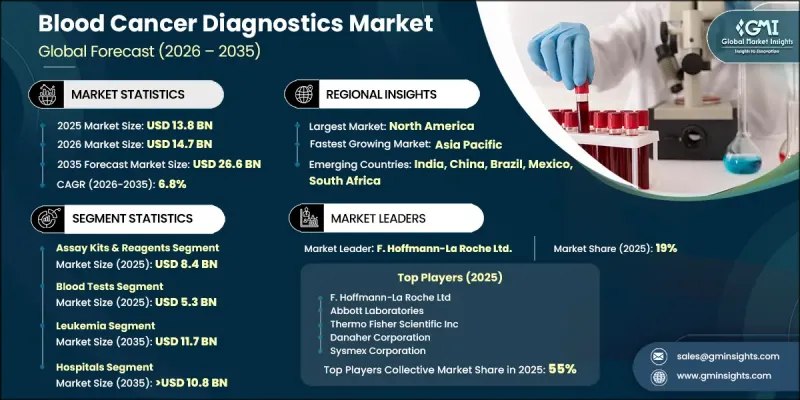
세계의 혈액암 진단 시장은 2025년에 138억 달러로 평가되었고, CAGR 6.8%로 성장할 전망이며, 2035년까지 266억 달러에 이를 것으로 추정되고 있습니다.
시장 성장은 인구 통계학적 변화와 질병 감지 능력의 향상에 힘입어 전 세계적으로 증가하는 혈액 악성 종양 발병률에 의해 주도되고 있습니다. 조기 및 정확한 진단에 대한 요구가 증가함에 따라 의료 시스템은 적시에 개입하고 환자 결과를 개선할 수 있는 첨단 진단 솔루션을 우선순위에 두고 있습니다. 암 검진 및 조기 발견의 중요성에 대한 인식이 높아지면서 진단 검사 건수가 더욱 증가하고 있습니다. 진단 플랫폼의 기술 발전으로 정확도, 민감도, 결과 보고까지의 시간이 크게 개선되어 질병에 대한 보다 상세한 특성 파악과 맞춤 치료 계획을 수립할 수 있게 되었습니다. 분자진단 및 시퀀싱 기술과 같은 첨단 도구의 통합은 진단 워크플로우를 변화시키고 임상적 의사결정을 개선하고 있습니다. 또한, 일상적인 검사 프로토콜의 채택이 확대됨에 따라 모든 의료 현장에서 일관된 수요가 보장되고 있습니다. 연구개발에 대한 투자 증가와 보다 효율적인 진단 접근 방식에 대한 요구가 결합되어 혈액암 진단 시장의 전반적인 성장 궤도가 계속 강화되고 있습니다.
| 시장 범위 | |
|---|---|
| 개시 연도 | 2025년 |
| 예측 기간 | 2026-2035년 |
| 개시 연도 시장 규모 | 138억 달러 |
| 예측 시장 규모 | 266억 달러 |
| CAGR | 6.8% |
분석 키트 및 시약 부문은 2025년 84억 달러의 매출을 기록했습니다. 이 부문은 질병 관련 바이오마커의 검출 및 측정을 지원하는 진단 생태계의 중요한 구성 요소입니다. 이 제품들은 여러 연구 방법론에서 널리 사용되고 있으며, 임상 및 조사 응용 분야 모두에서 필수적인 제품입니다. 표준화된 설계, 실험실 시스템과의 호환성 및 즉시 사용 가능한 형식은 업무 효율성 향상과 일관된 검사 결과를 보장하는 데 기여합니다. 정확하고 재현성 있는 진단 결과에 대한 지속적인 수요가 이 분야에서의 채택을 촉진하고 있습니다.
혈액 검사 부문은 2025년 53억 달러를 차지했습니다. 이 부문은 혈액 파라미터의 일상적인 분석을 통해 이상 징후를 조기에 평가할 수 있게 함으로써 진단 과정에서 기초적인 역할을 수행합니다. 이는 잠재적인 건강 문제를 식별하고 추가 진단 절차를 안내하는 첫 번째 단계입니다. 의료시설 전반에서 혈액 검사를 광범위하게 사용함으로써 검사 건수 증가와 안정적 이용에 기여하고 있습니다. 표준 임상 진료에 통합되어 스크리닝, 모니터링, 평가를 위한 지속적인 수요를 보장합니다.
2025년 북미의 혈액암 진단 시장은 46.5%의 점유율을 차지했습니다. 이 지역의 혈액암 진단 시장은 혈액 악성종양 부담 증가를 배경으로 강력한 성장세를 보이고 있습니다. 백혈병, 림프종, 다발성 골수종과 같은 질병의 발병률 증가는 북미 전역의 진단 솔루션 수요 증가에 크게 기여하고 있습니다. 고령화, 생활습관 관련 위험요인의 변화 등 인구통계학적 추세가 진단율의 상승을 부추기고 있습니다. 환자 수가 증가함에 따라 신속하고 정확한 검출에 대한 시급성이 높아지고 있으며, 이에 따라 의료시설 및 전문 검사기관에서 첨단 진단기술의 도입이 진행되고 있습니다. 또한, 이 지역은 잘 구축된 의료 시스템과 높은 1인당 의료비를 배경으로 고급 진단 기능을 광범위하게 이용할 수 있는 환경을 갖추고 있습니다.
자주 묻는 질문
목차
제1장 조사 방법
제2장 주요 요약
제3장 업계 인사이트
제4장 경쟁 구도
제5장 시장 추산 및 예측 : 제품별(2022-2035년)
제6장 시장 추산 및 예측 : 테스트 유형별(2022-2035년)
제7장 시장 추산 및 예측 : 암 유형별(2022-2035년)
제8장 시장 추산 및 예측 : 최종 용도별(2022-2035년)
제9장 시장 추산 및 예측 : 지역별(2022-2035년)
제10장 기업 개요
AJY 26.06.11The Global Blood Cancer Diagnostics Market was valued at USD 13.8 billion in 2025 and is estimated to grow at a CAGR of 6.8% to reach USD 26.6 billion by 2035.
Market growth is driven by the increasing global incidence of hematological malignancies, supported by demographic shifts and improvements in disease detection capabilities. The growing need for early and accurate diagnosis is encouraging healthcare systems to prioritize advanced diagnostic solutions that enable timely intervention and improved patient outcomes. Rising awareness regarding cancer screening and the importance of early detection is further increasing the volume of diagnostic testing. Technological advancements in diagnostic platforms are significantly enhancing precision, sensitivity, and turnaround time, enabling better disease characterization and personalized treatment planning. The integration of advanced tools such as molecular diagnostics and sequencing technologies is transforming diagnostic workflows and improving clinical decision-making. In addition, expanding adoption of routine testing protocols is ensuring consistent demand across healthcare settings. Increasing investments in research and development, combined with the need for more efficient diagnostic approaches, continue to strengthen the overall growth trajectory of the blood cancer diagnostics market.
| Market Scope | |
|---|---|
| Start Year | 2025 |
| Forecast Year | 2026-2035 |
| Start Value | $13.8 Billion |
| Forecast Value | $26.6 Billion |
| CAGR | 6.8% |
The assay kits and reagents segment generated USD 8.4 billion in 2025. This segment represents a critical component of the diagnostic ecosystem, supporting the detection and measurement of disease-related biomarkers. These products are widely utilized across multiple diagnostic methodologies and are essential for both clinical and research applications. Their standardized design, compatibility with laboratory systems, and ready-to-use formats contribute to operational efficiency and consistent testing outcomes. The ongoing demand for accurate and reproducible diagnostic results continues to drive adoption within this segment.
The blood tests segment accounted for USD 5.3 billion in 2025. This segment plays a foundational role in the diagnostic pathway by enabling the initial assessment of abnormalities through routine analysis of blood parameters. It serves as a primary step in identifying potential health concerns and guiding further diagnostic procedures. The widespread use of blood testing across healthcare facilities contributes to high testing volumes and consistent utilization. Its integration into standard clinical practices ensures ongoing demand for screening, monitoring, and evaluation purposes.
North America Blood Cancer Diagnostics Market accounted for 46.5% share in 2025. The blood cancer diagnostics market in the region is witnessing strong growth momentum, supported by the increasing burden of hematological malignancies. The rising occurrence of conditions such as leukemia, lymphoma, and multiple myeloma is significantly contributing to the demand for diagnostic solutions across North America. Demographic trends, including an aging population and evolving lifestyle-related risk factors, are further driving higher diagnosis rates. Growing patient volumes are increasing the urgency for timely and precise detection, leading to greater adoption of advanced diagnostic technologies across healthcare facilities and specialized laboratories. Additionally, the region benefits from well-established healthcare systems and high healthcare expenditure per capita, enabling broader access to advanced diagnostic capabilities.
Key players operating in the Blood Cancer Diagnostics Market include F. Hoffmann La Roche Ltd., Abbott Laboratories, Thermo Fisher Scientific Inc., Danaher Corporation, Becton Dickinson and Company (BD), Agilent Technologies, Inc., QIAGEN N.V., Bio Rad Laboratories, Inc., Sysmex Corporation, GE Healthcare, Guardant Health, Inc., Adaptive Biotechnologies Corporation, Invivoscribe Technologies, Inc., Precipio Diagnostics, and Exact Sciences Corporation. Companies in the Blood Cancer Diagnostics Market are focusing on innovation, strategic partnerships, and portfolio expansion to strengthen their competitive position. Significant investments are being made in research and development to enhance diagnostic accuracy and introduce advanced technologies. Collaborations with healthcare providers and research institutions are helping companies expand their clinical capabilities and improve product adoption. Firms are also working on expanding their global presence through geographic diversification and distribution network enhancements. Regulatory compliance and quality assurance remain key priorities to ensure product reliability.
Table of Contents
Chapter 1 Research Methodology
- 1.1 Research approach
- 1.2 Quality commitments
- 1.2.1 GMI AI policy & data integrity commitment
- 1.2.1.1 Source consistency protocol
- 1.2.1 GMI AI policy & data integrity commitment
- 1.3 Research trail & confidence scoring
- 1.3.1 Research trail components
- 1.3.2 Scoring components
- 1.4 Data collection
- 1.4.1 Partial list of primary sources
- 1.5 Data mining sources
- 1.5.1 Paid sources
- 1.5.1.1 Sources, by region
- 1.5.1 Paid sources
- 1.6 Base estimates and calculations
- 1.6.1 Base year calculation for any one approach
- 1.7 Forecast model
- 1.7.1 Quantified market impact analysis
- 1.7.1.1 Mathematical impact of growth parameters on forecast
- 1.7.1 Quantified market impact analysis
- 1.8 Research transparency addendum
- 1.8.1 Source attribution framework
- 1.8.2 Quality assurance metrics
- 1.8.3 Our commitment to trust
Chapter 2 Executive Summary
- 2.1 Industry 3600 synopsis
- 2.2 Key market trends
- 2.2.1 Product trends
- 2.2.2 Test type trends
- 2.2.3 Cancer type trends
- 2.2.4 End use trends
- 2.2.5 Regional trends
- 2.3 CXO perspectives: Strategic imperatives
Chapter 3 Industry Insights
- 3.1 Industry ecosystem analysis
- 3.2 Industry impact forces
- 3.2.1 Growth drivers
- 3.2.1.1 Rising prevalence of blood cancer
- 3.2.1.2 Advancements in cancer diagnostic technologies
- 3.2.1.3 Growing awareness and early screening programs
- 3.2.2 Industry pitfalls and challenges
- 3.2.2.1 High cost of advanced diagnostics
- 3.2.2.2 Stringent regulatory scenario
- 3.2.3 Market opportunities
- 3.2.3.1 Development of point-of-care and decentralized testing solutions
- 3.2.1 Growth drivers
- 3.3 Growth potential analysis
- 3.4 Regulatory landscape (Driven by primary research)
- 3.4.1 North America
- 3.4.2 Europe
- 3.4.3 Asia Pacific
- 3.4.4 Latin America
- 3.4.5 Middle East and Africa
- 3.5 Technology landscape (Driven by primary research)
- 3.5.1 Current technological trends
- 3.5.1.1 Integration of Molecular Diagnostics (PCR Based Tests)
- 3.5.1.2 Growing Adoption of Next Generation Sequencing (NGS) Panels
- 3.5.2 Emerging technologies
- 3.5.2.1 Liquid Biopsy for Blood Cancer Monitoring
- 3.5.2.2 Point of Care and Decentralized Diagnostic Platforms
- 3.5.1 Current technological trends
- 3.6 Future market trends (Driven by primary research)
- 3.7 Impact of AI and Generative AI on the market (Driven by primary research)
- 3.8 Pricing analysis, 2025 (Driven by primary research)
- 3.9 Porter's analysis
- 3.10 PESTEL analysis
Chapter 4 Competitive Landscape, 2025
- 4.1 Introduction
- 4.2 Company market share analysis
- 4.2.1 Global
- 4.2.2 North America
- 4.2.3 Europe
- 4.2.4 Asia Pacific
- 4.3 Company matrix analysis
- 4.4 Competitive analysis of major market players
- 4.5 Competitive positioning matrix
- 4.6 Key developments
- 4.6.1 Mergers and acquisitions
- 4.6.2 Partnerships and collaborations
- 4.6.3 New product launches
- 4.6.4 Expansion plans
Chapter 5 Market Estimates and Forecast, By Product, 2022 - 2035 ($ Mn)
- 5.1 Key trends
- 5.2 Instruments
- 5.3 Assay kits and reagents
Chapter 6 Market Estimates and Forecast, By Test type, 2022 - 2035 ($ Mn)
- 6.1 Key trends
- 6.2 Blood tests
- 6.3 Imaging tests
- 6.4 Biopsy
- 6.5 Molecular test
Chapter 7 Market Estimates and Forecast, By Cancer Type, 2022 - 2035 ($ Mn)
- 7.1 Key trends
- 7.2 Leukemia
- 7.3 Lymphoma
- 7.4 Myeloma
Chapter 8 Market Estimates and Forecast, By End Use, 2022 - 2035 ($ Mn)
- 8.1 Key trends
- 8.2 Hospitals
- 8.3 Diagnostic laboratories
- 8.4 Diagnostic imaging centers
- 8.5 Cancer research institutes
Chapter 9 Market Estimates and Forecast, By Region, 2022 - 2035 ($ Mn)
- 9.1 Key trends
- 9.2 North America
- 9.2.1 U.S.
- 9.2.2 Canada
- 9.3 Europe
- 9.3.1 Germany
- 9.3.2 UK
- 9.3.3 France
- 9.3.4 Spain
- 9.3.5 Italy
- 9.3.6 Netherlands
- 9.4 Asia Pacific
- 9.4.1 China
- 9.4.2 Japan
- 9.4.3 India
- 9.4.4 Australia
- 9.4.5 South Korea
- 9.5 Latin America
- 9.5.1 Brazil
- 9.5.2 Mexico
- 9.5.3 Argentina
- 9.6 Middle East and Africa
- 9.6.1 South Africa
- 9.6.2 Saudi Arabia
- 9.6.3 UAE
Chapter 10 Company Profiles
- 10.1 Abbott Laboratories
- 10.2 Adaptive Biotechnologies Corporation
- 10.3 Agilent Technologies, Inc.
- 10.4 Beckman Coulter, Inc.
- 10.5 Becton, Dickinson and Company (BD)
- 10.6 Bio Rad Laboratories, Inc.
- 10.7 F. Hoffmann-La Roche Ltd.
- 10.8 GE Healthcare
- 10.9 Guardant Health, Inc.
- 10.10 Invivoscribe Technologies, Inc.
- 10.11 Precipio Diagnostics
- 10.12 QIAGEN N.V.
- 10.13 Sysmex Corporation
- 10.14 Thermo Fisher Scientific Inc
- 10.15 Exact Sciences Corporation


