|
시장보고서
상품코드
2038456
피레스로이드 시장 : 시장 기회, 성장요인, 업계 동향 분석 및 예측(2026-2035년)Pyrethroids Market Opportunity, Growth Drivers, Industry Trend Analysis, and Forecast 2026 - 2035 |
||||||

세계의 피레스로이드 시장은 2025년에 47억 달러로 평가되었고, CAGR 5.3%로 성장할 전망이며, 2035년에는 78억 달러에 이를 것으로 추정되고 있습니다.
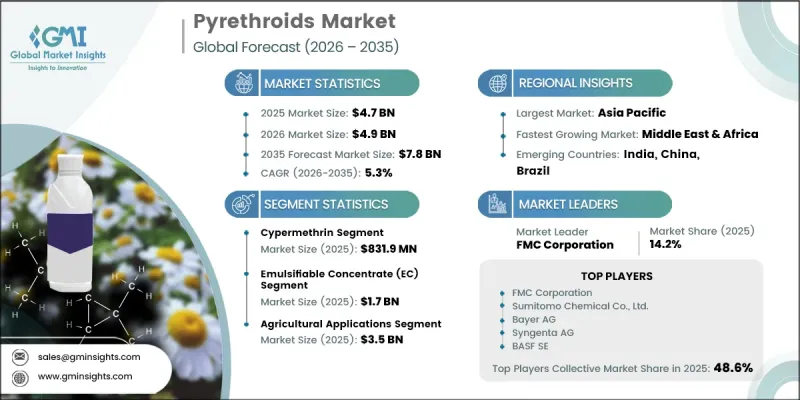
피레스로이드는 국화꽃에서 추출되는 천연 피레트린을 화학적으로 변형하여 개발된 합성 살충제 화합물입니다. 이 화합물들은 곤충의 신경계를 표적으로 하여 그 기능을 억제함으로써 우수한 광안정성과 강력한 살충 효과를 발휘하도록 설계되어 있습니다. 주요 특성으로는 즉각적인 녹다운 효과, 광범위한 해충 방제 능력, 환경 분해에 대한 내성, 실내 및 실외 모두에서 사용하기에 적합하다는 점 등을 들 수 있습니다. 피레스로이드계 살충제는 그 효과와 포유류에 대한 비교적 낮은 독성으로 인해 농업, 공중 보건 프로그램 및 주택 해충 관리 분야에서 널리 사용되고 있습니다. 또한, 다재다능하고 다양한 환경에서 안정적인 성능으로 인해 종합적 해충관리(IPM) 전략에 포함되는 경우가 증가하고 있습니다. 합성 경로 개선, 입체 화학적 제어, 제형 기술 향상 등 생산 기술의 지속적인 발전으로 제품의 효율성과 안전성 프로파일이 강화되고 있습니다. 이러한 혁신을 통해 제조업체는 유효성, 안정성 및 환경적 거동을 정밀하게 제어할 수 있게 되어 여러 최종 사용 산업에서 세계 수요 증가를 뒷받침하고 있습니다. 이러한 전망은 전 세계 선진국과 신흥 시장에서의 지속적인 채택을 반영하고 있습니다.
| 시장 범위 | |
|---|---|
| 개시 연도 | 2025년 |
| 예측 기간 | 2026-2035년 |
| 개시 연도 시장 규모 | 47억 달러 |
| 예측 시장 규모 | 78억 달러 |
| CAGR | 5.3% |
시퍼메트린 시장은 2025년 8억 3,190만 달러에 달했습니다. 농업용 방제 및 구조물 해충 방제 분야에서 견조한 수요에 힘입어 저렴한 가격과 폭넓은 효과로 높은 효과를 발휘하고 있습니다. 이 화합물은 광범위한 해충 방제에서 계속 중심적인 역할을 하고 있으며, 여러 응용 분야에서 상업적 중요성이 높아지고 있습니다. 동시에 새로운 피레스로이드계 화합물의 개발로 인해 광안정성 향상과 장기 잔류 효과가 요구되는 전문 분야에서의 기회가 확대되고 있으며, 이 유형의 살충제의 적용 범위가 더욱 확대되고 있습니다.
유화 농축제(EC) 제제 부문은 2025년 17억 달러 시장 규모를 기록했습니다. 이 부문은 취급의 용이성, 살포 커버리지의 향상, 유효 성분의 효율적인 공급으로 인해 지속적으로 성장하고 있습니다. 농부들은 기존 살포 장비와 원활하게 통합할 수 있는 수화제를 점점 더 선호하고 있으며, 이는 지속적인 수요 증가를 뒷받침하고 있습니다. EC 제제의 편리성, 호환성 및 운영 효율성은 전체 해충 방제 분야에서 EC 제제의 광범위한 채택을 촉진하는 중요한 요인입니다.
북미의 피레스로이드 시장은 2025년 13억 달러로 평가되었고, 2035년 22억 달러로 성장할 것으로 예측됩니다. 이 지역의 성장은 주로 효과적인 작물 보호 솔루션에 대한 농업 분야의 강력한 수요와 종합적 해충 관리(IPM) 기법의 광범위한 도입에 의해 주도되고 있습니다. 시장 확대는 다양한 적용 환경에서 제품의 신뢰성을 유지하면서 장기적인 해충 방제 효과를 높이는 첨단 제형 기술 및 체계적인 저항성 관리 프로그램 채택 확대에 힘입어 더욱 확대되고 있습니다.
FMC Corporation, Syngenta AG, Bayer AG, BASF SE, Sumitomo Chemical Co., Ltd., UPL Limited, ADAMA Agricultural Solutions Ltd., Jiangsu Yangnong Chemical Co., Ltd., Heranba Industries Limited, Meghmani Organics Ltd., Gharda Chemicals Limited, Tagros Chemicals India Pvt. Ltd., Nanjing Red Sun Co., Ltd., SinoHarvest Corp. 및 Zhejiang Xinan Chemical Industrial Group 등이 피레스로이드 시장에서 활동하는 주요 기업 중 일부입니다. 피레스로이드 산업에서 사업을 영위하는 기업들은 제형 기술과 유효 성분의 효율성에 대한 지속적인 혁신을 통해 시장에서의 입지를 강화하는 데 주력하고 있습니다. 각 업체들은 제품의 안정성 향상, 해충 저항성 관리 개선 및 용도 다양화를 위해 연구개발에 많은 투자를 하고 있습니다. 또한, 시장 침투율을 높이기 위해 전략적 제휴와 파트너십, 그리고 고성장 농업 지역으로의 지리적 확장을 우선순위로 삼고 있습니다. 또한, 각 제조업체들은 비용 효율성과 제품의 균일성을 향상시키기 위해 첨단 합성 기술과 최적화된 생산 공정을 도입하고 있습니다.
자주 묻는 질문
목차
제1장 조사 방법 및 범위
제2장 주요 요약
제3장 업계 인사이트
제4장 경쟁 구도
제5장 시장 추산 및 예측 : 제품 유형별(2022-2035년)
제6장 시장 추산 및 예측 : 제제 유형별(2022-2035년)
제7장 시장 추산 및 예측 : 용도별(2022-2035년)
제8장 시장 추산 및 예측 : 지역별(2022-2035년)
제9장 기업 개요
AJY 26.06.11The Global Pyrethroids Market was valued at USD 4.7 billion in 2025 and is estimated to grow at a CAGR of 5.3% to reach USD 7.8 billion in 2035.
Pyrethroids are synthetic insecticidal compounds developed through chemical modification of naturally occurring pyrethrins derived from chrysanthemum flowers. These compounds are engineered to provide enhanced photostability and strong insecticidal performance by targeting and disrupting the nervous systems of insects. Their key properties include rapid knockdown action, broad-spectrum pest control capability, resistance to environmental degradation, and suitability for both indoor and outdoor applications. Pyrethroids are widely utilized across agriculture, public health programs, and residential pest management due to their effectiveness and relatively low toxicity toward mammals. They are also increasingly incorporated into integrated pest management strategies because of their versatility and consistent performance across varied environments. Continuous advancements in production technologies, including improved synthesis routes, stereochemical control, and enhanced formulation techniques, have strengthened product efficiency and safety profiles. These innovations enable manufacturers to achieve precise control over efficacy, stability, and environmental behavior, supporting expanding global demand across multiple end-use industries. This outlook reflects sustained adoption across both developed and emerging markets globally.
| Market Scope | |
|---|---|
| Start Year | 2025 |
| Forecast Year | 2026-2035 |
| Start Value | $4.7 Billion |
| Forecast Value | $7.8 Billion |
| CAGR | 5.3% |
The cypermethrin segment reached USD 831.9 million in 2025. Its dominance is supported by strong demand in agricultural protection and structural pest control applications, where its affordability and wide-spectrum efficacy make it highly effective. The compound continues to play a central role in controlling a broad range of insect pests, reinforcing its commercial importance across multiple usage areas. At the same time, the development of newer pyrethroid variants is expanding opportunities in specialized segments that require improved photostability and longer residual performance, further widening the application scope of this class of insecticides.
The emulsifiable concentrate (EC) formulations segment generated USD 1.7 billion in 2025. This segment continues to gain traction due to its ease of handling, improved spray coverage, and efficient delivery of active ingredients. Farmers increasingly prefer water-dispersible solutions that integrate seamlessly with existing spraying equipment, supporting consistent demand growth. The convenience, compatibility, and operational efficiency of EC formulations are key factors driving their widespread adoption across pest control applications.
North America Pyrethroids Market is projected to grow from USD 1.3 billion in 2025 to USD 2.2 billion in 2035. Growth in this region is primarily driven by strong agricultural demand for effective crop protection solutions and the widespread implementation of integrated pest management practices. Market expansion is further supported by increasing adoption of advanced formulation technologies and structured resistance management programs that enhance long-term pest control effectiveness while maintaining product reliability across diverse application settings.
FMC Corporation, Syngenta AG, Bayer AG, BASF SE, Sumitomo Chemical Co., Ltd., UPL Limited, ADAMA Agricultural Solutions Ltd., Jiangsu Yangnong Chemical Co., Ltd., Heranba Industries Limited, Meghmani Organics Ltd., Gharda Chemicals Limited, Tagros Chemicals India Pvt. Ltd., Nanjing Red Sun Co., Ltd., SinoHarvest Corp., and Zhejiang Xinan Chemical Industrial Group are among the leading companies operating in the pyrethroids market. Companies operating in the pyrethroids industry are focusing on strengthening their market position through continuous innovation in formulation technologies and active ingredient efficiency. They are investing heavily in research and development to enhance product stability, improve pest resistance management, and expand application versatility. Strategic collaborations, partnerships, and geographic expansion into high-growth agricultural regions are also being prioritized to increase market penetration. Manufacturers are further adopting advanced synthesis techniques and optimized production processes to improve cost efficiency and product consistency.
Table of Contents
Chapter 1 Methodology & Scope
- 1.1 Market scope and definition
- 1.2 Research design
- 1.2.1 Research approach
- 1.2.2 Data collection methods
- 1.3 Data mining sources
- 1.3.1 Global
- 1.3.2 Regional/Country
- 1.4 Base estimates and calculations
- 1.4.1 Base year calculation
- 1.4.2 Key trends for market estimation
- 1.5 Primary research and validation
- 1.5.1 Primary sources
- 1.6 Forecast model
- 1.7 Research assumptions and limitations
Chapter 2 Executive Summary
- 2.1 Industry 360° synopsis
- 2.2 Key market trends
- 2.2.1 Product Type
- 2.2.2 Formulation Type
- 2.2.3 Application
- 2.2.4 Regional
- 2.3 TAM Analysis, 2026-2035
- 2.4 CXO perspectives: Strategic imperatives
Chapter 3 Industry Insights
- 3.1 Industry ecosystem analysis
- 3.1.1 Supplier landscape
- 3.1.2 Profit margin
- 3.1.3 Value addition at each stage
- 3.1.4 Factor affecting the value chain
- 3.1.5 Disruptions
- 3.2 Industry impact forces
- 3.2.1 Growth drivers
- 3.2.2 Industry pitfalls and challenges
- 3.2.3 Market opportunities
- 3.3 Growth potential analysis
- 3.4 Regulatory landscape
- 3.4.1 North America
- 3.4.2 Europe
- 3.4.3 Asia Pacific
- 3.4.4 Latin America
- 3.4.5 Middle East & Africa
- 3.5 Porter's analysis
- 3.6 PESTEL analysis
- 3.7 Price trends
- 3.7.1 By region
- 3.7.2 By product type
- 3.8 Future market trends
- 3.9 Technology and Innovation landscape
- 3.9.1 Current technological trends
- 3.9.2 Emerging technologies
- 3.10 Patent Landscape
- 3.11 Trade statistics (HS code)
- 3.11.1 Major importing countries
- 3.11.2 Major exporting countries
- 3.12 Sustainability and environmental aspects
- 3.12.1 Sustainable practices
- 3.12.2 Waste reduction strategies
- 3.12.3 Energy efficiency in production
- 3.12.4 Eco-friendly initiatives
- 3.13 Carbon footprint consideration
Chapter 4 Competitive Landscape, 2025
- 4.1 Introduction
- 4.2 Company market share analysis
- 4.2.1 By region
- 4.2.1.1 North America
- 4.2.1.2 Europe
- 4.2.1.3 Asia Pacific
- 4.2.1.4 LATAM
- 4.2.1.5 MEA
- 4.2.1 By region
- 4.3 Competitive analysis of major market players
- 4.4 Competitive positioning matrix
- 4.5 Key developments
- 4.5.1 Mergers & acquisitions
- 4.5.2 Partnerships & collaborations
- 4.5.3 New Product Launches
- 4.5.4 Expansion Plans
Chapter 5 Market Estimates and Forecast, By Product Type, 2022-2035 (USD Billion) (Million Litters)
- 5.1 Key trends
- 5.2 Bifenthrin
- 5.3 Deltamethrin
- 5.4 Permethrin
- 5.5 Cypermethrin
- 5.6 Cyfluthrin
- 5.7 Lambda-Cyhalothrin
- 5.8 Others
Chapter 6 Market Estimates and Forecast, By Formulation Type, 2022-2035 (USD Billion) (Million Litters)
- 6.1 Key trends
- 6.2 Emulsifiable Concentrate (EC)
- 6.3 Wettable Powder (WP)
- 6.4 Water-Dispersible Granules (WG)
- 6.5 Granular (GR)
- 6.6 Ultra-Low Volume (ULV)
- 6.7 Others
Chapter 7 Market Estimates and Forecast, By Application, 2022-2035 (USD Billion) (Million Litters)
- 7.1 Key trends
- 7.2 Agricultural Applications
- 7.2.1 Cereals & Grains
- 7.2.2 Oilseeds & Pulses
- 7.2.3 Fruits & Vegetables
- 7.2.4 Others
- 7.3 Non-Agricultural Applications
- 7.3.1 Public Health
- 7.3.2 Residential
- 7.3.3 Others
Chapter 8 Market Estimates and Forecast, By Region, 2022-2035 (USD Billion) (Kilo Tons)
- 8.1 Key trends
- 8.2 North America
- 8.2.1 U.S.
- 8.2.2 Canada
- 8.3 Europe
- 8.3.1 Germany
- 8.3.2 UK
- 8.3.3 France
- 8.3.4 Spain
- 8.3.5 Italy
- 8.3.6 Rest of Europe
- 8.4 Asia Pacific
- 8.4.1 China
- 8.4.2 India
- 8.4.3 Japan
- 8.4.4 Australia
- 8.4.5 South Korea
- 8.4.6 Rest of Asia Pacific
- 8.5 Latin America
- 8.5.1 Brazil
- 8.5.2 Mexico
- 8.5.3 Argentina
- 8.5.4 Rest of Latin America
- 8.6 Middle East and Africa
- 8.6.1 Saudi Arabia
- 8.6.2 South Africa
- 8.6.3 UAE
- 8.6.4 Rest of Middle East and Africa
Chapter 9 Company Profiles
- 9.1 FMC Corporation
- 9.2 Sumitomo Chemical Co., Ltd.
- 9.3 Bayer AG
- 9.4 Syngenta AG
- 9.5 BASF SE
- 9.6 ADAMA Agricultural Solutions Ltd.
- 9.7 UPL Limited
- 9.8 Jiangsu Yangnong Chemical Co., Ltd.
- 9.9 Nanjing Red Sun Co., Ltd.
- 9.10 Tagros Chemicals India Pvt. Ltd.
- 9.11 Heranba Industries Limited
- 9.12 Gharda Chemicals Limited
- 9.13 Meghmani Organics Ltd.
- 9.14 SinoHarvest Corp.
- 9.15 Zhejiang Xinan Chemical Industrial Group