

|
시장보고서
상품코드
2038464
완두콩 단백질 분리물 시장 : 시장 기회, 성장요인, 업계 동향 분석 및 예측(2026-2035년)Pea Protein Isolate Market Opportunity, Growth Drivers, Industry Trend Analysis, and Forecast 2026 - 2035 |
||||||

세계의 완두콩 단백질 분리물 시장은 2025년에 2억 4,230만 달러로 평가되었고, 2035년까지 연평균 복합 성장률(CAGR) 10.2%로 성장할 전망이며, 6억 4,140만 달러에 이를 것으로 예측됩니다.
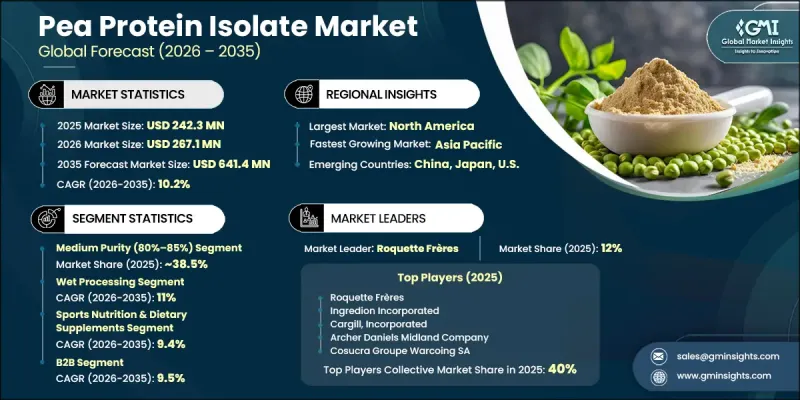
이 시장은 전 세계 식품 시스템에서 지속 가능하고 알레르기를 유발하지 않는 식물성 단백질 공급원에 대한 소비자의 선호도가 높아짐에 따라 성장세를 보이고 있습니다. 소비자의 건강에 대한 인식이 높아진 데다 플렉시테리언, 비건, 유당이 없는 식단으로의 급속한 전환으로 완두콩 단백질 분리물에 대한 수요가 크게 증가하고 있습니다. 이 원료는 높은 단백질 함량, 균형 잡힌 아미노산 구성, 그리고 소화가 잘 되어 동물성 단백질이나 다른 식물성 단백질의 대체품으로 널리 인정받고 있습니다. 클린 라벨 영양, 비 유전자 변형(Non-GMO) 인증, 글루텐 프리 배합에 대한 관심이 높아지면서 음료 및 식품 분야에서의 제품 채택이 더욱 가속화되고 있습니다. 또한, 근육 지원, 포만감 증진, 체중 관리 지원과 같은 기능적 이점으로 인해 스포츠 영양 식품 및 건강 보조 식품에 배합이 증가하고 있습니다. 완두콩 단백질 분리물은 맛이 독특하지 않고 기능적인 측면에서 다재다능하여 단백질 파우더, 육류 대체품, 기능성 식품, 베이커리 제품, 즉석 음료, 특수 영양 솔루션 등 다양한 용도로 활용될 수 있습니다. 식물성 단백질 배합 기술의 혁신과 일반 및 프리미엄 영양 카테고리에서 계속 확대되고 있는 용도 분야로 인해 시장은 계속해서 혜택을 누리고 있습니다.
| 시장 범위 | |
|---|---|
| 개시 연도 | 2025년 |
| 예측 기간 | 2026-2035년 |
| 개시 시점 시장 규모 | 2억 4,230만 달러 |
| 예측 시장 규모 | 6억 4,140만 달러 |
| CAGR | 10.2% |
중순도 부문(80%-85%)은 2025년 38.5%의 점유율을 차지했으며, 2035년까지 연평균 9.8%의 성장률을 보일 것으로 전망됩니다. 이 부문은 비용 효율성과 기능적 성능의 균형이 잘 잡혀 있어 견고한 수요를 유지하고 있습니다. 이 부문은 용해성, 식감, 영양가가 중요한 요건인 베이커리 제품, 스낵, 에너지바, 식물성 식품에 널리 사용됩니다. 그 범용성과 다양한 배합 요구에 대응할 수 있는 능력이 시장에서 안정적인 채택을 뒷받침하고 있습니다.
습식 가공 부문은 2025년 62.5%의 점유율을 차지했으며, 2026-2035년 연평균 복합 성장률(CAGR) 11%를 나타낼 것으로 예측됩니다. 이 방법은 우수한 순도와 기능성을 제공할 수 있기 때문에 고품질 완두콩 단백질 분리물의 주요 제조 기술로 자리매김하고 있습니다. 이 공정은 일반적으로 산 또는 효소를 이용한 추출에 이어 침전 및 건조를 통해 높은 단백질 농도, 개선된 용해도 및 향상된 기능적 특성을 가진 제품을 얻을 수 있습니다. 습식 가공은 제조 비용이 높지만, 특히 음료, 보충제, 식물성 육류 대체품 등 우수한 식감, 유화성, 소화성이 요구되는 응용 분야에서는 습식 가공이 필수적입니다.
북미의 완두콩 단백질 분리물 시장은 식물성 육류 대체품 및 즉석 단백질 음료에 대한 소비자의 강력한 수요에 힘입어 2025년 35.4%의 점유율을 차지했습니다. 이 지역의 성장은 비 유전자 변형(Non-GMO) 및 알레르겐이 없는 식품 원료에 대한 규제적 지원으로 인해 더욱 가속화되고 있으며, 이는 식음료 산업 전반에 걸쳐 제품 채택을 촉진하고 있습니다.
자주 묻는 질문
목차
제1장 조사 방법 및 범위
제2장 주요 요약
제3장 업계 인사이트
제4장 경쟁 구도
제5장 시장 추산 및 예측 : 순도별(2022-2035년)
제6장 시장 추산 및 예측 : 가공 방법별(2022-2035년)
제7장 시장 추산 및 예측 : 용도별(2022-2035년)
제8장 시장 추산 및 예측 : 유통 채널별(2022-2035년)
제9장 시장 추산 및 예측 : 지역별(2022-2035년)
제10장 기업 개요
AJY 26.06.11The Global Pea Protein Isolate Market was valued at USD 242.3 million in 2025 and is estimated to grow at a CAGR of 10.2% to reach USD 641.4 million by 2035.
The market is witnessing momentum driven by rising consumer preference for plant-based, sustainable, and allergen-free protein sources across global food systems. Increasing health awareness among consumers, along with the rapid shift toward flexitarian, vegan, and lactose-free diets, is significantly strengthening demand for pea protein isolate. The ingredient is widely recognized for its high protein concentration, balanced amino acid composition, and easy digestibility, making it a preferred alternative to animal-based and other plant-derived proteins. Growing focus on clean-label nutrition, non-GMO certification, and gluten-free formulations is further enhancing product adoption across food and beverage applications. In addition, its functional advantages, including muscle support, satiety benefits, and weight management support, are driving its inclusion in sports nutrition and dietary supplement formulations. The neutral taste profile and strong functional versatility of pea protein isolate are enabling its integration into a wide range of applications such as protein powders, meat substitutes, functional foods, bakery products, ready-to-drink beverages, and specialized nutrition solutions. The market continues to benefit from increasing innovation in plant protein formulation technologies and expanding applications across mainstream and premium nutrition categories.
| Market Scope | |
|---|---|
| Start Year | 2025 |
| Forecast Year | 2026-2035 |
| Start Value | $242.3 Million |
| Forecast Value | $641.4 Million |
| CAGR | 10.2% |
The medium purity segment (80%-85%) accounted for 38.5% share in 2025 and is projected to grow at a CAGR of 9.8% through 2035. This segment maintains strong demand due to its balanced combination of cost efficiency and functional performance. It is widely used in bakery formulations, snack products, energy bars, and plant-based food applications where solubility, texture, and nutritional value are key requirements. Its versatility and ability to meet diverse formulation needs continue to support stable market adoption.
The wet processing segment held a 62.5% share in 2025 and is expected to grow at a CAGR of 11% between 2026 and 2035. This method remains the primary production technique for high-quality pea protein isolate due to its ability to deliver superior purity and functional performance. The process typically involves extraction using acid or enzymatic methods followed by precipitation and drying, resulting in a product with high protein concentration, improved solubility, and enhanced functional properties. Despite higher production costs, wet processing is essential for applications requiring superior texture, emulsification, and digestibility, particularly in beverages, supplements, and plant-based meat alternatives.
North America Pea Protein Isolate Market accounted for 35.4% share in 2025, supported by strong consumer demand for plant-based meat alternatives and ready-to-drink protein beverages. The region's growth is further reinforced by regulatory support for non-GMO and allergen-free food ingredients, which is encouraging broader product adoption across the food and nutrition industry.
Key players operating in the Pea Protein Isolate Industry include Roquette Freres, Cargill, Incorporated, Ingredion Incorporated, Archer Daniels Midland Company, Glanbia Nutritionals, Emsland Group, Cosucra Groupe Warcoing SA, Axiom Foods, Inc., AGT Food and Ingredients Inc., Burcon NutraScience / Merit Functional Foods, Louis Dreyfus Company, NutriPea, PURIS, The Scoular Company, and Yantai Shuangta Food Co., Ltd. Companies in the Pea Protein Isolate Market are focusing on expanding production capacities and investing in advanced extraction and processing technologies to improve yield and protein quality. Strong emphasis is being placed on research and development to enhance functional properties such as solubility, texture, and taste neutrality for broader application use. Strategic partnerships with food and beverage manufacturers are enabling companies to strengthen product integration across mainstream and specialty nutrition categories. Firms are also expanding into emerging markets to capture rising demand for plant-based protein solutions. Sustainability initiatives, including environmentally efficient sourcing and low-impact processing methods, are being prioritized to align with clean-label trends.
Table of Contents
Chapter 1 Methodology & Scope
- 1.1 Market scope and definition
- 1.2 Research design
- 1.2.1 Research approach
- 1.2.2 Data collection methods
- 1.3 Data mining sources
- 1.3.1 Global
- 1.3.2 Regional/Country
- 1.4 Base estimates and calculations
- 1.4.1 Base year calculation
- 1.4.2 Key trends for market estimation
- 1.5 Primary research and validation
- 1.5.1 Primary sources
- 1.6 Forecast model
- 1.7 Research assumptions and limitations
Chapter 2 Executive Summary
- 2.1 Industry 360° synopsis
- 2.2 Key market trends
- 2.2.1 Regional
- 2.2.2 Purity level
- 2.2.3 Processing method
- 2.2.4 Application
- 2.2.5 Distribution channel
- 2.3 TAM Analysis, 2026-2035
- 2.4 CXO perspectives: Strategic imperatives
- 2.4.1 Executive decision points
- 2.4.2 Critical success factors
- 2.5 Future Outlook and Strategic Recommendations
Chapter 3 Industry Insights
- 3.1 Industry ecosystem analysis
- 3.1.1 Supplier landscape
- 3.1.2 Profit margin
- 3.1.3 Value addition at each stage
- 3.1.4 Factor affecting the value chain
- 3.1.5 Disruptions
- 3.2 Industry impact forces
- 3.2.1 Growth drivers
- 3.2.1.1 Rising consumer demand for plant-based proteins
- 3.2.1.2 Growing vegan & vegetarian population
- 3.2.1.3 Allergen-free protein alternative demand
- 3.2.2 Industry pitfalls and challenges
- 3.2.2.1 High production costs & processing expenses
- 3.2.2.2 Limited raw material availability & agricultural constraints
- 3.2.3 Market opportunities
- 3.2.3.1 Emerging applications in pet food & animal nutrition
- 3.2.3.2 Infant formula & clinical nutrition segments
- 3.2.1 Growth drivers
- 3.3 Growth potential analysis
- 3.4 Regulatory landscape
- 3.4.1 North America
- 3.4.2 Europe
- 3.4.3 Asia Pacific
- 3.4.4 Latin America
- 3.4.5 Middle East & Africa
- 3.5 Porter's analysis
- 3.6 PESTEL analysis
- 3.7 Price trends
- 3.7.1 By region
- 3.7.2 By Purity level
- 3.8 Future market trends
- 3.9 Technology and Innovation landscape
- 3.9.1 Current technological trends
- 3.9.2 Emerging technologies
- 3.10 Patent Landscape
- 3.11 Trade statistics (HS code)
- 3.11.1 Major importing countries
- 3.11.2 Major exporting countries
- 3.12 Sustainability and environmental aspects
- 3.12.1 Sustainable practices
- 3.12.2 Waste reduction strategies
- 3.12.3 Energy efficiency in production
- 3.12.4 Eco-friendly initiatives
- 3.13 Carbon footprint consideration
Chapter 4 Competitive Landscape, 2025
- 4.1 Introduction
- 4.2 Company market share analysis
- 4.2.1 By region
- 4.2.1.1 North America
- 4.2.1.2 Europe
- 4.2.1.3 Asia Pacific
- 4.2.1.4 LATAM
- 4.2.1.5 MEA
- 4.2.1 By region
- 4.3 Company matrix analysis
- 4.4 Competitive analysis of major market players
- 4.5 Competitive positioning matrix
- 4.6 Key developments
- 4.6.1 Mergers & acquisitions
- 4.6.2 Partnerships & collaborations
- 4.6.3 New Product Launches
- 4.6.4 Expansion Plans
Chapter 5 Market Estimates and Forecast, By Purity Level, 2022-2035 (USD Million) (Kilo Tons)
- 5.1 Key trends
- 5.2 Low purity (75%-80%)
- 5.3 Medium purity (80%-85%)
- 5.4 High purity (>85%)
Chapter 6 Market Estimates and Forecast, By Processing Method, 2022-2035 (USD Million) (Kilo Tons)
- 6.1 Key trends
- 6.2 Dry processing
- 6.3 Wet processing
Chapter 7 Market Estimates and Forecast, By Application, 2022-2035 (USD Million) (Kilo Tons)
- 7.1 Key trends
- 7.2 Sports Nutrition & Dietary Supplements
- 7.2.1 Protein powders & shakes
- 7.2.2 Energy bars & functional foods
- 7.2.3 Pre-/post-workout nutrition
- 7.3 Meat Substitutes & Plant-Based Foods
- 7.3.1 Vegan meat analogs
- 7.3.2 Plant-based burgers & sausages
- 7.3.3 Textured protein products
- 7.4 Bakery & Confectionery
- 7.4.1 Protein-fortified baked goods
- 7.4.2 High-protein snacks
- 7.4.3 Functional bakery ingredients
- 7.5 Beverages
- 7.5.1 Ready-to-drink (RTD) beverages
- 7.5.2 Energy drinks
- 7.6 Animal Feed & Pet Food
- 7.6.1 Livestock nutritional supplements
- 7.6.2 Premium pet food formulations
- 7.6.3 Aquaculture feed applications
- 7.7 Others
Chapter 8 Market Estimates and Forecast, By Distribution Channel, 2022-2035 (USD Million) (Kilo Tons)
- 8.1 Key trends
- 8.2 B2B
- 8.3 B2C
Chapter 9 Market Estimates and Forecast, By Region, 2022-2035 (USD Million) (Kilo Tons)
- 9.1 Key trends
- 9.2 North America
- 9.2.1 U.S.
- 9.2.2 Canada
- 9.3 Europe
- 9.3.1 Germany
- 9.3.2 UK
- 9.3.3 France
- 9.3.4 Spain
- 9.3.5 Italy
- 9.3.6 Rest of Europe
- 9.4 Asia Pacific
- 9.4.1 China
- 9.4.2 India
- 9.4.3 Japan
- 9.4.4 Australia
- 9.4.5 South Korea
- 9.4.6 Rest of Asia Pacific
- 9.5 Latin America
- 9.5.1 Brazil
- 9.5.2 Mexico
- 9.5.3 Argentina
- 9.5.4 Rest of Latin America
- 9.6 Middle East and Africa
- 9.6.1 Saudi Arabia
- 9.6.2 South Africa
- 9.6.3 UAE
- 9.6.4 Rest of Middle East and Africa
Chapter 10 Company Profiles
- 10.1 Archer Daniels Midland Company
- 10.2 AGT Food and Ingredients Inc.
- 10.3 Axiom Foods, Inc.
- 10.4 Burcon NutraScience / Merit Functional Foods
- 10.5 Cargill, Incorporated
- 10.6 Cosucra Groupe Warcoing SA
- 10.7 Emsland Group
- 10.8 Glanbia Nutritionals
- 10.9 Ingredion Incorporated
- 10.10 Louis Dreyfus Company
- 10.11 NutriPea
- 10.12 PURIS
- 10.13 Roquette Freres
- 10.14 The Scoular Company
- 10.15 Yantai Shuangta Food Co., Ltd.


