

|
시장보고서
상품코드
2038481
폴리올레핀 분말 시장 : 시장 비즈니스 기회, 성장요인, 업계 동향 분석 및 예측(2026-2035년)Polyolefin Powders Market Opportunity, Growth Drivers, Industry Trend Analysis, and Forecast 2026 - 2035 |
||||||

세계의 폴리올레핀 분말 시장은 2025년에 98억 달러로 평가되었고, CAGR 4.6%로 성장할 전망이며, 2035년에는 154억 달러에 이를 것으로 추정되고 있습니다.
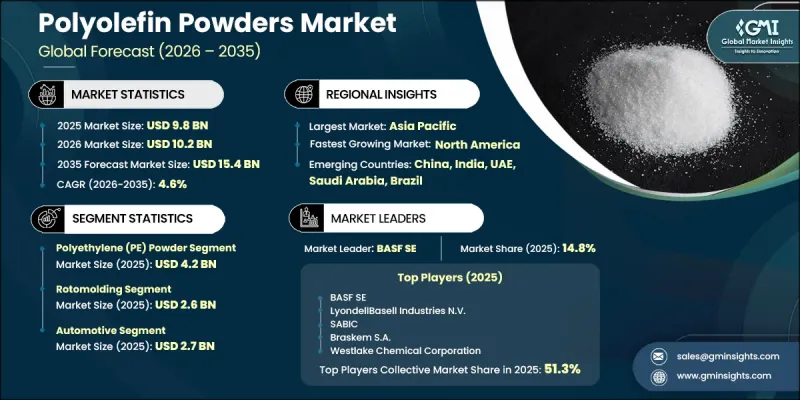
폴리올레핀 분말은 주로 폴리에틸렌(PE), 폴리프로필렌(PP), 에틸렌-프로파일렌-디엔 모노머(EPDM)를 원료로 하여 분쇄, 침전 또는 에멀젼 기반 공정을 통해 생산되는 미세한 고분자 입자입니다. 이 소재는 내화학성, 저흡습성, 열 안정성 및 가공 편의성으로 널리 인정받고 있으며, 회전 성형, 분체 도장, 접착제 및 첨단 제조 솔루션과 같은 용도 분야에 적합합니다. 이 시장은 제조업체들이 일관된 성능의 내구성, 유연성, 비용 효율성을 갖춘 제품을 개발할 수 있게 함으로써 광범위한 폴리머 산업에서 매우 중요한 역할을 하고 있습니다. 분말 형태는 펠릿이나 과립 형태에 비해 정확한 계량, 균일한 분산 및 가공 효율을 향상시킬 수 있어 전 세계적으로 보급이 확대되고 있습니다. 또한, 고성능 소재가 필수적인 자동차, 건설, 포장 부문의 견조한 소비가 수요를 형성하고 있습니다. 첨단 제조 산업은 제품 품질 향상, 지속가능성 목표 달성, 비용 최적화를 달성하기 위해 이러한 분말에 의존하고 있습니다. 이 산업에는 특정 입자 특성과 성능의 일관성을 달성하기 위해 분쇄, 극저온 및 침전 기술을 사용하는 전문 제조업체와 대규모 화학 제조업체가 모두 포함됩니다.
| 시장 범위 | |
|---|---|
| 개시 연도 | 2025년 |
| 예측 기간 | 2026-2035년 |
| 개시 시점 시장 규모 | 98억 달러 |
| 예측 시장 규모 | 154억 달러 |
| CAGR | 4.6% |
폴리에틸렌(PE) 분말 부문은 뛰어난 범용성, 저렴한 가격, 회전 성형, 코팅, 접착제, 적층 가공 등 다양한 용도 분야로 인해 2025년 42억 달러 규모를 차지했습니다. 이 소재는 내화학성, 낮은 흡습성, 우수한 가공성 외에도 LDPE와 HDPE를 포함한 다양한 밀도 등급을 사용할 수 있어 용도에 따라 유연하게 사용할 수 있다는 점에서 높은 평가를 받고 있습니다. 폴리프로필렌(PP) 분말도 폴리에틸렌계 제품에 비해 내열성이 높고, 강성이 향상되고, 화학적 안정성이 강화되어 꾸준히 수요가 증가하고 있습니다.
회전 성형 부문은 2025년에 26억 달러에 달했습니다. 이 부문은 피팅가 없고 구조적으로 균일한 중공 부품을 일관된 벽 두께로 생산할 수 있기 때문에 소비의 대부분을 차지합니다. 이 공정은 전적으로 분말 원료에 의존하고 있으며, 탱크, 컨테이너, 놀이기구, 자동차 부품 등의 제품에서 폴리에틸렌 분말의 사용량이 90% 이상을 차지합니다. 고품질의 완성된 부품을 보장하기 위해서는 제어된 입자 크기 분포, 안정된 유동 특성 및 일관된 용융 거동이 성공적인 가공에 필수적입니다.
북미의 폴리올레핀 분말 시장은 2025년 28억 달러로 평가되었고, 2035년까지 43억 달러로 성장할 것으로 예측됩니다. 이 지역의 성장은 견조한 자동차 제조, 첨단 가공 기술 채택, 저공해 분체 도장 시스템에 대한 규제 지원, 인프라 개발의 확대에 힘입어 성장세를 보이고 있습니다. 미국은 여전히 주요 기여국이며, 회전 성형, 코팅, 접착제 및 적층 가공(AM) 분야에서 널리 활용되고 있습니다. 또한, 이 지역은 통합된 석유화학 기반, 강력한 폴리머 가공 능력, 생산자와 최종 사용자 간의 효율적인 공급망 연계의 혜택을 누리고 있습니다.
자주 묻는 질문
목차
제1장 조사 방법 및 범위
제2장 주요 요약
제3장 업계 인사이트
제4장 경쟁 구도
제5장 시장 추산 및 예측 : 유형별(2022-2035년)
제6장 시장 추산 및 예측 : 용도별(2022-2035년)
제7장 시장 추산 및 예측 : 최종 이용 산업별(2022-2035년)
제8장 시장 추산 및 예측 : 지역별(2022-2035년)
제9장 기업 개요
AJY 26.06.11The Global Polyolefin Powders Market was valued at USD 9.8 billion in 2025 and is estimated to grow at a CAGR of 4.6% to reach USD 15.4 billion in 2035.
Polyolefin powders are finely milled polymer particles derived mainly from polyethylene (PE), polypropylene (PP), and ethylene propylene diene monomer (EPDM), produced through grinding, precipitation, or emulsion-based processes. These materials are widely recognized for their chemical resistance, low moisture uptake, thermal stability, and processing convenience, which make them suitable for applications such as rotomolding, powder coatings, adhesives, and advanced manufacturing solutions. The market plays a crucial role in the broader polymer industry by enabling manufacturers to develop durable, flexible, and cost-efficient products with consistent performance. Their powder form supports accurate dosing, even dispersion, and improved processing efficiency compared to pellet and granular formats, which continues to support global adoption. Demand is also shaped by strong consumption across automotive, construction, and packaging sectors, where high-performance materials are essential. Advanced manufacturing economies depend on these powders to achieve improved product quality, sustainability objectives, and cost optimization. The industry includes both specialized producers and large-scale chemical manufacturers using grinding, cryogenic, and precipitation techniques to achieve targeted particle properties and performance consistency.
| Market Scope | |
|---|---|
| Start Year | 2025 |
| Forecast Year | 2026-2035 |
| Start Value | $9.8 Billion |
| Forecast Value | $15.4 Billion |
| CAGR | 4.6% |
The polyethylene (PE) powder segment accounted for USD 4.2 billion in 2025, driven by strong versatility, affordability, and widespread use across rotomolding, coatings, adhesives, and additive manufacturing applications. The material is valued for its chemical resistance, low moisture absorption, and strong processing behavior, along with availability in multiple density grades, including LDPE and HDPE, allowing tailored use across applications. Polypropylene powders are also gaining steady traction due to higher temperature resistance, improved rigidity, and enhanced chemical stability compared to polyethylene-based alternatives.
The rotomolding segment reached USD 2.6 billion in 2025. This segment dominates consumption due to its ability to produce seamless, hollow, and structurally uniform components with consistent wall thickness. The process depends entirely on powder feedstocks, with polyethylene powders accounting for more than 90% of usage across products such as tanks, containers, playground structures, and automotive components. Successful processing requires controlled particle size distribution, stable flow characteristics, and consistent melting behavior to ensure high-quality finished parts.
North America Polyolefin Powders Market is expected to grow from USD 2.8 billion in 2025 to USD 4.3 billion by 2035. Growth in the region is supported by strong automotive manufacturing, adoption of advanced processing technologies, regulatory support for low-emission powder coating systems, and rising infrastructure development. The United States remains the key contributor, with widespread usage across rotomolding, coatings, adhesives, and additive manufacturing. The region also benefits from an integrated petrochemical base, strong polymer processing capabilities, and efficient supply chain alignment between producers and end users.
Major players operating in the Global Polyolefin Powders Industry include LyondellBasell Industries N.V., SABIC, BASF SE, Braskem S.A., Westlake Chemical Corporation, Mitsui Chemicals, Celanese Corporation, Honeywell International Inc., Clariant AG, Shamrock Technologies Inc., Micro Powders Inc., and Marcus Oil & Chemical. Companies in the polyolefin powders market are strengthening their position through capacity expansion, product innovation, and advanced polymer modification technologies. They are focusing on developing customized powder grades with improved particle uniformity, thermal resistance, and processing stability. Strategic collaborations with automotive, construction, and coatings manufacturers are supporting tailored product development. Investments in sustainable production methods, including energy-efficient processing and recyclable polymer solutions, are increasing. Firms are also expanding distribution networks to improve global supply chain efficiency while adopting digital process control systems for consistent quality assurance.
Table of Contents
Chapter 1 Methodology & Scope
- 1.1 Market scope and definition
- 1.2 Research design
- 1.2.1 Research approach
- 1.2.2 Data collection methods
- 1.3 Data mining sources
- 1.3.1 Global
- 1.3.2 Regional/Country
- 1.4 Base estimates and calculations
- 1.4.1 Base year calculation
- 1.4.2 Key trends for market estimation
- 1.5 Primary research and validation
- 1.5.1 Primary sources
- 1.6 Forecast model
- 1.7 Research assumptions and limitations
Chapter 2 Executive Summary
- 2.1 Industry 360° synopsis
- 2.2 Key market trends
- 2.2.1 Type
- 2.2.2 Application
- 2.2.3 End use industry
- 2.2.4 Regional
- 2.3 TAM Analysis, 2026-2035
- 2.4 CXO perspectives: Strategic imperatives
Chapter 3 Industry Insights
- 3.1 Industry ecosystem analysis
- 3.1.1 Supplier landscape
- 3.1.2 Profit margin
- 3.1.3 Value addition at each stage
- 3.1.4 Factor affecting the value chain
- 3.1.5 Disruptions
- 3.2 Industry impact forces
- 3.2.1 Growth drivers
- 3.2.2 Industry pitfalls and challenges
- 3.2.3 Market opportunities
- 3.3 Growth potential analysis
- 3.4 Regulatory landscape
- 3.4.1 North America
- 3.4.2 Europe
- 3.4.3 Asia Pacific
- 3.4.4 Latin America
- 3.4.5 Middle East & Africa
- 3.5 Porter's analysis
- 3.6 PESTEL analysis
- 3.7 Price trends
- 3.7.1 By region
- 3.7.2 By type
- 3.8 Future market trends
- 3.9 Technology and Innovation landscape
- 3.9.1 Current technological trends
- 3.9.2 Emerging technologies
- 3.10 Patent Landscape
- 3.11 Trade statistics (HS code)
- 3.11.1 Major importing countries
- 3.11.2 Major exporting countries
- 3.12 Sustainability and environmental aspects
- 3.12.1 Sustainable practices
- 3.12.2 Waste reduction strategies
- 3.12.3 Energy efficiency in production
- 3.12.4 Eco-friendly initiatives
- 3.13 Carbon footprint consideration
Chapter 4 Competitive Landscape, 2025
- 4.1 Introduction
- 4.2 Company market share analysis
- 4.2.1 By region
- 4.2.1.1 North America
- 4.2.1.2 Europe
- 4.2.1.3 Asia Pacific
- 4.2.1.4 LATAM
- 4.2.1.5 MEA
- 4.2.1 By region
- 4.3 Competitive analysis of major market players
- 4.4 Competitive positioning matrix
- 4.5 Key developments
- 4.5.1 Mergers & acquisitions
- 4.5.2 Partnerships & collaborations
- 4.5.3 New Product Launches
- 4.5.4 Expansion Plans
Chapter 5 Market Estimates and Forecast, By Type, 2022-2035 (USD Billion) (Kilo Tons)
- 5.1 Key trends
- 5.2 Polyethylene (PE) Powder
- 5.3 Polypropylene (PP) Powder
- 5.4 Ethylene Propylene Diene Monomer (EPDM) Powder
- 5.5 Others (polybutene, polyolefin elastomers)
Chapter 6 Market Estimates and Forecast, By Application, 2022-2035 (USD Billion) (Kilo Tons)
- 6.1 Key trends
- 6.2 Rotomolding
- 6.3 Masterbatches
- 6.4 Powder Coatings
- 6.5 Hot Melt Adhesives
- 6.6 Thermoplastic Elastomers
- 6.7 Additive Manufacturing (3D Printing)
- 6.8 Others
Chapter 7 Market Estimates and Forecast, By End-Use Industry, 2022-2035 (USD Million) (Kilo Tons)
- 7.1 Key trends
- 7.2 Automotive
- 7.3 Construction
- 7.4 Packaging
- 7.5 Consumer Goods
- 7.6 Electrical & Electronics
- 7.7 Others
Chapter 8 Market Estimates and Forecast, By Region, 2022-2035 (USD Million) (Kilo Tons)
- 8.1 Key trends
- 8.2 North America
- 8.2.1 U.S.
- 8.2.2 Canada
- 8.3 Europe
- 8.3.1 Germany
- 8.3.2 UK
- 8.3.3 France
- 8.3.4 Spain
- 8.3.5 Italy
- 8.3.6 Rest of Europe
- 8.4 Asia Pacific
- 8.4.1 China
- 8.4.2 India
- 8.4.3 Japan
- 8.4.4 Australia
- 8.4.5 South Korea
- 8.4.6 Rest of Asia Pacific
- 8.5 Latin America
- 8.5.1 Brazil
- 8.5.2 Mexico
- 8.5.3 Argentina
- 8.5.4 Rest of Latin America
- 8.6 Middle East and Africa
- 8.6.1 Saudi Arabia
- 8.6.2 South Africa
- 8.6.3 UAE
- 8.6.4 Rest of Middle East and Africa
Chapter 9 Company Profiles
- 9.1 BASF SE
- 9.2 Braskem S.A.
- 9.3 LyondellBasell Industries N.V.
- 9.4 SABIC
- 9.5 Westlake Chemical Corporation
- 9.6 Mitsui Chemicals
- 9.7 Celanese Corporation
- 9.8 Honeywell International Inc.
- 9.9 Clariant AG
- 9.10 Shamrock Technologies Inc.
- 9.11 Micro Powders Inc.
- 9.12 Marcus Oil & Chemical


