

|
시장보고서
상품코드
2038633
위내 풍선 시장 : 시장 기회, 성장요인, 업계 동향 분석 및 예측(2026-2035년)Intragastric Balloon Market Opportunity, Growth Drivers, Industry Trend Analysis, and Forecast 2026 - 2035 |
||||||

세계의 위내 풍선 시장은 2025년에 7,750만 달러로 평가되었고, 2035년까지 연평균 복합 성장률(CAGR) 15.2%로 성장할 전망이며, 3억 1,290만 달러에 이를 것으로 추정되고 있습니다.
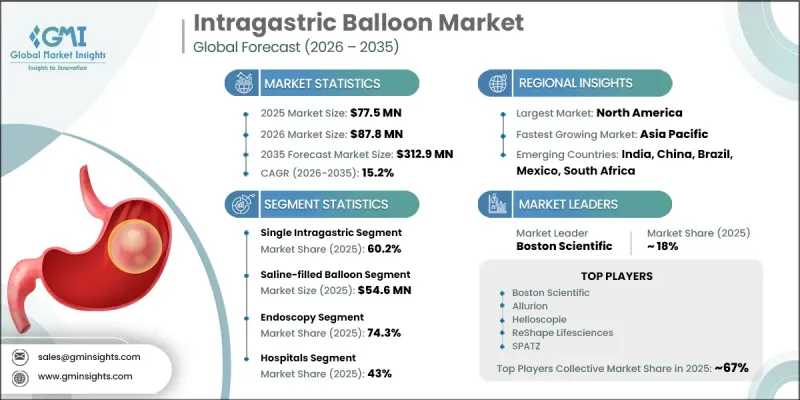
이 시장의 성장은 비만 유병률 증가, 임상적 인식 개선, 체중 관리 치료에 대한 접근성 확대, 비만 관련 치료에 대한 보험 적용 범위 확대에 의해 뒷받침되고 있습니다. 의료기기 기술의 지속적인 발전은 치료 결과와 환자의 수용성을 향상시키고 있습니다. 위내 풍선은 위 내에 삽입하여 포만감을 주어 식사 섭취량을 줄이기 위해 위 내에 삽입하는 저침습적, 비수술적 체중감량용 장치입니다. 일반적으로 식이요법이나 운동만으로 효과를 보지 못한 분들에게 추천합니다. 이 장치는 내시경을 이용하거나 캡슐 형태로 삽입되며, 정해진 치료 기간이 지나면 제거됩니다. 조정 가능한 시스템, 삼킬 수 있는 캡슐 기술 등 풍선 디자인의 지속적인 혁신으로 안전성과 편안함, 시술 효율성이 향상되고 있습니다. 디지털 헬스 툴과 원격 환자 모니터링의 통합으로 시술 후 관리 및 치료 순응도가 더욱 향상되고 있습니다. 또한, 비만관리 전문 클리닉의 확대도 의료 시스템 전반의 보급을 촉진하고 있습니다.
| 시장 범위 | |
|---|---|
| 개시 연도 | 2025년 |
| 예측 기간 | 2026-2035년 |
| 개시 연도 시장 규모 | 7,750만 달러 |
| 예측 시장 규모 | 3억 1,290만 달러 |
| CAGR | 15.2% |
2025년에는 단일 위내 풍선 부문이 60.2%의 점유율을 차지했습니다. 이는 이미 확립된 임상적 용도, 삽입 및 제거 과정의 용이성, 그리고 멀티벌룬 시스템에 비해 합병증 위험이 낮기 때문입니다. 이 장치들은 시술 시간을 단축하고 환자의 편의성을 높이는 간단한 이식 절차를 제공하기 때문에 널리 선호되고 있습니다. 이러한 편리함을 통해 의료진은 안전 기준을 유지하면서 보다 효율적으로 치료할 수 있습니다. 그 결과, 의사들의 강력한 지지와 입증된 임상 결과를 바탕으로 단일 풍선 시스템은 체중 감량 치료에서 가장 널리 사용되는 선택이 되고 있습니다.
식염수 충전형 풍선 시장은 2025년에 5,460만 달러 시장 규모를 기록했으며, 2035년까지 연평균 14.8%의 성장률을 보일 것으로 예측됩니다. 이 부문은 높은 안전성 프로파일과 체중 조절 치료에서 신뢰할 수 있는 성능으로 인해 널리 선호되고 있습니다. 누출이나 파열이 발생하더라도 식염수 충전 시스템은 체내에 안전하게 흡수되기 때문에 위험을 최소화할 수 있습니다. 또한, 이 풍선은 사용 중 팽창을 제어하고 안정성을 높여 수축에 따른 합병증 발생 위험을 줄여줍니다. 일관된 성능과 높은 안전성으로 인해 비수술적 체중 감량 솔루션을 찾는 의료진과 환자들 사이에서 신뢰할 수 있는 선택이 되고 있습니다.
북미의 위내 풍선 시장은 높은 비만 유병률과 비침습적 체중 관리 솔루션에 대한 수요 증가에 힘입어 2025년 38.9%의 점유율을 차지했습니다. 앉아서 생활하는 습관, 고칼로리 식습관 등 생활습관 요인이 이 지역 전체의 비만율 상승에 크게 기여하고 있습니다. 이는 비만과 관련된 질병의 부담을 증가시키고 조기 개입 전략을 촉진하고 있습니다. 이 지역의 의료 서비스 제공업체들은 자격을 갖춘 환자들에게 비만 수술의 대안으로 위내 풍선을 점점 더 많이 채택하고 있으며, 이는 모든 임상 현장에서 시장의 꾸준한 성장을 뒷받침하고 있습니다.
자주 묻는 질문
목차
제1장 조사 방법
제2장 주요 요약
제3장 업계 인사이트
제4장 경쟁 구도
제5장 시장 추산 및 예측 : 제품별(2022-2035년)
제6장 시장 추산 및 예측 : 충전 재별(2022-2035년)
제7장 시장 추산 및 예측 : 투여 경로별(2022-2035년)
제8장 시장 추산 및 예측 : 최종 용도별(2022-2035년)
제9장 시장 추산 및 예측 : 지역별(2022-2035년)
제10장 기업 개요
AJY 26.06.11The Global Intragastric Balloon Market was valued at USD 77.5 million in 2025 and is estimated to grow at a CAGR of 15.2% to reach USD 312.9 million by 2035.
The market growth is supported by rising obesity prevalence, improved clinical awareness, expanding access to weight management treatments, and increasing insurance coverage for obesity-related interventions. Continuous advancements in medical device technology are also improving treatment outcomes and patient acceptance. Intragastric balloons are minimally invasive, non-surgical weight-loss devices placed in the stomach to reduce food intake by creating a feeling of fullness. They are generally recommended for individuals who have not achieved results through diet and exercise alone. These devices are inserted endoscopically or in capsule form and removed after a defined treatment period. Ongoing innovation in balloon design, including adjustable systems and swallowable capsule technologies, is enhancing safety, comfort, and procedural efficiency. Integration of digital health tools and remote patient monitoring is further improving post-procedure care and treatment adherence. Expansion of specialized obesity management clinics is also supporting broader adoption across healthcare systems.
| Market Scope | |
|---|---|
| Start Year | 2025 |
| Forecast Year | 2026-2035 |
| Start Value | $ 77.5 Million |
| Forecast Value | $312.9 Million |
| CAGR | 15.2% |
The single intragastric balloon segment held a 60.2% share in 2025 owing to its established clinical usage, easier insertion and removal process, and lower complication risk compared to multi-balloon systems. These devices are widely preferred because they offer a straightforward implantation procedure that reduces procedural time and enhances patient convenience. Their simplicity also allows healthcare providers to perform treatments more efficiently while maintaining safety standards. As a result, single balloon systems continue to be the most widely used option in weight-loss interventions, supported by strong physician preference and proven clinical outcomes.
The saline-filled balloon segment generated USD 54.6 million in 2025 and is projected to grow at a CAGR of 14.8% through 2035. This segment is widely preferred due to its strong safety profile and reliable performance in weight management treatments. In case of leakage or rupture, saline-filled systems pose minimal risk as the solution is safely absorbed by the body. These balloons also provide controlled inflation and greater stability during use, reducing the likelihood of deflation-related complications. Their consistent performance and improved safety characteristics make them a trusted choice among healthcare professionals and patients seeking non-surgical weight loss solutions.
North America Intragastric Balloon Market held a 38.9% share in 2025, driven by a high prevalence of obesity and increasing demand for non-invasive weight management solutions. Lifestyle factors such as sedentary behavior and high-calorie diets have significantly contributed to rising obesity rates across the region. This has increased the burden of obesity-related conditions, encouraging early intervention strategies. Healthcare providers in the region are increasingly adopting intragastric balloons as an alternative to bariatric surgery for eligible patients, supporting steady market expansion across clinical settings.
Major players operating in the Global Intragastric Balloon Industry are Allurion, Boston Scientific, ReShape Lifesciences, SPATZ, Medispar, SILIMED, Endalis, HELIOSCOPIE, Districlass Medical, Beijing ZKSK Technology, SHENYUN, Suzhou Shenyun Medical, Medicone, HEALTH WARE. Companies in the Intragastric Balloon Market are focusing on strengthening their market position through continuous product innovation and the development of safer, more comfortable, and minimally invasive weight-loss devices. Strategic partnerships with hospitals, bariatric clinics, and healthcare providers are being used to expand clinical adoption and improve patient access. Firms are investing heavily in research and development to introduce adjustable and swallowable balloon technologies that enhance treatment efficiency and reduce procedural complexity. Expansion into emerging healthcare markets is also supporting revenue growth and broader geographic reach. In addition, companies are integrating digital health platforms and remote monitoring tools to improve patient follow-up and treatment outcomes. Strong emphasis is being placed on clinical trials and regulatory approvals to build trust and strengthen product credibility.
Table of Contents
Chapter 1 Research Methodology
- 1.1 Research approach
- 1.2 Quality commitments
- 1.2.1 GMI AI policy & data integrity commitment
- 1.2.1.1 Source consistency protocol
- 1.2.1 GMI AI policy & data integrity commitment
- 1.3 Research trail & confidence scoring
- 1.3.1 Research trail components
- 1.3.2 Scoring components
- 1.4 Data collection
- 1.4.1 Partial list of primary sources
- 1.5 Data mining sources
- 1.5.1 Paid sources
- 1.5.1.1 Sources, by region
- 1.5.1 Paid sources
- 1.6 Base estimates and calculations
- 1.6.1 Base year calculation for any one approach
- 1.7 Forecast model
- 1.7.1 Quantified market impact analysis
- 1.7.1.1 Mathematical impact of growth parameters on forecast
- 1.7.1 Quantified market impact analysis
- 1.8 Research transparency addendum
- 1.8.1 Source attribution framework
- 1.8.2 Quality assurance metrics
- 1.8.3 Our commitment to trust
Chapter 2 Executive Summary
- 2.1 Industry 3600 synopsis
- 2.2 Key market trends
- 2.2.1 Regional trends
- 2.2.2 Product trends
- 2.2.3 Filling material trends
- 2.2.4 Administration trends
- 2.2.5 End use trends
- 2.3 CXO perspectives: Strategic imperatives
Chapter 3 Industry Insights
- 3.1 Industry ecosystem analysis
- 3.2 Industry impact forces
- 3.2.1 Growth drivers
- 3.2.1.1 Increasing prevalence of obesity
- 3.2.1.2 Growing preference for minimally invasive procedures
- 3.2.1.3 Technological advancements in intragastric balloon systems
- 3.2.2 Industry pitfalls and challenges
- 3.2.2.1 Risk of side effects and complications
- 3.2.3 Market opportunities
- 3.2.3.1 Development of advanced and swallowable balloon technologies
- 3.2.3.2 Expansion of bariatric and endoscopic treatment centers
- 3.2.1 Growth drivers
- 3.3 Growth potential analysis
- 3.4 Regulatory landscape (Driven by primary research)
- 3.4.1 North America
- 3.4.2 Europe
- 3.4.3 Asia Pacific
- 3.5 Technology landscape
- 3.5.1 Current technological trends
- 3.5.2 Emerging technologies
- 3.6 Reimbursement scenario (Driven by primary research)
- 3.7 Future market trends
- 3.8 Porter's analysis
- 3.9 PESTEL analysis
- 3.10 Customer insights (Driven by primary research)
- 3.11 Start-up scenarios (Driven by primary research)
- 3.12 Impact of AI and its future assessment
- 3.13 Value chain analysis
Chapter 4 Competitive Landscape, 2025
- 4.1 Introduction
- 4.2 Company matrix analysis
- 4.3 Company market share analysis (Driven by primary research)
- 4.3.1 Global
- 4.3.2 North America
- 4.3.3 Europe
- 4.3.4 Asia Pacific
- 4.4 Competitive positioning matrix
- 4.5 Competitive analysis of major market players
- 4.6 Key developments
- 4.6.1 Mergers & acquisitions
- 4.6.2 Partnerships & collaborations
- 4.6.3 New product launches
- 4.6.4 Expansion plans
Chapter 5 Market Estimates and Forecast, By Product, 2022 - 2035 ($ Mn)
- 5.1 Key trends
- 5.2 Single intragastric balloon
- 5.3 Dual intragastric balloon
- 5.4 Triple intragastric balloon
Chapter 6 Market Estimates and Forecast, By Filling Material, 2022 - 2035 ($ Mn)
- 6.1 Key trends
- 6.2 Saline-filled balloon
- 6.3 Gas-filled balloon
Chapter 7 Market Estimates and Forecast, By Administration, 2022 - 2035 ($ Mn)
- 7.1 Key trends
- 7.2 Endoscopy
- 7.3 Pill form
Chapter 8 Market Estimates and Forecast, By End Use, 2022 - 2035 ($ Mn)
- 8.1 Key trends
- 8.2 Hospitals
- 8.3 Ambulatory surgical centers
- 8.4 Specialty clinics
- 8.5 Other end users
Chapter 9 Market Estimates and Forecast, By Region, 2022 - 2035 ($ Mn)
- 9.1 Key trends
- 9.2 North America
- 9.2.1 U.S.
- 9.2.2 Canada
- 9.3 Europe
- 9.3.1 Germany
- 9.3.2 UK
- 9.3.3 France
- 9.3.4 Spain
- 9.3.5 Italy
- 9.3.6 Netherlands
- 9.4 Asia Pacific
- 9.4.1 China
- 9.4.2 Japan
- 9.4.3 India
- 9.4.4 Australia
- 9.4.5 South Korea
- 9.5 Latin America
- 9.5.1 Brazil
- 9.5.2 Mexico
- 9.5.3 Argentina
- 9.6 Middle East and Africa
- 9.6.1 South Africa
- 9.6.2 Saudi Arabia
- 9.6.3 UAE
Chapter 10 Company Profiles
- 10.1 Allurion
- 10.2 Beijing ZKSK Technology
- 10.3 Boston Scientific
- 10.4 Districlass Medical
- 10.5 Endalis
- 10.6 HEALTH WARE
- 10.7 Helioscopie
- 10.8 Medicone
- 10.9 Medispar
- 10.10 ReShape Lifesciences
- 10.11 SHENYUN
- 10.12 SILIMED
- 10.13 SPATZ
- 10.14 Suzhou Shenyun Medical


