|
시장보고서
상품코드
2038639
선내 엔진 시장 : 시장 비즈니스 기회, 성장요인, 업계 동향 분석 및 예측(2026-2035년)Inboard Engines Market Opportunity, Growth Drivers, Industry Trend Analysis, and Forecast 2026 - 2035 |
||||||

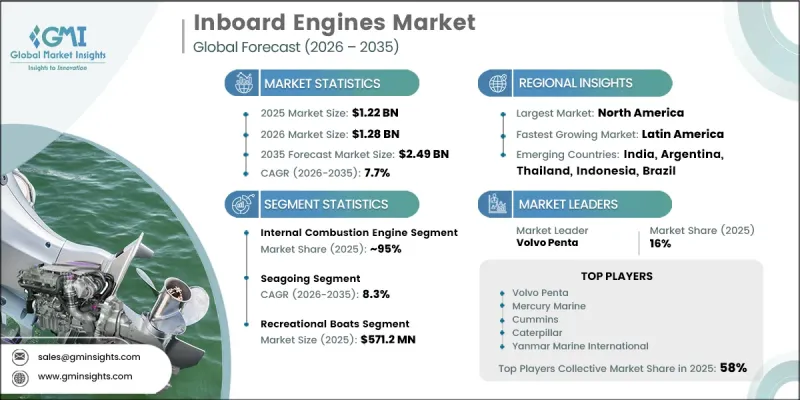
세계의 선내 엔진 시장은 2025년에 12억 2,000만 달러로 평가되었고, CAGR 7.7%로 성장할 전망이며, 2035년까지 24억 9,000만 달러에 이를 것으로 예측됩니다.
시장 확대는 레크리에이션 보트 활동 증가, 선박 추진 기술의 지속적인 발전, 경제 상황의 개선 및 환경 규제 강화에 의해 주도되고 있습니다. 선상 엔진의 설치는 종종 복잡하고 많은 노력이 필요하며, 전문 장비와 숙련된 기술 전문 지식이 필요합니다. 동시에, 선박 추진 시스템에 디지털 기술과 스마트 기술을 통합하여 실시간 모니터링과 성능 제어가 가능해져 사용자 경험을 혁신적으로 변화시키고 있습니다. 이러한 변화는 고도의 연결성과 지능형 시스템 기능을 기대하는 기술 지향적인 보트 소유자 증가로 인해 더욱 가속화되고 있습니다. 그러나 정비, 오일 교환, 계절별 준비와 같은 지속적인 유지 보수 요구 사항으로 인해 소유 비용은 여전히 높은 수준을 유지하고 있으며, 이는 보트 운영자의 라이프 사이클 비용에 추가됩니다. 또한, 코로나19 사태 기간 동안 시장은 혼란을 겪었습니다. 공급망 제약과 노동력 부족이 일시적으로 생산에 영향을 미치고 설치가 지연되어 해당 기간 동안 선박 생산량이 감소했습니다. 이러한 문제에도 불구하고, 해상 운송 및 레저용 보트 활동이 전 세계적으로 확대됨에 따라 장기적인 수요는 계속 증가하고 있습니다.
| 시장 범위 | |
|---|---|
| 개시 연도 | 2025년 |
| 예측 기간 | 2026-2035년 |
| 개시 연도 시장 규모 | 12억 2,000만 달러 |
| 예측 시장 규모 | 24억 9,000만 달러 |
| CAGR | 7.7% |
내연기관 부문은 2025년 95%의 점유율을 차지했으며, 2026-2035년 연평균 복합 성장률(CAGR) 5.9%를 나타낼 것으로 예측됩니다. 이러한 선도적 위치는 이미 확립된 성능과 신뢰성, 성숙한 인프라, 연료 에너지 밀도에서의 큰 우위를 바탕으로 하고 있습니다. 디젤 동력 시스템은 높은 토크 출력, 내구성 및 연료 효율로 인해 열악한 해양 환경에 적합하기 때문에 여전히 가장 널리 사용되는 구성입니다. 그러나 이 부문은 전동화 추세, 규제 강화, 연료비 변동으로 인한 압력 증가에 직면해 있습니다.
원양 항해 부문은 2025년 60%의 점유율을 차지했으며, 2035년까지 연평균 8.3%의 성장률을 보일 것으로 전망됩니다. 이 부문에는 해양 환경에서의 해양 작업, 연안 운송 및 레크리에이션 보트 활동이 포함됩니다. 이 분야에서는 지속적인 해수 노출과 장기간의 작동 사이클과 같은 가혹한 작동 조건에서도 높은 내구성, 내식성 및 신뢰성 있는 성능을 발휘할 수 있는 추진 시스템이 요구됩니다.
미국의 선내 엔진 시장은 2025년 3억 7,500만 달러 규모에 달했습니다. 연간 참여자가 1억 명에 육박하는 이 나라의 뿌리 깊은 레크리에이션 보트 문화는 안정적인 수요를 뒷받침하고 있습니다. 광활한 내륙 수로와 연안 수로, 주요 상업 해운 항로 또한 시장 활성화에 더욱 기여하고 있습니다. 또한, 정부 및 국방 분야에서도 안정적인 수요를 창출하고 있으며, 해군 및 해안경비대 활동은 중요한 임무 수행을 위해 신뢰할 수 있는 선박용 추진 시스템을 요구하고 있습니다.
자주 묻는 질문
목차
제1장 조사 방법 및 범위
제2장 주요 요약
제3장 업계 인사이트
제4장 경쟁 구도
제5장 시장 추산 및 예측 : 엔진별(2022-2035년)
제6장 시장 추산 및 예측 : 전력별(2022-2035년)
제7장 시장 추산 및 예측 : 용도별(2022-2035년)
제8장 시장 추산 및 예측 : 수로별(2022-2035년)
제9장 시장 추산 및 예측 : 최종 용도별(2022-2035년)
제10장 시장 추산 및 예측 : 지역별(2022-2035년)
제11장 기업 개요
AJY 26.06.11The Global Inboard Engines Market was valued at USD 1.22 billion in 2025 and is estimated to grow at a CAGR of 7.7% to reach USD 2.49 billion by 2035.
Market expansion is driven by increasing recreational boating activity, continuous advancements in marine propulsion technologies, improving economic conditions, and tightening environmental regulations. The installation of inboard engines is often complex and labor-intensive, requiring specialized equipment and skilled technical expertise. At the same time, the integration of digital and smart technologies into marine propulsion systems is transforming user experience by enabling real-time monitoring and performance control. This shift is being reinforced by a growing base of technology-oriented boat owners who expect enhanced connectivity and intelligent system capabilities. However, ownership costs remain elevated due to ongoing maintenance requirements such as servicing, oil replacement, and seasonal preparation, which add to lifecycle expenses for boat operators. The market also experienced disruptions during the COVID-19 period, when supply chain constraints and workforce shortages temporarily impacted production and delayed installations, resulting in reduced vessel output during that timeframe. Despite these challenges, long-term demand continues to strengthen as marine transportation and recreational boating activities expand globally.
| Market Scope | |
|---|---|
| Start Year | 2025 |
| Forecast Year | 2026-2035 |
| Start Value | $1.22 Billion |
| Forecast Value | $2.49 Billion |
| CAGR | 7.7% |
The internal combustion engine segment held a share of 95% in 2025 and is expected to grow at a CAGR of 5.9% from 2026 to 2035. Its leadership position is supported by established performance reliability, mature infrastructure, and strong fuel energy density advantages. Diesel-powered systems remain the most widely used configuration due to their high torque output, durability, and fuel efficiency, making them well-suited for demanding marine environments. However, the segment faces increasing pressure from electrification trends, regulatory tightening, and fluctuating fuel costs.
The seagoing segment accounted for 60% share in 2025 and is projected to grow at a CAGR of 8.3% through 2035. This segment includes offshore operations, coastal transport, and recreational boating activities in marine environments. It requires propulsion systems capable of delivering high durability, corrosion resistance, and reliable performance under harsh operating conditions, including continuous saltwater exposure and extended operational cycles.
U.S. Inboard Engines Market generated USD 375 million in 2025. The country's strong recreational boating culture, with nearly 100 million annual participants, supports consistent demand. Extensive inland and coastal waterways, along with major commercial maritime routes, further contribute to market activity. In addition, government and defense applications provide stable demand, with naval and coast guard operations requiring reliable marine propulsion systems for critical missions.
Key companies operating in the Global Inboard Engines Market include MAN Energy Solutions, Volvo Penta, Caterpillar, Cummins, Mercury Marine, Yanmar Marine International, Scania AB, FPT Industrial, Nanni Industries, and Pleasurecraft Marine Engine. Companies in the Inboard Engines Market are focusing on enhancing engine efficiency, durability, and digital integration to strengthen their competitive position. Investment in smart propulsion systems and connectivity features enable real-time monitoring and predictive maintenance capabilities. Manufacturers are expanding product portfolios to include advanced fuel-efficient and hybrid-ready solutions in response to evolving regulatory standards. Strategic partnerships with boat builders and marine service providers are helping improve market penetration and customer reach. Firms are also increasing spending on research and development to improve corrosion resistance, fuel economy, and performance reliability in harsh marine environments.
Table of Contents
Chapter 1 Methodology & Scope
- 1.1 Research approach
- 1.2 Quality Commitments
- 1.2.1 GMI AI policy & data integrity commitment
- 1.2.1.1 Source consistency protocol
- 1.2.1 GMI AI policy & data integrity commitment
- 1.3 Research Trail & Confidence Scoring
- 1.3.1 Research Trail Components
- 1.3.2 Scoring Components
- 1.4 Data Collection
- 1.4.1 Partial list of primary sources
- 1.5 Data mining sources
- 1.5.1 Paid sources
- 1.5.1.1 Sources, by region
- 1.5.1 Paid sources
- 1.6 Base estimates and calculations
- 1.6.1 Base year calculation for any one approach
- 1.7 Forecast
- 1.7.1 Quantified market impact analysis
- 1.7.1.1 Mathematical impact of growth parameters on forecast
- 1.7.1 Quantified market impact analysis
- 1.8 Research transparency addendum
- 1.8.1 Source attribution framework
- 1.8.2 Quality assurance metrics
- 1.8.3 Our commitment to trust
Chapter 2 Executive Summary
- 2.1 Industry 360° synopsis
- 2.2 Key market trends
- 2.2.1 Regional
- 2.2.2 Engine
- 2.2.3 Power
- 2.2.4 Application
- 2.2.5 Waterways
- 2.2.6 End use
- 2.3 TAM Analysis, 2026-2035
- 2.4 CXO perspectives: Strategic imperatives
Chapter 3 Industry Insights
- 3.1 Industry ecosystem analysis
- 3.1.1 Supplier landscape
- 3.1.1.1 Raw material suppliers
- 3.1.1.2 Component manufacturers
- 3.1.1.3 Engine manufacturers
- 3.1.1.4 Equipment manufacturers
- 3.1.1.5 Distributors and dealers
- 3.1.1.6 Aftermarket suppliers
- 3.1.2 Cost structure
- 3.1.3 Profit margin
- 3.1.4 Value addition at each stage
- 3.1.5 Vertical integration trends
- 3.1.6 Disruptors
- 3.1.1 Supplier landscape
- 3.2 Impact on forces
- 3.2.1 Growth drivers
- 3.2.1.1 Growth in commercial marine transport and inland waterway logistics
- 3.2.1.2 Rising demand for recreational boating and leisure marine activities
- 3.2.1.3 Fleet modernization and replacement of aging marine engines
- 3.2.1.4 Stricter marine emission norms
- 3.2.2 Industry pitfalls & challenges
- 3.2.2.1 High initial cost of advanced inboard marine engines
- 3.2.2.2 Volatility in marine fuel prices and operating costs
- 3.2.3 Market opportunities
- 3.2.3.1 Shift toward fuel-efficient and low-emission propulsion systems
- 3.2.3.2 Increasing adoption of hybrid and electric-hybrid marine propulsion
- 3.2.3.3 Integration of digital engine monitoring and predictive maintenance
- 3.2.3.4 Growth in modular and compact engine designs
- 3.2.1 Growth drivers
- 3.3 Technology trends & innovation ecosystem
- 3.3.1 Current technologies
- 3.3.2 Emerging technologies
- 3.4 Growth potential analysis
- 3.5 Regulatory landscape
- 3.5.1 North America
- 3.5.1.1 Inflation Reduction Act
- 3.5.1.2 Clean Air Act
- 3.5.2 Europe
- 3.5.2.1 European Green Deal
- 3.5.2.2 Euro 7 Emission Standards
- 3.5.3 Asia-Pacific
- 3.5.3.1 New Energy Vehicle (NEV) Credit Policy
- 3.5.3.2 Automotive Industry Standard (AIS) 156
- 3.5.4 Latin America
- 3.5.4.1 Programa Rota 2030
- 3.5.4.2 Mexican NOM Emissions Standards
- 3.5.5 Middle East & Africa
- 3.5.5.1 UAE Net Zero 2050 Strategy
- 3.5.5.2 South Africa Green Transport Strategy
- 3.5.1 North America
- 3.6 Porter's analysis
- 3.7 PESTEL analysis
- 3.8 Patent analysis (Driven by Primary Research)
- 3.9 Pricing Analysis (Driven by Primary Research)
- 3.9.1 Historical Price Trend Analysis
- 3.9.2 Pricing Strategy by Player Type
- 3.10 Capacity & Production Landscape (Driven by Primary Research)
- 3.10.1 Installed Capacity by Region & Key Producer
- 3.10.2 Capacity Utilization Rates & Expansion Pipelines
- 3.11 Trade Data Analysis (Driven by Primary Research)
- 3.11.1 Import/Export Volume & Value Trends
- 3.11.2 Key Trade Corridors & Tariff Impact
- 3.12 Sustainability and environmental aspects
- 3.12.1 Sustainable practices
- 3.12.2 Waste reduction strategies
- 3.12.3 Energy efficiency in production
- 3.12.4 Eco-friendly initiatives
- 3.12.5 Carbon footprint considerations
- 3.13 Impact of AI & generative AI on the market
- 3.13.1 AI-driven disruption of existing business models
- 3.13.2 GenAI use cases & adoption roadmap by segment
- 3.13.3 Risks, limitations & regulatory considerations
- 3.14 Forecast assumptions & scenario analysis (Driven by Primary Research)
- 3.14.1 Base Case - key macro & industry variables driving CAGR
- 3.14.2 Optimistic Scenarios - Favorable Macro and Industry Tailwinds
- 3.14.3 Pessimistic Scenario - Macroeconomic slowdown or industry headwinds
Chapter 4 Competitive Landscape, 2025
- 4.1 Introduction
- 4.2 Company market share analysis
- 4.2.1 North America
- 4.2.2 Europe
- 4.2.3 Asia Pacific
- 4.2.4 Latin America
- 4.2.5 MEA
- 4.3 Competitive analysis of major market players
- 4.4 Competitive positioning matrix
- 4.5 Company Tier Benchmarking
- 4.5.1 Tier Classification Criteria & Qualifying Thresholds
- 4.5.2 Tier Positioning Matrix by Revenue, Geography & Innovation
- 4.6 Key developments
- 4.6.1 Mergers & acquisitions
- 4.6.2 Partnerships & collaborations
- 4.6.3 New product launches
- 4.6.4 Expansion plans and funding
Chapter 5 Market Estimates & Forecast, By Engine, 2022 - 2035 ($ Bn, Units)
- 5.1 Key trends
- 5.2 Internal Combustion Engine
- 5.2.1 Two-stroke
- 5.2.2 Four-stroke
- 5.3 Electric
Chapter 6 Market Estimates & Forecast, By Power, 2022 - 2035 ($ Bn, Units)
- 6.1 Key trends
- 6.2 Up to 100 hp
- 6.3 100-300 hp
- 6.4 Above 300 hp
Chapter 7 Market Estimates & Forecast, By Application, 2022 - 2035 ($ Bn, Units)
- 7.1 Key trends
- 7.2 Recreational boats
- 7.2.1 Yachts
- 7.2.2 Pleasure boats
- 7.2.3 Water sports boats
- 7.2.4 Others
- 7.3 Commercial boats
- 7.3.1 Fishing boats
- 7.3.2 Passenger boats
- 7.3.3 Ferries
- 7.3.4 Goods Tranportation
- 7.3.5 Others
- 7.4 Government & Defense
- 7.4.1 Military
- 7.4.2 Coast guard
- 7.4.3 Patrol
- 7.4.4 Rescue
- 7.4.5 Others
- 7.5 Others
Chapter 8 Market Estimates & Forecast, By Waterways, 2022 - 2035 ($ Bn, Units)
- 8.1 Key trends
- 8.2 Seagoing
- 8.3 Inland
Chapter 9 Market Estimates & Forecast By End use, 2022 - 2035 ($ Bn, Units)
- 9.1 Key trends
- 9.2 OEM
- 9.3 Aftermarket
Chapter 10 Market Estimates & Forecast, By Region, 2022 - 2035 ($ Bn, Units)
- 10.1 Key trends
- 10.2 North America
- 10.2.1 US
- 10.2.2 Canada
- 10.3 Europe
- 10.3.1 UK
- 10.3.2 Germany
- 10.3.3 France
- 10.3.4 Italy
- 10.3.5 Spain
- 10.3.6 Belgium
- 10.3.7 Netherlands
- 10.3.8 Sweden
- 10.3.9 Russia
- 10.4 Asia Pacific
- 10.4.1 China
- 10.4.2 India
- 10.4.3 Japan
- 10.4.4 Australia
- 10.4.5 Singapore
- 10.4.6 South Korea
- 10.4.7 Vietnam
- 10.4.8 Indonesia
- 10.5 Latin America
- 10.5.1 Brazil
- 10.5.2 Mexico
- 10.5.3 Argentina
- 10.6 MEA
- 10.6.1 South Africa
- 10.6.2 Saudi Arabia
- 10.6.3 UAE
Chapter 11 Company Profiles
- 11.1 Global players
- 11.1.1 Volvo Penta
- 11.1.2 Mercury Marine
- 11.1.3 Caterpillar
- 11.1.4 Cummins
- 11.1.5 Yanmar Marine International
- 11.1.6 MAN Energy Solutions
- 11.1.7 FPT Industrial (Iveco Group)
- 11.1.8 Scania AB
- 11.1.9 Pleasurecraft Marine Engine
- 11.2 Regional players
- 11.2.1 Nanni Industries
- 11.2.2 STEYR Motors
- 11.2.3 Sole Diesel
- 11.2.4 Beta Marine
- 11.2.5 HD Hyundai Infracore
- 11.2.6 Torqeedo
- 11.2.7 Oceanvolt
- 11.3 Emerging players
- 11.3.1 EVOY
- 11.3.2 Elco Motor Yachts
- 11.3.3 Ilmor Marine
- 11.3.4 Indmar Marine