|
시장보고서
상품코드
2038641
테레프탈산 디메틸 시장 : 시장 기회, 성장요인, 업계 동향 분석 및 예측(2026-2035년)Dimethyl Terephthalate Market Opportunity, Growth Drivers, Industry Trend Analysis, and Forecast 2026 - 2035 |
||||||

세계의 테레프탈산 디메틸 시장은 2025년에 13억 달러로 평가되었고, CAGR 5.8%로 성장할 전망이며, 2035년까지 22억 4,000만 달러에 이를 것으로 추정되고 있습니다.
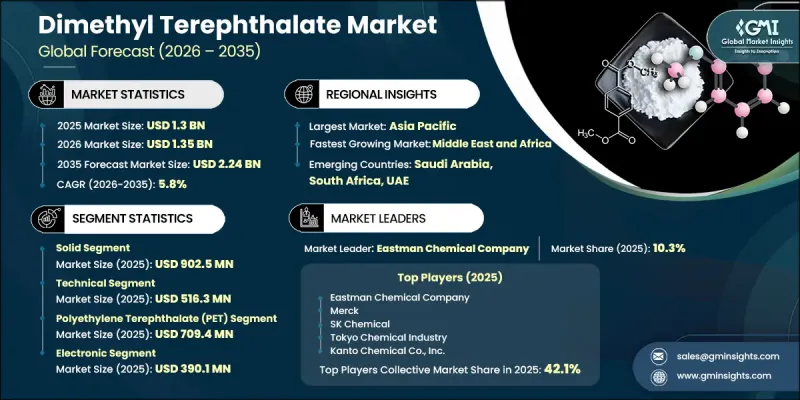
테레프탈산 디메틸은 폴리에스테르 제조의 주요 중간체로 널리 사용되는 유기 화합물입니다. 메탄올과 테레프탈산의 에스테르화 반응에 의해 생성되는 무색, 미약한 냄새가 나는 고체입니다. 이 화합물은 화학적 가치사슬에서 필수적인 구성 요소로 작용하며, 섬유, 필름, 수지 계열 용도 분야에 추가로 사용되는 폴리머로 전환됩니다. 안정된 품질, 취급의 용이성, 대규모 산업적 가공에 대한 적합성으로 인해 제조 현장에서 선호되는 소재가 되었습니다. 이 시장은 다운스트림 폴리에스테르 생산과 밀접한 관련이 있으며, 그 수요는 섬유, 포장재, 자동차 부품, 전기절연제품의 소비에 따라 좌우됩니다. 폴리에스테르계 제품의 세계 소비 트렌드는 시장 확대에 큰 영향을 미치고 있습니다. 공급 동향은 원재료의 가용성 및 전체 제조 시설의 생산 효율성에 따라 달라집니다. 또한, 업계는 공정 최적화, 운영 효율성 향상, 청정 생산 기술 및 자원 활용 개선을 통한 환경 부하 감소에 점점 더 많은 노력을 기울이고 있습니다.
| 시장 범위 | |
|---|---|
| 개시 연도 | 2025년 |
| 예측 기간 | 2026-2035년 |
| 개시 연도 시장 규모 | 13억 달러 |
| 예측 시장 규모 | 22억 4,000만 달러 |
| CAGR | 5.8% |
2025년, 고체 부문은 9억 2,500만 달러를 차지했습니다. 고체 테레프탈산 디메틸은 안정성, 안전한 보관 특성 및 기존 폴리에스테르 생산 시스템과의 호환성으로 인해 널리 선호되고 있습니다. 취급의 용이성과 제어된 산업 공정에 대한 적합성으로 인해 대규모 생산에서 일관된 품질의 생산이 필수적인 배치식 제조 환경에서 매우 효과적입니다.
폴리에틸렌 테레프탈레이트(PET) 용도 분야는 2025년 7억 9,400만 달러에 달했습니다. 이 부문이 선도적인 위치를 차지하고 있는 이유는 섬유 생산, 포장용 필름, 플라스틱 용기에 PET가 널리 사용되고 있기 때문입니다. 포장 및 섬유 산업의 안정적인 수요가 성장을 뒷받침하고 있으며, 이들 분야는 내구성이 뛰어나고 비용 효율적인 소재 솔루션으로 PET에 크게 의존하고 있습니다. 또한, 폴리트리메틸렌테레프탈레이트(PTT)는 규모는 작지만 꾸준히 성장하고 있는 분야로, 테레프탈산 디메틸은 유연성, 탄력성 및 제어된 기계적 성능 특성이 요구되는 특수 섬유 및 엔지니어링 소재의 제조에 사용됩니다.
북미의 테레프탈산 디메틸 시장은 2025년 3억 5,060만 달러로 평가되었고, 2035년 6억 달러로 성장할 것으로 예측됩니다. 이 지역에는 폴리에스테르 생산시설, 포장산업, 그리고 탄탄한 산업 인프라가 존재하기 때문에 수요는 안정적입니다. 소비 패턴은 제조 효율 및 각 최종 사용 산업에서 표준화 된 재료의 사용 현황과 밀접한 관련이 있습니다. 미국에서는 포장용, 자동차 부품 및 산업용 섬유 생산에서 균형 잡힌 수요를 유지하고 있습니다. 지속적인 공정 최적화와 규제 요건의 변화로 인해 제조업체는 보다 효율적인 생산 방식을 채택하고 엄선된 원료를 사용해야 하는 상황에 직면해 있습니다.
자주 묻는 질문
목차
제1장 조사 방법 및 범위
제2장 주요 요약
제3장 업계 인사이트
제4장 경쟁 구도
제5장 시장 추산 및 예측 : 형태별(2022-2035년)
제6장 시장 추산 및 예측 : 등급별(2022-2035년)
제7장 시장 추산 및 예측 : 용도별(2022-2035년)
제8장 시장 추산 및 예측 : 최종 용도별(2022-2035년)
제9장 시장 추산 및 예측 : 지역별(2022-2035년)
제10장 기업 개요
AJY 26.06.11The Global Dimethyl Terephthalate Market was valued at USD 1.3 billion in 2025 and is estimated to grow at a CAGR of 5.8% to reach USD 2.24 billion by 2035.
Dimethyl terephthalate is an organic chemical compound widely used as a key intermediate in polyester manufacturing. It appears as a colorless solid with a mild odor and is produced through an esterification reaction between methanol and terephthalic acid. The compound serves as an essential building block in the chemical value chain, converting into polymers that are further used in fibers, films, and resin-based applications. Its consistent quality, ease of handling, and suitability for large-scale industrial processing make it a preferred material in manufacturing environments. The market is closely tied to downstream polyester production, where demand is shaped by the consumption of textiles, packaging materials, automotive components, and electrical insulation products. Global consumption trends in polyester-based products significantly influence market expansion. Supply dynamics are impacted by raw material availability and production efficiency across manufacturing facilities. In addition, the industry is increasingly focused on process optimization, improving operational efficiency, and reducing environmental impact through cleaner production technologies and better resource utilization.
| Market Scope | |
|---|---|
| Start Year | 2025 |
| Forecast Year | 2026-2035 |
| Start Value | $1.3 Billion |
| Forecast Value | $2.24 Billion |
| CAGR | 5.8% |
The solid segment accounted for USD 902.5 million in 2025. Solid dimethyl terephthalate is widely preferred due to its stability, safe storage characteristics, and compatibility with conventional polyester production systems. Its ease of handling and suitability for controlled industrial processes make it highly effective in batch-based manufacturing environments, where consistent quality output is essential for large-scale production.
The polyethylene terephthalate (PET) application segment reached USD 709.4 million in 2025. This segment leads due to the extensive use of PET in textile fiber production, packaging films, and plastic-based containers. Steady demand from the packaging and textile industries continues to support growth, as these sectors rely heavily on PET for durable and cost-efficient material solutions. In addition, polytrimethylene terephthalate (PTT) represents a smaller yet steadily growing segment, where dimethyl terephthalate is used in producing specialty fibers and engineered materials that require flexibility, resilience, and controlled mechanical performance characteristics.
North America Dimethyl Terephthalate Market is projected to grow from USD 350.6 million in 2025 to USD 600 million in 2035. Demand in the region remains stable due to the strong presence of polyester production facilities, packaging industries, and established industrial infrastructure. Consumption patterns are closely linked to manufacturing efficiency and standardized material usage across end-use industries. The United States maintains balanced demand across packaging applications, automotive components, and technical textile production. Ongoing process optimization and evolving regulatory requirements are influencing manufacturers to adopt more efficient production methods and carefully selected material inputs.
Major players operating in the Global Dimethyl Terephthalate Industry include SK Chemical, Eastman Chemical Company, Oxxynova, Connect Chemical, Fiber Intermediate Product Company, Tokyo Chemical Industry, Merck, Sarna Chemicals, Kanto Chemical Co Inc., Kishida Chemicals, and Haihang Industry Co. Ltd. Companies in the Dimethyl Terephthalate Market are strengthening their competitive position by investing in process innovation and production efficiency improvements that enhance yield and reduce operational costs. A strong focus is placed on optimizing esterification and purification technologies to ensure consistent product quality and higher output stability. Manufacturers are also expanding downstream integration strategies to secure demand from polyester value chains, particularly in textiles and packaging industries. Strategic partnerships with raw material suppliers are being developed to ensure stable feedstock availability and cost control. In addition, firms are increasing investments in environmentally efficient production systems that reduce emissions and improve sustainability performance. Expansion of production capacity and modernization of existing facilities further support long-term growth objectives.
Table of Contents
Chapter 1 Methodology & Scope
- 1.1 Market scope and definition
- 1.2 Research design
- 1.2.1 Research approach
- 1.2.2 Data collection methods
- 1.3 Data mining sources
- 1.3.1 Global
- 1.3.2 Regional/Country
- 1.4 Base estimates and calculations
- 1.4.1 Base year calculation
- 1.4.2 Key trends for market estimation
- 1.5 Primary research and validation
- 1.5.1 Primary sources
- 1.6 Forecast model
- 1.7 Research assumptions and limitations
Chapter 2 Executive Summary
- 2.1 Industry 360° synopsis
- 2.2 Key market trends
- 2.2.1 Form
- 2.2.2 Grade
- 2.2.3 Application
- 2.2.4 End Use
- 2.2.5 Regional
- 2.3 TAM Analysis, 2026-2035
- 2.4 CXO perspectives: Strategic imperatives
- 2.5 Future outlook and strategic recommendations
Chapter 3 Industry Insights
- 3.1 Industry ecosystem analysis
- 3.1.1 Supplier landscape
- 3.1.2 Profit margin
- 3.1.3 Value addition at each stage
- 3.1.4 Factor affecting the value chain
- 3.1.5 Disruptions
- 3.2 Industry impact forces
- 3.2.1 Growth drivers
- 3.2.1.1 Rising health consciousness & demand for dietary fiber
- 3.2.1.2 Growing prevalence of digestive & cardiovascular disorders
- 3.2.1.3 Increasing adoption in functional food & beverage application
- 3.2.2 Pitfalls/challenge
- 3.2.2.1 High price volatility due to agricultural & climatic dependence
- 3.2.2.2 Allergic reactions & occupational health concerns
- 3.2.3 Opportunities
- 3.2.3.1 Emerging applications in cosmetic & personal care industry
- 3.2.3.2 Growing demand for organic & certified psyllium products
- 3.2.1 Growth drivers
- 3.3 Growth potential analysis
- 3.4 Regulatory landscape
- 3.4.1 North America
- 3.4.2 Europe
- 3.4.3 Asia Pacific
- 3.4.4 Latin America
- 3.4.5 Middle East & Africa
- 3.5 Porter's analysis
- 3.6 PESTEL analysis
- 3.7 Technology and innovation landscape
- 3.7.1 Current technological trends
- 3.7.2 Emerging technologies
- 3.8 Price trends
- 3.8.1 By region
- 3.8.2 By form
- 3.9 Future market trends
- 3.10 Patent landscape
- 3.11 Trade statistics (HS code)
- 3.11.1 Major importing countries
- 3.11.2 Major exporting countries
- 3.12 Sustainability and environmental aspects
- 3.12.1 Sustainable practices
- 3.12.2 Waste reduction strategies
- 3.12.3 Energy efficiency in production
- 3.13.4 Eco-friendly initiatives
- 3.13 Carbon footprint consideration
Chapter 4 Competitive Landscape, 2025
- 4.1 Introduction
- 4.2 Company market share analysis
- 4.2.1 By region
- 4.2.1.1 North America
- 4.2.1.2 Europe
- 4.2.1.3 Asia Pacific
- 4.2.1.4 LATAM
- 4.2.1.5 MEA
- 4.2.1 By region
- 4.3 Company matrix analysis
- 4.4 Competitive analysis of major market players
- 4.5 Competitive positioning matrix
- 4.6 Key developments
- 4.6.1 Mergers & acquisitions
- 4.6.2 Partnerships & collaborations
- 4.6.3 New product launches
- 4.6.4 Expansion plans
Chapter 5 Market Estimates and Forecast, By Form, 2022-2035 (USD Million) (Kilo Tons)
- 5.1 Key trends
- 5.2 Solid
- 5.3 Liquid
Chapter 6 Market Estimates and Forecast, By Grade, 2022-2035 (USD Million) (Kilo Tons)
- 6.1 Key trends
- 6.2 Technical
- 6.3 Reagent
- 6.4 Pure
- 6.5 Synthesis
Chapter 7 Market Estimates and Forecast, By Application, 2022-2035 (USD Million) (Kilo Tons)
- 7.1 Key trends
- 7.2 Polyethylene terephthalate (PET)
- 7.3 Polytrimethylene terephthalate (PTT)
- 7.4 Polybutylene terephthalate (PBT)
Chapter 8 Market Estimates and Forecast, By End Use, 2022-2035 (USD Million) (Kilo Tons)
- 8.1 Key trends
- 8.2 Electronic
- 8.3 Construction
- 8.4 Automotive
- 8.5 Textile & Fiber
- 8.6 Packaging
Chapter 9 Market Estimates and Forecast, By Region, 2022-2035 (USD Million) (Kilo Tons)
- 9.1 Key trends
- 9.2 North America
- 9.2.1 U.S.
- 9.2.2 Canada
- 9.3 Europe
- 9.3.1 Germany
- 9.3.2 UK
- 9.3.3 France
- 9.3.4 Spain
- 9.3.5 Italy
- 9.3.6 Rest of Europe
- 9.4 Asia Pacific
- 9.4.1 China
- 9.4.2 India
- 9.4.3 Japan
- 9.4.4 Australia
- 9.4.5 South Korea
- 9.4.6 Rest of Asia Pacific
- 9.5 Latin America
- 9.5.1 Brazil
- 9.5.2 Mexico
- 9.5.3 Argentina
- 9.5.4 Rest of Latin America
- 9.6 Middle East and Africa
- 9.6.1 Saudi Arabia
- 9.6.2 South Africa
- 9.6.3 UAE
- 9.6.4 Rest of Middle East and Africa
Chapter 10 Company Profiles
- 10.1 Eastman Chemical Company
- 10.2 Connect Chemical
- 10.3 Tokyo Chemical Industry
- 10.4 Fiber Intermediate Product Company
- 10.5 Sarna Chemicals
- 10.6 SK Chemical
- 10.7 Merck
- 10.8 Kanto chemical co inc.
- 10.9 Kishida Chemicals
- 10.10 Haihang Industry Co. Ltd
- 10.11 Oxxynova