

|
시장보고서
상품코드
2038643
베이커리용 프리믹스 시장 : 시장 기회, 성장요인, 업계 동향 분석 및 예측(2026-2035년)Bakery Premixes Market Opportunity, Growth Drivers, Industry Trend Analysis, and Forecast 2026 - 2035 |
||||||

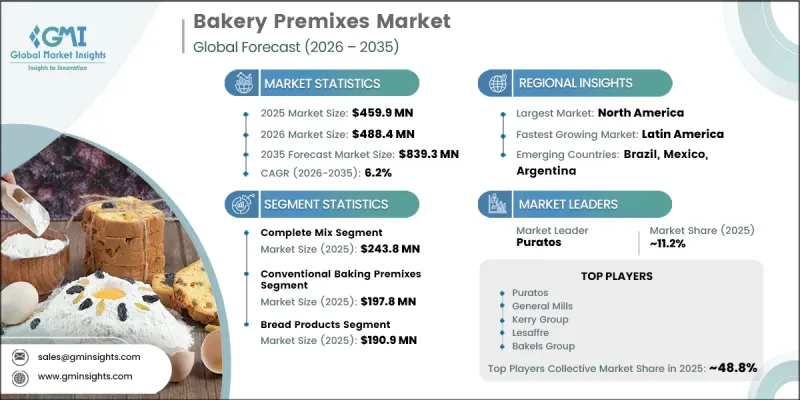
세계의 베이커리용 프리믹스 시장은 2025년에 4억 5,990만 달러로 평가되었고, CAGR 6.2%로 성장할 전망이며, 2035년까지 8억 3,930만 달러에 이를 것으로 예측됩니다.
시장 성장은 가정 및 상업용 베이커리 환경 모두에서 편의성을 중시하는 식품 조리 솔루션에 대한 수요 증가에 힘입어 성장세를 보이고 있습니다. 베이커리용 프리믹스는 준비 시간 단축, 숙련공에 대한 의존도 최소화, 균일한 제품 품질 확보를 통한 생산 공정의 효율화에 기여하기 때문에 산업용 베이커리뿐만 아니라 소규모 장인적 생산자에게도 매우 적합합니다. 도시화의 진전과 소비자의 라이프 스타일이 가속화됨에 따라 품질 기준을 유지하면서 식품 조리를 간소화하는 즉시 사용 가능한 베이킹 재료에 대한 수요가 지속적으로 증가하고 있습니다. 조직화된 베이커리 체인과 퀵서비스 레스토랑의 급속한 확장도 시장 성장을 더욱 촉진하고 있습니다. 이들 사업자는 여러 매장 간 품질 일관성을 보장하고 대량 생산의 효율성을 높이기 위해 표준화된 원료 솔루션이 필요하기 때문입니다. 또한, 카페 문화와 매장 내 베이커리 형태의 확대로 인해 다양한 제과류에 대한 수요가 가속화되고 있으며, 이는 상업용 푸드서비스 사업에서 프리믹스 도입을 더욱 강화하고 있습니다. 기능성 및 건강 지향적 배합에 대한 관심이 높아지면서 식이섬유, 단백질, 효소, 프로바이오틱스 배합이 증가하는 등 제품 혁신이 이루어지고 있습니다. 소비자의 선호도가 글루텐 프리, 비건, 저당, 클린 라벨 제품으로 이동하고 있으며, 이는 제조업체들이 보다 영양가 있고 전문화된 프리믹스 제품을 개발하도록 장려하고 있으며, 이는 전 세계 각 지역에서 장기적인 시장 확대를 뒷받침하고 있습니다.
| 시장 범위 | |
|---|---|
| 개시 연도 | 2025년 |
| 예측 기간 | 2026-2035년 |
| 개시 시점 시장 규모 | 4억 5,990만 달러 |
| 예측 시장 규모 | 8억 3,930만 달러 |
| CAGR | 6.2% |
2025년 완전 배합 제품 부문 시장 규모는 2억 4,380만 달러에 달했습니다. 이 카테고리는 배합이 단순화되어 있어 널리 선호되고 있으며, 사용자는 최소한의 추가 재료로 안정적인 베이킹을 할 수 있습니다. 특히 효율성과 균일성이 업무 성공에 필수적인 대량 생산 환경에서 높은 평가를 받고 있습니다.
빵 기반 용도 분야는 2025년 1억 9,090만 달러의 매출을 기록할 것으로 예측됩니다. 수요는 주로 많은 지역에서 빵이 주식으로 널리 소비되고 있기 때문입니다. 케이크와 페이스트리 제품도 대규모 제빵 공정에서 맛, 식감, 품질의 일관성을 보장하는 표준화된 제조방법으로 큰 기여를 하고 있습니다.
2025년 북미의 베이커리용 프리믹스 시장은 1억 6,330만 달러에 달했습니다. 이 지역은 고도로 발달한 식품 가공 산업과 선진화된 소매 유통 인프라의 혜택을 누리고 있습니다. 이러한 성장은 베이커리 및 외식 산업 부문의 성장에 힘입어, 업무 효율성을 높이기 위해 프리믹스 원료에 대한 의존도를 높이고 있습니다. 건강 지향적인 레시피와 빠른 조리 솔루션에 대한 소비자의 선호도 변화와 상업용 및 소매 베이커리 채널 수요 증가도 시장 발전에 영향을 미치고 있습니다.
ADM, Kerry Group, Dawn Foods, Puratos, Lesaffre, General Mills, AB Mauri, Zeelandia, Bakels Group, Watson Inc., Corbion, Swiss Bake Ingredients Pvt. Ltd. 및 PreGel은 베이커리 프리믹스 산업에서 사업을 영위하는 주요 기업 중 일부입니다. 베이커리용 프리믹스 업계에서 사업을 전개하는 주요 기업 중 일부입니다. 베이커리용 프리믹스 시장 업체들은 경쟁력 강화를 위해 제품 혁신, 클린 라벨 제품 개발, 기능성 원료의 통합에 적극 나서고 있습니다. 또한, 글루텐 프리, 비건, 저당 제품 등 변화하는 소비자 기호에 맞추어 보다 건강한 배합을 도입하기 위해 연구개발에 투자하고 있습니다. 베이커리 체인 및 외식업체와의 전략적 제휴는 유통망 확대와 시장 침투율 향상에 기여하고 있습니다. 또한, 각 제조업체들은 고도의 가공 기술과 비용 효율적인 배합 기술을 통해 생산 효율의 최적화를 추진하고 있습니다.
자주 묻는 질문
목차
제1장 조사 방법 및 범위
제2장 주요 요약
제3장 업계 인사이트
제4장 경쟁 구도
제5장 시장 추산 및 예측 : 유형별(2022-2035년)
제6장 시장 추산 및 예측 : 카테고리별(2022-2035년)
제7장 시장 추산 및 예측 : 용도별(2022-2035년)
제8장 시장 추산 및 예측 : 지역별(2022-2035년)
제9장 기업 개요
AJY 26.06.11The Global Bakery Premixes Market was valued at USD 459.9 million in 2025 and is estimated to grow at a CAGR of 6.2% to reach USD 839.3 million by 2035.
Market growth is supported by the rising demand for convenience-driven food preparation solutions across both household and commercial baking environments. Bakery premixes help streamline production processes by reducing preparation time, minimizing reliance on highly skilled labor, and ensuring uniform product quality, which makes them highly suitable for industrial bakeries as well as smaller artisanal producers. Increasing urbanization and fast-paced consumer lifestyles are driving consistent demand for ready-to-use baking ingredients that simplify food preparation while maintaining quality standards. The rapid expansion of organized bakery chains and quick-service restaurants is further reinforcing market growth, as these businesses require standardized ingredient solutions to ensure consistency across multiple locations and high-volume output efficiency. Additionally, the growth of cafe culture and in-store bakery formats is accelerating demand for diverse baked goods, which is further strengthening the adoption of premixes across commercial foodservice operations. Rising interest in functional and health-focused formulations is also shaping product innovation, with increasing incorporation of fiber, proteins, enzymes, and probiotics. Consumer preference is shifting toward gluten-free, vegan, low-sugar, and clean-label products, which is encouraging manufacturers to develop more nutritious and specialized premix offerings, supporting long-term market expansion across global regions.
| Market Scope | |
|---|---|
| Start Year | 2025 |
| Forecast Year | 2026-2035 |
| Start Value | $459.9 Million |
| Forecast Value | $839.3 Million |
| CAGR | 6.2% |
The complete mix products segment reached USD 243.8 million in 2025. This category is widely preferred due to its simplified formulation approach, allowing users to achieve consistent baking results with minimal additional ingredients. It is especially valued in high-volume production environments where efficiency and uniformity are essential for operational success.
The bread-based applications segment accounted for USD 190.9 million in 2025. Demand is primarily driven by the widespread consumption of bread as a dietary staple across many regions. Cakes and pastry products also contribute significantly due to standardized production methods that ensure consistent taste, texture, and quality across large-scale baking operations.
North American Bakery Premixes Market reached USD 163.3 million in 2025. The region benefits from a highly developed food processing industry and advanced retail distribution infrastructure. Growth is further supported by the expanding bakery and foodservice sectors, which are increasingly relying on premixed ingredients to improve operational efficiency. Changing consumer preferences toward health-oriented recipes and time-saving food preparation solutions are also influencing market development, alongside rising demand from both commercial and retail bakery channels.
ADM, Kerry Group, Dawn Foods, Puratos, Lesaffre, General Mills, AB Mauri, Zeelandia, Bakels Group, Watson Inc., Corbion, Swiss Bake Ingredients Pvt. Ltd., and PreGel are among the key participants operating in the Bakery Premixes Industry. Companies in the Bakery Premixes Market are actively focusing on product innovation, clean-label development, and functional ingredient integration to strengthen their competitive position. They are investing in research and development to introduce healthier formulations that align with evolving consumer preferences such as gluten-free, vegan, and reduced-sugar products. Strategic partnerships with bakery chains and foodservice operators are helping expand distribution networks and improve market penetration. Manufacturers are also optimizing production efficiency through advanced processing technologies and cost-effective formulation techniques.
Table of Contents
Chapter 1 Methodology & Scope
- 1.1 Market scope and definition
- 1.2 Research design
- 1.2.1 Research approach
- 1.2.2 Data collection methods
- 1.3 Data mining sources
- 1.3.1 Global
- 1.3.2 Regional/Country
- 1.4 Base estimates and calculations
- 1.4.1 Base year calculation
- 1.4.2 Key trends for market estimation
- 1.5 Primary research and validation
- 1.5.1 Primary sources
- 1.6 Forecast model
- 1.7 Research assumptions and limitations
Chapter 2 Executive Summary
- 2.1 Industry 360° synopsis
- 2.2 Key market trends
- 2.2.1 Regional
- 2.2.2 Type
- 2.2.3 Category
- 2.2.4 Application
- 2.3 TAM Analysis, 2026-2035
- 2.4 CXO perspectives: Strategic imperatives
- 2.4.1 Executive decision points
- 2.4.2 Critical success factors
- 2.5 Future Outlook and Strategic Recommendations
Chapter 3 Industry Insights
- 3.1 Industry ecosystem analysis
- 3.1.1 Supplier Landscape
- 3.1.2 Profit Margin
- 3.1.3 Value addition at each stage
- 3.1.4 Factor affecting the value chain
- 3.1.5 Disruptions
- 3.2 Industry impact forces
- 3.2.1 Growth drivers
- 3.2.1.1 Rising demand for convenience foods
- 3.2.1.2 Expansion of organized bakery & QSR sector
- 3.2.1.3 Growing health & clean-label awareness
- 3.2.2 Industry pitfalls and challenges
- 3.2.2.1 High cost of specialty and functional premixes
- 3.2.2.2 Volatility in raw material prices
- 3.2.3 Market opportunities
- 3.2.3.1 Growth in emerging markets
- 3.2.3.2 Innovation in functional & customized premixes
- 3.2.1 Growth drivers
- 3.3 Growth potential analysis
- 3.4 Regulatory landscape
- 3.4.1 North America
- 3.4.2 Europe
- 3.4.3 Asia Pacific
- 3.4.4 Latin America
- 3.4.5 Middle East & Africa
- 3.5 Porter's analysis
- 3.6 PESTEL analysis
- 3.7 Price trends
- 3.7.1 By region
- 3.7.2 Product type
- 3.8 Future market trends
- 3.9 Technology and Innovation Landscape
- 3.9.1 Current technological trends
- 3.9.2 Emerging technologies
- 3.10 Patent Landscape
- 3.11 Trade statistics (HS code) (Note: the trade statistics will be provided for key countries only)
- 3.11.1 Major importing countries
- 3.11.2 Major exporting countries
- 3.12 Sustainability and environmental aspects
- 3.12.1 Sustainable practices
- 3.12.2 Waste reduction strategies
- 3.12.3 Energy efficiency in production
- 3.12.4 Eco-friendly initiatives
Chapter 4 Competitive Landscape, 2025
- 4.1 Introduction
- 4.2 Company market share analysis
- 4.2.1 By region
- 4.2.1.1 North America
- 4.2.1.2 Europe
- 4.2.1.3 Asia Pacific
- 4.2.1.4 LATAM
- 4.2.1.5 MEA
- 4.2.1 By region
- 4.3 Company matrix analysis
- 4.4 Competitive analysis of major market players
- 4.5 Competitive positioning matrix
- 4.6 Key developments
- 4.6.1 Mergers & acquisitions
- 4.6.2 Partnerships & collaborations
- 4.6.3 New product launches
- 4.6.4 Expansion plans
Chapter 5 Market Estimates and Forecast, By Type, 2022 - 2035 (USD Million) (Tons)
- 5.1 Key trends
- 5.2 Complete Mix
- 5.3 Dough Base
- 5.4 Dough Concentrate
Chapter 6 Market Estimates and Forecast, By Category, 2022 - 2035 (USD Million) (Tons)
- 6.1 Key trends
- 6.2 Conventional baking premixes
- 6.3 Gluten free baking premixes
- 6.4 Organic Baking Premixes
- 6.5 Vegan Baking Premixes
- 6.6 Specialty Baking Premixes
Chapter 7 Market Estimates and Forecast, By Application, 2022 - 2035 (USD Million) (Tons)
- 7.1 Key trends
- 7.2 Bread Products
- 7.3 Cakes and Pastries
- 7.4 Muffins
- 7.5 Donuts
- 7.6 Pancakes
- 7.7 Other Bakery Products
Chapter 8 Market Estimates and Forecast, By Region, 2022 - 2035 (USD Million) (Tons)
- 8.1 Key trends
- 8.2 North America
- 8.2.1 U.S.
- 8.2.2 Canada
- 8.3 Europe
- 8.3.1 Germany
- 8.3.2 UK
- 8.3.3 France
- 8.3.4 Spain
- 8.3.5 Italy
- 8.3.6 Rest of Europe
- 8.4 Asia Pacific
- 8.4.1 China
- 8.4.2 India
- 8.4.3 Japan
- 8.4.4 Australia
- 8.4.5 South Korea
- 8.4.6 Rest of Asia Pacific
- 8.5 Latin America
- 8.5.1 Brazil
- 8.5.2 Mexico
- 8.5.3 Rest of Latin America
- 8.6 Middle East and Africa
- 8.6.1 Saudi Arabia
- 8.6.2 South Africa
- 8.6.3 UAE
- 8.6.4 Rest of Middle East and Africa
Chapter 9 Company Profiles
- 9.1 Bakels Group
- 9.2 Dawn Foods
- 9.3 General Mills
- 9.4 Kerry Group
- 9.5 Lesaffre
- 9.6 Swiss Bake Ingredients Pvt. Ltd.
- 9.7 Puratos
- 9.8 ADM
- 9.9 AB Mauri
- 9.10 Watson Inc.
- 9.11 PreGel
- 9.12 Zeelandia
- 9.13 Corbion


