|
시장보고서
상품코드
2038662
신루 디바이스 시장 기회, 성장요인, 업계 동향 분석 및 예측(2026-2035년)Nephrostomy Devices Market Opportunity, Growth Drivers, Industry Trend Analysis, and Forecast 2026 - 2035 |
||||||

세계의 신루 디바이스 시장은 2025년에 14억 달러로 평가되었고 CAGR 8.8%로 성장하여 2035년까지 32억 달러에 이를 것으로 예측됩니다.
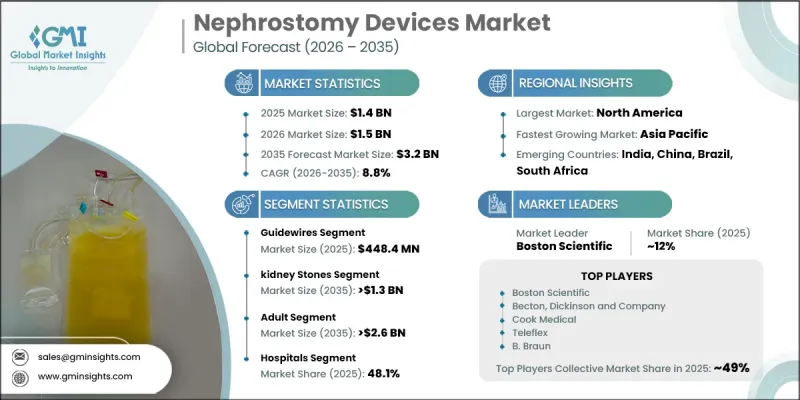
요로폐색, 신장 합병증 등 효과적인 배액 솔루션을 필요로 하는 신장 관련 질환의 발생률이 증가함에 따라 시장은 꾸준히 성장하고 있습니다. 의료진이 회복 기간 단축과 환자 결과 개선을 우선시하는 가운데, 최소침습 수술에 대한 선호도가 높아지면서 이 제품의 채택에 큰 영향을 미치고 있습니다. 또한, 장치 설계 및 재료의 지속적인 혁신을 통해 안전성, 정확성 및 시술의 효율성을 향상시켜 시장 상황을 더욱 강화하고 있습니다. 의료 인식의 향상으로 인한 진단 능력의 향상과 비뇨기과 의료 접근성 확대도 수요를 더욱 촉진하고 있습니다. 또한, 만성 신장질환 및 생활습관병의 부담이 증가함에 따라 신뢰할 수 있는 요로 배액 시스템에 대한 요구가 지속적으로 증가하고 있습니다. 첨단 영상진단 기술의 통합과 카테터 기술의 향상으로 보다 정확한 시술이 가능해져 시장의 꾸준한 성장에 기여하고 있습니다. 전반적으로, 임상 수요, 기술 발전, 의료 인프라의 발전이 결합되어 신루 디바이스 시장의 장기적인 확장을 촉진하고 있습니다.
| 시장 범위 | |
|---|---|
| 시작 연도 | 2025년 |
| 예측 기간 | 2026-2035년 |
| 시작 연도 시장 규모 | 14억 달러 |
| 예측 규모 | 32억 달러 |
| CAGR | 8.8% |
신루 디바이스는 자연적 소변의 흐름이 억제되었을 때 신장에서 직접 소변을 배출하기 위해 고안된 특수 의료기구입니다. 이 시스템은 일반적으로 피부에서 신우까지 카테터를 삽입하여 소변이 막힌 부분을 우회하여 안전하게 배출되도록 하는 시스템입니다. 이들은 합병증을 예방하기 위해 신장의 즉각적인 감압이 필요한 상황에서 널리 사용됩니다. 요로폐색 및 관련 합병증 발생률 증가는 이러한 장치에 대한 수요를 지속적으로 견인하고 있습니다. 카테터 재료의 개선과 제어 메커니즘의 고도화 등 기술적 진보로 인해 임상 결과가 향상되는 동시에 시술에 따른 위험이 감소하고 있습니다. 또한, 기기의 유연성과 정확도 향상도 다양한 환자층에 대한 보급 확대에 기여하고 있습니다.
가이드와이어 시장은 2025년 4억 4,840만 달러 규모에 달했습니다. 이러한 구성 요소들은 신루 카테터의 정확한 삽입을 보장하고, 시술의 성공과 환자의 안전을 위해 매우 중요한 역할을 합니다. 적응성, 부드러운 조작성, 다양한 장치와의 호환성으로 인해 임상 현장에서 필수적인 존재로 자리 잡았습니다. 코팅 기술 및 구조 설계의 지속적인 개선으로 성능이 향상되고 있으며, 시술 중 조작성 향상과 합병증 발생률 감소를 가능하게 하고 있습니다.
신장 결석 부문은 신장 결석증 및 관련 합병증 유병률 증가에 힘입어 2035년까지 13억 달러에 달할 것으로 예측됩니다. 요로폐색은 종종 신루루술과 같은 즉각적인 개입이 필요하기 때문에 이 부문은 시장 수요의 주요 요인으로 작용하고 있습니다. 라이프스타일의 변화와 건강에 대한 관심 증가는 이러한 질병 부담 증가에 지속적으로 기여하고 있습니다. 저침습 기술과 영상진단 기술의 발전으로 치료 성공률은 더욱 향상되고 있으며, 이는 신루 디바이스의 사용 확대를 뒷받침하고 있습니다.
미국 신루 디바이스 시장은 2025년 4억 9,110만 달러로, 2035년까지 연평균 8.2% 성장할 것으로 예측됩니다. 이 지역의 성장은 신장 질환의 높은 유병률과 잘 구축된 의료 인프라가 뒷받침하고 있습니다. 조기 진단, 고급 치료 옵션, 외래 진료 모델에 대한 관심이 높아지면서 안정적인 수요를 견인하고 있습니다. 의료 기술에 대한 지속적인 투자와 비뇨기과 의료에 대한 인식이 높아짐에 따라 북미 전역 시장 확대가 더욱 가속화되고 있습니다.
자주 묻는 질문
목차
제1장 조사 방법
제2장 주요 요약
제3장 업계 인사이트
제4장 경쟁 구도
제5장 시장 추산 및 예측 : 제품별, 2022-2035년
제6장 시장 추산 및 예측 : 용도별, 2022-2035년
제7장 시장 추산 및 예측 : 환자 유형별, 2022-2035년
제8장 시장 추산 및 예측 : 최종 용도별, 2022-2035년
제9장 시장 추산 및 예측 : 지역별, 2022-2035년
제10장 기업 개요
JHS 26.05.29The Global Nephrostomy Devices Market was valued at USD 1.4 billion in 2025 and is estimated to grow at a CAGR of 8.8% to reach USD 3.2 billion by 2035.
The market is expanding steadily due to the increasing incidence of kidney-related conditions, including urinary obstructions and renal complications that require effective drainage solutions. Growing preference for minimally invasive procedures is significantly influencing adoption, as healthcare providers prioritize reduced recovery time and improved patient outcomes. Continuous innovation in device design and materials is also strengthening the market landscape by enhancing safety, precision, and procedural efficiency. Rising healthcare awareness improved diagnostic capabilities, and broader access to urological care are further supporting demand. In addition, the growing burden of chronic kidney conditions and lifestyle-related disorders continues to elevate the need for reliable urinary drainage systems. The integration of advanced imaging support and improved catheter technologies is enabling more accurate interventions, contributing to consistent market growth. Overall, the combination of clinical demand, technological progress, and healthcare infrastructure development is reinforcing long-term expansion across the nephrostomy devices market.
| Market Scope | |
|---|---|
| Start Year | 2025 |
| Forecast Year | 2026-2035 |
| Start Value | $1.4 Billion |
| Forecast Value | $3.2 Billion |
| CAGR | 8.8% |
Nephrostomy devices are specialized medical tools designed to drain urine directly from the kidneys when natural urinary flow is blocked. These systems typically include a catheter inserted through the skin into the renal pelvis, allowing urine to bypass obstructions and exit safely. They are widely used in conditions that require immediate decompression of the kidney to prevent complications. The increasing occurrence of urinary tract blockages and related complications continues to drive demand for these devices. Technological advancements, including improved catheter materials and enhanced control mechanisms, have strengthened clinical outcomes while reducing procedural risks. Enhanced device flexibility and precision have also contributed to broader adoption across different patient groups.
The guidewires segment generated USD 448.4 million in 2025. These components play a critical role in ensuring accurate placement of nephrostomy catheters, supporting procedural success and patient safety. Their adaptability, smooth navigation, and compatibility with a range of devices make them essential in clinical practice. Ongoing improvements in coating technologies and structural design are enhancing performance, enabling better maneuverability and reduced complication rates during procedures.
The kidney stones segment is projected to reach USD 1.3 billion by 2035, driven by the increasing prevalence of nephrolithiasis and associated complications. This segment represents a major contributor to market demand, as urinary blockages often require immediate intervention through nephrostomy procedures. Changing lifestyle patterns and rising health concerns continue to contribute to the growing burden of such conditions. Advancements in minimally invasive techniques and imaging technologies are further improving treatment success rates, supporting increased utilization of nephrostomy devices.
U.S. Nephrostomy Devices Market accounted for USD 491.1 million in 2025 and is expected to grow at a CAGR of 8.2% through 2035. Growth in the region is supported by a high prevalence of renal disorders and a well-established healthcare infrastructure. Increased focus on early diagnosis, advanced treatment options, and outpatient care models is driving consistent demand. Continued investments in medical technology and rising awareness around urological health are further strengthening market expansion across North America.
Key players operating in the Global Nephrostomy Devices Market include Becton, Dickinson and Company, Boston Scientific, B. Braun, AngioDynamics, Argon Medical Devices, Coloplast, Cook Medical, Galt Medical, Meditech Devices, Merit Medical, Nipro, Rocamed, Teleflex, Uresil, UROMED, and Urovision Urotech. Companies in the nephrostomy devices market are focusing on innovation, strategic collaborations, and geographic expansion to strengthen their competitive position. Manufacturers are investing in advanced materials and design improvements to enhance device safety, flexibility, and performance. Partnerships with healthcare providers and distributors are helping expand market reach and improve product accessibility. Firms are also prioritizing regulatory compliance and quality standards to build trust and ensure consistent adoption. Increasing focus on minimally invasive solutions and patient-centric product development is driving differentiation in the market.
Table of Contents
Chapter 1 Research Methodology
- 1.1 Research approach
- 1.2 Quality commitments
- 1.2.1 GMI AI policy & data integrity commitment
- 1.2.1.1 Source consistency protocol
- 1.2.1 GMI AI policy & data integrity commitment
- 1.3 Research trail & confidence scoring
- 1.3.1 Research trail components
- 1.3.2 Scoring components
- 1.4 Data collection
- 1.4.1 Partial list of primary sources
- 1.5 Data mining sources
- 1.5.1 Paid sources
- 1.5.1.1 Sources, by region
- 1.5.1 Paid sources
- 1.6 Base estimates and calculations
- 1.6.1 Base year calculation for any one approach
- 1.7 Forecast model
- 1.7.1 Quantified market impact analysis
- 1.7.1.1 Mathematical impact of growth parameters on forecast
- 1.7.1 Quantified market impact analysis
- 1.8 Research transparency addendum
- 1.8.1 Source attribution framework
- 1.8.2 Quality assurance metrics
- 1.8.3 Our commitment to trust
Chapter 2 Executive Summary
- 2.1 Industry 360° synopsis
- 2.2 Key market trends
- 2.2.1 Regional trends
- 2.2.2 Product trends
- 2.2.3 Application trends
- 2.2.4 Patient type trends
- 2.2.5 End use trends
- 2.3 CXO perspectives: Strategic imperatives
Chapter 3 Industry Insights
- 3.1 Industry ecosystem analysis
- 3.2 Industry impact forces
- 3.2.1 Growth drivers
- 3.2.1.1 Rising prevalence of kidney disorders
- 3.2.1.2 Increased adoption of minimally invasive surgical procedure
- 3.2.1.3 Technological advancements in nephrostomy devices
- 3.2.1.4 Increasing awareness among patients and healthcare professionals
- 3.2.2 Industry pitfalls and challenges
- 3.2.2.1 Risks associated with the nephrostomy devices
- 3.2.2.2 Availability of substitute procedures
- 3.2.3 Market opportunity
- 3.2.3.1 Development of infection-resistant and antimicrobial devices
- 3.2.1 Growth drivers
- 3.3 Growth potential analysis
- 3.4 Regulatory landscape (Driven by Primary Research)
- 3.4.1 North America
- 3.4.2 Europe
- 3.4.3 Asia Pacific
- 3.4.4 Latin America
- 3.4.5 Middle East and Africa
- 3.5 Technological landscape (Driven by Primary Research)
- 3.5.1 Current technologies
- 3.5.1.1 Increased use of single use, sterile, pre configured nephrostomy kits
- 3.5.1.2 Expansion of nephrostomy use beyond acute care
- 3.5.2 Emerging technologies
- 3.5.2.1 Increasing focus on pediatric specific nephrostomy devices
- 3.5.2.2 Customized and 3D-printed devices for patient-specific anatomical needs
- 3.5.1 Current technologies
- 3.6 Future market trends (Driven by Primary Research)
- 3.7 Impact of AI and Generative AI on the market
- 3.8 Pricing analysis, 2025 (Driven by Primary Research)
- 3.9 Patent analysis
- 3.10 Porter's analysis
- 3.11 PESTEL analysis
- 3.12 Investment landscape
- 3.13 Gap analysis
Chapter 4 Competitive Landscape, 2025
- 4.1 Introduction
- 4.2 Company market share analysis (Driven by Primary Research)
- 4.2.1 North America
- 4.2.2 Europe
- 4.2.3 Asia Pacific
- 4.3 Company matrix analysis
- 4.4 Competitive analysis of major market players
- 4.5 Competitive positioning matrix
- 4.6 Key developments
- 4.6.1 Merger and acquisition
- 4.6.2 Partnership and collaboration
- 4.6.3 New product launches
- 4.6.4 Expansion plans
Chapter 5 Market Estimates and Forecast, By Product, 2022-2035 ($ Mn)
- 5.1 Key trends
- 5.2 Guidewires
- 5.3 Drainage tubes
- 5.4 Nephrostomy catheters
- 5.5 Sheath dilators
- 5.6 Other products
Chapter 6 Market Estimates and Forecast, By Application, 2022-2035 ($ Mn)
- 6.1 Key trends
- 6.2 Kidney stones
- 6.3 Urinary tract infections
- 6.4 Bladder cancer
- 6.5 Other applications
Chapter 7 Market Estimates and Forecast, By Patient Type, 2022-2035 ($ Mn)
- 7.1 Key trends
- 7.2 Adult
- 7.3 Pediatric
Chapter 8 Market Estimates and Forecast, By End Use, 2022-2035 ($ Mn)
- 8.1 Key trends
- 8.2 Hospitals
- 8.3 Clinics
- 8.4 Ambulatory surgical centers
- 8.5 Other end users
Chapter 9 Market Estimates and Forecast, By Region, 2022-2035 ($ Mn)
- 9.1 Key trends
- 9.2 North America
- 9.2.1 U.S.
- 9.2.2 Canada
- 9.3 Europe
- 9.3.1 Germany
- 9.3.2 UK
- 9.3.3 France
- 9.3.4 Spain
- 9.3.5 Italy
- 9.3.6 Netherlands
- 9.4 Asia Pacific
- 9.4.1 China
- 9.4.2 Japan
- 9.4.3 India
- 9.4.4 Australia
- 9.4.5 South Korea
- 9.5 Latin America
- 9.5.1 Brazil
- 9.5.2 Mexico
- 9.5.3 Argentina
- 9.6 Middle East and Africa
- 9.6.1 South Africa
- 9.6.2 Saudi Arabia
- 9.6.3 UAE
Chapter 10 Company Profiles
- 10.1 AngioDynamics
- 10.2 Argon Medical Devices
- 10.3 B. Braun
- 10.4 Becton, Dickinson and Company
- 10.5 Boston Scientific
- 10.6 Coloplast
- 10.7 Cook Medical
- 10.8 Galt Medical
- 10.9 Meditech Devices
- 10.10 Merit Medical
- 10.11 Nipro
- 10.12 Rocamed
- 10.13 Teleflex
- 10.14 Uresil
- 10.15 UROMED
- 10.16 Urovision-Urotech