|
시장보고서
상품코드
2038665
FMCG 물류 시장 : 시장 기회, 성장요인, 업계 동향 분석 및 예측(2026-2035년)FMCG Logistics Market Opportunity, Growth Drivers, Industry Trend Analysis, and Forecast 2026 - 2035 |
||||||

세계의 FMCG 물류 시장은 2025년에 1,380억 달러로 평가되었고, CAGR 4.8%로 성장할 전망이며, 2035년까지 2,218억 달러에 이를 것으로 추정되고 있습니다.
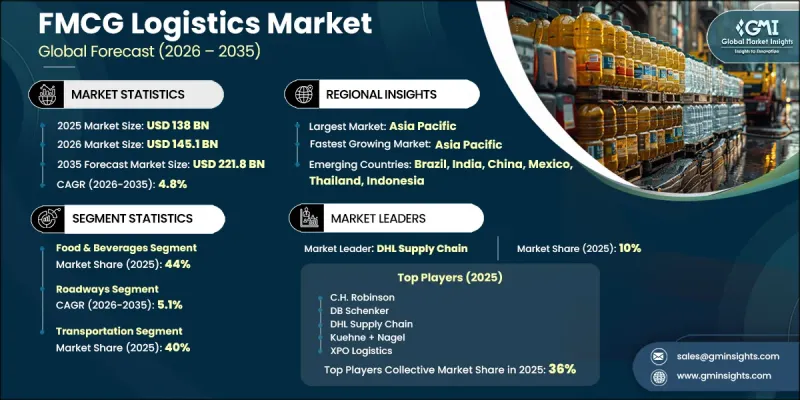
이 시장은 빠른 회전과 안정적인 공급이 요구되는 수요가 많은 소비재의 효율적인 취급, 보관 및 운송을 중심으로 형성되어 있습니다. 물류 업무는 적시 유통을 보장하고, 제품 품질을 유지하며, 여러 판매 채널에 걸쳐 재고 수준을 최적화하도록 설계되어 있습니다. 이러한 상품들은 시간적 제약이 심한 특성으로 인해 기업들은 속도, 신뢰성 및 비용 효율적인 배송 시스템을 우선시합니다. 첨단 기술의 통합이 진행됨에 따라 업무의 정확성이 향상되고 공급망 전반의 협력이 강화되고 있습니다. 온도 관리 시스템 및 실시간 모니터링 도구와 같은 현대적인 물류 인프라는 성능을 향상시키고 비효율을 줄입니다. 공급망이 더욱 역동적이고 수요 주도적으로 변화함에 따라, FMCG 물류 시장은 변화하는 소비자의 기대와 진화하는 유통 모델에 적응하면서 원활한 제품 흐름을 지원하는 데 중요한 역할을 하고 있습니다.
| 시장 범위 | |
|---|---|
| 개시 연도 | 2025년 |
| 예측 기간 | 2026-2035년 |
| 개시 시점 시장 규모 | 1,380억 달러 |
| 예측 시장 규모 | 2,218억 달러 |
| CAGR | 4.8% |
FMCG 물류 시장에는 운송, 보관, 재고 관리, 주문 처리, 부가가치 서비스 등 다양한 서비스가 포함됩니다. 서비스 제공업체는 원활한 협력과 효율적인 제품 이동을 보장함으로써 가치사슬 전반의 다양한 이해관계자들을 지원하고 있습니다. 자동화, 커넥티드 추적 시스템, 첨단 창고 관리 솔루션의 사용 확대로 가시성이 향상되고 업무의 혼란이 감소하고 있습니다. 디지털로 연결된 공급망으로의 전환으로 기존의 물류 프레임워크는 보다 신속하고 효율적인 시스템으로 변화하고 있습니다. 더 빠른 배송에 대한 수요 증가는 라스트마일 배송과 지역 밀착형 풀필먼트 능력의 향상에도 영향을 미치고 있습니다.
식음료 부문은 2025년 44%의 점유율을 차지했으며, 2026-2035년 연평균 5%의 성장률을 보일 것으로 전망됩니다. 이 부문은 소비량 증가와 전문적인 취급 및 운송 프로세스의 필요성으로 인해 계속해서 선두를 유지하고 있습니다. 이 부문의 물류 업무는 품질을 유지하고 적시에 배송을 보장하기 위해 세심한 관리가 필요하며, 이는 시장에서의 확고한 입지를 뒷받침하고 있습니다.
도로 운송 부문은 2025년 70.3%의 점유율을 차지했으며, 2035년까지 연평균 5.1%의 성장률을 보일 것으로 예측됩니다. 이러한 선도적 위치는 운영의 유연성, 효율적인 경로 설정, 장거리 및 지역 배송을 모두 지원할 수 있는 능력에 의해 뒷받침됩니다. 도로 운송은 전체 물류 네트워크의 원활한 연결을 보장하고 다양한 물류 요구 사항을 충족시키는 데 필수적인 역할을 하고 있습니다.
중국의 FMCG(일용소비재) 물류 시장은 2026-2035년 연평균 4%의 성장률을 보일 것으로 예측됩니다. 이 나라의 강력한 생산 능력과 잘 정비된 유통 인프라가 시장 성장을 뒷받침하고 있습니다. 소비재에 대한 수요 증가와 더불어 급속한 도시화로 인해 효율적인 물류 솔루션에 대한 요구가 증가하고 있습니다. 시장은 배송 네트워크와 공급망 능력의 향상에 따른 혜택을 계속 누리고 있으며, 주요 지역 허브로서의 입지를 공고히 하고 있습니다.
자주 묻는 질문
목차
제1장 조사 방법
제2장 주요 요약
제3장 업계 인사이트
제4장 경쟁 구도
제5장 시장 추산 및 예측 : 제품별(2022-2035년)
제6장 시장 추산 및 예측 : 서비스별(2022-2035년)
제7장 시장 추산 및 예측 : 운송 수단별(2022-2035년)
제8장 시장 추산 및 예측 : 최종 용도별(2022-2035년)
제9장 시장 추산 및 예측 : 지역별(2022-2035년)
제10장 기업 개요
AJY 26.06.11The Global FMCG Logistics Market was valued at USD 138 billion in 2025 and is estimated to grow at a CAGR of 4.8% to reach USD 221.8 billion by 2035.
This market is centered on the efficient handling, storage, and movement of high-demand consumer goods that require rapid turnover and consistent availability. Logistics operations are designed to ensure timely distribution, maintain product quality, and optimize inventory levels across multiple sales channels. Due to the time-sensitive nature of these goods, companies are prioritizing speed, reliability, and cost-effective delivery systems. The increasing integration of advanced technologies is enhancing operational precision and enabling better coordination across supply chains. Modern logistics infrastructure, including temperature-controlled systems and real-time monitoring tools, is improving performance and reducing inefficiencies. As supply chains become more dynamic and demand-driven, the FMCG logistics market is playing a critical role in supporting seamless product flow while adapting to shifting consumer expectations and evolving distribution models.
| Market Scope | |
|---|---|
| Start Year | 2025 |
| Forecast Year | 2026-2035 |
| Start Value | $138 Billion |
| Forecast Value | $221.8 Billion |
| CAGR | 4.8% |
The FMCG logistics market includes a wide range of services such as transportation, storage, inventory control, order processing, and additional value-added activities. Service providers support various stakeholders across the supply chain by ensuring smooth coordination and efficient product movement. The growing use of automation, connected tracking systems, and advanced warehouse management solutions is improving visibility and reducing operational disruptions. The shift toward digitally connected supply chains is transforming traditional logistics frameworks into more responsive and efficient systems. Rising demand for faster deliveries is also driving improvements in last-mile distribution and localized fulfillment capabilities.
The food and beverages segment accounted for 44% share in 2025 and is projected to grow at a CAGR of 5% from 2026 to 2035. This segment continues to lead due to increasing consumption levels and the need for specialized handling and transportation processes. Logistics operations in this segment require careful management to maintain quality and ensure timely delivery, supporting its strong position in the market.
The roadways segment held a 70.3% share in 2025 and is expected to grow at a CAGR of 5.1% through 2035. Its leadership is driven by operational flexibility, efficient routing, and the ability to support both long-distance and local deliveries. Road transport remains essential for ensuring seamless connectivity across distribution networks and meeting diverse logistics requirements.
China FMCG Logistics Market is expected to grow at a CAGR of 4% from 2026 to 2035. The country's strong production capacity and well-developed distribution infrastructure are supporting market growth. Increasing demand for consumer goods, along with rapid urban expansion, is driving the need for efficient logistics solutions. The market continues to benefit from improvements in delivery networks and supply chain capabilities, reinforcing its position as a key regional hub.
Key companies operating in the FMCG Logistics Market include DHL Supply Chain, Kuehne + Nagel, DB Schenker, DSV (including Panalpina), CEVA Logistics, Geodis, XPO Logistics, C.H. Robinson, Bollore Logistics, and A.P. Moller. Companies in the FMCG Logistics Market are strengthening their market presence through technology adoption, network expansion, and strategic collaborations. They are investing in automation, real-time tracking systems, and data analytics to improve efficiency and enhance supply chain visibility. Many firms are expanding their warehousing and distribution infrastructure to support growing demand and faster delivery requirements. Partnerships with retailers and e-commerce platforms are helping improve service integration and customer reach. In addition, companies are focusing on optimizing last-mile delivery and adopting flexible logistics models to meet changing consumer expectations.
Table of Contents
Chapter 1 Methodology
- 1.1 Research approach
- 1.2 Quality commitments
- 1.3 Research trail and confidence scoring
- 1.3.1 Research trail components
- 1.3.2 Scoring components
- 1.4 Data collection
- 1.4.1 Partial list of primary sources
- 1.5 Data mining sources
- 1.5.1 Paid sources
- 1.6 Best estimates and calculations
- 1.6.1 Base year calculation for any one approach
- 1.7 Forecast model
- 1.8 Research transparency addendum
Chapter 2 Executive Summary
- 2.1 Industry 360° synopsis, 2022 - 2035
- 2.2 Key market trends
- 2.2.1 Regional
- 2.2.2 Product
- 2.2.3 Service
- 2.2.4 Mode of Transportation
- 2.2.5 End Use
- 2.3 TAM Analysis, 2026-2035
- 2.4 CXO perspectives: Strategic imperatives
Chapter 3 Industry Insights
- 3.1 Industry ecosystem analysis
- 3.1.1 Supplier landscape
- 3.1.2 Profit margin analysis
- 3.1.3 Cost structure
- 3.1.4 Value addition at each stage
- 3.1.5 Factor affecting the value chain
- 3.1.6 Disruptions
- 3.2 Industry impact forces
- 3.2.1 Growth drivers
- 3.2.1.1 Explosive growth in e-commerce and omnichannel retail
- 3.2.1.2 Rising consumer demand for faster delivery and same-day services
- 3.2.1.3 FMCG manufacturers outsourcing non-core logistics functions
- 3.2.1.4 Increasing focus on supply chain visibility and traceability
- 3.2.1.5 Growth in organized retail and modern trade formats
- 3.2.2 Industry pitfalls and challenges
- 3.2.2.1 High capital investment in cold chain infrastructure
- 3.2.2.2 Driver shortage and labor cost pressures
- 3.2.2.3 Fragmented logistics market in emerging economies
- 3.2.2.4 Regulatory complexity in cross-border operations
- 3.2.3 Market opportunities
- 3.2.3.1 Untapped potential in Tier 2 and Tier 3 cities
- 3.2.3.2 Sustainability-driven green logistics solutions
- 3.2.3.3 Micro-fulfillment centers for hyperlocal delivery
- 3.2.3.4 Integration of advanced analytics and AI for demand forecasting
- 3.2.3.5 Consolidation and strategic partnerships
- 3.2.1 Growth drivers
- 3.3 Growth potential analysis
- 3.4 Regulatory landscape
- 3.4.1 North America
- 3.4.1.1 US- Food safety modernization act (FSMA) & sanitary transportation Rule
- 3.4.1.2 Canada - Safe food for canadians regulations (SFCR)
- 3.4.2 Europe
- 3.4.2.1 Germany- EU general food law & cold chain compliance
- 3.4.2.2 UK- Post-brexit food safety & logistics regulations
- 3.4.2.3 France- Anti-waste law (AGEC) & sustainable packaging mandates
- 3.4.2.4 Italy- HACCP compliance & urban logistics restrictions
- 3.4.3 Asia Pacific
- 3.4.3.1 China- Food safety law & cold chain logistics standards
- 3.4.3.2 India- FSSAI regulations & E-way bill system
- 3.4.3.3 Japan- Food sanitation act & logistics efficiency act
- 3.4.3.4 Australia- Food standards code & chain of responsibility (CoR)
- 3.4.4 LATAM
- 3.4.4.1 Mexico- NOM standards & cold chain compliance
- 3.4.4.2 Argentina- National food code & transport regulations
- 3.4.5 MEA
- 3.4.5.1 South Africa- Foodstuffs, cosmetics and disinfectants act
- 3.4.5.2 Saudi Arabia- SFDA regulations & vision 2030 logistics initiatives
- 3.4.1 North America
- 3.5 Porter's analysis
- 3.6 PESTEL analysis
- 3.7 Technology and innovation landscape
- 3.7.1 Current technological trends
- 3.7.1.1 Warehouse automation and robotics
- 3.7.1.2 IoT and real-time tracking systems
- 3.7.1.3 Predictive analytics and AI in route optimization
- 3.7.2 Emerging technologies
- 3.7.2.1 Blockchain for supply chain transparency
- 3.7.2.2 Autonomous vehicles and drones
- 3.7.1 Current technological trends
- 3.8 3.5. Patent landscape (driven by primary research)
- 3.8.1 Cold chain technology patents
- 3.8.2 Automation and robotics patents
- 3.8.3 Last-mile delivery innovation patents
- 3.8.4 Geographic distribution of patents
- 3.9 Pricing analysis
- 3.9.1 Historical price trend analysis
- 3.9.2 Pricing strategy by player type (premium / value / cost-plus)
- 3.9.3 Total cost of ownership (TCO) analysis
- 3.10 Trade data analysis (driven by primary research)
- 3.10.1 Import/export volume and value trends (driven by primary research)
- 3.10.2 Key trade corridors and tariff impact (driven by primary research)
- 3.10.3 Cross-border FMCG logistics flows
- 3.11 Use cases & success stories
- 3.12 Impact of AI & generative AI on the market
- 3.12.1 AI-driven disruption of existing business models
- 3.12.2 GenAI use cases and adoption roadmap by segment
- 3.12.3 Risks, limitations, and regulatory considerations
- 3.13 Sustainability and environmental aspects
- 3.13.1 Sustainable practices
- 3.13.2 Waste reduction strategies
- 3.13.3 Energy efficiency in production
- 3.13.4 Eco-friendly Initiatives
- 3.13.5 Carbon footprint considerations
Chapter 4 Competitive Landscape, 2025
- 4.1 Introduction
- 4.2 Company market share analysis
- 4.2.1 North America
- 4.2.2 Europe
- 4.2.3 Asia Pacific
- 4.2.4 LATAM
- 4.2.5 MEA
- 4.3 Competitive analysis of major market players
- 4.4 Competitive positioning matrix
- 4.5 Company Tier Benchmarking
- 4.5.1 Tier Classification Criteria & Qualifying Thresholds
- 4.5.2 Tier Positioning Matrix by Revenue, Geography & Innovation
- 4.6 Key developments
- 4.6.1 Mergers & acquisitions
- 4.6.2 Partnerships & collaborations
- 4.6.3 New product launches
- 4.6.4 Expansion plans and funding
Chapter 5 Market Estimates & Forecast, By Product, 2022 - 2035 ($Bn, Tons)
- 5.1 Key trends
- 5.2 Food & beverages
- 5.3 Personal care
- 5.4 Household care
- 5.5 Other consumables
Chapter 6 Market Estimates & Forecast, By Service, 2022 - 2035 ($Bn)
- 6.1 Key trends
- 6.2 Transportation
- 6.3 Warehousing
- 6.4 Packaging services
- 6.5 Inventory management
- 6.6 Distribution
Chapter 7 Market Estimates & Forecast, By Mode of Transportation, 2022 - 2035 ($Bn, Tons)
- 7.1 Key trends
- 7.2 Railways
- 7.3 Airways
- 7.4 Roadways
- 7.5 Seaways
Chapter 8 Market Estimates & Forecast, By End Use, 2022 - 2035 ($Bn, Tons)
- 8.1 Key trends
- 8.2 Retail
- 8.2.1 Supermarkets & hypermarkets
- 8.2.2 Convenience stores
- 8.3 E-commerce / online retail
- 8.4 Foodservice / HoReCa
- 8.5 Pharmacies & healthcare stores
- 8.6 Others
Chapter 9 Market Estimates & Forecast, By Region, 2022 - 2035 ($Bn, Tons)
- 9.1 Key trends
- 9.2 North America
- 9.2.1 US
- 9.2.2 Canada
- 9.3 Europe
- 9.3.1 Germany
- 9.3.2 UK
- 9.3.3 France
- 9.3.4 Italy
- 9.3.5 Spain
- 9.3.6 Russia
- 9.3.7 Netherlands
- 9.3.8 Sweden
- 9.3.9 Denmark
- 9.3.10 Poland
- 9.4 Asia Pacific
- 9.4.1 China
- 9.4.2 India
- 9.4.3 Japan
- 9.4.4 Australia
- 9.4.5 South Korea
- 9.4.6 Singapore
- 9.4.7 Thailand
- 9.4.8 Indonesia
- 9.4.9 Vietnam
- 9.5 Latin America
- 9.5.1 Brazil
- 9.5.2 Mexico
- 9.5.3 Argentina
- 9.5.4 Colombia
- 9.6 MEA
- 9.6.1 South Africa
- 9.6.2 Saudi Arabia
- 9.6.3 UAE
- 9.6.4 Israel
Chapter 10 Company Profiles
- 10.1 Global Players
- 10.1.1 A.P. Moller - Maersk
- 10.1.2 Bollore Logistics
- 10.1.3 C.H. Robinson
- 10.1.4 CEVA Logistics
- 10.1.5 DB Schenker
- 10.1.6 DHL Supply Chain
- 10.1.7 DSV
- 10.1.8 Geodis
- 10.1.9 Kuehne + Nagel
- 10.1.10 XPO Logistics
- 10.1.11 Yusen Logistics
- 10.2 Regional Players
- 10.2.1 Agility Logistics
- 10.2.2 Hub
- 10.2.3 J.B. Hunt Transport Services
- 10.2.4 Ryder System
- 10.2.5 Schneider National
- 10.2.6 Sinotrans
- 10.3 Emerging Players
- 10.3.1 Kintetsu World Express
- 10.3.2 Panalpina
- 10.3.3 TNT Express