|
시장보고서
상품코드
2038679
가스 감지기 시장 : 시장 기회, 성장요인, 업계 동향 분석 및 예측(2026-2035년)Gas Detector Market Opportunity, Growth Drivers, Industry Trend Analysis, and Forecast 2026 - 2035 |
||||||

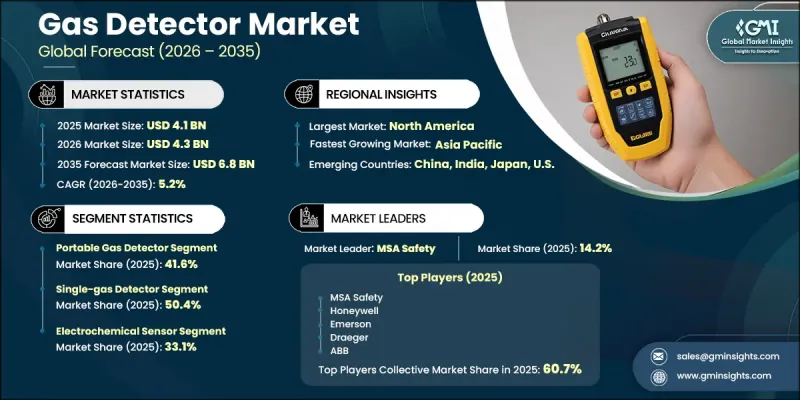
세계의 가스 감지기 시장은 2025년에 41억 달러로 평가되었고, CAGR 5.2%로 성장할 전망이며, 2035년까지 68억 달러에 이를 것으로 추정되고 있습니다.
여러 최종 사용 부문에서 안전에 대한 인식이 높아지고 조직이 위험 예방 및 규정 준수를 우선시함에 따라 이 산업은 계속 성장하고 있습니다. 변화하는 규제 프레임워크를 준수하면서 유해가스를 모니터링하고 안전한 작업 환경을 유지해야 할 필요성으로 인해 수요는 더욱 증가하고 있습니다. 감지 기술의 지속적인 개선과 더불어 정확도와 응답 시간의 개선은 보다 광범위한 도입을 뒷받침하고 있습니다. 각 산업계에서는 감시를 중단하지 않고 안전 위험을 최소화하기 위해 가스 감지 시스템을 운영 인프라에 통합하는 움직임이 가속화되고 있습니다. 유해 배출가스 모니터링이 점점 더 중요해지면서 환경 보호에 대한 관심이 높아지는 것도 시장을 견인하고 있습니다. 기업들은 실시간 인사이트와 데이터 기반 의사결정 기능을 제공하는 고급 감지 솔루션을 도입하고 있습니다. 산업화의 진전과 엄격한 작업장 안전 기준의 시행으로 도입이 더욱 가속화되고 있습니다. 혁신, 규제 압력 및 운영 안전 요구 사항이 결합되어 전 세계 산업 전반에 걸쳐 가스 검출기 시장의 견고한 성장 기반을 구축하고 있습니다.
| 시장 범위 | |
|---|---|
| 개시 연도 | 2025년 |
| 예측 기간 | 2026-2035년 |
| 개시 연도 시장 규모 | 41억 달러 |
| 예측 시장 규모 | 68억 달러 |
| CAGR | 5.2% |
휴대형 부문은 편의성과 운영 유연성으로 인해 2025년 41.6%의 점유율을 차지했습니다. 이러한 기기는 사용자가 감지 시스템을 위험이 예상되는 환경에 직접 가져갈 수 있고, 위험한 가스 농도에 대해 즉각적인 경보를 발령하여 신속한 대응이 가능하기 때문에 널리 선호되고 있습니다. 이 부문은 컴팩트한 디자인, 다기능성 및 향상된 연결 기능의 혜택을 계속 누리고 있습니다. 이러한 발전은 모니터링 시스템과의 원활한 통합을 가능하게 하고, 작업자의 안전과 운영 인식을 향상시킵니다. 사용 편의성을 유지하면서 신뢰할 수 있는 실시간 데이터를 제공할 수 있는 능력은 다양한 용도 분야에서 휴대용 가스 감지기의 우위를 지속적으로 뒷받침하고 있습니다.
멀티 가스 검출기 부문은 2026-2035년 연평균 5.7%의 연평균 복합 성장률(CAGR)을 보일 것으로 예측됩니다. 이러한 성장은 여러 가스를 동시에 감지할 수 있는 종합적인 안전 솔루션에 대한 수요 증가에 따른 것입니다. 각 업계에서는 더 높은 안전 기준을 확보하면서 효율성을 높이는 시스템을 우선시하고 있습니다. 조직이 위험 감지 및 대응 메커니즘을 개선하고자 하는 가운데, 고급 분석 및 디지털 모니터링 기능의 통합으로 인해 도입이 더욱 가속화되고 있습니다. 높은 안전 성능을 유지하면서 업무 효율을 높일 수 있다는 점은 다중 가스 감지 기술의 중요성을 입증하고 있습니다.
북미의 가스 감지기 시장은 엄격한 안전 규정과 탄탄한 산업 인프라에 힘입어 2025년 35.2%의 점유율을 차지했습니다. 이 지역에서는 조직이 규정 준수와 운영 안전에 대한 중요성을 강조함에 따라 가스 감지 시스템 도입이 지속적으로 증가하고 있습니다. 철저한 규제와 첨단 모니터링 기술에 대한 지속적인 투자가 시장의 꾸준한 확대에 기여하고 있습니다. 기존 산업 부문의 존재와 배출가스 모니터링에 대한 관심이 높아지면서 수요를 더욱 촉진하고 있습니다. 커넥티드 감지 시스템 및 첨단 감지 기술의 도입으로 실시간 모니터링 능력이 향상되면서 이 지역 시장 전망은 더욱 견고해지고 있습니다.
자주 묻는 질문
목차
제1장 조사 방법 및 범위
제2장 주요 요약
제3장 업계 인사이트
제4장 경쟁 구도
제5장 시장 추산 및 예측 : 제품 유형별(2022-2035년)
제6장 시장 추산 및 예측 : 설치 유형별(2022-2035년)
제7장 시장 추산 및 예측 : 기술별(2022-2035년)
제8장 시장 추산 및 예측 : 최종 이용 산업별(2022-2035년)
제9장 시장 추산 및 예측 : 지역별(2022-2035년)
제10장 기업 개요
AJY 26.06.11The Global Gas Detector Market was valued at USD 4.1 billion in 2025 and is estimated to grow at a CAGR of 5.2% to reach USD 6.8 billion by 2035.
The industry continues to gain momentum as safety awareness rises across multiple end-use sectors and organizations prioritize risk prevention and compliance. Demand is being reinforced by the need to monitor hazardous gases and maintain secure working environments while adhering to evolving regulatory frameworks. Continuous improvements in sensing technologies, along with advancements in accuracy and response time, are supporting wider adoption. Industries are increasingly integrating gas detection systems into their operational infrastructure to ensure uninterrupted monitoring and minimize safety risks. The market is also benefiting from a growing focus on environmental protection, as monitoring harmful emissions becomes more critical. Companies are adopting advanced detection solutions that offer real-time insights and data-driven decision-making capabilities. Increasing industrialization and stricter enforcement of workplace safety norms are further accelerating deployment. The combination of innovation, regulatory pressure, and operational safety requirements is creating a strong growth foundation for the gas detector market across global industries.
| Market Scope | |
|---|---|
| Start Year | 2025 |
| Forecast Year | 2026-2035 |
| Start Value | $4.1 Billion |
| Forecast Value | $6.8 Billion |
| CAGR | 5.2% |
The portable segment accounted for a share of 41.6% in 2025, owing to convenience and operational flexibility. These devices are widely preferred because they allow users to carry detection systems directly into potentially hazardous environments, ensuring immediate alerts and faster response to unsafe gas levels. The segment continues to benefit from improvements in compact design, multi-functionality, and enhanced connectivity features. These advancements enable seamless integration with monitoring systems, improving worker safety and operational awareness. The ability to deliver reliable, real-time data while maintaining ease of use continues to support the dominance of portable gas detectors across diverse applications.
The multi-gas detector segment is expected to register a CAGR of 5.7% during 2026-2035. This growth is driven by increasing demand for comprehensive safety solutions capable of identifying multiple gases simultaneously. Industries are prioritizing systems that enhance efficiency while ensuring higher safety standards. The integration of advanced analytics and digital monitoring capabilities further strengthens adoption, as organizations aim to improve hazard detection and response mechanisms. The ability to streamline operations while maintaining high safety performance reinforces the importance of multi-gas detection technologies.
North America Gas Detector Market held a share of 35.2% in 2025, supported by stringent safety regulations and strong industrial infrastructure. The region continues to witness increased adoption of gas detection systems as organizations emphasize compliance and operational safety. Regulatory enforcement and ongoing investments in advanced monitoring technologies are contributing to steady market expansion. The presence of well-established industrial sectors and a growing focus on emission monitoring are further supporting demand. The adoption of connected detection systems and advanced sensing technologies is enhancing real-time monitoring capabilities, strengthening the regional market outlook.
Major key players in the Global Gas Detector Market include ABB, Aeroqual, Ametek, CO2Meter, Crowcon Detection Instruments, Draeger, Emerson, GasClip Technologies, GfG Instrumentation, Honeywell Analytics, Industrial Scientific Corporation, Ion Science, MSA Safety, MSR-Electronic, New Cosmos Electric Co., RKI Instruments, Sensit Technologies, Siemens, Teledyne Technologies, Thermo Fisher Scientific Companies in the Global Gas Detector Market are focusing on innovation, strategic collaborations, and product differentiation to strengthen their competitive position. They are investing in advanced sensor technologies, wireless connectivity, and integration with digital platforms to enhance performance and usability. Expanding product portfolios with multi-functional and application-specific solutions allows companies to cater to diverse industry needs. Partnerships with industrial players and technology providers help improve market reach and accelerate adoption. Businesses are also emphasizing regulatory compliance and certifications to build trust among customers. Additionally, firms are enhancing after-sales services, maintenance solutions, and training programs to improve customer retention. Geographic expansion and targeting emerging markets further support long-term growth and market penetration.
Table of Contents
Chapter 1 Methodology and Scope
- 1.1 Market scope and definition
- 1.2 Research design
- 1.2.1 Research approach
- 1.2.2 Data collection methods
- 1.3 Data mining sources
- 1.3.1 Global
- 1.3.2 Regional/Country
- 1.4 Base estimates and calculations
- 1.4.1 Base year calculation
- 1.4.2 Key trends for market estimation
- 1.5 Primary research and validation
- 1.5.1 Primary sources
- 1.6 Forecast model
- 1.7 Research assumptions and limitations
Chapter 2 Executive Summary
- 2.1 Industry 360° synopsis, 2022 - 2035
- 2.2 Key market trends
- 2.2.1 Product type trends
- 2.2.2 Installation trends
- 2.2.3 Technology trends
- 2.2.4 End-use industry trends
- 2.2.5 Regional trends
- 2.3 CXO perspectives: Strategic imperatives
Chapter 3 Industry Insights
- 3.1 Industry ecosystem analysis
- 3.1.1 Supplier Landscape
- 3.1.2 Profit Margin
- 3.1.3 Cost structure
- 3.1.4 Value addition at each stage
- 3.1.5 Factor affecting the value chain
- 3.1.6 Disruptions
- 3.2 Industry impact forces
- 3.2.1 Growth drivers
- 3.2.1.1 Growing demand for gas detectors in industrial applications.
- 3.2.1.2 Increasing adoption of gas detection systems in oil & gas facilities.
- 3.2.1.3 Rising concerns about environmental pollution.
- 3.2.1.4 Growing technological advancements enhancing the efficiency and accuracy of gas detectors.
- 3.2.1.5 Growing emphasis on worker health and safety standards.
- 3.2.2 Industry pitfalls and challenges
- 3.2.2.1 High initial costs and maintenance requirements.
- 3.2.2.2 Technological complexity and integration issues.
- 3.2.3 Market opportunities
- 3.2.3.1 Expansion in emerging urban infrastructure projects
- 3.2.3.2 Integration with AI and predictive analytics
- 3.2.1 Growth drivers
- 3.3 Growth potential analysis
- 3.4 Regulatory landscape
- 3.4.1 North America
- 3.4.2 Europe
- 3.4.3 Asia Pacific
- 3.4.4 Latin America
- 3.4.5 Middle East & Africa
- 3.5 Porter's analysis
- 3.6 PESTEL analysis
- 3.7 Technology and Innovation landscape
- 3.7.1 Current technological trends
- 3.7.2 Emerging technologies
- 3.8 Price trends
- 3.8.1 By region
- 3.8.2 By product
- 3.9 Pricing Strategies
- 3.10 Emerging Business Models
- 3.11 Compliance Requirements
- 3.12 Patent and IP analysis
Chapter 4 Competitive Landscape, 2025
- 4.1 Introduction
- 4.2 Company market share analysis
- 4.2.1 By region
- 4.2.1.1 North America
- 4.2.1.2 Europe
- 4.2.1.3 Asia Pacific
- 4.2.1.4 Latin America
- 4.2.1.5 Middle East & Africa
- 4.2.2 Market concentration analysis
- 4.2.1 By region
- 4.3 Competitive benchmarking of key players
- 4.3.1 Financial performance comparison
- 4.3.1.1 Revenue
- 4.3.1.2 Profit margin
- 4.3.1.3 R&D
- 4.3.2 Product portfolio comparison
- 4.3.2.1 Product range breadth
- 4.3.2.2 Technology
- 4.3.2.3 Innovation
- 4.3.3 Geographic presence comparison
- 4.3.3.1 Global footprint analysis
- 4.3.3.2 Service network coverage
- 4.3.3.3 Market penetration by region
- 4.3.4 Competitive positioning matrix
- 4.3.4.1 Leaders
- 4.3.4.2 Challengers
- 4.3.4.3 Followers
- 4.3.4.4 Niche players
- 4.3.1 Financial performance comparison
- 4.4 Key developments
- 4.4.1 Mergers and acquisitions
- 4.4.2 Partnerships and collaborations
- 4.4.3 Technological advancements
- 4.4.4 Expansion and investment strategies
- 4.4.5 Digital transformation initiatives
- 4.5 Emerging/ startup competitors landscape
Chapter 5 Market Estimates and Forecast, By Product Type, 2022 - 2035 (USD Million & Units)
- 5.1 Key trends
- 5.2 Single-gas detectors
- 5.2.1 Combustible/Flammable Gas (LEL/UEL)
- 5.2.2 Oxygen (O2)
- 5.2.3 Carbon Monoxide (CO)
- 5.2.4 Ammonia (NH3)
- 5.2.5 Chlorine (Cl2)
- 5.2.6 Carbon dioxide
- 5.2.7 Nitrogen Oxides (NOx)
- 5.2.8 Others
- 5.3 Multi-gas detectors
Chapter 6 Market Estimates and Forecast, By Installation Type, 2022 - 2035 (USD Million & Units)
- 6.1 Key trends
- 6.2 Fixed gas detector
- 6.3 Portable gas detector
Chapter 7 Market Estimates and Forecast, By Technology, 2022 - 2035 (USD Million & Units)
- 7.1 Key trends
- 7.2 Electrochemical
- 7.3 Photo-ionization
- 7.4 Infrared
- 7.5 Ultrasonic
- 7.6 Catalytic
- 7.7 Semiconductor/Metal Oxide (MOS)
- 7.8 Others
Chapter 8 Market Estimates and Forecast, By End-use Industry, 2022 - 2035 (USD Million & Units)
- 8.1 Key trends
- 8.2 Chemicals and petrochemicals
- 8.3 Energy & power
- 8.4 Metal and mining
- 8.5 Oil and gas
- 8.6 Manufacturing & industrial
- 8.7 Others
Chapter 9 Market Estimates and Forecast, By Region, 2022 - 2035 (USD Million & Units)
- 9.1 Key trends
- 9.2 North America
- 9.2.1 U.S.
- 9.2.2 Canada
- 9.3 Europe
- 9.3.1 Germany
- 9.3.2 UK
- 9.3.3 France
- 9.3.4 Spain
- 9.3.5 Italy
- 9.3.6 Netherlands
- 9.4 Asia Pacific
- 9.4.1 China
- 9.4.2 India
- 9.4.3 Japan
- 9.4.4 Australia
- 9.4.5 South Korea
- 9.5 Latin America
- 9.5.1 Brazil
- 9.5.2 Mexico
- 9.5.3 Argentina
- 9.6 Middle East and Africa
- 9.6.1 South Africa
- 9.6.2 Saudi Arabia
- 9.6.3 UAE
Chapter 10 Company Profiles
- 10.1 Global Key Players
- 10.1.1 ABB
- 10.1.2 Honeywell Analytics
- 10.1.3 Emerson
- 10.1.4 Draeger
- 10.1.5 MSA Safety
- 10.1.6 Siemens
- 10.1.7 Thermo Fisher Scientific
- 10.1.8 Teledyne Technologies
- 10.1.9 Industrial Scientific Corporation
- 10.2 Regional key players
- 10.2.1 Aeroqual
- 10.2.2 Ametek
- 10.2.3 Crowcon Detection Instruments
- 10.2.4 GasClip Technologies
- 10.2.5 GfG Instrumentation
- 10.2.6 Ion Science
- 10.2.7 RKI Instruments
- 10.2.8 New Cosmos Electric Co.
- 10.2.9 Sensit Technologies
- 10.3 Niche Players/Disruptors
- 10.3.1 CO2Meter
- 10.3.2 MSR-Electronic