|
시장보고서
상품코드
2038703
고속도 강철 금속 절삭 공구 시장 : 시장 비즈니스 기회, 성장요인, 업계 동향 분석 및 예측(2026-2035년)High-Speed Steel Metal Cutting Tools Market Opportunity, Growth Drivers, Industry Trend Analysis, and Forecast 2026 - 2035 |
||||||

세계의 고속도 강철 금속 절삭 공구 시장은 2025년에 67억 달러로 평가되었고, CAGR 5.7%로 성장할 전망이며, 2035년까지 115억 달러에 이를 것으로 추정되고 있습니다.
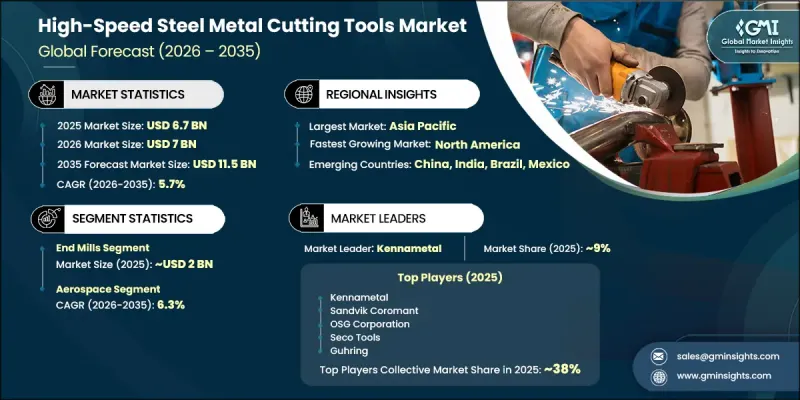
이 시장은 세계 제조 활동의 확대, 산업 자동화, 자동차 및 항공우주와 같은 주요 최종 사용 산업 수요 증가에 힘입어 성장하고 있습니다. 인도, 중국, 동남아시아를 포함한 신흥 경제권의 급속한 산업화는 시장 수요를 더욱 강화하고 있습니다. 이 지역에서는 자동차, 항공우주, 방위, 건설 분야에서 생산이 증가하고 있으며, 이들 분야는 모두 고정밀 금속 절삭 솔루션에 크게 의존하고 있기 때문입니다. 질화티타늄 코팅 기술 및 개선된 야금 가공 기술을 포함한 고속도강의 구성이 지속적으로 발전함에 따라 공구의 내구성, 내마모성 및 절삭 성능이 크게 향상되어 정밀 가공 용도 분야에 더욱 적합해졌습니다. 또한, 자동차 제조의 경량화 및 항공우주 생산에서 첨단 고강도 합금의 채택이 증가함에 따라 높은 응력 조건에서도 정밀도를 유지할 수 있는 신뢰할 수 있는 절삭 공구에 대한 요구가 증가하고 있습니다. 고속도강 공구는 비용 효율성, 인성 및 다양한 가공 공정에서 다재다능한 특성으로 인해 제조 현장에서 계속 널리 사용되고 있습니다. 이러한 공구에는 드릴, 밀링, 탭, 리머 및 기타 산업 생산에 필수적인 다양한 정밀 절삭 공구가 포함됩니다.
| 시장 범위 | |
|---|---|
| 개시 연도 | 2025년 |
| 예측 기간 | 2026-2035년 |
| 개시 연도 시장 규모 | 67억 달러 |
| 예측 시장 규모 | 115억 달러 |
| CAGR | 5.7% |
엔드밀 시장은 2025년에 약 20억 달러 규모에 달했으며, 2026-2035년 연평균 6.3% 성장할 것으로 예측됩니다. 이 부문은 다양한 제조 산업에서 밀링 가공에 널리 사용되어 시장을 주도하고 있습니다. 고속 강철 엔드밀은 금속 부품의 슬롯, 캐비티, 프로파일 및 복잡한 형상을 가공하는 데 널리 사용됩니다. 항공우주 제조 산업에서는 알루미늄 합금, 티타늄 및 기타 고정밀도가 요구되는 특수 소재의 가공에 필수적인 공구입니다. 자동차 생산 시설에서는 엔진 부품, 변속기 부품 및 구조물 어셈블리 제조에 엔드밀이 활용되고 있습니다. 황삭과 정삭 가공 모두에 대응할 수 있는 적응성으로 작업 효율을 향상시키고 공구 교환 빈도를 줄일 수 있습니다.
항공우주 부문은 2025년 28.7%의 점유율을 차지했으며, 2035년까지 연평균 6.3%의 성장률을 보일 것으로 전망됩니다. 이 우위는 엄격한 정밀 기준과 항공우주 부품의 복잡성에 기인합니다. 항공기 구조 부품, 엔진 시스템 및 랜딩 기어 어셈블리에는 내구성이 뛰어난 절삭 공구가 뒷받침하는 고도의 가공 공정이 필요합니다. 고속도강(HSS) 공구는 인성과 절삭날 칩에 대한 저항성으로 인해 특정 항공우주 분야에서 선호되고 있습니다. 이 부문은 민간 항공기, 방산 항공기 및 우주선 부품 생산에 의해 더욱 뒷받침되고 있으며, 이들 모두 티타늄 합금, 스테인리스 스틸, 내열성 금속과 같은 난삭재 가공이 수반됩니다.
미국의 고속도 강철 금속 절삭 공구 시장은 2025년에 12억 달러에 달했으며, 2026-2035년 연평균 7%의 연평균 복합 성장률(CAGR)을 보일 것으로 예측됩니다. 이 나라 시장 성장은 활발한 항공우주 제조 활동, 자동차 생산 및 첨단 산업기계 개발에 의해 주도되고 있습니다. 국방 분야는 군용 장비 및 시스템의 정밀 가공 수요로 인해 시장에 크게 기여하고 있습니다. 의료기기 산업도 수술기구 및 임플란트 전문 제조를 통해 수요를 뒷받침하고 있습니다. 광범위한 산업 제조 활동은 다양한 용도의 절삭 공구의 안정적인 소비를 더욱 뒷받침하고 있습니다.
자주 묻는 질문
목차
제1장 조사 방법 및 범위
제2장 주요 요약
제3장 업계 인사이트
제4장 경쟁 구도
제5장 시장 추산 및 예측 : 유형별(2022-2035년)
제6장 시장 추산 및 예측 : 재료 등급별(2022-2035년)
제7장 시장 추산 및 예측 : 용도별(2022-2035년)
제8장 시장 추산 및 예측 : 최종 이용 산업별(2022-2035년)
제9장 시장 추산 및 예측 : 판매 채널별(2022-2035년)
제10장 시장 추산 및 예측 : 지역별(2022-2035년)
제11장 기업 개요
AJY 26.06.11The Global High-Speed Steel Metal Cutting Tools Market was valued at USD 6.7 billion in 2025 and is estimated to grow at a CAGR of 5.7% to reach USD 11.5 billion by 2035.
The market is expanding, supported by the growth of global manufacturing activities, industrial automation, and rising demand from major end-use industries such as automotive and aerospace. Rapid industrialization across emerging economies, including India, China, and Southeast Asia is further strengthening market demand as these regions experience increasing production in automotive, aerospace, defense, and construction sectors, all of which rely heavily on high-precision metal cutting solutions. Continuous advancements in high-speed steel compositions, including titanium nitride coating technologies and improved metallurgical processing techniques, have significantly enhanced tool durability, wear resistance, and cutting performance, making these tools more suitable for precision machining applications. In addition, increasing adoption of lightweight materials in automotive manufacturing and advanced high-strength alloys in aerospace production is boosting demand for reliable cutting tools capable of maintaining accuracy under high-stress conditions. High-speed steel tools continue to remain widely used in manufacturing operations due to their cost efficiency, toughness, and versatility across multiple machining processes. These tools include drills, milling cutters, taps, reamers, and various other precision cutting instruments essential for industrial production.
| Market Scope | |
|---|---|
| Start Year | 2025 |
| Forecast Year | 2026-2035 |
| Start Value | $6.7 Billion |
| Forecast Value | $11.5 Billion |
| CAGR | 5.7% |
The end mills segment accounted for around USD 2 billion in 2025 and is projected to grow at a CAGR of 6.3% between 2026 and 2035. This segment leads the market due to its extensive use in milling applications across diverse manufacturing industries. High-speed steel end mills are widely used for producing slots, cavities, profiles, and complex geometries in metal components. Aerospace manufacturing relies on these tools for machining aluminum alloys, titanium, and other specialized materials requiring high precision. Automotive production facilities utilize end mills for manufacturing engine parts, transmission components, and structural assemblies. Their adaptability for both roughing and finishing operations enhances operational efficiency and reduces tool change requirements.
The aerospace segment held a 28.7% share in 2025 and is expected to grow at a CAGR of 6.3% through 2035. This dominance is attributed to strict precision standards and the complexity of aerospace components. Aircraft structural parts, engine systems, and landing gear assemblies require advanced machining processes supported by durable cutting tools. High-speed steel tools are favored in certain aerospace applications due to their toughness and resistance to edge chipping. The segment is further supported by the production of commercial aircraft, defense aircraft, and spacecraft components, all of which involve machining of difficult materials such as titanium alloys, stainless steels, and high-temperature resistant metals.
U.S. High-Speed Steel Metal Cutting Tools Market reached USD 1.2 billion in 2025 and is forecast to grow at a CAGR of 7% from 2026 to 2035. Market growth in the country is driven by strong aerospace manufacturing activity, automotive production, and advanced industrial machinery development. The defense sector contributes significantly due to its requirement for precision machining in military equipment and systems. The medical device industry also supports demand through specialized manufacturing of surgical instruments and implants. Broad-based industrial manufacturing activities further sustain consistent consumption of cutting tools across multiple applications.
Key players operating in the Global High-Speed Steel Metal Cutting Tools Market include Dormer Pramet, Sandvik Coromant, Kennametal, OSG Corporation, Seco Tools, Guhring, Sumitomo Electric Industries, Emuge-Franken, Vargus, BIG Kaiser (BIG DAISHOWA Americas), Niagara Cutter, Hannibal Carbide Tool, GWS Tool Group, Toolmex Industrial Solutions, and RTS Cutting Tools. Companies in the high-speed steel metal cutting tools market are focusing on continuous product innovation to enhance tool life, cutting precision, and heat resistance through advanced coatings and improved metallurgy. Manufacturers are expanding their production capabilities and investing in automated manufacturing technologies to improve efficiency and reduce production costs. Strategic partnerships with automotive, aerospace, and industrial OEMs are strengthening long-term supply agreements and ensuring stable demand. Firms are also emphasizing research and development to design tools compatible with advanced materials and high-speed machining applications. Geographic expansion into emerging manufacturing hubs is helping companies capture new demand centers.
Table of Contents
Chapter 1 Methodology and Scope
- 1.1 Market scope and definition
- 1.2 Research design
- 1.2.1 Research approach
- 1.2.2 Data collection methods
- 1.3 Data mining sources
- 1.3.1 Global
- 1.3.2 Regional/Country
- 1.4 Base estimates and calculations
- 1.4.1 Base year calculation
- 1.4.2 Key trends for market estimation
- 1.5 Primary research and validation
- 1.5.1 Primary sources
- 1.6 Forecast model
- 1.7 Research assumptions and limitations
Chapter 2 Executive Summary
- 2.1 Industry 360° synopsis
- 2.2 Key market trends
- 2.2.1 Regional
- 2.2.2 Type
- 2.2.3 Material Grade
- 2.2.4 Application
- 2.2.5 End Use Industry
- 2.2.6 Distribution Channel
Chapter 3 Industry Insights
- 3.1 Industry ecosystem analysis
- 3.1.1 Supplier landscape
- 3.1.2 Profit margin
- 3.1.3 Value addition at each stage
- 3.1.4 Factor affecting the value chain
- 3.2 Industry impact forces
- 3.2.1 Growth drivers
- 3.2.1.1 Growing aerospace and automotive manufacturing
- 3.2.1.2 Expansion of industrial manufacturing and machinery production
- 3.2.1.3 Rising demand for precision-engineered medical devices
- 3.2.2 Industry pitfalls & challenges
- 3.2.2.1 Competition from carbide and ceramic cutting tools
- 3.2.2.2 Fluctuating raw material costs and supply chain issues
- 3.2.3 Opportunities
- 3.2.3.1 Growing online retail and e-commerce platforms
- 3.2.3.2 Expansion in emerging markets and youth participation
- 3.2.1 Growth drivers
- 3.3 Growth potential analysis
- 3.4 Future market trends
- 3.5 Technology and innovation landscape
- 3.5.1 Current technological trends
- 3.5.2 Emerging technologies
- 3.6 Pricing Analysis (Driven by Primary Research)
- 3.6.1 Historical Price Trend Analysis (Driven by Primary Research)
- 3.6.2 Pricing Strategy by Player Type (Premium/Value/Cost-plus) (Driven by Primary Research)
- 3.7 Regulatory landscape
- 3.7.1 Standards and compliance requirements
- 3.7.2 Regional regulatory frameworks
- 3.7.3 Certification standards
- 3.8 Porter's analysis
- 3.9 PESTEL analysis
- 3.10 Trade Data Analysis (Driven by Primary Research)
- 3.10.1 Import/Export Volume & Value Trends (Driven by Primary Research)
- 3.10.2 Key Trade Corridors & Tariff Impact (Driven by Primary Research)
- 3.10.3 HS Code Classification & Trade Flow Analysis
- 3.11 Impact of AI & Generative AI on the Market
- 3.11.1 AI-Driven Disruption of Existing Business Models
- 3.11.2 GenAI Use Cases & Adoption Roadmap by Segment
- 3.11.3 Risks, Limitations & Regulatory Considerations
- 3.12 Distribution Infrastructure & Channel Penetration Landscape (Driven by Primary Research)
- 3.12.1 Channel Coverage by Region & Format (Modern vs. Traditional Trade) (Driven by Primary Research)
- 3.12.2 Last-Mile Infrastructure Gaps & Emerging Channel Shifts (Driven by Primary Research)
Chapter 4 Competitive Landscape, 2025
- 4.1 Introduction
- 4.2 Company market share analysis
- 4.2.1 By region
- 4.2.1.1 North America
- 4.2.1.2 Europe
- 4.2.1.3 Asia Pacific
- 4.2.1.4 Latin America
- 4.2.1.5 Middle East and Africa
- 4.2.1 By region
- 4.3 Company matrix analysis
- 4.4 Competitive analysis of major market players
- 4.5 Competitive positioning matrix
- 4.6 Key developments
- 4.6.1 Mergers & acquisitions
- 4.6.2 Partnerships & collaborations
- 4.6.3 New product launches
- 4.6.4 Expansion plans
Chapter 5 Market Estimates & Forecast, By Type, 2022 - 2035 (USD Billion) (Million Units)
- 5.1 Key trends
- 5.2 End mills
- 5.3 Drills
- 5.4 Taps
- 5.5 Reamers
- 5.6 Broaches
- 5.7 Others (countersinking etc.)
Chapter 6 Market Estimates & Forecast, By Material Grade, 2022 - 2035 (USD Billion) (Million Units)
- 6.1 Key trends
- 6.2 T series
- 6.3 M series
- 6.4 Others (cobalt steel etc.)
Chapter 7 Market Estimates & Forecast, By Application, 2022 - 2035 (USD Billion) (Million Units)
- 7.1 Key trends
- 7.2 Turning
- 7.3 Milling
- 7.4 Drilling
- 7.5 Tapping
- 7.6 Others (threading etc.)
Chapter 8 Market Estimates & Forecast, By End Use Industry, 2022 - 2035 (USD Billion) (Million Units)
- 8.1 Key trends
- 8.2 Aerospace
- 8.3 Medical
- 8.4 Automotive
- 8.5 Industrial manufacturing
- 8.6 Construction
- 8.7 Others (electronics & electrical etc.)
Chapter 9 Market Estimates & Forecast, By Distribution Channel, 2022 - 2035 (USD Billion) (Million Units)
- 9.1 Key trends
- 9.2 Direct sales
- 9.3 Indirect sales
Chapter 10 Market Estimates and Forecast, By Region, 2022 - 2035 (USD Billion) (Thousand Units)
- 10.1 Key trends
- 10.2 North America
- 10.2.1 U.S.
- 10.2.2 Canada
- 10.3 Europe
- 10.3.1 Germany
- 10.3.2 UK
- 10.3.3 France
- 10.3.4 Italy
- 10.3.5 Spain
- 10.4 Asia Pacific
- 10.4.1 China
- 10.4.2 Japan
- 10.4.3 India
- 10.4.4 Australia
- 10.4.5 South Korea
- 10.5 Latin America
- 10.5.1 Brazil
- 10.5.2 Mexico
- 10.5.3 Argentina
- 10.6 Middle East and Africa
- 10.6.1 South Africa
- 10.6.2 Saudi Arabia
- 10.6.3 UAE
Chapter 11 Company Profiles
- 11.1 Top Global Player
- 11.1.1 Sandvik Coromant
- 11.1.2 Kennametal
- 11.1.3 Sumitomo Electric Industries
- 11.1.4 Seco Tools
- 11.1.5 OSG Corporation
- 11.1.6 Dormer Pramet
- 11.2 Regional Player
- 11.2.1 Emuge-Franken
- 11.2.2 Niagara Cutter
- 11.2.3 BIG Kaiser (BIG DAISHOWA Americas)
- 11.2.4 Guhring
- 11.2.5 Vargus
- 11.3 Emerging Players
- 11.3.1 RTS Cutting Tools
- 11.3.2 Hannibal Carbide Tool
- 11.3.3 Toolmex Industrial Solutions
- 11.3.4 GWS Tool Group