|
시장보고서
상품코드
2038736
의료 영상 시장 : 시장 비즈니스 기회, 성장요인, 업계 동향 분석 및 예측(2026-2035년)Medical Imaging Market Opportunity, Growth Drivers, Industry Trend Analysis, and Forecast 2026 - 2035 |
||||||

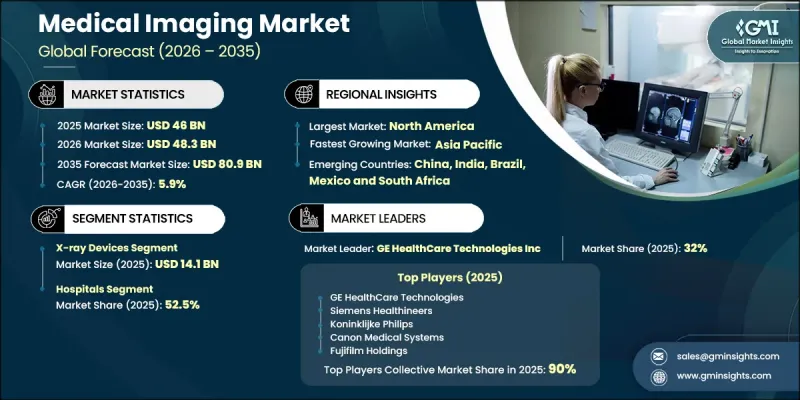
세계의 의료 영상 시장은 2025년에 460억 달러로 평가되었고, CAGR 5.9%로 성장할 전망이며, 2035년까지 809억 달러에 이를 것으로 예측됩니다.
이러한 성장은 만성질환의 부담 증가, 고령화, 영상진단 기술의 지속적인 발전, 그리고 신흥국과 선진국 모두에서 의료비 증가에 의해 뒷받침되고 있습니다. 의료용 영상진단은 의료진이 내부 장기, 조직, 뼈를 상세하게 시각화할 수 있게 함으로써 임상 진단 및 치료 계획의 기초가 되고 있습니다. 이러한 기술들은 질병의 조기 발견을 돕고, 최소침습 수술의 가이드라인이 되어 장기적인 환자 관리에 기여하고 있습니다. 하드웨어 및 소프트웨어 혁신, 이미지 선명도 향상, 이미지 처리 속도 향상, 임상적 판단의 고도화, 환자 결과 개선, 세계 수요 증가로 인해 의료 영상에 대한 수요가 증가하고 있습니다.
| 시장 범위 | |
|---|---|
| 개시 연도 | 2025년 |
| 예측 기간 | 2026-2035년 |
| 개시 연도 시장 규모 | 460억 달러 |
| 예측 시장 규모 | 809억 달러 |
| CAGR | 5.9% |
의료 영상은 임상 평가 및 수술 절차를 지원하기 위해 고화질 시각 데이터를 생성하는 기술에 의존하고 있습니다. 이러한 도구는 진단의 필수적인 요소로 진화하여 모든 의료 분야에서 정확성과 신속성을 제공합니다. MRI 시스템, 엑스레이 장치, CT 스캐너, 초음파 진단 장치 등의 장비는 내장 손상, 만성 질환, 이상 여부를 평가하기 위해 임상 현장 곳곳에 도입되고 있습니다. 이러한 실시간 영상화 기능은 진단을 돕고 워크플로우의 효율성을 높이는데 기여하고 있습니다.
2025년, 엑스레이 장비 부문은 141억 달러에 달했습니다. 이는 주로 만성질환의 조기 진단에 대한 활용도가 높아졌기 때문입니다. 이 부문의 성장은 엑스레이 기술의 지속적인 업그레이드에 의해 뒷받침되고 있습니다. 현재는 정확성을 보장하고, 워크플로우를 간소화하며, 영상의학과 의사의 부담을 덜어주기 위해 설계된 AI 기반 영상 진단 솔루션이 포함되어 있습니다. 이러한 첨단 시스템은 다기관 공동 평가에서 그 효과가 입증되어 임상 현장에서 널리 채택되고 있습니다. 스마트 진단 기능의 도입은 의료 제공업체의 신뢰를 크게 높여 현대 의료 영상 진단 현장에서 엑스레이 시스템의 이용 확대에 기여하고 있습니다.
2025년 기준, 병원 부문은 52.5%의 점유율을 차지했습니다. 점유율 확대는 급속한 도시화, 인구 증가, 의료 인프라에 대한 투자 확대의 영향을 받고 있습니다. 고급 진단 장비의 광범위한 도입과 함께 이를 조작할 수 있는 숙련된 전문가의 존재는 병원을 이 시장의 주요 최종 사용자로 자리매김하고 있습니다. 또한, 특히 개발도상국의 병원 개보수 및 신축에 대한 자금 투입이 증가하면서 영상진단기기 도입을 촉진하고 있습니다. 병원 인프라 개선을 위한 정부 및 민간의 투자가 고성능 영상진단 기술에 대한 큰 수요를 견인하고 있습니다.
2025년 미국의 의료 영상 시장 규모는 158억 달러로 평가되었습니다. 환경 및 생활습관 관련 요인으로 인해 미국 내 암 유병률이 증가함에 따라 암을 조기에 발견하고 추적 관찰할 수 있는 효과적이고 진보된 영상 진단 도구에 대한 요구가 증가하고 있습니다. 이러한 질병 발생률 증가는 병원 및 클리닉에 높은 진단 가치와 환자별 정확도를 제공하는 영상진단 시스템에 대한 투자를 촉진하고 있으며, 그 결과 미국 시장 전체의 성장을 가속화하고 있습니다.
자주 묻는 질문
목차
제1장 조사 방법 및 범위
제2장 주요 요약
제3장 업계 인사이트
제4장 경쟁 구도
제5장 시장 추산 및 예측 : 제품별(2022-2035년)
제6장 시장 추산 및 예측 : 최종 용도별(2022-2035년)
제7장 시장 추산 및 예측 : 지역별(2022-2035년)
제8장 기업 개요
AJY 26.06.11The Global Medical Imaging Market was valued at USD 46 billion in 2025 and is estimated to grow at a CAGR of 5.9% to reach USD 80.9 billion by 2035.
This growth is supported by the increasing burden of chronic diseases, a rising aging population, ongoing advancements in imaging technologies, and greater healthcare spending across both emerging and developed nations. Medical imaging continues to be a cornerstone in clinical diagnostics and treatment planning, as it enables healthcare providers to visualize internal organs, tissues, and bones in detail. These technologies help in early disease detection, guide minimally invasive procedures, and contribute to long-term patient management. Innovations in hardware and software, improved image clarity, and faster image processing are further elevating clinical decision-making, improving patient outcomes, and boosting demand worldwide.
| Market Scope | |
|---|---|
| Start Year | 2025 |
| Forecast Year | 2026-2035 |
| Start Value | $46 Billion |
| Forecast Value | $80.9 Billion |
| CAGR | 5.9% |
Medical imaging relies on technologies that produce high-definition visual data to assist in clinical evaluations and surgical interventions. These tools have evolved into essential components of diagnostics, offering precision and speed across medical disciplines. Devices such as MRI systems, X-rays, CT scanners, and ultrasound machines are deployed across clinical settings to evaluate internal injuries, chronic conditions, and abnormalities. Their real-time imaging capabilities support diagnosis and improve workflow efficiency.
In 2025, the X-ray devices segment reached USD 14.1 billion, primarily due to its increased usage for early diagnosis of chronic illnesses. This segment's growth is supported by the constant upgrades in X-ray technologies that now include AI-powered imaging solutions designed to ensure accuracy, streamline workflows, and reduce the burden on radiologists. These advanced systems have proven their efficacy in multicenter evaluations and are widely adopted across clinical setups. The incorporation of smart diagnostic capabilities is significantly enhancing provider confidence and contributing to the rising utilization of X-ray systems in modern medical imaging practices.
The hospitals segment held a 52.5% share in 2025. Their growing share is influenced by rapid urbanization, population growth, and a rise in healthcare infrastructure investments. The widespread installation of advanced diagnostic equipment, coupled with skilled professionals available to operate them, is positioning hospitals as dominant end-users in this market. Additionally, increased funding for hospital upgrades and new construction especially across developing regions is elevating the adoption of imaging equipment. Government and private investments in improving hospital infrastructure are driving significant demand for high-performance imaging technologies.
United States Medical Imaging Market was valued at USD 15.8 billion in 2025. The rising cancer prevalence across the country, stemming from environmental and lifestyle-related factors, has intensified the need for effective and advanced imaging tools for early cancer detection and monitoring. The growing incidence of such conditions is pushing hospitals and clinics to invest in imaging systems that offer high diagnostic value and patient-specific accuracy, thus accelerating overall market growth in the U.S.
Prominent companies operating in the Global Medical Imaging Market include GE HealthCare Technologies, Shimadzu, Samsung Medison, Carestream Health, Canon Medical Systems, Fujifilm Holdings, Hologic, Konica Minolta, Esaote, Siemens Healthineers, and Koninklijke Philips. Leading medical imaging companies are prioritizing innovation by investing in AI integration, machine learning algorithms, and automation to boost image accuracy and diagnostic speed. They are expanding their digital health platforms to support remote diagnostics, cloud-based image storage, and data interoperability. Global market players are actively pursuing mergers, acquisitions, and collaborations with hospitals and technology firms to broaden their solution portfolios. Expansion into high-growth emerging markets is another critical strategy, supported by localized manufacturing and service centers. To remain competitive, manufacturers are also offering modular imaging systems that reduce maintenance and allow for easier upgrades.
Table of Contents
Chapter 1 Methodology and Scope
- 1.1 Research approach
- 1.2 Quality commitments
- 1.2.1 GMI AI policy & data integrity commitment
- 1.2.1.1 Source consistency protocol
- 1.2.1 GMI AI policy & data integrity commitment
- 1.3 Research trail & confidence scoring
- 1.3.1 Research trail components
- 1.3.2 Scoring components
- 1.4 Data collection
- 1.4.1 Partial list of primary sources
- 1.5 Data mining sources
- 1.5.1 Paid sources
- 1.5.1.1 Sources, by region
- 1.5.1 Paid sources
- 1.6 Base estimates and calculations
- 1.6.1 Base year calculation for any one approach
- 1.7 Forecast model
- 1.7.1 Quantified market impact analysis
- 1.7.1.1 Mathematical impact of growth parameters on forecast
- 1.7.1 Quantified market impact analysis
- 1.8 Research transparency addendum
- 1.8.1 Source attribution framework
- 1.8.2 Quality assurance metrics
- 1.8.3 Our commitment to trust
Chapter 2 Executive Summary
- 2.1 Industry 360° synopsis
- 2.2 Key market trends
- 2.2.1 Product trends
- 2.2.2 End use trends
- 2.2.3 Regional trends
- 2.3 CXO perspectives: Strategic imperatives
Chapter 3 Industry Insights
- 3.1 Industry ecosystem analysis
- 3.2 Industry impact forces
- 3.2.1 Growth drivers
- 3.2.1.1 Incremental innovations and advancements in medical imaging technology
- 3.2.1.2 Rise in healthcare expenditure
- 3.2.1.3 Increasing disease burden along with rapidly growing geriatric population base
- 3.2.1.4 Emergence of artificial intelligence (AI) in radiology
- 3.2.1.5 Favorable government initiatives
- 3.2.2 Industry pitfalls and challenges
- 3.2.2.1 High cost of imaging devices
- 3.2.2.2 Changes in reimbursement policies
- 3.2.3 Market opportunities
- 3.2.3.1 Expansion in emerging markets
- 3.2.1 Growth drivers
- 3.3 Growth potential analysis
- 3.4 Regulatory landscape (Driven by Primary Research)
- 3.4.1 North America
- 3.4.2 Europe
- 3.4.3 Asia Pacific
- 3.5 Technological landscape (Driven by Primary Research)
- 3.5.1 Current technologies
- 3.5.1.1 Digital X ray and flat panel detector systems
- 3.5.1.2 Advanced computed tomography (CT) and magnetic resonance imaging (MRI) systems
- 3.5.1.3 PACS and cloud based imaging data management platforms
- 3.5.2 Emerging technologies
- 3.5.2.1 AI powered image analysis and clinical decision support systems
- 3.5.2.2 Portable and point of care imaging technologies
- 3.5.2.3 Low dose and high sensitivity imaging technologies
- 3.5.2.4 Interoperable imaging ecosystems with integrated digital health platforms
- 3.5.1 Current technologies
- 3.6 Future market trends (Driven by Primary Research)
- 3.7 Patent analysis (Driven by Primary Research)
- 3.8 Pricing analysis, 2025 (Driven by Primary Research)
- 3.9 Impact of AI and Generative AI on the market (Driven by Primary Research)
- 3.10 Porter's analysis
- 3.11 PESTEL analysis
Chapter 4 Competitive Landscape, 2025
- 4.1 Introduction
- 4.2 Company market share analysis
- 4.3 Company matrix analysis
- 4.4 Competitive analysis of major market players
- 4.5 Competitive positioning matrix
- 4.6 Strategy outlook matrix
- 4.7 Key developments
- 4.7.1 Mergers and acquisitions
- 4.7.2 Partnerships and collaborations
- 4.7.3 New product launches
- 4.7.4 Expansion plans
Chapter 5 Market Estimates and Forecast, By Product, 2022 - 2035 ($ Mn)
- 5.1 Key trends
- 5.2 X-ray devices
- 5.2.1 Digital
- 5.2.1.1 Direct radiography systems
- 5.2.1.2 Computed radiography systems
- 5.2.2 Analog
- 5.2.1 Digital
- 5.3 MRI
- 5.4 Ultrasound
- 5.4.1 2D Ultrasound
- 5.4.2 3D Ultrasound
- 5.4.3 Other ultrasounds
- 5.5 Computed tomography
- 5.6 Nuclear imaging
- 5.7 Mammography
Chapter 6 Market Estimates and Forecast, By End Use, 2022 - 2035 ($ Mn)
- 6.1 Key trends
- 6.2 Hospitals
- 6.3 Diagnostic centers
- 6.4 Other end users
Chapter 7 Market Estimates and Forecast, By Region, 2022 - 2035 ($ Mn)
- 7.1 Key trends
- 7.2 North America
- 7.2.1 U.S.
- 7.2.2 Canada
- 7.3 Europe
- 7.3.1 Germany
- 7.3.2 UK
- 7.3.3 France
- 7.3.4 Spain
- 7.3.5 Italy
- 7.3.6 Netherlands
- 7.4 Asia Pacific
- 7.4.1 China
- 7.4.2 Japan
- 7.4.3 India
- 7.4.4 Australia
- 7.4.5 South Korea
- 7.5 Latin America
- 7.5.1 Brazil
- 7.5.2 Mexico
- 7.5.3 Argentina
- 7.6 Middle East and Africa
- 7.6.1 South Africa
- 7.6.2 Saudi Arabia
- 7.6.3 UAE
Chapter 8 Company Profiles
- 8.1 Agfa-Gevaert Group
- 8.2 Canon Medical Systems
- 8.3 Carestream Health
- 8.4 Esaote
- 8.5 Fujifilm Holdings
- 8.6 GE HealthCare Technologies
- 8.7 Hologic
- 8.8 Konica Minolta
- 8.9 Koninklijke Philips
- 8.10 Orthoscan
- 8.11 Planmed Oy
- 8.12 Samsung Medison
- 8.13 Shimadzu
- 8.14 Siemens Healthineers
- 8.15 Trivitron Healthcare