

|
시장보고서
상품코드
2038750
블루베리 원료 시장 : 시장 기회, 성장요인, 업계 동향 분석 및 예측(2026-2035년)Blueberry Ingredient Market Opportunity, Growth Drivers, Industry Trend Analysis, and Forecast 2026 - 2035 |
||||||

세계의 블루베리 원료 시장은 2025년에 28억 달러로 평가되었고, CAGR 7%로 성장할 전망이며, 2035년까지 56억 달러에 이를 것으로 예측됩니다.
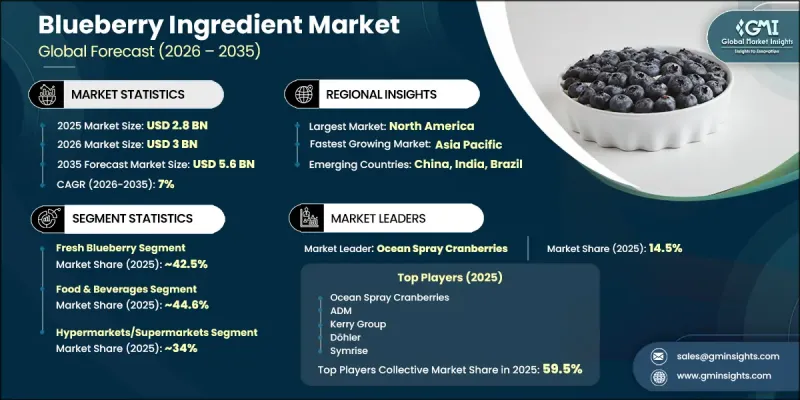
다양한 산업 분야에서 소비자들이 천연 유래, 클린 라벨, 항산화 물질이 풍부한 식품 원료를 점점 더 선호함에 따라 시장은 강력한 모멘텀을 보이고 있습니다. 기능성 영양과 예방의학에 대한 인식이 높아지면서 식품, 음료, 보충제, 퍼스널케어 제품에서 블루베리 기반 성분의 사용이 가속화되고 있습니다. 업계 데이터에 따르면 북미의 블루베리 재배 및 수출 활동이 꾸준히 증가하고 있으며, 남미와 유럽의 농지 확대가 산업 규모의 가공 수요를 뒷받침하고 있습니다. 제조업체들은 클린 라벨에 대한 기대에 부응하고 제품 포지셔닝을 개선하기 위해 인공 첨가물 대신 블루베리 농축액, 퓌레, 분말을 점점 더 많이 사용하고 있습니다. 기능성 및 영양학적 용도에 대한 수요 증가는 시장 확대를 더욱 촉진하고 있으며, 블루베리 추출물과 표준화 분말은 건강 보조 식품, 웰빙 음료, 건강 지향적 스낵 등에 널리 사용되고 있습니다. 안토시아닌과 폴리페놀에 대한 연구는 이 성분의 건강 측면에서의 입지를 더욱 공고히 하고, 인지 기능, 심혈관계 및 항산화 작용에 초점을 맞춘 제형에 대한 사용을 촉진하고 있습니다. 동시에, 퍼스널케어 및 화장품 업계에서는 천연 유래 안티에이징 및 피부 보호 솔루션에 대한 수요에 힘입어 블루베리 종자유 및 추출물과 같은 블루베리 유래 성분을 스킨케어 및 헤어케어 제품에 통합하는 움직임이 점점 더 확산되고 있습니다.
| 시장 범위 | |
|---|---|
| 개시 연도 | 2025년 |
| 예측 기간 | 2026-2035년 |
| 개시 연도 시장 규모 | 28억 달러 |
| 예측 시장 규모 | 56억 달러 |
| CAGR | 7% |
2025년 생블루베리 부문은 소비자의 높은 선호도와 소매점에서의 높은 인지도를 바탕으로 시장 점유율 42.5%를 차지했습니다. 제조업체들이 신선도, 비용효율성, 보존성을 동시에 추구하면서 시장은 구조적으로 다변화되고 있습니다. 생 블루베리는 여전히 계절적 소매 수요의 주류를 이루고 있지만, 음료 및 식품 제조업체들은 연중 안정적인 공급을 위해 냉동, 건조, 농축 원료 등 가공 형태를 점점 더 많이 활용하고 있습니다. 이러한 다양한 조달 방식을 통해 베이커리, 유제품, 음료, 스낵 등의 용도에서 맛, 색조, 영양가의 안정성을 유지하여 산업용으로 일관되게 사용할 수 있도록 지원합니다.
2025년에는 대형마트와 슈퍼마켓 부문이 34%의 점유율을 차지했습니다. 유통 구조는 점차 옴니채널로 전환되고 있으며, 대형 소매점은 신선, 냉동 및 포장된 블루베리 제품을 통해 판매량에서 여전히 지배적인 위치를 유지하고 있습니다. 동시에 전문점 및 건강 지향적 소매 채널은 프리미엄, 유기농, 기능성 블루베리 제품을 강조하면서 블루베리 제품 판매에 박차를 가하고 있습니다. 이러한 소매 업계의 종합적인 발전으로 인해 제품의 접근성이 향상되고, 주류 및 틈새 시장 모두에서 소비자의 접근성이 확대되고 있습니다.
북미의 블루베리 원료 시장은 2025년 9억 9,500만 달러로 평가되었고, 2035년까지 19억 9,000만 달러로 확대될 것으로 예측됩니다. 이 지역의 성장은 1인당 블루베리 소비량이 많고, 가공 인프라가 잘 구축되어 있으며, 클린 라벨 및 기능성 식품 원료에 대한 수요가 높기 때문에 성장세를 보이고 있습니다. 블루베리를 기반으로 한 제품은 자연 유래의 건강 지향적 원료에 대한 소비자의 강한 선호에 힘입어 베이커리, 유제품, 스낵, 뉴트리슈티컬(기능성 식품) 등 다양한 카테고리에서 널리 사용되고 있습니다.
자주 묻는 질문
목차
제1장 조사 방법 및 범위
제2장 주요 요약
제3장 업계 인사이트
제4장 경쟁 구도
제5장 시장 추산 및 예측 : 원료 유형별(2022-2035년)
제6장 시장 추산 및 예측 : 용도별(2022-2035년)
제7장 시장 추산 및 예측 : 유통 채널별(2022-2035년)
제8장 시장 추산 및 예측 : 지역별(2022-2035년)
제9장 기업 개요
AJY 26.06.11The Global Blueberry Ingredient Market was valued at USD 2.8 billion in 2025 and is estimated to grow at a CAGR of 7% to reach USD 5.6 billion by 2035.
The market is witnessing strong momentum as consumers increasingly prefer natural, clean-label, and antioxidant-rich food ingredients across multiple industries. Rising awareness of functional nutrition and preventive health is accelerating the use of blueberry-based formulations in food, beverages, supplements, and personal care applications. Industry data indicates consistent growth in blueberry cultivation and export activities in North America, while expanding agricultural acreage in South America and Europe is supporting industrial-scale processing demand. Manufacturers are increasingly replacing artificial additives with blueberry concentrates, purees, and powders to meet clean-label expectations and improve product positioning. The growing demand for functional and nutraceutical applications is further strengthening market expansion, with blueberry extracts and standardized powders widely used in dietary supplements, wellness beverages, and health-focused snacks. Scientific research on anthocyanins and polyphenols continues to reinforce the ingredient's health positioning, encouraging its use in cognitive, cardiovascular, and antioxidant-focused formulations. At the same time, the personal care and cosmetics industry is increasingly incorporating blueberry-derived ingredients such as seed oil and extracts into skincare and haircare products, driven by demand for natural anti-aging and skin protection solutions.
| Market Scope | |
|---|---|
| Start Year | 2025 |
| Forecast Year | 2026-2035 |
| Start Value | $2.8 Billion |
| Forecast Value | $5.6 Billion |
| CAGR | 7% |
The fresh blueberry category accounted for 42.5% share in 2025, supported by strong consumer preference and high retail visibility. The market is undergoing structural diversification as manufacturers balance freshness, cost efficiency, and shelf stability. While fresh blueberries remain dominant in seasonal retail demand, processed formats such as frozen, dried, and concentrate-based ingredients are increasingly used by food and beverage producers to ensure consistent year-round availability. This diversified sourcing approach helps maintain stable flavor profiles, color integrity, and nutritional value across bakery, dairy, beverage, and snack applications, supporting consistent industrial usage.
The hypermarkets and supermarkets segment held 34% share in 2025. The distribution landscape is gradually shifting toward an omnichannel structure, where large retail outlets continue to dominate volume sales through fresh, frozen, and packaged blueberry offerings. At the same time, specialty stores and health-focused retail channels are gaining traction by emphasizing premium, organic, and functional blueberry products. This combined retail evolution is improving product accessibility and expanding consumer reach across both mainstream and niche segments.
North America Blueberry Ingredient Market is projected to rise from USD 995 million in 2025 to USD 1.99 billion by 2035. Growth in this region is driven by high per capita blueberry consumption, well-established processing infrastructure, and strong demand for clean-label and functional food ingredients. Blueberry-based formulations are widely used across bakery, dairy, snack, and nutraceutical categories, supported by strong consumer preference for natural and health-oriented ingredients.
Major players operating in the Global Blueberry Ingredient Industry include ADM, Berry Global Group, Dohler, Graceland Fruit, Givaudan, Herbafood Ingredients, Kerry Group, Medtronic (Covidien), Milne Fruit Products, Nutra Food Ingredients, Ocean Spray Cranberries, Symrise, Sensient Technologies Corporation, SVZ International, and The Green Labs. Key companies in the Global Blueberry Ingredient Market are focusing on strengthening supply chain integration by securing long-term sourcing agreements with growers to ensure consistent raw material availability. They are investing heavily in advanced processing technologies such as freeze-drying, spray-drying, and extraction systems to improve product quality, stability, and functional performance. Expansion of product portfolios into concentrates, powders, and specialty extracts is enabling companies to serve diverse applications across food, beverage, nutraceutical, and personal care industries. Strategic partnerships with food manufacturers and beverage brands are helping firms increase product adoption in functional formulations. Additionally, companies are emphasizing clean-label positioning, natural sourcing, and traceability initiatives to align with evolving consumer preferences.
Table of Contents
Chapter 1 Methodology & Scope
- 1.1 Market scope and definition
- 1.2 Research design
- 1.2.1 Research approach
- 1.2.2 Data collection methods
- 1.3 Data mining sources
- 1.3.1 Global
- 1.3.2 Regional/Country
- 1.4 Base estimates and calculations
- 1.4.1 Base year calculation
- 1.4.2 Key trends for market estimation
- 1.5 Primary research and validation
- 1.5.1 Primary sources
- 1.6 Forecast model
- 1.7 Research assumptions and limitations
Chapter 2 Executive Summary
- 2.1 Industry 360° synopsis
- 2.2 Key market trends
- 2.2.1 Regional
- 2.2.2 Ingredient Type
- 2.2.3 Application
- 2.2.4 Distribution Channel
- 2.3 TAM Analysis, 2026-2035
- 2.4 CXO perspectives: Strategic imperatives
- 2.4.1 Executive decision points
- 2.4.2 Critical success factors
- 2.5 Future Outlook and Strategic Recommendations
Chapter 3 Industry Insights
- 3.1 Industry ecosystem analysis
- 3.1.1 Supplier landscape
- 3.1.2 Profit margin
- 3.1.3 Value addition at each stage
- 3.1.4 Factor affecting the value chain
- 3.1.5 Disruptions
- 3.2 Industry impact forces
- 3.2.1 Growth drivers
- 3.2.1.1 Growing demand for natural, clean-label fruit ingredients Boosts blueberry use in mainstream and premium products
- 3.2.1.2 Expanding global blueberry production and processing Improves availability, supports volume and innovation
- 3.2.1.3 Rising functional food, beverage, nutraceutical launches Increases demand for concentrates, powders, and extracts
- 3.2.2 Industry pitfalls and challenges
- 3.2.2.1 Weather sensitivity and seasonal yield fluctuations
- 3.2.2.2 Intense competition from other fruit ingredients
- 3.2.3 Market opportunities
- 3.2.3.1 Innovation in value-added formats and blends
- 3.2.3.2 Growing adoption in cosmetics and personal care
- 3.2.1 Growth drivers
- 3.3 Growth potential analysis
- 3.4 Regulatory landscape
- 3.4.1 North America
- 3.4.2 Europe
- 3.4.3 Asia Pacific
- 3.4.4 Latin America
- 3.4.5 Middle East & Africa
- 3.5 Porter's analysis
- 3.6 PESTEL analysis
- 3.7 Price trends
- 3.7.1 By region
- 3.7.2 By Ingredient Type
- 3.8 Future market trends
- 3.9 Technology and Innovation landscape
- 3.9.1 Current technological trends
- 3.9.2 Emerging technologies
- 3.10 Patent Landscape
- 3.11 Trade statistics (HS code)
- 3.11.1 Major importing countries
- 3.11.2 Major exporting countries
- 3.12 Sustainability and environmental aspects
- 3.12.1 Sustainable practices
- 3.12.2 Waste reduction strategies
- 3.12.3 Energy efficiency in production
- 3.12.4 Eco-friendly initiatives
- 3.13 Carbon footprint consideration
Chapter 4 Competitive Landscape, 2025
- 4.1 Introduction
- 4.2 Company market share analysis
- 4.2.1 By region
- 4.2.1.1 North America
- 4.2.1.2 Europe
- 4.2.1.3 Asia Pacific
- 4.2.1.4 LATAM
- 4.2.1.5 MEA
- 4.2.1 By region
- 4.3 Company matrix analysis
- 4.4 Competitive analysis of major market players
- 4.5 Competitive positioning matrix
- 4.6 Key developments
- 4.6.1 Mergers & acquisitions
- 4.6.2 Partnerships & collaborations
- 4.6.3 New Product Launches
- 4.6.4 Expansion Plans
Chapter 5 Market Estimates and Forecast, By Ingredient Type, 2022-2035 (USD Billion) (Kilo Tons)
- 5.1 Key trends
- 5.2 Fresh blueberry
- 5.3 Frozen blueberry
- 5.4 Dried blueberry
- 5.5 Blueberry juice concentrate
- 5.6 Blueberry puree
- 5.7 Blueberry extracts
- 5.8 Others
Chapter 6 Market Estimates and Forecast, By Application, 2022-2035 (USD Billion) (Kilo Tons)
- 6.1 Key trends
- 6.2 Food & beverages
- 6.2.1 Bakery & confectionery
- 6.2.2 Dairy products
- 6.2.3 Beverages
- 6.2.4 Snacks & bars
- 6.2.5 Others
- 6.3 Pharmaceutical
- 6.4 Cosmetics & personal care
- 6.5 Nutraceutical
- 6.6 Others
Chapter 7 Market Estimates and Forecast, By Distribution Channel, 2022-2035 (USD Billion) (Kilo Tons)
- 7.1 Key trends
- 7.2 Hypermarkets/Supermarkets
- 7.3 Specialty stores
- 7.4 Convenience stores
- 7.5 Online retail
- 7.6 Others
Chapter 8 Market Estimates and Forecast, By Region, 2022-2035 (USD Billion) (Kilo Tons)
- 8.1 Key trends
- 8.2 North America
- 8.2.1 U.S.
- 8.2.2 Canada
- 8.3 Europe
- 8.3.1 Germany
- 8.3.2 UK
- 8.3.3 France
- 8.3.4 Spain
- 8.3.5 Italy
- 8.3.6 Rest of Europe
- 8.4 Asia Pacific
- 8.4.1 China
- 8.4.2 India
- 8.4.3 Japan
- 8.4.4 Australia
- 8.4.5 South Korea
- 8.4.6 Rest of Asia Pacific
- 8.5 Latin America
- 8.5.1 Brazil
- 8.5.2 Mexico
- 8.5.3 Argentina
- 8.5.4 Rest of Latin America
- 8.6 Middle East and Africa
- 8.6.1 Saudi Arabia
- 8.6.2 South Africa
- 8.6.3 UAE
- 8.6.4 Rest of Middle East and Africa
Chapter 9 Company Profiles
- 9.1 ADM
- 9.2 Berry Global Group
- 9.3 Dohler
- 9.4 Graceland Fruit
- 9.5 Givaudan
- 9.6 Herbafood Ingredients
- 9.7 Kerry Group
- 9.8 Medtronic (Covidien)
- 9.9 Milne Fruit Products
- 9.10 Nutra Food Ingredients
- 9.11 Ocean Spray Cranberries
- 9.12 Symrise
- 9.13 Sensient Technologies Corporation
- 9.14 SVZ International
- 9.15 The Green Labs


