

|
시장보고서
상품코드
2038795
웨어러블 생체 전자 피부 패치 시장 : 시장 비즈니스 기회, 성장요인, 업계 동향 분석 및 예측(2026-2035년)Wearable Bioelectronic Skin Patches Market Opportunity, Growth Drivers, Industry Trend Analysis, and Forecast 2026 - 2035 |
||||||

세계의 웨어러블 생체 전자 피부 패치 시장은 2025년에 141억 달러로 평가되었고, 2035년까지 연평균 복합 성장률(CAGR) 15.1%로 성장할 전망이며, 565억 달러에 이를 것으로 추정되고 있습니다.
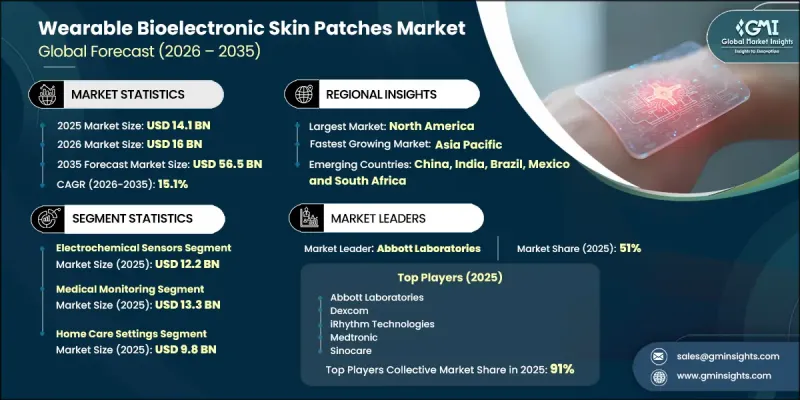
이 시장은 비침습적이고 지속적인 건강 모니터링 기술에 대한 수요 증가와 더불어 유연하고 탄력적인 전자 시스템의 급속한 발전으로 인해 주도되고 있습니다. 또한, 의료진과 환자들이 조기 발견과 지속적인 추적에 대한 관심이 높아지면서 만성질환의 유병률 증가도 주요 성장 요인으로 작용하고 있습니다. 예방 의료와 개인 건강 유지에 대한 인식이 높아지면서 소비자 및 임상 적용에 대한 도입이 더욱 가속화되고 있습니다. 또한, 원격 환자 모니터링 시스템의 확대로 인해 웨어러블 건강 기술이 주류 의료 제공 체계에 통합되는 움직임이 가속화되고 있습니다. 이 생체 전자 피부 패치는 의료 및 웰니스 환경에서 피부와의 원활한 접촉과 무선 연결을 통해 생리적 신호의 실시간 모니터링, 치료 기능 지원 및 진단 용도를 지원하는 유연하고 피부에 밀착되는 장치로 설계되었습니다.
| 시장 범위 | |
|---|---|
| 개시 연도 | 2025년 |
| 예측 기간 | 2026-2035년 |
| 개시 연도 시장 규모 | 141억 달러 |
| 예측 시장 규모 | 565억 달러 |
| CAGR | 15.1% |
이 시장의 성장은 전 세계 만성질환의 부담 증가에 크게 영향을 받고 있으며, 이로 인해 의료 시스템은 지속적인 모니터링과 예방 의료 모델로 전환하고 있습니다. 기존의 진단 방법은 침습적인 시술이나 반복적인 통원치료가 필요한 경우가 많아 비용 증가와 환자의 불편함을 초래하는 경우가 많습니다. 반면, 웨어러블 생체 전자 피부 패치는 혈당, 심박수, 수분 상태와 같은 중요한 건강 지표를 지속적으로 추적할 수 있는 편안하고 비침습적인 대안을 제공합니다. 원격 환자 모니터링 솔루션의 도입 확대는 이러한 장치에 대한 수요를 더욱 촉진하고 있습니다. 의료 서비스 제공업체들은 실시간 데이터 접근과 조기 개입 전략을 통해 환자의 치료 결과를 개선하는 데 점점 더 집중하고 있습니다. 소형 센서, 유연한 전자장치, 무선 통신 기술의 발전은 장치의 성능과 사용 편의성을 향상시켜 임상 현장과 재택 간호 모두에서 장기적으로 사용하기에 적합합니다.
전기화학 센서 분야는 2025년 122억 달러 시장 규모를 기록했습니다. 이 부문의 성장은 심혈관 질환, 당뇨병, 대사성 질환과 같은 만성 질환의 유병률 증가에 기인합니다. 전기화학 센싱 기술을 통해 포도당, 젖산, 땀 속 이온과 같은 바이오마커를 피부나 조직간액에서 직접 지속적으로 비침습적으로 모니터링할 수 있습니다. 이 실시간 데이터 수집 기능은 더 나은 질병 관리를 돕고, 빈번한 임상 검사에 대한 의존도를 낮추며, 전체 환자 치료의 효율성을 향상시킬 수 있습니다.
의료 모니터링 부문은 급성 및 만성 질환에 대한 지속적인 건강 평가에 대한 수요 증가에 힘입어 2025년 133억 달러 규모에 달했습니다. 조기 진단과 지속적인 생리적 모니터링에 대한 관심이 높아지면서 웨어러블 피부착용형 디바이스의 보급이 확산되고 있습니다. 이러한 솔루션은 중요한 건강 지표를 실시간으로 추적하여 침습적인 진단 절차의 필요성을 최소화하고 적시에 의료 개입을 지원하여 의료 전반의 효율성을 향상시킬 수 있습니다.
미국의 웨어러블 생체 전자 피부 패치 시장은 2025년 59억 달러에 달했습니다. 이 나라 시장 확대는 탄탄한 의료 인프라, 높은 수준의 의료 기술 보급, 그리고 충분한 의료비 지출 능력에 의해 뒷받침되고 있습니다. 예방 의료, 자가 모니터링, 질병 조기 발견에 대한 인식이 높아지면서 확산이 더욱 가속화되고 있습니다. 또한, 디지털 헬스 플랫폼 및 웰니스 솔루션과의 통합이 진행되면서 원격 모니터링, 맞춤형 의료, 임상 현장 및 재택 환경에서 지속적인 환자 관리를 위한 웨어러블 생체 전자 피부 패치의 수용을 촉진하고 있습니다.
자주 묻는 질문
목차
제1장 조사 방법
제2장 주요 요약
제3장 업계 인사이트
제4장 경쟁 구도
제5장 시장 추산 및 예측 : 유형별(2022-2035년)
제6장 시장 추산 및 예측 : 용도별(2022-2035년)
제7장 시장 추산 및 예측 : 최종 용도별(2022-2035년)
제8장 시장 추산 및 예측 : 지역별(2022-2035년)
제9장 기업 개요
AJY 26.06.11The Global Wearable Bioelectronic Skin Patches Market was valued at USD 14.1 billion in 2025 and is estimated to grow at a CAGR of 15.1% to reach USD 56.5 billion by 2035.
The market is propelled by increasing demand for non-invasive, continuous health monitoring technologies, along with rapid advancements in flexible and stretchable electronic systems. Rising prevalence of chronic health conditions is also a major growth catalyst, as healthcare providers and patients increasingly prioritize early detection and continuous tracking. Growing awareness of preventive healthcare and personal wellness is further supporting adoption across consumer and clinical applications. In addition, expansion of remote patient monitoring systems is accelerating integration of wearable health technologies into mainstream healthcare delivery. These bioelectronic skin patches are designed as flexible, skin-adaptive devices that enable real-time monitoring of physiological signals, support therapeutic functions, and assist in diagnostic applications through seamless skin contact and wireless connectivity across medical and wellness environments.
| Market Scope | |
|---|---|
| Start Year | 2025 |
| Forecast Year | 2026-2035 |
| Start Value | $14.1 Billion |
| Forecast Value | $56.5 Billion |
| CAGR | 15.1% |
The market growth is strongly influenced by the rising burden of chronic diseases worldwide, which is pushing healthcare systems toward continuous monitoring and preventive care models. Traditional diagnostic methods often involve invasive procedures and repeated hospital visits, leading to higher costs and patient discomfort. In contrast, wearable bioelectronic skin patches offer a comfortable, non-invasive alternative that enables continuous tracking of vital health indicators such as glucose levels, heart rate, and hydration status. Increasing adoption of remote patient monitoring solutions is further reinforcing demand for these devices. Healthcare providers are increasingly focusing on improving patient outcomes through real-time data access and early intervention strategies. Technological improvements in miniaturized sensors, flexible electronics, and wireless communication are also enhancing device performance and usability, making them more suitable for long-term use in both clinical and home care settings.
The electrochemical sensors segment generated USD 12.2 billion in 2025. Growth in this segment is supported by the increasing incidence of chronic illnesses such as cardiovascular disorders, diabetes, and metabolic imbalances. Electrochemical sensing technologies enable continuous, non-invasive monitoring of biomarkers including glucose, lactate, and sweat-based ions directly from the skin or interstitial fluids. This real-time data collection capability supports better disease management, reduces dependence on frequent clinical testing, and improves overall patient care efficiency.
The medical monitoring segment accounted for USD 13.3 billion in 2025, driven by the rising need for continuous health assessment in both acute and chronic conditions. Increasing focus on early diagnosis and ongoing physiological monitoring is encouraging widespread adoption of wearable skin-based devices. These solutions enable real-time tracking of vital health indicators, supporting timely medical intervention while minimizing the need for invasive diagnostic procedures and improving overall healthcare efficiency.
U.S. Wearable Bioelectronic Skin Patches Market reached USD 5.9 billion in 2025. Market expansion in the country is supported by strong healthcare infrastructure, high medical technology adoption, and significant healthcare expenditure capacity. Rising awareness of preventive healthcare, self-monitoring practices, and early disease detection is further accelerating adoption. The growing integration of digital health platforms and wellness solutions is also enhancing the acceptance of wearable bioelectronic skin patches for remote monitoring, personalized healthcare, and continuous patient management across clinical and home-based settings.
Prominent players operating in the Global Wearable Bioelectronic Skin Patches Industry are as mentioned below: Abbott Laboratories, Medtronic, Koninklijke Philips, Dexcom, Boston Scientific, Baxter International, GE Healthcare Technologies, iRhythm Technologies, Insulet Corporation, SmartCardia, VitalConnect, VivaLNK, Epicore Biosystems, Biolinq, LifeSignals, Sinocare, GENTAG, and 2M Engineering. Key strategies adopted by companies in the Wearable Bioelectronic Skin Patches Market focus on strengthening R&D investments to enhance sensor accuracy, flexibility, and long-term wearability. Firms are increasingly forming partnerships with healthcare providers and digital health platforms to expand clinical integration and real-world usage. Strategic collaborations with semiconductor and material science companies are improving product miniaturization and performance. Players are also prioritizing regulatory approvals to accelerate commercialization in medical applications. Expansion into remote patient monitoring ecosystems and subscription-based digital health services is helping improve recurring revenue models. Additionally, companies are focusing on cost optimization, product diversification, and geographic expansion to strengthen market penetration and competitive positioning.
Table of Contents
Chapter 1 Research Methodology
- 1.1 Research approach
- 1.2 Quality commitments
- 1.2.1 GMI AI policy & data integrity commitment
- 1.2.1.1 Source consistency protocol
- 1.2.1 GMI AI policy & data integrity commitment
- 1.3 Research trail & confidence scoring
- 1.3.1 Research trail components
- 1.3.2 Scoring components
- 1.4 Data collection
- 1.4.1 Partial list of primary sources
- 1.5 Data mining sources
- 1.5.1 Paid sources
- 1.5.1.1 Sources, by region
- 1.5.1 Paid sources
- 1.6 Base estimates and calculations
- 1.6.1 Base year calculation for any one approach
- 1.7 Forecast model
- 1.7.1 Quantified market impact analysis
- 1.7.1.1 Mathematical impact of growth parameters on forecast
- 1.7.1 Quantified market impact analysis
- 1.8 Research transparency addendum
- 1.8.1 Source attribution framework
- 1.8.2 Quality assurance metrics
- 1.8.3 Our commitment to trust
Chapter 2 Executive Summary
- 2.1 Industry 360° synopsis
- 2.1.1 Key market trends
- 2.1.2 Type trends
- 2.1.3 Application trends
- 2.1.4 End use trends
- 2.1.5 Regional trends
- 2.2 CXO perspectives: Strategic imperatives
Chapter 3 Industry Insights
- 3.1 Industry ecosystem analysis
- 3.2 Industry impact forces
- 3.2.1 Growth drivers
- 3.2.1.1 Rising demand for non-invasive and real-time health monitoring solutions
- 3.2.1.2 Technological advancements in flexible and stretchable electronics
- 3.2.1.3 Growing prevalence of chronic diseases
- 3.2.1.4 Increasing health awareness and fitness consciousness
- 3.2.2 Industry pitfalls and challenges
- 3.2.2.1 High development and manufacturing costs
- 3.2.2.2 Concerns regarding data privacy and security
- 3.2.3 Market opportunity
- 3.2.3.1 Growth potential in emerging markets with improving healthcare infrastructure
- 3.2.1 Growth drivers
- 3.3 Growth potential analysis
- 3.4 Regulatory landscape (Driven by Primary Research)
- 3.4.1 North America
- 3.4.2 Europe
- 3.4.3 Asia Pacific
- 3.5 Technological landscape (Driven by Primary Research)
- 3.5.1 Current technologies
- 3.5.1.1 Electrochemical biosensors
- 3.5.1.2 Flexible and stretchable electronics
- 3.5.1.3 Wireless communication technologies
- 3.5.1.4 Microcontroller and signal processing units
- 3.5.2 Emerging technologies
- 3.5.2.1 AI driven biosignal analytics
- 3.5.2.2 Microfluidic sweat analysis systems
- 3.5.2.3 Advanced nanomaterials and nanostructured sensors
- 3.5.2.4 Cloud connected and interoperable platforms
- 3.5.1 Current technologies
- 3.6 Future market trends (Driven by Primary Research)
- 3.7 Patent analysis (Driven by Primary Research)
- 3.8 Impact of AI and Generative AI on the market (Driven by Primary Research)
- 3.9 Porter's analysis
- 3.10 PESTEL analysis
Chapter 4 Competitive Landscape, 2025
- 4.1 Introduction
- 4.2 Company market share analysis
- 4.3 Company matrix analysis
- 4.4 Competitive analysis of major market players
- 4.5 Competitive positioning matrix
- 4.6 Key developments
- 4.6.1 Merger and acquisition
- 4.6.2 Partnership and collaboration
- 4.6.3 New product launches
- 4.6.4 Expansion plans
Chapter 5 Market Estimates and Forecast, By Type, 2022 - 2035 ($ Mn)
- 5.1 Key trends
- 5.2 Electrochemical sensors
- 5.3 ECG sensors
- 5.4 Temperature sensors
- 5.5 EMG sensors
- 5.6 Other types
Chapter 6 Market Estimates and Forecast, By Application, 2022 - 2035 ($ Mn)
- 6.1 Key trends
- 6.2 Fitness and wellness
- 6.3 Medical monitoring
- 6.4 Other applications
Chapter 7 Market Estimates and Forecast, By End Use, 2022 - 2035 ($ Mn)
- 7.1 Key trends
- 7.2 Hospitals and clinics
- 7.3 Home care settings
- 7.4 Other end users
Chapter 8 Market Estimates and Forecast, By Region, 2022 - 2035 ($ Mn)
- 8.1 Key trends
- 8.2 North America
- 8.2.1 U.S.
- 8.2.2 Canada
- 8.3 Europe
- 8.3.1 Germany
- 8.3.2 UK
- 8.3.3 France
- 8.3.4 Spain
- 8.3.5 Italy
- 8.3.6 Netherlands
- 8.4 Asia Pacific
- 8.4.1 China
- 8.4.2 Japan
- 8.4.3 India
- 8.4.4 Australia
- 8.4.5 South Korea
- 8.5 Latin America
- 8.5.1 Brazil
- 8.5.2 Mexico
- 8.5.3 Argentina
- 8.6 Middle East and Africa
- 8.6.1 South Africa
- 8.6.2 Saudi Arabia
- 8.6.3 UAE
Chapter 9 Company Profiles
- 9.1 2M Engineering
- 9.2 Abbott Laboratories
- 9.3 Baxter International
- 9.4 Biolinq
- 9.5 Boston Scientific
- 9.6 Dexcom
- 9.7 Epicore Biosystems
- 9.8 GE Healthcare Technologies
- 9.9 GENTAG
- 9.10 Insulet Corporation
- 9.11 iRhythm Technologies
- 9.12 Koninklijke Philips
- 9.13 LifeSignals
- 9.14 Medtronic
- 9.15 Sinocare
- 9.16 SmartCardia
- 9.17 VitalConnect
- 9.18 VivaLNK


