
|
시장보고서
상품코드
2038802
헤지 가위 시장 기회, 성장요인, 업계 동향 분석 및 예측(2026-2035년)Hedge Shears Market Opportunity, Growth Drivers, Industry Trend Analysis, and Forecast 2026 - 2035 |
||||||

세계의 헤지 가위 시장은 2025년에 8억 6,170만 달러로 평가되었고 CAGR 3.5%로 성장하여 2035년까지 12억 달러에 이를 것으로 추정되고 있습니다.
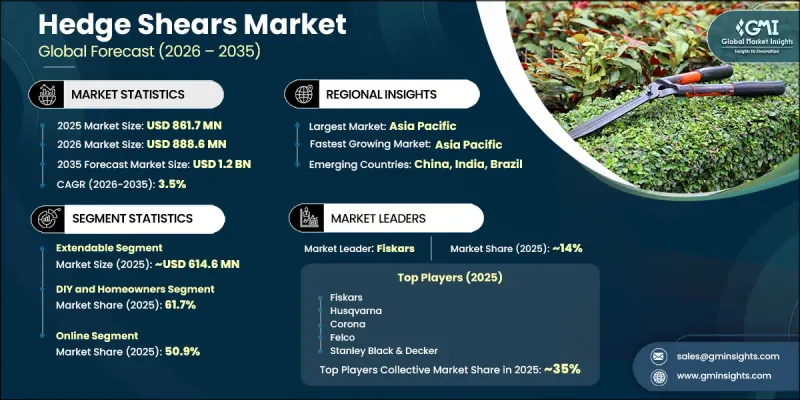
이러한 성장은 주거용 사용자와 전문 조경업자 모두에서 원예 활동의 인기가 높아짐에 따라 주도되고 있습니다. 기계화 된 원예 도구의 발전, 잘 관리 된 야외 생활 공간에 대한 수요 증가, 온라인 소매 채널에 대한 접근성 확대는 시장 확대를 더욱 촉진하고 있습니다. 또한, 친환경 원예에 대한 인식이 높아지면서 소비자들이 수동식 및 에너지 절약형 공구를 사용하도록 유도하고 있습니다. 특히 라이프스타일의 변화에 따라 DIY 원예로의 전환이 진행되면서 제품 채택이 크게 확대되었습니다. 도시 개발 및 미관을 고려한 녹지 설계에 대한 관심이 높아지면서 내구성과 효율성이 뛰어난 울타리용 헤지 가위에 대한 수요가 더욱 증가하고 있습니다. 특히 가처분 소득 수준이 높아지는 지역에서는 사용 편의성, 성능 및 전체 경관의 미관을 향상시키는 고품질 원예 도구에 대한 투자가 증가하고 있습니다.
| 시장 범위 | |
|---|---|
| 시작 연도 | 2025년 |
| 예측 기간 | 2026-2035년 |
| 시작 연도 시장 규모 | 8억 6,170만 달러 |
| 예측 시장 규모 | 12억 달러 |
| CAGR | 3.5% |
이 시장은 정원, 파티오, 조경된 공간이 주택 설계의 필수적인 요소로 자리 잡고 있는 야외 주거 환경 개선의 확대 추세에 의해 더욱 영향을 받고 있습니다. 이러한 변화로 인해 주택 소유주들은 시각적으로 매력적인 야외 환경을 보장하기 위해 정밀한 가지치기와 정기적인 유지 관리를 지원하는 도구에 대한 투자를 촉진하고 있습니다. 또한, 전문적인 조경 서비스도 수요의 꾸준한 성장에 기여하고 있습니다.
텔레스코픽 울타리 헤지 가위 부문은 2025년에 6억 1,460만 달러 시장 규모를 기록해, 2026년부터 2035년까지 연평균 3.8%의 성장률을 보일 것으로 예측됩니다. 이 부문은 대규모 울타리나 높은 곳에 있는 식재를 관리하는 사용자에게 작업 범위의 확대와 조작의 편의성을 제공할 수 있다는 점에서 주목받고 있습니다. 이 도구들은 신체적 부담을 최소화하면서 작업의 편의성을 향상시키도록 설계되었으며, 전문가용과 주거용 모두에 적합합니다. 전정 작업 시 추가 장비가 필요 없다는 특징으로 안전성과 효율성이 향상되어 보급을 더욱 촉진하고 있습니다.
DIY 및 일반 가정 부문은 2025년 61.7%의 점유율을 차지하며 주요 최종 사용자 카테고리로 자리매김했습니다. 이러한 우위는 개인의 정원 가꾸기 및 가정 내 조경 활동에 대한 관심이 높아졌기 때문입니다. 이 부문의 소비자들은 사용하기 쉽고, 가볍고, 다기능적인 도구를 선호합니다. 또한, 장시간 사용으로 인한 피로를 줄이면서 원예 전반의 효율성을 높이는 제품을 찾는 사용자가 증가함에 따라 에너지 절약형 울타리 헤지 가위에 대한 수요도 증가하고 있습니다. 비용 효율적이고 다기능적인 도구에 대한 선호도가 높아짐에 따라 이 부문이 지속적으로 성장하고 있습니다.
미국의 헤지 가위 시장은 2025년에 2억 8,000만 달러 규모에 달해, 2026년부터 2035년까지 연평균 3.3%의 성장률을 보일 것으로 예측됩니다. 이 나라 시장 성장은 DIY 정원 가꾸기 참여 증가, 지속 가능한 조경 방법의 보급, 전문 조경 서비스 확대에 의해 뒷받침되고 있습니다. 야외 공간 개선에 대한 소비자의 높은 관심과 가처분 소득 증가가 결합하여 고급 원예 도구에 대한 수요를 주도하고 있습니다. 주택 소유주들은 점점 더 디자인적인 야외 환경 유지에 초점을 맞추고 있으며, 이는 주거용 헤지 가위의 보급을 더욱 촉진하고 있습니다.
자주 묻는 질문
목차
제1장 조사 방법과 범위
제2장 주요 요약
제3장 업계 인사이트
제4장 경쟁 구도
제5장 시장 추산 및 예측 : 제품 유형별, 2022-2035년
제6장 시장 추산 및 예측 : 블레이드 사이즈별, 2022-2035년
제7장 시장 추산 및 예측 : 블레이드 유형별, 2022-2035년
제8장 시장 추산 및 예측 : 블레이드 재질별, 2022-2035년
제9장 시장 추산 및 예측 : 가격별, 2022-2035년
제10장 시장 추산 및 예측 : 최종 사용자별, 2022-2035년
제11장 시장 추산 및 예측 : 유통 채널별, 2022-2035년
제12장 시장 추산 및 예측 : 지역별, 2022-2035년
제13장 기업 개요
JHS 26.06.11The Global Hedge Shears Market was valued at USD 861.7 million in 2025 and is estimated to grow at a CAGR of 3.5% to reach USD 1.2 billion by 2035.
Growth is driven by the expanding popularity of horticultural practices among both residential users and professional landscapers. Increasing development of mechanized gardening tools, growing demand for well-maintained outdoor living spaces, and wider access to online retail channels are further supporting market expansion. Rising awareness of eco-friendly gardening practices is also encouraging consumers to adopt manual and energy-efficient tools. The shift toward DIY gardening, particularly after changes in lifestyle patterns, has significantly strengthened product adoption. Urban development and increasing emphasis on aesthetically designed green spaces are further driving demand for durable and efficient hedge shears. Consumers are increasingly investing in high-quality gardening tools that enhance usability, performance, and overall landscape appearance, particularly in regions where disposable income levels are rising.
| Market Scope | |
|---|---|
| Start Year | 2025 |
| Forecast Year | 2026-2035 |
| Start Value | $861.7 Million |
| Forecast Value | $1.2 Billion |
| CAGR | 3.5% |
The market is further influenced by the growing trend of outdoor home enhancement, where gardens, patios, and landscaped spaces are becoming integral parts of residential design. This shift is encouraging homeowners to invest in tools that support precision trimming and regular maintenance, ensuring visually appealing outdoor environments. Professional landscaping services are also contributing to steady demand growth.
The extendable hedge shears segment generated USD 614.6 million in 2025 and is expected to grow at a CAGR of 3.8% from 2026 to 2035. This segment is gaining traction due to its ability to offer improved reach and operational convenience for users managing larger hedges and elevated plant structures. These tools are designed to enhance accessibility while minimizing physical effort, making them suitable for both professional and residential applications. Their ability to eliminate the need for additional equipment during trimming tasks improves safety and efficiency, further supporting their widespread adoption.
The DIY and homeowners segment held 61.7% share in 2025, establishing itself as the leading end-user category. This dominance is driven by increasing interest in personal gardening and home landscaping activities. Consumers in this segment prefer tools that are easy to use, lightweight, and capable of performing multiple functions. The demand for energy-efficient hedge shears is also rising as users seek products that reduce fatigue during extended use while improving overall gardening efficiency. Growing preference for cost-effective and multifunctional tools continues to support segment expansion.
U.S. Hedge Shears Market accounted for USD 200.8 million in 2025 and is projected to grow at a CAGR of 3.3% from 2026 to 2035. Market growth in the country is supported by rising participation in DIY gardening, increasing adoption of sustainable landscaping practices, and the expansion of professional landscaping services. Strong consumer interest in enhancing outdoor spaces, combined with higher disposable income levels, is driving demand for advanced gardening tools. Homeowners are increasingly focusing on maintaining well-designed outdoor environments, further supporting the adoption of hedge shears across residential applications.
Key companies operating in the Global Hedge Shears Market include Fiskars, Stanley Black & Decker, Bosch, Husqvarna, Makita, Stihl, Echo, Felco, Corona, Bahco, ARS, Barnel, Kanenori, Tata Agrico, and Woodland Tools. Companies in the Hedge Shears Market are focusing on product innovation, ergonomic design improvements, and material advancements to strengthen their market position. They are introducing lightweight and durable tools that enhance user comfort and efficiency during prolonged use. Expansion of product portfolios with energy-efficient and multifunctional gardening tools is helping companies cater to both professional and residential users. Strategic distribution through online and offline retail channels is improving product accessibility and brand reach. Manufacturers are also investing in marketing campaigns that highlight sustainability and ease of use. Additionally, continuous improvements in blade technology and handle design are enhancing performance, while partnerships with landscaping service providers are supporting broader market penetration and customer engagement.
Table of Contents
Chapter 1 Methodology & Scope
- 1.1 Market scope & definitions
- 1.2 Research design
- 1.2.1 Research approach
- 1.2.2 Data collection methods
- 1.3 Base estimates and calculations
- 1.3.1 Base year calculation
- 1.3.2 Market estimates & forecasts parameters
- 1.4 Forecast Model
- 1.4.1 Key trends for market estimates
- 1.4.2 Quantified market impact analysis
- 1.4.2.1 Mathematical impact of growth parameters on forecast
- 1.4.3 Scenario analysis framework
- 1.5 Primary research and validation
- 1.5.1 Some of the primary sources (but not limited to)
- 1.6 Data mining sources
- 1.6.1 Paid Sources
- 1.7 Primary research and validation
- 1.7.1 Primary sources
- 1.8 Research Trail & confidence scoring
- 1.8.1 Research trail components
- 1.8.2 Scoring components
- 1.9 Research transparency addendum
- 1.9.1 Source attribution framework
- 1.9.2 Quality assurance metrics
- 1.9.3 Our commitment to trust
- 1.10 Market Definitions
Chapter 2 Executive Summary
- 2.1 Industry 360° synopsis
- 2.2 Key market trends
- 2.2.1 Regional
- 2.2.2 Product type
- 2.2.3 Blade size
- 2.2.4 Blade type
- 2.2.5 Blade material
- 2.2.6 Price
- 2.2.7 End use
- 2.2.8 Distribution channel
Chapter 3 Industry Insights
- 3.1 Industry ecosystem analysis
- 3.1.1 Raw material suppliers
- 3.1.2 Component manufacturers
- 3.1.3 OEM manufacturers & assembly
- 3.1.4 Distributors & wholesalers
- 3.1.5 Retail channels
- 3.1.6 End users
- 3.1.7 Factor affecting the value chain
- 3.1.8 Profit margin analysis (driven by primary research)
- 3.1.9 Disruptions
- 3.1.10 Future outlook
- 3.2 Industry impact forces
- 3.2.1 Growth drivers
- 3.2.1.1 Growing demand for precision & efficiency in heavy manufacturing
- 3.2.1.2 Increased interest in gardening & landscaping
- 3.2.1.3 Rising outdoor living trends & home improvement spending
- 3.2.1.4 Urbanization & growth in residential green spaces
- 3.2.2 Market pitfalls
- 3.2.2.1 High competition & price sensitivity
- 3.2.2.2 Seasonal nature of gardening & demand fluctuations
- 3.2.3 Opportunities
- 3.2.3.1 Premiumization & ergonomic innovation demand
- 3.2.3.2 Expansion in emerging asia pacific markets
- 3.2.3.3 E-commerce channel growth & direct-to-consumer models
- 3.2.3.4 Sustainability-driven product development
- 3.2.1 Growth drivers
- 3.3 Growth potential analysis
- 3.4 Future market trends
- 3.5 Technology and innovation landscape
- 3.5.1 Current technological trends
- 3.5.2 Emerging technologies
- 3.6 Price trends
- 3.6.1 By region
- 3.6.2 By product
- 3.6.3 Historical price trend analysis
- 3.6.4 Pricing strategy by player type
- 3.7 Regulatory landscape
- 3.7.1 Product Safety Standards (ISO, ANSI, EN Standards)
- 3.7.2 Material Compliance (RoHS, REACH Regulations)
- 3.7.3 Import/Export Tariff Structures by Region
- 3.7.4 Labeling & Packaging Requirements
- 3.7.5 Environmental Regulations Impacting Manufacturing
- 3.8 Major market trends and disruptions
- 3.9 Technological and innovation landscape
- 3.9.1 Blade material innovations
- 3.9.2 Ergonomic handle design advancements
- 3.9.3 Anti-rust coating technologies
- 3.9.4 Telescoping mechanism engineering
- 3.9.5 Smart hedge shears development
- 3.10 Pricing analysis, 2025
- 3.10.1 By region
- 3.10.2 Historical Price Trend Analysis (Driven by Primary Research)
- 3.10.3 Pricing Strategy by Player Type (Premium / Value / Cost-Plus) (Driven by Primary Research)
- 3.10.4 Regional Price Variance Analysis
- 3.10.5 Impact of raw material costs on pricing
- 3.11 Future market trends
- 3.12 Raw material analysis
- 3.13 Product design analysis
- 3.13.1 Ergonomic design principles & user comfort metrics
- 3.13.2 Blade geometry & cutting efficiency
- 3.13.3 Weight optimization strategies
- 3.13.4 Aesthetic design trends & consumer preferences
- 3.14 Porter's analysis
- 3.15 PESTEL analysis
- 3.16 Supply chain analysis
- 3.16.1 Global sourcing landscape for raw materials
- 3.16.2 Manufacturing hubs & production clusters
- 3.16.3 Logistics & distribution infrastructure
- 3.16.4 Supply chain vulnerabilities & risk mitigation
- 3.17 Trade Data Analysis (Driven by paid database) (HS code- 820160)
- 3.17.1 Import/Export Volume & Value Trends
- 3.17.2 Key Trade Corridors & Tariff Impact
- 3.17.3 Trade Balance by Major Economies
- 3.18 Impact of AI & Generative AI on the Market
- 3.18.1 AI-driven disruption of existing business models
- 3.18.2 GenAI use cases & adoption roadmap by segment
- 3.18.3 Risks, limitations & regulatory considerations
- 3.19 Channel coverage by region & format (modern vs. Traditional trade) (driven by primary research)
- 3.19.1 Last-mile infrastructure gaps & emerging channel shifts
- 3.19.2 E-commerce penetration & digital marketplace dynamics
- 3.19.3 Specialty garden center network density
Chapter 4 Competitive Landscape, 2025
- 4.1 Introduction
- 4.2 Company market share analysis
- 4.2.1 By Region
- 4.2.1.1 North America
- 4.2.1.2 Europe
- 4.2.1.3 Asia Pacific
- 4.2.1.4 Latin America
- 4.2.1.5 Middle East & Africa
- 4.2.1 By Region
- 4.3 Company matrix analysis
- 4.4 Competitive analysis of major market players
- 4.5 Competitive positioning matrix
- 4.6 Key developments
- 4.6.1 Mergers & acquisitions
- 4.6.2 Partnerships & collaborations
- 4.6.3 New product launches
- 4.6.4 Expansion plans
Chapter 5 Market Estimates & Forecast, By Product Type, 2022 - 2035, (USD Million) (Thousand Units)
- 5.1 Key trends
- 5.2 Extendable hedge shears
- 5.3 Non-extendable hedge shears
Chapter 6 Market Estimates & Forecast, By Blade Size, 2022 - 2035, (USD Million) (Thousand Units)
- 6.1 Key trends
- 6.2 Below 5 inches
- 6.3 5 to 7 inches
- 6.4 7 to 9 inches
- 6.5 Above 9 inches
Chapter 7 Market Estimates & Forecast, By Blade Type, 2022 - 2035, (USD Million) (Thousand Units)
- 7.1 Key trends
- 7.2 Bypass edge
- 7.3 Straight edge
Chapter 8 Market Estimates & Forecast, By Blade Material, 2022 - 2035, (USD Million) (Thousand Units)
- 8.1 Key trends
- 8.2 Alloy steel
- 8.3 Aluminum
- 8.4 Carbon steel
- 8.5 Stainless steel
- 8.6 Others (titanium etc.)
Chapter 9 Market Estimates & Forecast, By Price, 2022 - 2035, (USD Million) (Thousand Units)
- 9.1 Key trends
- 9.2 Low
- 9.3 Medium
- 9.4 High
Chapter 10 Market Estimates & Forecast, By End User, 2022 - 2035, (USD Million) (Thousand Units)
- 10.1 Key trends
- 10.2 DIY and homeowners
- 10.3 Professionals
- 10.3.1 Landscapers
- 10.3.2 Garden maintenance
- 10.3.3 Others (property management companies etc.)
Chapter 11 Market Estimates & Forecast, By Distribution Channel, 2022 - 2035, (USD Million) (Thousand Units)
- 11.1 Key trends
- 11.2 Online
- 11.2.1 E-commerce
- 11.2.2 Company websites
- 11.3 Offline
- 11.3.1 Supermarkets
- 11.3.2 Specialty stores
- 11.3.3 Others (departmental stores, etc.)
Chapter 12 Market Estimates & Forecast, By Region, 2022 - 2035, (USD Million) (Thousand Units)
- 12.1 Key trends
- 12.2 North America
- 12.2.1 U.S.
- 12.2.2 Canada
- 12.3 Europe
- 12.3.1 Germany
- 12.3.2 UK
- 12.3.3 France
- 12.3.4 Italy
- 12.3.5 Spain
- 12.4 Asia Pacific
- 12.4.1 China
- 12.4.2 India
- 12.4.3 Japan
- 12.4.4 South Korea
- 12.4.5 Australia
- 12.5 Latin America
- 12.5.1 Brazil
- 12.5.2 Mexico
- 12.5.3 Argentina
- 12.6 MEA
- 12.6.1 Saudi Arabia
- 12.6.2 UAE
- 12.6.3 South Africa
Chapter 13 Company Profiles
- 13.1 ARS
- 13.2 Bahco
- 13.3 Barnel
- 13.4 Bosch
- 13.5 Corona
- 13.6 Echo
- 13.7 Felco
- 13.8 Fiskars
- 13.9 Husqvarna
- 13.10 Kanenori
- 13.11 Makita
- 13.12 Stanley Black & Decker
- 13.13 Stihl
- 13.14 Tata Agrico
- 13.15 Woodland Tools