

|
시장보고서
상품코드
2045717
극저온 펌프 시장 비즈니스 기회, 성장요인, 업계 동향 분석 및 예측(2026-2035년)Cryogenic Pumps Market Opportunity, Growth Drivers, Industry Trend Analysis, and Forecast 2026 - 2035 |
||||||

세계의 극저온 펌프 시장은 2025년에 25억 달러로 평가되었고 CAGR 5.6%로 성장하여 2035년까지 42억 달러에 이를 것으로 추정되고 있습니다.
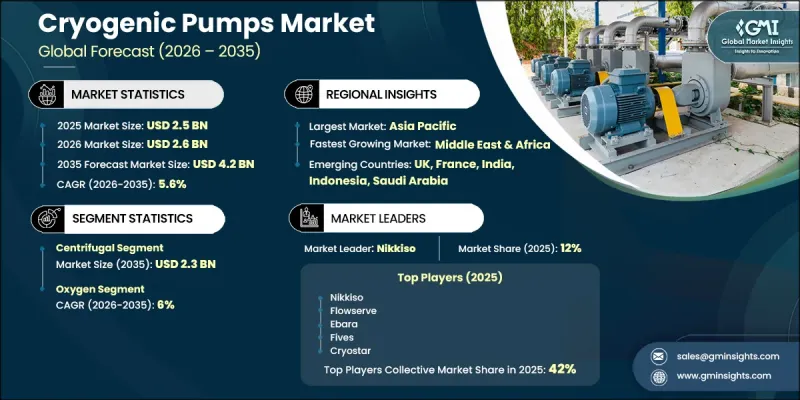
시장 확대는 신흥국에 대한 해외 투자 증가와 더불어 다양한 산업 부문의 급속한 발전으로 인해 주도되고 있습니다. 극저온 유체의 효율적인 저장, 이송 및 운송에 대한 수요 증가는 산업의 성장을 더욱 촉진하고 있습니다. 또한, 기술의 발전으로 극저온 처리 시스템의 안전성, 신뢰성, 효율성이 향상되어 시장 확대에 활용될 수 있는 새로운 기회가 창출되고 있습니다. 극저온 펌프는 극저온 하에서 액화 가스를 처리 및 수송하는 동시에 기화를 방지하고 시스템의 안정성을 유지하도록 설계된 특수 장비입니다. 의료 인프라의 확장은 특히 의료용 가스 처리 응용 분야에서 시장 수요를 더욱 촉진하고 있습니다. 또한, 온실가스 배출 규제 강화, 액화천연가스(LNG) 교역 확대, 가스 기반 에너지 시스템으로의 전환이 진행되면서 산업 전망을 더욱 견고하게 하고 있습니다. 가스 저장 인프라에 대한 투자 확대와 다양한 분야에서의 LNG 도입 확대는 시장 성장을 더욱 가속화하고 있습니다. 화학, 석유 및 가스, 야금 등의 산업 확장도 수요를 뒷받침하고 있으며, 도시화와 인프라 개발로 인한 에너지 수요 증가는 장기적인 시장 기회를 더욱 공고히 하고 있습니다.
| 시장 범위 | |
|---|---|
| 시작 연도 | 2025년 |
| 예측 기간 | 2026-2035년 |
| 시작 연도 시장 규모 | 25억 달러 |
| 예측 시장 규모 | 42억 달러 |
| CAGR | 5.6% |
원심식 극저온 펌프 시장은 2035년까지 23억 달러에 달할 것으로 예측됩니다. 이 부문 수요 증가는 질소, 아르곤과 같은 극저온 가스가 다양한 산업 응용 분야에서 채택되고 있는 것에 기인합니다. 의료, 화학 처리, 식품 관련 산업에서 저장 및 운송을 위한 액화천연가스의 사용이 증가하고 있는 것도 이 부문의 성장에 기여하고 있습니다. 효율을 높이고 마찰을 줄이는 초전도 자기 베어링의 활용을 포함한 기술적 진보로 인해 작동 성능이 향상되고 있습니다. 또한, 극한의 온도 및 압력 조건을 견딜 수 있는 첨단 복합소재의 지속적인 개발은 원심식 극저온 펌프 시스템의 채택을 더욱 촉진하고 있습니다.
2025년 천연가스 부문 시장 규모는 8억 9,620만 달러에 달했습니다. 천연가스는 액화된 형태로 널리 처리, 저장 및 운송되고 있으며, 이는 극저온 펌프 시스템의 주요 응용 분야가 되었습니다. 이 펌프는 액화 플랜트, 저장 시설, 수출입 터미널, 선박에서 육상으로의 이송 작업, 재기화 장치, 유조선 적재 시스템 등 LNG 인프라 전반에 걸쳐 광범위하게 사용되고 있습니다. 유연하고 효율적인 에너지원으로서 천연가스에 대한 전 세계의 의존도가 높아짐에 따라, 에너지 인프라 네트워크 전반에 걸쳐 첨단 극저온 펌프 솔루션에 대한 수요가 더욱 증가하고 있습니다.
미국의 극저온 펌프 시장은 2035년까지 6억 5,100만 달러에 달할 것으로 예측됩니다. 이 나라의 성장은 산업용 액화천연가스 소비 증가, 저장 시설 및 극저온 탱크 시스템을 포함한 LNG 인프라에 대한 지속적인 투자에 의해 주도되고 있습니다. 액체 산소 및 액체 질소 취급을 수반하는 의료용도의 확대도 시장 수요에 기여하고 있습니다. 또한, 우주 탐사 부문에서 극저온 추진 시스템의 사용 확대는 미국의 장기적인 산업 성장을 더욱 촉진하고 있습니다.
자주 묻는 질문
목차
제1장 조사 방법과 범위
제2장 주요 요약
제3장 산업 인사이트
제4장 경쟁 구도
제5장 시장 규모와 예측 : 제품별, 2022-2035년
제6장 시장 규모와 예측 : 극저온 가스 유형별, 2022-2035년
제7장 시장 규모와 예측 : 최종 사용자별, 2022-2035년
제8장 시장 규모와 예측 : 지역별, 2022-2035년
제9장 기업 개요
JHS 26.06.11The Global Cryogenic Pumps Market was valued at USD 2.5 billion in 2025 and is estimated to grow at a CAGR of 5.6% to reach USD 4.2 billion by 2035.
Market expansion is driven by rising foreign investments in emerging economies along with rapid industrial development across multiple sectors. Increasing demand for efficient storage, transfer, and transportation of cryogenic fluids is further supporting industry growth. Technological advancements are also improving the safety, reliability, and efficiency of cryogenic handling systems, creating new opportunities for market expansion. Cryogenic pumps are specialized equipment designed to handle and transport liquefied gases at extremely low temperatures while preventing vaporization and maintaining system stability. Expansion of healthcare infrastructure is further contributing to market demand, particularly in medical gas handling applications. In addition, stricter greenhouse gas emission regulations, rising liquefied natural gas trade, and the ongoing transition toward gas-based energy systems are strengthening industry prospects. Increasing investments in gas storage infrastructure and growing adoption of LNG across multiple sectors are further accelerating market growth. Industrial expansion in sectors such as chemicals, oil and gas, and metallurgy is also supporting demand, while growing energy needs driven by urbanization and infrastructure development continue to reinforce long-term market opportunities.
| Market Scope | |
|---|---|
| Start Year | 2025 |
| Forecast Year | 2026-2035 |
| Start Value | $2.5 Billion |
| Forecast Value | $4.2 Billion |
| CAGR | 5.6% |
The centrifugal cryogenic pumps segment is projected to reach USD 2.3 billion by 2035. Demand growth in this segment is supported by the rising adoption of cryogenic gases such as nitrogen and argon across various industrial applications. Increasing utilization of liquefied natural gas across healthcare, chemical processing, and food-related industries for storage and transportation purposes is further contributing to segment expansion. Technological advancements, including the use of superconducting magnetic bearings that enhance efficiency and reduce friction, are improving operational performance. In addition, continuous developments in advanced composite materials capable of withstanding extreme temperature and pressure conditions are further strengthening the adoption of centrifugal cryogenic pump systems.
The natural gas segment accounted for USD 896.2 million in 2025. Natural gas is widely processed, stored, and transported in liquefied form, making it a key application area for cryogenic pump systems. These pumps are extensively used across LNG infrastructure, including liquefaction plants, storage facilities, import and export terminals, ship-to-shore transfer operations, regasification units, and tanker loading systems. Growing global reliance on natural gas as a flexible and efficient energy source is further increasing demand for advanced cryogenic pumping solutions across energy infrastructure networks.
U.S. Cryogenic Pumps Market is projected to reach USD 651 million by 2035. Growth in the country is being driven by rising consumption of liquefied natural gas across industrial applications and continuous investments in LNG infrastructure, including storage facilities and cryogenic tank systems. Expanding healthcare applications involving liquid oxygen and nitrogen handling are also contributing to market demand. In addition, increasing utilization of cryogenic propulsion systems within the space exploration sector is further supporting long-term industry growth across the United States.
Key companies operating in the Global Cryogenic Pumps Market include Flowserve, Chart Industries, Nikkiso, Ebara, Sulzer Pumps, Cryostar, SHI Cryogenics Group, The Weir Group, Trillium Flow Technologies, Torishima Pump, Stirling Cryogenics, Cryomec, Barber-Nichols, Fives, Huzhou Baihui Cryogenic Equipment, Indian Compressors, PACKO Industries, SMS Pumps & Engineers, Sumitomo Heavy Industries, Vanzetti Engineering. Companies operating in the cryogenic pumps market focus on multiple strategic initiatives to strengthen their competitive position and expand global market reach. Manufacturers are investing heavily in research and development to enhance pump efficiency, durability, and performance under extreme cryogenic conditions. Many players are also adopting advanced materials and precision engineering techniques to improve operational reliability and reduce energy consumption. Strategic collaborations with LNG infrastructure developers, industrial gas providers, and energy companies are helping firms expand application reach and strengthen supply chain integration.
Table of Contents
Chapter 1 Methodology & Scope
- 1.1 Research design
- 1.2 Quality commitments
- 1.2.1 GMI AI policy & data integrity commitment
- 1.2.1.1 Source consistency protocol
- 1.2.1 GMI AI policy & data integrity commitment
- 1.3 Research trail & confidence scoring
- 1.3.1 Research trail components
- 1.3.2 Scoring components
- 1.4 Data collection
- 1.4.1 Partial list of primary sources
- 1.5 Data mining sources
- 1.5.1 Paid sources
- 1.5.1.1 Sources, by region
- 1.5.1 Paid sources
- 1.6 Base estimates and calculations
- 1.6.1 Base year calculation for any one approach
- 1.7 Market estimates and forecasts parameters
- 1.8 Forecast model
- 1.8.1 Quantified market impact analysis
- 1.8.1.1 Mathematical impact of growth parameters on forecast
- 1.8.1 Quantified market impact analysis
- 1.9 Research transparency addendum
- 1.9.1 Source attribution framework
- 1.9.2 Quality assurance metrics
- 1.9.3 Our commitment to trust
- 1.10 Market definitions
Chapter 2 Executive Summary
- 2.1 Industry synopsis, 2022 - 2035
- 2.2 Business trends
- 2.3 Product trends
- 2.4 Cryogens type trends
- 2.5 End user trends
- 2.6 Regional trends
Chapter 3 Industry Insights
- 3.1 Industry ecosystem analysis
- 3.1.1 Raw material availability & sourcing analysis
- 3.1.2 Manufacturing capacity assessment
- 3.1.3 Supply chain resilience & risk factors
- 3.1.4 Distribution network analysis
- 3.2 Regulatory landscape
- 3.3 Industry impact forces
- 3.3.1 Growth drivers
- 3.3.2 Industry pitfalls & challenges
- 3.4 Growth potential analysis
- 3.5 Porter's Analysis
- 3.5.1 Bargaining power of suppliers
- 3.5.2 Bargaining power of buyers
- 3.5.3 Threat of new entrants
- 3.5.4 Threat of substitutes
- 3.6 PESTEL Analysis
- 3.6.1 Political factors
- 3.6.2 Economic factors
- 3.6.3 Social factors
- 3.6.4 Technological factors
- 3.6.5 Legal factors
- 3.6.6 Environmental factors
- 3.7 Cost structure analysis of cryogenic pumps
- 3.8 Pricing analysis (Driven by Primary Research)
- 3.8.1 By product
- 3.8.2 By region
- 3.9 Impact of AI & Gen AI on the industry (Driven by Primary Research)
- 3.9.1 AI driven product optimization
- 3.9.2 Predictive maintenance & fault detection
- 3.10 Investment analysis & future outlook
- 3.11 digitalization & IoT integration
Chapter 4 Competitive Landscape, 2026
- 4.1 Introduction
- 4.2 Company market share analysis, 2025
- 4.2.1 North America
- 4.2.2 Europe
- 4.2.3 Asia Pacific
- 4.2.4 Middle East & Africa
- 4.2.5 Latin America
- 4.3 Competitive analysis of major market players
- 4.4 Competitive positioning matrix
- 4.5 Key developments
- 4.5.1 Mergers & acquisitions
- 4.5.2 Partnerships & collaborations
- 4.5.3 New product launches
- 4.5.4 Expansion plans & funding
- 4.6 Company tier benchmarking
- 4.6.1 Tier classification criteria & qualifying thresholds
- 4.6.2 Tier positioning matrix by revenue, geography & innovation
Chapter 5 Market Size and Forecast, By Product, 2022 - 2035 (USD Million)
- 5.1 Key trends
- 5.2 Centrifugal
- 5.3 Reciprocating
- 5.4 Submerged
Chapter 6 Market Size and Forecast, By Cryogens Type, 2022 - 2035 (USD Million)
- 6.1 Key trends
- 6.2 Nitrogen
- 6.3 Oxygen
- 6.4 Natural gas
- 6.5 Argon
- 6.6 Other cryogens
Chapter 7 Market Size and Forecast, By End User, 2022 - 2035 (USD Million)
- 7.1 Key trends
- 7.2 O&G industry
- 7.3 Power
- 7.4 Food & beverage
- 7.5 Chemical
- 7.6 Rubber & plastics
- 7.7 Metallurgy
- 7.8 Healthcare
- 7.9 Shipping
- 7.10 Agriculture, forestry & fishing
- 7.11 Other industries
Chapter 8 Market Size and Forecast, By Region, 2022 - 2035 (USD Million)
- 8.1 Key trends
- 8.2 North America
- 8.2.1 U.S.
- 8.2.2 Canada
- 8.3 Europe
- 8.3.1 UK
- 8.3.2 Germany
- 8.3.3 Italy
- 8.3.4 France
- 8.3.5 Spain
- 8.3.6 Russia
- 8.4 Asia Pacific
- 8.4.1 China
- 8.4.2 Japan
- 8.4.3 South Korea
- 8.4.4 India
- 8.4.5 Australia
- 8.5 Middle East & Africa
- 8.5.1 Saudi Arabia
- 8.5.2 UAE
- 8.5.3 Turkey
- 8.5.4 South Africa
- 8.5.5 Egypt
- 8.6 Latin America
- 8.6.1 Brazil
- 8.6.2 Argentina
Chapter 9 Company Profiles
- 9.1 Barber-Nichols
- 9.2 Cryomec
- 9.3 Cryostar
- 9.4 Chart Industries
- 9.5 Ebara
- 9.6 Fives
- 9.7 Flowserve
- 9.8 Huzhou Baihui Cryogenic Equipment
- 9.9 Indian Compressors
- 9.10 Nikkiso
- 9.11 PACKO Industry
- 9.12 SHI Cryogenics Group
- 9.13 SMS Pumps & Engineers
- 9.14 Sumitomo Heavy Industries
- 9.15 Sulzer Pumps
- 9.16 Stirling Cryogenics
- 9.17 The Weir Group
- 9.18 Trillium Flow Technologies
- 9.19 Torishima Pump
- 9.20 Vanzetti Engineering


