|
시장보고서
상품코드
2045718
새우 시장 기회, 성장요인, 업계 동향 분석 및 예측(2026-2035년)Shrimp Market Opportunity, Growth Drivers, Industry Trend Analysis, and Forecast 2026 - 2035 |
||||||

세계의 새우 시장은 2025년에 825억 달러로 평가되었고 CAGR 6.6%로 성장하여 2035년까지 1,564억 달러에 이를 것으로 추정되고 있습니다.
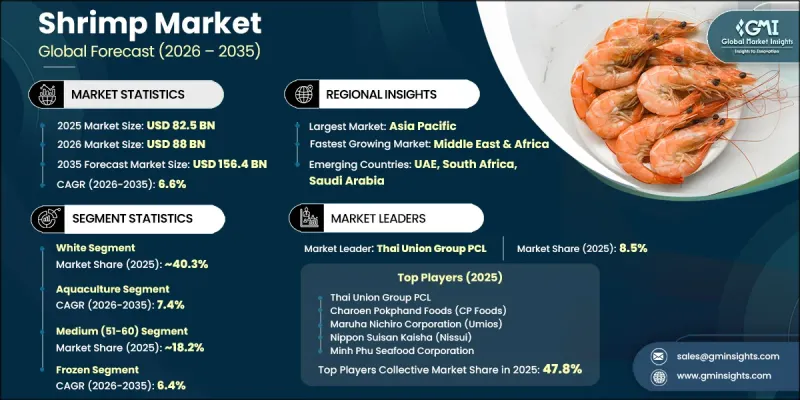
이 산업은 단백질이 풍부한 식품에 대한 전 세계 수요 증가와 세계 식생활에서 수산물의 역할 확대에 힘입어 지속적인 성장세를 보이고 있습니다. 새우는 국제 수산물 무역에서 여전히 중요한 위치를 차지하고 있으며, 주요 생산 지역의 식량 안보와 수출 수입에 기여하고 있습니다. 오메가3 지방산이 풍부한 고단백, 저지방 식품에 대한 소비자의 선호도가 높아지면서 특히 건강을 중시하는 계층을 중심으로 수요가 더욱 증가하고 있습니다. 또한, 새우는 다양한 조리법과 요리 스타일에 쉽게 적응할 수 있기 때문에 요리의 다양성 또한 시장 침투를 촉진하고 있습니다. 냉동, 통조림, 생고기 등 다양한 가공 형태가 가능하기 때문에 일반 가정과 외식업체 모두 접근성을 높일 수 있습니다. 새우 양식 확대는 안정적인 공급망을 뒷받침하는 동시에 전 세계 소비량 증가에 대응하기 위한 생산 규모 확대를 가능하게 하고 있습니다. 또한, 세계 각국의 요리 및 즉석식품 트렌드가 영향력을 확대함에 따라 가공식품 및 편의식품 카테고리에서 새우의 사용이 확대되고 있으며, 이는 장기적인 시장 성장을 가속하고 있습니다.
| 시장 범위 | |
|---|---|
| 시작 연도 | 2025년 |
| 예측 기간 | 2026-2035년 |
| 시작 연도 시장 규모 | 825억 달러 |
| 예측 시장 규모 | 1,564억 달러 |
| CAGR | 6.6% |
2025년에는 화이트 쉬림프 부문이 40.3%의 점유율을 차지해, 2035년까지 연평균 복합 성장률(CAGR) 7%를 나타낼 것으로 예측됩니다. 이 부문은 순한 맛과 탄탄한 식감으로 외식 산업과 소매 채널에서 다양한 요리에 적합하여 시장을 선도하고 있습니다. 주요 생산지에서의 광범위한 양식은 비용 효율성과 안정적인 공급에 기여하고 있습니다. 소비자의 높은 수용성과 다양한 요리에 대한 적응력으로 세계 새우 산업에서 선도적인 위치를 더욱 확고히 하고 있습니다.
양식 부문은 2025년 65%의 점유율을 차지해, 2026-2035년 연평균 7.4%의 성장률을 보일 것으로 전망됩니다. 이 부문의 성장은 안정적인 생산, 품질 향상, 연중 공급을 보장하는 관리된 양식 시스템에 의해 주도되고 있습니다. 양식 기술의 발전으로 주요 생산 지역 전체에서 생산성과 운영 효율성이 크게 향상되었습니다. 인도, 베트남, 에콰도르, 태국 등의 국가는 잘 구축된 양식 인프라와 강력한 수출 지향적 사업에 힘입어 세계 새우 생산에서 주요한 역할을 계속하고 있습니다.
북미 새우 시장은 2025년 20%의 점유율을 차지했습니다. 이 지역은 수산물 소비 수준이 높고, 다양한 메뉴에 새우를 적극적으로 도입하는 등 외식산업이 잘 발달한 지역입니다. 편리하고 단백질이 풍부한 식품에 대한 수요 증가도 시장 확대를 더욱 촉진하고 있습니다. 탄탄한 유통망과 새우 가공품의 가용성 향상도 소매 및 푸드서비스 산업 채널 전반에서 꾸준한 시장 성장에 기여하고 있습니다.
자주 묻는 질문
목차
제1장 조사 방법과 범위
제2장 주요 요약
제3장 산업 인사이트
제4장 경쟁 구도
제5장 시장 추정 및 예측 : 유형별, 2022-2035년
제6장 시장 추정 및 예측 : 공급원별, 2022-2035년
제7장 시장 추정 및 예측 : 규모 구분별, 2022-2035년
제8장 시장 추정 및 예측 : 형태별, 2022-2035년
제9장 시장 추정 및 예측 : 최종 용도별, 2022-2035년
제10장 시장 추정 및 예측 : 유통 채널별, 2022-2035년
제11장 시장 추정 및 예측 : 지역별, 2022-2035년
제12장 기업 개요
JHSThe Global Shrimp Market was valued at USD 82.5 billion in 2025 and is estimated to grow at a CAGR of 6.6% to reach USD 156.4 billion by 2035.
The industry is experiencing sustained growth due to rising global demand for protein-rich food products and the expanding role of seafood in global diets. Shrimp continues to hold a significant position in international seafood trade, contributing to food security and export earnings across major producing regions. Increasing consumer preference for high-protein, low-fat food options enriched with omega-3 fatty acids is further supporting demand, particularly among health-conscious populations. Its versatility in culinary applications is also strengthening market penetration, as shrimp adapts easily to diverse cooking styles and cuisines. The availability of multiple processed forms, including frozen, canned, and peeled products, is improving accessibility for both households and foodservice operators. Expansion of shrimp aquaculture is also supporting stable supply chains while enabling scalable production to meet rising global consumption. In addition, the growing influence of global cuisines and ready-to-eat food trends is expanding shrimp usage across processed meals and convenience food categories, reinforcing long-term market growth.
| Market Scope | |
|---|---|
| Start Year | 2025 |
| Forecast Year | 2026-2035 |
| Start Value | $82.5 Billion |
| Forecast Value | $156.4 Billion |
| CAGR | 6.6% |
The white shrimp segment accounted for 40.3% share in 2025 and is projected to grow at a CAGR of 7% through 2035. This segment continues to dominate due to its mild flavor profile and firm texture, making it suitable for a wide range of culinary applications across foodservice and retail channels. Its widespread farming across major producing regions contributes to cost efficiency and strong supply availability. High consumer acceptance and adaptability in various cuisines further strengthen its leading position in the global shrimp industry.
The aquaculture segment held a share of 65% in 2025 and is expected to grow at a CAGR of 7.4% through 2026-2035. Growth in this segment is driven by controlled farming systems that ensure consistent production, improved quality, and year-round supply. Advancements in aquaculture technologies have significantly enhanced productivity and operational efficiency across key producing regions. Countries such as India, Vietnam, Ecuador, and Thailand continue to play a major role in global shrimp production, supported by established farming infrastructure and strong export-oriented operations.
North America Shrimp Market accounted for 20% share in 2025. The region benefits from high seafood consumption levels and a well-developed foodservice sector that actively incorporates shrimp into a wide range of menu offerings. Rising demand for convenient and protein-rich food products is further supporting market expansion. Strong distribution networks and increasing availability of processed shrimp products are also contributing to steady market growth across retail and hospitality channels.
Key companies operating in the Global Shrimp Industry include Blue Star Foods, Charoen Pokphand Foods, Clearwater Seafoods, Clover Leaf Seafoods, High Liner Foods, Leroy Seafood Group, Maruha Nichiro Corporation, Minh Phu Seafood Corporation, Morubel, Nippon Suisan Kaisha, Pacific Seafood, Rich Products Corporation, Royal Greenland, and Thai Union Group. Companies operating in the shrimp market are increasingly focusing on strengthening supply chain efficiency and expanding aquaculture production capacity to meet rising global demand. Leading players are investing in advanced farming technologies, improved feed formulations, and disease management systems to enhance yield and product quality. Many companies are expanding cold chain logistics and processing infrastructure to maintain freshness and extend shelf life across international markets. Strategic partnerships with distributors, retailers, and foodservice operators are helping firms secure stronger market access and improve product reach. Sustainability initiatives, including responsible farming practices and certification programs, are being adopted to align with evolving environmental expectations. Companies are also diversifying product portfolios by offering value-added and ready-to-cook shrimp products to cater to convenience-driven consumers.
Table of Contents
Chapter 1 Methodology & Scope
- 1.1 Market scope and definition
- 1.2 Research design
- 1.2.1 Research approach
- 1.2.2 Data collection methods
- 1.3 Data mining sources
- 1.3.1 Global
- 1.3.2 Regional/Country
- 1.4 Base estimates and calculations
- 1.4.1 Base year calculation
- 1.4.2 Key trends for market estimation
- 1.5 Primary research and validation
- 1.5.1 Primary sources
- 1.6 Forecast model
- 1.7 Research assumptions and limitations
Chapter 2 Executive Summary
- 2.1 Industry 360° synopsis
- 2.2 Key market trends
- 2.2.1 Regional
- 2.2.2 Type
- 2.2.3 Source
- 2.2.4 Size category
- 2.2.5 Form
- 2.2.6 End use
- 2.2.7 Distribution channel
- 2.3 TAM Analysis, 2026-2035
- 2.4 CXO perspectives: Strategic imperatives
- 2.4.1 Executive decision points
Chapter 3 Industry Insights
- 3.1 Industry ecosystem analysis
- 3.1.1 Supplier landscape
- 3.1.2 Profit margin
- 3.1.3 Value addition at each stage
- 3.1.4 Factor affecting the value chain
- 3.1.5 Disruptions
- 3.2 Industry impact forces
- 3.2.1 Growth drivers
- 3.2.2 Industry pitfalls and challenges
- 3.2.3 Market opportunities
- 3.3 Growth potential analysis
- 3.4 Regulatory landscape
- 3.4.1 North America
- 3.4.2 Europe
- 3.4.3 Asia Pacific
- 3.4.4 Latin America
- 3.4.5 Middle East & Africa
- 3.5 Porter's analysis
- 3.6 PESTEL analysis
- 3.7 Price trends
- 3.7.1 By region
- 3.7.2 By type
- 3.8 Future market trends
- 3.9 Technology and Innovation landscape
- 3.9.1 Current technological trends
- 3.9.2 Emerging technologies
- 3.10 Patent Landscape
- 3.11 Trade statistics (HS code)
- 3.11.1 Major importing countries
- 3.11.2 Major exporting countries
- 3.12 Sustainability and environmental aspects
- 3.12.1 Sustainable practices
- 3.12.2 Waste reduction strategies
- 3.12.3 Energy efficiency in production
- 3.12.4 Eco-friendly initiatives
- 3.13 Carbon footprint consideration
Chapter 4 Competitive Landscape, 2025
- 4.1 Introduction
- 4.2 Company market share analysis
- 4.2.1 By region
- 4.2.1.1 North America
- 4.2.1.2 Europe
- 4.2.1.3 Asia Pacific
- 4.2.1.4 LATAM
- 4.2.1.5 MEA
- 4.2.1 By region
- 4.3 Company matrix analysis
- 4.4 Competitive analysis of major market players
- 4.5 Competitive positioning matrix
- 4.6 Key developments
- 4.6.1 Mergers & acquisitions
- 4.6.2 Partnerships & collaborations
- 4.6.3 New Product Launches
- 4.6.4 Expansion Plans
Chapter 5 Market Estimates and Forecast, By Type, 2022-2035 (USD Billion) (Kilo Tons)
- 5.1 Key trends
- 5.2 White
- 5.3 Pink
- 5.4 Brown
- 5.5 Others
Chapter 6 Market Estimates and Forecast, By Source, 2022-2035 (USD Billion) (Kilo Tons)
- 6.1 Key trends
- 6.2 Aquaculture
- 6.3 Wild capture
Chapter 7 Market Estimates and Forecast, By Size Category, 2022-2035 (USD Billion) (Kilo Tons)
- 7.1 Key trends
- 7.2 Colossal (<15)
- 7.3 Extra Jumbo (15-20)
- 7.4 Jumbo (21-25)
- 7.5 Extra Large (26-30)
- 7.6 Large (31-40)
- 7.7 Medium Large (41-50)
- 7.8 Medium (51-60)
- 7.9 Small (61-70)
- 7.10 Extra Small (>70)
Chapter 8 Market Estimates and Forecast, By Form, 2022-2035 (USD Billion) (Kilo Tons)
- 8.1 Key trends
- 8.2 Frozen
- 8.3 Peeled
- 8.4 Canned
- 8.5 Others
Chapter 9 Market Estimates and Forecast, By End Use, 2022-2035 (USD Billion) (Kilo Tons)
- 9.1 Key trends
- 9.2 Residential
- 9.3 Commercial
- 9.3.1 Hotels & restaurants
- 9.3.2 Food service & catering
- 9.3.3 Quick service restaurants (QSR)
- 9.3.4 Institutional
Chapter 10 Market Estimates and Forecast, By Distribution Channel, 2022-2035 (USD Billion) (Kilo Tons)
- 10.1 Key trends
- 10.2 Supermarkets & hypermarkets
- 10.3 Specialty stores
- 10.4 Online retail
- 10.5 Convenience stores
- 10.6 Others
Chapter 11 Market Estimates and Forecast, By Region, 2022-2035 (USD Billion) (Kilo Tons)
- 11.1 Key trends
- 11.2 North America
- 11.2.1 U.S.
- 11.2.2 Canada
- 11.3 Europe
- 11.3.1 Germany
- 11.3.2 UK
- 11.3.3 France
- 11.3.4 Spain
- 11.3.5 Italy
- 11.3.6 Rest of Europe
- 11.4 Asia Pacific
- 11.4.1 China
- 11.4.2 India
- 11.4.3 Japan
- 11.4.4 Australia
- 11.4.5 South Korea
- 11.4.6 Rest of Asia Pacific
- 11.5 Latin America
- 11.5.1 Brazil
- 11.5.2 Mexico
- 11.5.3 Argentina
- 11.5.4 Rest of Latin America
- 11.6 Middle East and Africa
- 11.6.1 Saudi Arabia
- 11.6.2 South Africa
- 11.6.3 UAE
- 11.6.4 Rest of Middle East and Africa
Chapter 12 Company Profiles
- 12.1 Blue Star Foods
- 12.2 Charoen Pokphand Foods (CP Foods)
- 12.3 Clearwater Seafoods
- 12.4 Clover Leaf Seafoods
- 12.5 High Liner Foods
- 12.6 Leroy Seafood Group
- 12.7 Maruha Nichiro Corporation (Umios)
- 12.8 Minh Phu Seafood Corporation
- 12.9 Morubel nv (Cooke Europe)
- 12.10 Nippon Suisan Kaisha (Nissui)
- 12.11 Pacific Seafood
- 12.12 Rich Products Corporation (SeaPak)
- 12.13 Royal Greenland A/S
- 12.14 Thai Union Group PCL