

|
시장보고서
상품코드
2045721
안드로겐성 탈모증 치료 시장 : 기회, 성장 촉진요인, 업계 동향 분석 및 예측(2026-2035년)Androgenetic Alopecia Treatment Market Opportunity, Growth Drivers, Industry Trend Analysis, and Forecast 2026 - 2035 |
||||||

세계의 안드로겐성 탈모증 치료 시장은 2025년에 32억 달러로 평가되었고 CAGR 7.9%를 나타내 2035년까지 68억 달러에 이를 것으로 예측됩니다.
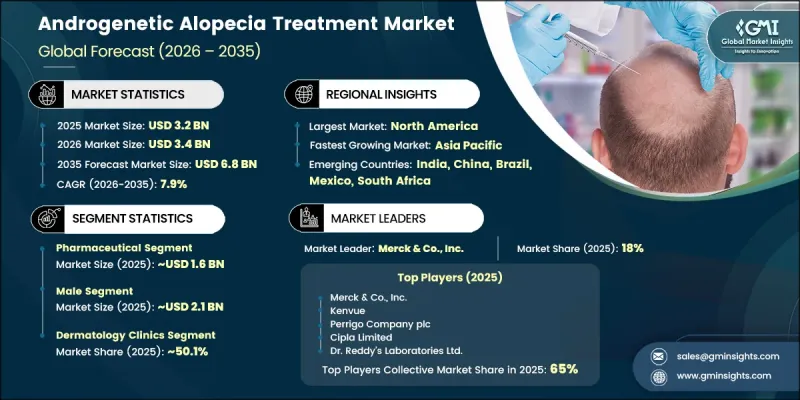
이 시장의 성장은 주로 남성과 여성 모두에서 안드로겐성 탈모증의 발병률이 증가하고 있으며, 치료법에 대한 인식이 높아짐에 따라 성장세를 보이고 있습니다. 디지털 건강 플랫폼, 온라인 의료 컨텐츠, 소비자 직접 마케팅 채널에 대한 접근성이 확대되면서 탈모증 증상과 치료법에 대한 환자들의 이해도가 크게 향상되고 있습니다. 피부과 전문의와 의료기관의 인식 개선 활동은 탈모증에 대한 사회적 편견을 줄여 조기 진단과 치료의 수용을 더욱 촉진하고 있습니다. 또한, 소셜 미디어와 환자 커뮤니티를 통한 임상 정보 접촉이 증가함에 따라 모발 재생 및 관리 솔루션에 대한 논의가 일반화되고 있습니다. 안드로겐성 탈모증(남성은 안드로겐성 탈모증, 여성은 여성형 탈모증으로 통칭)은 전 세계적으로 가장 광범위한 탈모증의 일종으로, 점차 특정 패턴으로 머리카락이 얇아지는 것이 특징입니다. 의약품 치료, 의료기기, 저침습적 임상 시술에 대한 소비자의 인식이 높아지면서 치료 도입률이 향상되고 있으며, 이는 전 세계 각 지역에서의 지속적인 시장 확대에 기여하고 있습니다.
| 시장 범위 | |
|---|---|
| 시작 연도 | 2025년 |
| 예측 기간 | 2026-2035년 |
| 시작 연도 시장 규모 | 32억 달러 |
| 예측 금액 | 68억 달러 |
| CAGR | 7.9% |
세계적으로 의료용 및 미용용 모발 재생 솔루션에 대한 수요가 증가함에 따라 안드로겐성 탈모증 치료 시장은 꾸준히 성장하고 있습니다. 피부과 연구와 치료 기술의 발전으로 임상 결과가 개선되고 치료 옵션이 확대되고 있습니다. 맞춤 치료 접근법과 조기 개입에 대한 관심이 높아지면서 시장의 발전을 더욱 촉진하고 있습니다. 또한, 의료 서비스 접근성 향상과 인식 개선 캠페인에 힘입어 탈모증에 대한 전문적인 의료 서비스를 받으려는 소비자의 의지가 높아진 것도 업계에는 호재로 작용하고 있습니다. 치료의 효과와 안전성을 향상시키기 위한 연구개발 활동에 대한 투자 확대는 업계의 장기적인 전망을 더욱 견고하게 하고 있습니다.
제약 부문은 2025년 16억 달러로 안드로겐성 탈모증 치료 시장에서 선두를 차지했습니다. 의약품 요법을 뒷받침하는 강력한 임상적 검증과 실제 데이터는 그 광범위한 보급에 크게 기여하고 있습니다. 이러한 치료법은 해당 질환과 관련된 호르몬 및 모낭 경로를 표적으로 삼아 탈모 진행을 늦추고 부분적인 재성장을 가속하는 능력으로 널리 알려져 있습니다. 의사의 신뢰도 증가와 임상적으로 입증된 치료법에 대한 환자들의 수용이 결합되어 이 부문의 성장을 더욱 촉진하고 있습니다. 제형 및 투여 기전의 지속적인 발전도 전체 환자군의 치료 효과와 복약 순응도를 높이는 데 기여하고 있습니다.
2025년, 남성 부문 시장 규모는 21억 달러에 달했습니다. 안드로겐성 탈모증은 남성의 유병률이 현저히 높고, 여성에 비해 발병 연령이 빠르며 진행 속도도 빠른 경향이 있습니다. 안드로겐성 탈모증은 자신감, 사회적 평가, 개인의 정체성에 영향을 미치는 등 뚜렷한 심리적, 정서적 영향을 수반합니다. 치료 옵션에 대한 인식이 높아지고 남성들 사이에서 의료적 개입에 대한 의지가 높아짐에 따라 이 부문의 확대가 더욱 가속화되고 있습니다. 또한, 남성 소비자들 사이에서 외모와 몸가짐에 대한 관심이 높아진 것도 의약품 및 화장품의 발모 솔루션 채택 확대에 기여하고 있습니다.
2025년 북미의 안드로겐성 탈모증 치료 시장은 32.8%의 점유율을 차지했습니다. 이 지역에서는 유전적 소인, 호르몬 불균형, 스트레스 관련 요인, 생활습관 변화 등으로 인해 탈모증의 유병률이 증가하고 있습니다. 미국과 캐나다의 고령화는 안드로겐성 탈모증의 발생률을 더욱 증가시켜 장기적인 치료 솔루션에 대한 수요를 증가시키고 있습니다. 의료서비스에 대한 접근성 향상, 소비자의 높은 인식, 그리고 첨단 피부과 치료의 조기 도입도 지역 시장 확대에 기여하고 있습니다.
자주 묻는 질문
목차
제1장 조사 방법
제2장 주요 요약
제3장 업계 인사이트
제4장 경쟁 구도
제5장 시장 추산 및 예측 : 치료 유형별(2022-2035년)
제6장 시장 추산 및 예측 : 성별(2022-2035년)
제7장 시장 추산 및 예측 : 약제 유형별(2022-2035년)
제8장 시장 추산 및 예측 : 최종 용도별(2022-2035년)
제9장 시장 추산 및 예측 : 지역별(2022-2035년)
제10장 기업 개요
KTH 26.06.10The Global Androgenetic Alopecia Treatment Market was valued at USD 3.2 billion in 2025 and is estimated to grow at a CAGR of 7.9% to reach USD 6.8 billion by 2035.
The market growth is primarily driven by the rising incidence of androgenetic alopecia across both men and women, along with increasing awareness regarding available treatment options. Expanding access to digital health platforms, online medical content, and direct-to-consumer marketing channels is significantly improving patient understanding of hair loss conditions and available interventions. Educational efforts from dermatology professionals and healthcare organizations are further encouraging early diagnosis and treatment adoption by reducing the social stigma associated with hair loss. In addition, increasing exposure to clinical information through social media and patient communities is helping normalize discussions around hair restoration and management solutions. Androgenetic alopecia, commonly referred to as male-pattern baldness in men and female-pattern baldness in women, represents the most widespread form of hair loss globally and is characterized by gradual and patterned hair thinning. Growing consumer awareness of pharmaceutical therapies, medical devices, and minimally invasive clinical procedures is contributing to higher treatment adoption rates, thereby supporting sustained market expansion across global regions.
| Market Scope | |
|---|---|
| Start Year | 2025 |
| Forecast Year | 2026-2035 |
| Start Value | $3.2 Billion |
| Forecast Value | $6.8 Billion |
| CAGR | 7.9% |
The androgenetic alopecia treatment industry is witnessing consistent growth as demand for both medical and cosmetic hair restoration solutions increases worldwide. Advances in dermatological research and treatment technologies are improving clinical outcomes and expanding available therapeutic options. Rising focus on personalized treatment approaches and early-stage intervention is further shaping market development. The industry is also benefiting from increasing consumer willingness to seek professional medical care for hair loss conditions, supported by improved healthcare accessibility and awareness campaigns. Growing investment in research and development activities aimed at improving treatment efficacy and safety is strengthening long-term industry prospects.
The pharmaceutical segment accounted for USD 1.6 billion in 2025 and continues to dominate the androgenetic alopecia treatment market. Strong clinical validation and real-world evidence supporting pharmaceutical therapies have significantly contributed to their widespread adoption. These treatments are widely recognized for their ability to slow hair loss progression and stimulate partial regrowth by targeting hormonal and follicular pathways associated with the condition. Increasing physician confidence, combined with patient acceptance of clinically proven therapies, is further driving segment growth. Continuous advancements in formulation and delivery mechanisms are also improving treatment effectiveness and compliance across patient populations.
The male segment captured USD 2.1 billion in 2025. Androgenetic alopecia is significantly more prevalent in men, often beginning at an earlier age and progressing at a faster rate compared to women. Male pattern hair loss is associated with notable psychological and emotional impacts, influencing self-confidence, social perception, and personal identity. Increasing awareness of treatment options and growing willingness among men to seek medical intervention are further supporting segment expansion. The rising focus on appearance and grooming among male consumers is also contributing to higher adoption of both pharmaceutical and cosmetic hair restoration solutions.
North America Androgenetic Alopecia Treatment Market accounted for 32.8% share in 2025. The region is experiencing a rising prevalence of hair loss conditions driven by genetic predisposition, hormonal imbalance, stress-related factors, and lifestyle changes. An aging population across the United States and Canada is further increasing the incidence of androgenetic alopecia, strengthening demand for long-term treatment solutions. Improved healthcare access, high consumer awareness, and early adoption of advanced dermatological treatments are also contributing to regional market expansion.
Key companies operating in the Global Androgenetic Alopecia Treatment Market include Merck & Co., Inc., Sun Pharmaceutical Industries Ltd., Dr. Reddy's Laboratories Ltd., Cipla Limited, Aurobindo Pharma Limited, Viatris Inc., Perrigo Company plc, Galderma S.A., Kenvue, Pierre Fabre Group, Curallux, LLC, Theradome Inc., Freedom Laser Therapy Inc., and Lexington International LLC. Companies operating in the androgenetic alopecia treatment market are adopting multiple strategic approaches to strengthen their market position and expand global reach. Leading players are increasing investment in clinical research and dermatological innovation to improve treatment efficacy, safety, and patient outcomes. Many companies are focusing on developing advanced drug formulations, combination therapies, and non-invasive treatment devices to diversify their product portfolios. Strategic partnerships with dermatology clinics, healthcare providers, and online health platforms are helping expand patient access and improve brand visibility. Companies are also leveraging digital marketing, telehealth integration, and direct-to-consumer engagement strategies to enhance awareness and adoption rates. Expansion into emerging markets and strengthening distribution networks are further supporting growth.
Table of Contents
Chapter 1 Research Methodology
- 1.1 Research approach
- 1.2 Quality commitments
- 1.2.1 GMI AI policy & data integrity commitment
- 1.2.1.1 Source consistency protocol
- 1.2.1 GMI AI policy & data integrity commitment
- 1.3 Research trail & confidence scoring
- 1.3.1 Research trail components
- 1.3.2 Scoring components
- 1.4 Data collection
- 1.4.1 Partial list of primary sources
- 1.5 Data mining sources
- 1.5.1 Paid sources
- 1.5.1.1 Sources, by region
- 1.5.1 Paid sources
- 1.6 Base estimates and calculations
- 1.6.1 Base year calculation for any one approach
- 1.7 Forecast model
- 1.7.1 Quantified market impact analysis
- 1.7.1.1 Mathematical impact of growth parameters on forecast
- 1.7.1 Quantified market impact analysis
- 1.8 Research transparency addendum
- 1.8.1 Source attribution framework
- 1.8.2 Quality assurance metrics
- 1.8.3 Our commitment to trust
Chapter 2 Executive Summary
- 2.1 Industry 3600 synopsis
- 2.2 Key market trends
- 2.2.1 Treatment type trends
- 2.2.2 Medication type trends
- 2.2.3 Gender trends
- 2.2.4 End use trends
- 2.2.5 Regional trends
- 2.3 CXO perspectives: Strategic imperatives
Chapter 3 Industry Insights
- 3.1 Industry ecosystem analysis
- 3.2 Industry impact forces
- 3.2.1 Growth drivers
- 3.2.1.1 Rising prevalence of androgenetic alopecia
- 3.2.1.2 Technological advancements in treatment
- 3.2.1.3 Growing awareness about alopecia treatment options
- 3.2.2 Industry pitfalls and challenges
- 3.2.2.1 High cost of treatments
- 3.2.2.2 Lack of insurance reimbursement and high out-of-pocket costs
- 3.2.3 Market opportunities
- 3.2.3.1 Combination therapies and personalized treatment protocols
- 3.2.1 Growth drivers
- 3.3 Growth potential analysis
- 3.4 Regulatory landscape (Driven by primary research)
- 3.4.1 North America
- 3.4.2 Europe
- 3.4.3 Asia Pacific
- 3.4.4 Latin America
- 3.4.5 Middle East and Africa
- 3.5 Technology landscape (Driven by primary research)
- 3.5.1 Current technological trends
- 3.5.1.1 PRP as a standard adjunct treatment
- 3.5.1.2 Digital trichoscopy for treatment monitoring
- 3.5.2 Emerging technologies
- 3.5.2.1 AI Based hair loss progression analytics
- 3.5.2.2 Advanced microneedling drug delivery systems
- 3.5.1 Current technological trends
- 3.6 Future market trends (Driven by primary research)
- 3.7 Impact of AI and Generative AI on the market (Driven by primary research)
- 3.8 Pricing trend analysis (Driven by primary research)
- 3.9 Pipeline analysis
- 3.10 Porter's analysis
- 3.11 PESTEL analysis
Chapter 4 Competitive Landscape, 2025
- 4.1 Introduction
- 4.2 Company market share analysis
- 4.2.1 Global
- 4.2.2 North America
- 4.2.3 Europe
- 4.2.4 Asia Pacific
- 4.3 Company matrix analysis
- 4.4 Competitive analysis of major market players
- 4.5 Competitive positioning matrix
- 4.6 Key developments
- 4.6.1 Mergers and acquisitions
- 4.6.2 Partnerships and collaborations
- 4.6.3 New product launches
- 4.6.4 Expansion plans
Chapter 5 Market Estimates and Forecast, By Treatment Type, 2022 - 2035 ($ Mn)
- 5.1 Key trends
- 5.2 Pharmaceutical
- 5.2.1 Topical
- 5.2.2 Oral
- 5.3 Device
- 5.3.1 Laser cap
- 5.3.2 Laser comb
- 5.3.3 Laser helmet
- 5.4 Other treatment types
Chapter 6 Market Estimates and Forecast, By Gender, 2022 - 2035 ($ Mn)
- 6.1 Key trends
- 6.2 Male
- 6.3 Female
Chapter 7 Market Estimates and Forecast, By Medication Type, 2022 - 2035 ($ Mn)
- 7.1 Key trends
- 7.2 Prescription
- 7.3 OTC
Chapter 8 Market Estimates and Forecast, By End Use, 2022 - 2035 ($ Mn)
- 8.1 Key trends
- 8.2 Dermatology clinics
- 8.3 Homecare settings
- 8.4 Other end users
Chapter 9 Market Estimates and Forecast, By Region, 2022 - 2035 ($ Mn)
- 9.1 Key trends
- 9.2 North America
- 9.2.1 U.S.
- 9.2.2 Canada
- 9.3 Europe
- 9.3.1 Germany
- 9.3.2 UK
- 9.3.3 France
- 9.3.4 Spain
- 9.3.5 Italy
- 9.3.6 Netherlands
- 9.4 Asia Pacific
- 9.4.1 China
- 9.4.2 Japan
- 9.4.3 India
- 9.4.4 Australia
- 9.4.5 South Korea
- 9.5 Latin America
- 9.5.1 Brazil
- 9.5.2 Mexico
- 9.5.3 Argentina
- 9.6 Middle East and Africa
- 9.6.1 South Africa
- 9.6.2 Saudi Arabia
- 9.6.3 UAE
Chapter 10 Company Profiles
- 10.1 Global players
- 10.1.1 Aurobindo Pharma Limited
- 10.1.2 Cipla Limited
- 10.1.3 Dr. Reddy’s Laboratories Ltd.
- 10.1.4 Galderma S.A.
- 10.1.5 Kenvue
- 10.1.6 Merck & Co., Inc.
- 10.1.7 Perrigo Company plc
- 10.1.8 Sun Pharmaceutical Industries Ltd.
- 10.1.9 Viatris Inc.
- 10.2 Regional players
- 10.2.1 Pierre Fabre Dermo
- 10.3 Emerging players
- 10.3.1 Curallux, LLC
- 10.3.2 Freedom Laser Therapy, Inc.
- 10.3.3 Lexington International, LLC
- 10.3.4 Theradome, Inc.


