

|
시장보고서
상품코드
2045730
단상 가변 분로 리액터 시장 : 시장 기회, 성장요인, 업계 동향 분석 및 예측(2026-2035년)Single Phase Variable Shunt Reactor Market Opportunity, Growth Drivers, Industry Trend Analysis, and Forecast 2026 - 2035 |
||||||

세계의 단상 가변 분로 리액터 시장은 2025년에 3억 9,450만 달러로 평가되었고, CAGR 6.5%로 성장할 전망이며, 2035년까지 7억 4,580만 달러에 이를 것으로 예측됩니다.
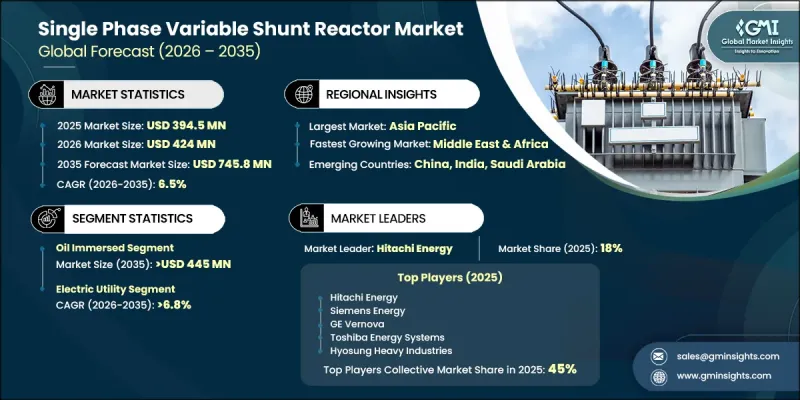
이 시장의 확대는 송전 인프라의 지속적인 발전과 현대 전력망에서 정밀한 전압 조정에 대한 요구가 증가함에 따라 주도되고 있습니다. 재생에너지원의 통합이 진행됨에 따라 발전량 변동을 관리하기 위한 효율적인 전압 제어 솔루션에 대한 수요가 더욱 증가하고 있습니다. 또한, 에너지 효율과 전력 품질 향상에 대한 관심이 높아지면서 첨단 리액터 기술의 채택이 가속화되고 있습니다. 또한, 스마트 그리드 시스템의 진화, 분산형 발전의 확대, 노후화된 송전망 인프라의 현대화가 시장 성장을 크게 촉진하고 있습니다. 세계 각국 정부는 에너지 인프라 개발에 적극적으로 투자하고 있으며, 이는 첨단 분로 리액터 시스템의 도입을 더욱 강화하고 있습니다. 전력회사들은 업데이트된 규제 프레임워크와 진화하는 전력망 요구사항을 준수하는 컴팩트하고 고성능의 솔루션에 점점 더 집중하고 있으며, 이는 장기적인 세계 시장 수요를 촉진하고 있습니다.
| 시장 범위 | |
|---|---|
| 개시 연도 | 2025년 |
| 예측 기간 | 2026-2035년 |
| 개시 연도 시장 규모 | 3억 9,450만 달러 |
| 예측 시장 규모 | 7억 4,580만 달러 |
| CAGR | 6.5% |
오일 침지 리액터 시장은 2035년까지 4억 4,500만 달러에 달할 것으로 예측됩니다. 이 부문은 전력망에서 우수한 열 성능, 운전 안정성, 안정적인 전압 제어 능력으로 인해 강력한 추진력을 보이고 있습니다. 오일 침지 분로 리액터는 효율적인 방열과 긴 작동 수명이 필수적인 고부하 용도에서 널리 선호되고 있습니다. 재생에너지 통합 프로젝트와 스마트 그리드 개발에 대한 투자 증가는 이러한 시스템의 도입을 더욱 촉진하고 있습니다. 에너지 손실을 최소화하면서 계통 안정성을 향상시키는 능력은 실용적인 규모의 용도 분야에서 폭넓은 도입을 뒷받침하고 있습니다.
전력 사업 부문은 2025년 66.1%의 점유율을 차지했으며, 2035년까지 연평균 6.8%의 성장률을 보일 것으로 전망됩니다. 전력회사는 여전히 주요 최종 사용자로 남아있습니다. 이는 전력의 흐름에 높은 변동성을 가져오는 재생에너지원의 통합이 진행되고 있기 때문입니다. 이러한 변동성에 대처하고 계통의 안정성과 운영 효율을 유지하기 위해서는 고도의 전압 조정 시스템이 필요합니다. 지속 가능한 에너지 인프라에 대한 투자 확대와 더불어 청정에너지로의 전환을 촉진하는 정부 지원책이 결합되어 수요를 더욱 견인하고 있습니다. 풍력 및 태양광 발전 시스템의 도입 확대는 전력망 내 효율적인 무효전력 보상 솔루션에 대한 수요를 증가시키고 있습니다.
미국의 단상 가변 분로 리액터 시장은 2025년에 4,360만 달러로 평가되었고, 2035년에는 7,200만 달러에 달할 것으로 예측됩니다. 이 나라의 성장은 송전 인프라의 지속적인 현대화와 효율적인 전압 조정 시스템에 대한 수요 증가에 의해 주도되고 있습니다. 재생에너지원이 국가 전력망에 통합됨에 따라 고급 무효전력 관리 솔루션의 필요성이 더욱 커지고 있습니다. 송전망 현대화 및 스마트그리드 도입에 따른 투자 확대도 시장 발전에 기여하고 있습니다. 미국 전력회사들은 전력망 신뢰도 향상, 전력 품질 개선, 장기적인 에너지 전환 목표 달성을 지원하기 위해 첨단 분로 리액터 시스템을 점점 더 많이 도입하고 있습니다.
자주 묻는 질문
목차
제1장 조사 방법 및 범위
제2장 주요 요약
제3장 산업 인사이트
제4장 경쟁 구도
제5장 시장 규모 및 예측 : 단열재별(2022-2035년)
제6장 시장 규모 및 예측 : 최종 용도별(2022-2035년)
제7장 시장 규모 및 예측 : 지역별(2022-2035년)
제8장 기업 개요
AJY 26.06.15The Global Single Phase Variable Shunt Reactor Market was valued at USD 394.5 million in 2025 and is estimated to grow at a CAGR of 6.5% to reach USD 745.8 million by 2035.
The market expansion is driven by continuous advancements in power transmission infrastructure and the increasing need for precise voltage regulation in modern electrical networks. The rising integration of renewable energy sources is further intensifying demand for efficient voltage control solutions to manage variability in power generation. Growing emphasis on energy efficiency and improved power quality is also accelerating the adoption of advanced reactor technologies. In addition, the evolution of smart grid systems, the expansion of distributed energy generation, and the modernization of aging grid infrastructure are significantly supporting market growth. Governments across multiple regions are actively investing in energy infrastructure development, which is further strengthening the deployment of advanced shunt reactor systems. Utilities are increasingly focusing on compact, high-performance solutions that comply with updated regulatory frameworks and evolving grid requirements, thereby boosting long-term market demand globally.
| Market Scope | |
|---|---|
| Start Year | 2025 |
| Forecast Year | 2026-2035 |
| Start Value | $394.5 Million |
| Forecast Value | $745.8 Million |
| CAGR | 6.5% |
The oil-immersed reactor segment is projected to reach USD 445 million by 2035. This segment is gaining strong traction due to its superior thermal performance, operational stability, and reliable voltage control capabilities in transmission networks. Oil-immersed shunt reactors are widely preferred in high-demand applications where efficient heat dissipation and long operational life are critical. Increasing investments in renewable integration projects and smart grid development are further strengthening the adoption of these systems. Their ability to enhance grid stability while minimizing energy losses continues to support their widespread deployment across utility-scale applications.
The electric utility sector accounted for 66.1% share in 2025 and is expected to grow at a CAGR of 6.8% through 2035. Utilities remain the primary end users due to the increasing integration of renewable energy sources that introduce higher variability in power flow. This variability requires advanced voltage regulation systems to maintain grid stability and operational efficiency. Rising investments in sustainable energy infrastructure, combined with supportive government policies promoting clean energy transition, are further driving demand. The growing deployment of wind and solar energy systems is also increasing the need for efficient reactive power compensation solutions within utility networks.
U.S. Single Phase Variable Shunt Reactor Market was valued at USD 43.6 million in 2025 and is projected to reach USD 72 million by 2035. Growth in the country is driven by the ongoing modernization of power transmission infrastructure and increasing demand for efficient voltage regulation systems. The integration of renewable energy sources into the national grid is further strengthening the need for advanced reactive power management solutions. Expanding investments in grid modernization and smart grid deployment initiatives are also contributing to market development. Utilities in the country are increasingly adopting advanced shunt reactor systems to improve grid reliability, enhance power quality, and support long-term energy transition goals.
Major companies operating in the Global Single Phase Variable Shunt Reactor Market include Siemens Energy, Hitachi Energy, GE Vernova, Fuji Electric, Toshiba Energy Systems & Solutions, Hyosung Heavy Industries, CG Power & Industrial Solutions, Nissin Electric, Trench Group, WEG, Prolec Energy, SGB SMIT, Pennsylvania Transformer, Phoenix Electric, TMC Transformers Manufacturing Company, Coil Innovation, GBE, GETRA, HICO America, Hilkar, and Shrihans Electricals. Companies operating in the single phase variable shunt reactor market are adopting multiple strategic initiatives to strengthen their market presence and improve competitiveness. Leading manufacturers are focusing on developing compact, energy-efficient, and high-performance reactor designs that align with modern grid requirements. Significant investments in research and development are being directed toward improving thermal efficiency, voltage stability, and operational reliability of shunt reactors. Companies are also expanding production capabilities and enhancing global supply chain networks to meet rising demand from utility-scale projects. Strategic collaborations with power utilities and grid operators are helping accelerate technology deployment and customization of solutions. In addition, firms are integrating digital monitoring and smart control systems into reactor designs to improve performance diagnostics and lifecycle management.
Table of Contents
Chapter 1 Methodology & Scope
- 1.1 Research approach
- 1.2 Quality commitment
- 1.2.1 GMI AI policy & data integrity commitment
- 1.2.1.1 Source consistency protocol
- 1.2.1 GMI AI policy & data integrity commitment
- 1.3 Research Trail & Confidence Scoring
- 1.3.1 Research Trail Components
- 1.3.2 Scoring Components
- 1.4 Data Collection
- 1.4.1 Partial list of primary sources
- 1.5 Data mining sources
- 1.5.1 Paid sources
- 1.5.1.1 Sources, by region
- 1.5.1 Paid sources
- 1.6 Base estimates and calculations
- 1.6.1 Base year calculation for any one approach
- 1.7 Forecast model
- 1.8 Research transparency addendum
- 1.8.1 Source attribution framework
- 1.8.2 Quality assurance metrics
- 1.8.3 Our commitment to trust
- 1.8.3.1 Market definitions
Chapter 2 Executive Summary
- 2.1 Industry synopsis, 2022 - 2035
- 2.2 Business trends
- 2.3 Insulation trends
- 2.4 End use trends
- 2.5 Regional trends
Chapter 3 Industry Insights
- 3.1 Industry ecosystem analysis
- 3.2 Regulatory landscape
- 3.3 Industry impact forces
- 3.3.1 Growth drivers
- 3.3.2 Industry pitfalls & challenges
- 3.4 Growth potential analysis
- 3.5 Porter's analysis
- 3.5.1 Bargaining power of suppliers
- 3.5.2 Bargaining power of buyers
- 3.5.3 Threat of new entrants
- 3.5.4 Threat of substitutes
- 3.6 PESTEL analysis
- 3.7 Cost structure analysis of shunt reactors
- 3.8 Trade data analysis (Driven by Primary Research)
- 3.8.1 Import/export value trends (Driven by Primary Research)
- 3.8.2 Key trade corridors & tariff impact (Driven by Primary Research)
- 3.9 Production capacity & utilization (Driven by Primary Research)
- 3.9.1 Production capacity by region (Driven by Primary Research)
- 3.9.2 Utilization rates and expansion pipeline (Driven by Primary Research)
- 3.10 Impact of AI & generative AI on the market [SOLUTION CORE]
- 3.10.1 AI-driven disruption of existing business models
- 3.10.2 GenAI use cases & adoption roadmap by segment
- 3.10.2.1 Predictive maintenance & fault detection
- 3.10.2.2 Digital twin simulation & testing
- 3.10.3 Risks, limitations & regulatory considerations
- 3.11 Emerging opportunities & trends
- 3.12 Investment analysis & future outlook
Chapter 4 Competitive Landscape, 2026
- 4.1 Introduction
- 4.2 Company market share analysis, by region, 2025
- 4.2.1 North America
- 4.2.2 Europe
- 4.2.3 Asia Pacific
- 4.2.4 Middle East & Africa
- 4.2.5 Latin America
- 4.3 Competitive positioning matrix
- 4.4 Key Developments
- 4.4.1 Mergers & acquisitions
- 4.4.2 Partnerships & collaborations
- 4.4.3 New product launches
- 4.4.4 Expansion plans and funding
Chapter 5 Market Size and Forecast, By Insulation, 2022 - 2035 (USD Million)
- 5.1 Key trends
- 5.2 Oil immersed
- 5.3 Air core
Chapter 6 Market Size and Forecast, By End Use, 2022 - 2035 (USD Million)
- 6.1 Key trends
- 6.2 Electric utility
- 6.3 Renewable energy
Chapter 7 Market Size and Forecast, By Region, 2022 - 2035 (USD Million)
- 7.1 Key trends
- 7.2 North America
- 7.2.1 U.S.
- 7.2.2 Canada
- 7.3 Europe
- 7.3.1 UK
- 7.3.2 Germany
- 7.3.3 France
- 7.3.4 Italy
- 7.3.5 Russia
- 7.4 Asia Pacific
- 7.4.1 China
- 7.4.2 India
- 7.4.3 Japan
- 7.4.4 Australia
- 7.5 Middle East & Africa
- 7.5.1 Saudi Arabia
- 7.5.2 UAE
- 7.5.3 Qatar
- 7.5.4 South Africa
- 7.6 Latin America
- 7.6.1 Brazil
- 7.6.2 Argentina
Chapter 8 Company Profiles
- 8.1 CG Power & Industrial Solutions
- 8.2 Coil Innovation
- 8.3 Fuji Electric
- 8.4 GE Vernova
- 8.5 GBE
- 8.6 GETRA
- 8.7 HICO America
- 8.8 Hilkar
- 8.9 Hitachi Energy
- 8.10 Hyosung Heavy Industries
- 8.11 Nissin Electric
- 8.12 Pennsylvania Transformer
- 8.13 Phoenix Electric
- 8.14 Prolec Energy
- 8.15 SGB SMIT
- 8.16 Shrihans Electricals
- 8.17 Siemens Energy
- 8.18 TMC Transformers Manufacturing Company
- 8.19 Toshiba Energy Systems & Solutions
- 8.20 Trench Group
- 8.21 WEG


