|
시장보고서
상품코드
2045737
시설 관리 시장 : 기회, 성장 촉진요인, 업계 동향 분석 및 예측(2026-2035년)Facility Management Market Opportunity, Growth Drivers, Industry Trend Analysis, and Forecast 2026 - 2035 |
||||||

세계의 시설 관리 시장은 2025년에 2조 4,500억 달러로 평가되었고 CAGR 6.8%를 나타내 2035년까지 4조 7,000억 달러에 이를 것으로 추정되고 있습니다.
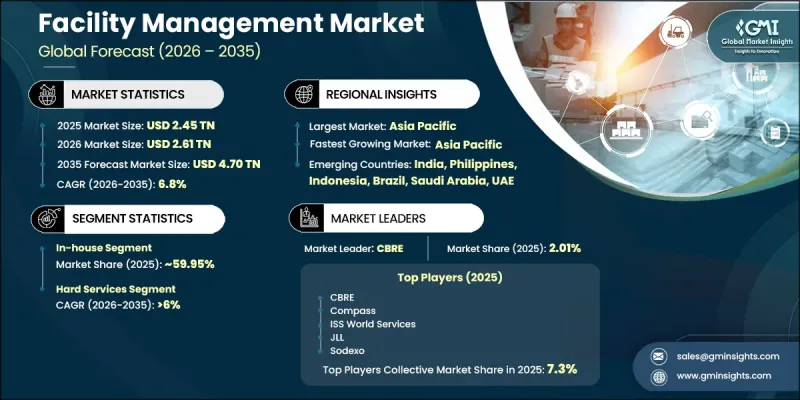
급속한 도시 개발, 스마트 인프라 프로젝트의 확대, 그리고 효율적인 건물 운영에 대한 수요 증가는 시설 관리 산업을 크게 변화시키고 있습니다. 시설물 관리는 기존의 유지보수 서비스를 넘어 자산 최적화, 작업장 효율화, 이용자 안전, 지속가능성 목표를 지원하는 전략적 운영 기능으로 인식되고 있습니다. 현대의 상업용 건물, 의료기관, 산업 시설 및 기업 캠퍼스에서는 자동화, 예지보전, 실시간 모니터링 기술을 통합한 지능형 시설 관리 시스템에 대한 의존도가 높아지고 있습니다. 조직은 운영 가시성을 개선하고 장기적인 비용을 절감하기 위해 에너지 관리, 작업 공간 최적화, 디지털 서비스 관리를 결합한 첨단 FM 플랫폼을 우선순위에 두고 있습니다. 자동 조명 시스템, 스마트 공조 제어, 디지털 유지보수 스케줄링 등의 기능은 자원 효율을 향상시키는 동시에 사용자 경험을 향상시킵니다. 또한, 지속가능성에 대한 노력과 ESG에 중점을 둔 운영 전략을 통해 시설 운영자는 친환경 건축 기술과 에너지 효율이 높은 인프라 솔루션의 도입을 촉진하고 있습니다. IoT 지원 시스템, 클라우드 기반 관리 플랫폼, AI를 활용한 분석 도구의 활용 확대는 전 세계 시설 관리 분야의 디지털 전환을 더욱 가속화하고 있습니다.
| 시장 범위 | |
|---|---|
| 시작 연도 | 2025년 |
| 예측 기간 | 2026-2035년 |
| 시작 연도 시장 규모 | 2조 4,500억 달러 |
| 예측 금액 | 4조 7,000억 달러 |
| CAGR | 6.8% |
아웃소싱 부문은 2026년부터 2035년까지 연평균 복합 성장률(CAGR) 7.4%를 나타낼 것으로 예측됩니다. 통합 시설관리 솔루션의 도입 확대, 비용 최적화에 대한 관심 증가, 전문적 노하우에 대한 수요 증가가 아웃소싱 서비스 부문의 성장을 견인하고 있습니다. 기업들은 높은 운영 기준을 유지하면서 주요 비즈니스 기능에 더 효과적으로 집중하기 위해 보안 서비스, 청소, 공조 설비 유지보수, 에너지 관리와 같은 비핵심 업무 활동을 외부 서비스 제공업체에 아웃소싱하는 추세가 증가하고 있습니다.
하드 서비스 부문은 2025년 54.3%의 점유율을 차지했으며, 2026년부터 2035년까지 연평균 복합 성장률(CAGR) 6%를 나타낼 것으로 전망됩니다. 이 부문은 기계, 전기, 배관, HVAC 시스템, 소방, 물 관리, 에너지 최적화 서비스 등 중요한 기술 및 인프라 관련 업무를 포괄하고 있기 때문에 계속해서 시장을 지배하고 있습니다. 하드 시설 관리 서비스는 건물의 성능 유지, 규정 준수, 운영 안전 및 자산의 효율적인 활용을 보장하기 위해 필수적입니다. 조직은 다운타임을 최소화하고, 인프라 투자를 보호하며, 장기적인 운영 안정성을 향상시키기 위해 이러한 서비스를 지속적으로 우선순위에 두고 있습니다.
중국의 시설 관리 시장은 2025년 44.2%의 점유율을 차지했으며 2026년부터 2035년까지 4,141억 달러 시장 규모를 창출할 것으로 예측됩니다. 중국 시장 성장은 급속한 도시화, 대규모 인프라 확장, 전문 부동산 관리 서비스에 대한 수요 증가에 힘입어 성장하고 있습니다. 상업 개발, 산업단지, 의료 인프라, 스마트시티 개념의 확대는 첨단 유지보수, 에너지 관리 및 통합 시설 관리 솔루션에 대한 강력한 수요를 창출하고 있습니다. 또한, 인건비 상승과 아웃소싱형 운영모델의 확산으로 중국 전역의 기업들이 체계화된 기술을 활용한 시설관리 시스템 도입을 추진하고 있습니다.
자주 묻는 질문
목차
제1장 조사 방법
제2장 주요 요약
제3장 업계 인사이트
제4장 경쟁 구도
제5장 시장 추산 및 예측 : 제공별(2022-2035년)
제6장 시장 추산 및 예측 : 서비스별(2022-2035년)
제7장 시장 추산 및 예측 : 최종 용도별(2022-2035년)
제8장 시장 추산 및 예측 : 조직 규모별(2022-2035년)
제9장 시장 추산 및 예측 : 지역별(2022-2035년)
제10장 기업 개요
KTH 26.06.10The Global Facility Management Market was valued at USD 2.45 trillion in 2025 and is estimated to grow at a CAGR of 6.8% to reach USD 4.70 trillion by 2035.
Rapid urban development, expanding smart infrastructure projects, and growing demand for efficient building operations are significantly reshaping the facility management industry. Facility management has evolved far beyond conventional maintenance services and is now considered a strategic operational function that supports asset optimization, workplace efficiency, occupant safety, and sustainability goals. Modern commercial buildings, healthcare institutions, industrial facilities, and corporate campuses increasingly rely on intelligent facility management systems that integrate automation, predictive maintenance, and real-time monitoring technologies. Organizations are prioritizing advanced FM platforms that combine energy management, workspace optimization, and digital service management to improve operational visibility and reduce long-term costs. Features such as automated lighting systems, smart climate control, and digital maintenance scheduling are enhancing user experience while improving resource efficiency. Sustainability initiatives and ESG-focused operational strategies are also encouraging facility operators to adopt green building technologies and energy-efficient infrastructure solutions. The growing use of IoT-enabled systems, cloud-based management platforms, and AI-driven analytics is further accelerating digital transformation across the facility management landscape globally.
| Market Scope | |
|---|---|
| Start Year | 2025 |
| Forecast Year | 2026-2035 |
| Start Value | $2.45 Trillion |
| Forecast Value | $4.70 Trillion |
| CAGR | 6.8% |
The outsourced segment is expected to grow at a CAGR of 7.4% during 2026-2035. Increasing adoption of integrated facility management solutions, rising focus on cost optimization, and growing demand for specialized expertise are driving expansion within the outsourced services segment. Businesses are increasingly outsourcing non-core operational activities such as security services, cleaning operations, HVAC maintenance, and energy management to external service providers to focus more effectively on primary business functions while maintaining high operational standards.
The hard services segment accounted for 54.3% share in 2025 and is anticipated to grow at a CAGR of 6% from 2026 to 2035. This segment continues to dominate because it covers critical technical and infrastructure-related operations, including mechanical, electrical, plumbing, HVAC systems, fire protection, water management, and energy optimization services. Hard facility management services are essential for ensuring uninterrupted building performance, regulatory compliance, operational safety, and efficient asset utilization. Organizations continue to prioritize these services to minimize downtime, protect infrastructure investments, and improve long-term operational reliability.
China Facility Management Market held a 44.2% share in 2025 and generated USD 414.1 billion during 2026-2035. The country's market growth is being supported by rapid urbanization, large-scale infrastructure expansion, and increasing demand for professional property management services. Growth in commercial developments, industrial zones, healthcare infrastructure, and smart city initiatives is creating strong demand for advanced maintenance, energy management, and integrated facility management solutions. In addition, rising labor costs and increasing adoption of outsourced operational models are encouraging businesses across China to implement structured and technology-enabled facility management systems.
Major companies operating in the Global Facility Management Market include Apleona, Aramark, BGIS, CBRE, Compass, Cushman & Wakefield, IBM TRIRIGA, ISS World Services, JLL, and Sodexo. Companies operating in the Facility Management Market are focusing on digital transformation, integrated service offerings, and sustainability initiatives to strengthen their market position. Industry participants are investing heavily in smart building technologies, IoT-enabled monitoring systems, predictive maintenance platforms, and cloud-based facility management software to improve operational efficiency and service quality. Strategic mergers, acquisitions, and partnerships are helping companies expand geographic reach and diversify their service portfolios. Many providers are also emphasizing energy-efficient solutions and ESG-driven operational strategies to meet evolving client expectations and regulatory standards. In addition, businesses are enhancing workforce training, adopting automation technologies, and strengthening data analytics capabilities to deliver customized and value-driven facility management services.
Table of Contents
Chapter 1 Methodology
- 1.1 Research approach
- 1.2 Quality Commitments
- 1.2.1 GMI AI policy & data integrity commitment
- 1.2.1.1 Source consistency protocol
- 1.2.1 GMI AI policy & data integrity commitment
- 1.3 Research Trail & Confidence Scoring
- 1.3.1 Research Trail Components
- 1.3.2 Scoring Components
- 1.4 Data Collection
- 1.4.1 Partial list of primary sources
- 1.5 Data mining sources
- 1.5.1 Paid sources
- 1.5.1.1 Sources, by region
- 1.5.1 Paid sources
- 1.6 Base estimates and calculations
- 1.6.1 Base year calculation for any one approach
- 1.7 Forecast
- 1.7.1 Quantified market impact analysis
- 1.7.1.1 Mathematical impact of growth parameters on forecast
- 1.7.1 Quantified market impact analysis
- 1.8 Research transparency addendum
- 1.8.1 Source attribution framework
- 1.8.2 Quality assurance metrics
- 1.8.3 Our commitment to trust
Chapter 2 Executive Summary
- 2.1 Industry 360° synopsis, 2022 - 2035
- 2.2 Key market trends
- 2.2.1 Regional
- 2.2.2 Offering
- 2.2.3 Service
- 2.2.4 End Use
- 2.2.5 Organization Size
- 2.3 TAM Analysis, 2026-2035
- 2.4 CXO perspectives: Strategic imperatives
Chapter 3 Industry Insights
- 3.1 Industry ecosystem analysis
- 3.1.1 Supplier landscape
- 3.1.2 Profit margin analysis
- 3.1.3 Cost structure
- 3.1.4 Value addition at each stage
- 3.1.5 Factor affecting the value chain
- 3.1.6 Disruptions
- 3.2 Industry impact forces
- 3.2.1 Growth drivers
- 3.2.1.1 Rapidly growing tourism and hospitality sectors
- 3.2.1.2 Rising demand for value-added services
- 3.2.1.3 Growing investments in construction sector
- 3.2.1.4 Supportive government initiatives for development of smart cities and business hubs
- 3.2.2 Industry pitfalls and challenges
- 3.2.2.1 Slow adoption of outsourced facilities management services
- 3.2.2.2 Limited awareness about the benefits of advanced facility management technologies
- 3.2.3 Market opportunities
- 3.2.3.1 Growing demand for integrated FM services
- 3.2.3.2 HR tech integration & workforce analytics
- 3.2.3.3 Sustainability services & green building compliance
- 3.2.3.4 Tier 2 & tier 3 cities expansion
- 3.2.1 Growth drivers
- 3.3 Growth potential analysis
- 3.4 Regulatory guideline
- 3.4.1 North America
- 3.4.1.1 U.S.: OSHA Workplace Safety & Energy Efficiency Regulations
- 3.4.1.2 Canada: National Building Code & Energy Efficiency Standards (NRCan)
- 3.4.2 Europe
- 3.4.2.1 Germany: Energy Saving Ordinance (EnEV) & Building Energy Act (GEG)
- 3.4.2.2 UK: Minimum Energy Efficiency Standards (MEES) & Health and Safety Regulations
- 3.4.2.3 France: Energy Performance of Buildings Directive (EPBD) Implementation
- 3.4.2.4 Italy: National Energy Efficiency Action Plan (NEEAP) Compliance
- 3.4.3 Asia Pacific
- 3.4.3.1 China: Green Building Evaluation Standard & Energy Conservation Law
- 3.4.3.2 India: Energy Conservation Building Code (ECBC) & Smart Cities Mission Guidelines
- 3.4.3.3 Japan: Building Energy Efficiency Act & CASBEE Certification System
- 3.4.3.4 Australia: National Construction Code (NCC) & NABERS Rating System
- 3.4.4 Latin America
- 3.4.4.1 Brazil: National Energy Efficiency Plan & Green Building Council Standards
- 3.4.4.2 Mexico: NOM Energy Efficiency Standards & Sustainable Building Codes
- 3.4.4.3 Argentina: National Program for Rational Energy Use (PRONUREE)
- 3.4.5 MEA
- 3.4.5.1 UAE: Estidama Pearl Rating System & Dubai Green Building Regulations
- 3.4.5.2 Saudi Arabia: Saudi Building Code & Energy Efficiency Program (SEEP)
- 3.4.5.3 South Africa: SANS 10400-XA Energy Usage in Buildings Regulation
- 3.4.1 North America
- 3.5 Porter's analysis
- 3.6 PESTEL analysis
- 3.7 Technology and Innovation landscape
- 3.7.1 Current technological trends
- 3.7.2 Emerging technologies
- 3.8 Patent analysis (Driven by Primary Research)
- 3.9 Pricing Analysis (Driven by Primary Research)
- 3.9.1 Historical Price Trend Analysis
- 3.9.2 Pricing Strategy by Player Type
- 3.10 Impact of AI & generative AI on the market
- 3.10.1 AI-Driven Disruption of Existing Business Models
- 3.10.2 GenAI Use Cases & Adoption Roadmap by Segment
- 3.10.3 Risks, limitations & regulatory considerations
- 3.11 Sustainability and environmental aspects
- 3.11.1 Sustainable practices
- 3.11.2 Waste reduction strategies
- 3.11.3 Energy efficiency in production
- 3.11.4 Eco-friendly initiatives
- 3.11.5 Carbon footprint considerations
- 3.12 Forecast assumptions & scenario analysis (Driven by Primary Research)
- 3.12.1 Base Case - Key Macro & Industry Variables Driving CAGR
- 3.12.2 Optimistic Scenarios - Favourable macro and industry tailwinds
- 3.12.3 Pessimistic Scenario - Macroeconomic slowdown or industry headwinds
Chapter 4 Competitive Landscape, 2025
- 4.1 Introduction
- 4.2 Company market share analysis
- 4.2.1 North America
- 4.2.2 Europe
- 4.2.3 Asia Pacific
- 4.2.4 Latin America
- 4.2.5 MEA
- 4.3 Competitive analysis of major market players
- 4.4 Competitive positioning matrix
- 4.5 Key developments
- 4.5.1 Mergers & acquisitions
- 4.5.2 Partnerships & collaborations
- 4.5.3 New Product Launches
- 4.5.4 Expansion Plans and funding
- 4.6 Company Tier Benchmarking
- 4.6.1 Tier Classification Criteria & Qualifying Thresholds
- 4.6.2 Tier Positioning Matrix by Revenue, Geography & Innovation
Chapter 5 Market Estimates & Forecast, By Offering, 2022 - 2035 ($Bn)
- 5.1 Key trends
- 5.2 In-House
- 5.3 Outsourced
Chapter 6 Market Estimates & Forecast, By Service, 2022 - 2035 ($Bn)
- 6.1 Key trends
- 6.2 Hard Services
- 6.2.1 Mechanical, Electrical, Plumbing & HVAC Maintenance
- 6.2.2 Energy Management
- 6.2.3 Fire Safety Systems
- 6.2.4 Water Management Systems
- 6.2.5 Asset Management
- 6.2.6 Others
- 6.3 Soft Services
- 6.3.1 Janitorial & Sanitization
- 6.3.2 Office Support & Security Services
- 6.3.3 Housekeeping
- 6.3.4 Pest Control
- 6.3.5 Catering Services
- 6.3.6 Ground Maintenance
- 6.3.7 Others
Chapter 7 Market Estimates & Forecast, By End Use, 2022 - 2035 ($Bn)
- 7.1 Key trends
- 7.2 Healthcare
- 7.3 Business & Corporate
- 7.4 Manufacturing
- 7.5 Government & Public Sector
- 7.6 Education
- 7.7 Construction & Real Estate
- 7.8 Hospitality & Travel
- 7.9 Retail
- 7.10 Military & Defense
- 7.11 Others
Chapter 8 Market Estimates & Forecast, By Organization Size, 2022 - 2035 ($Bn)
- 8.1 Key trends
- 8.2 Large Enterprises
- 8.3 Small & Medium Enterprises (SMEs)
Chapter 9 Market Estimates & Forecast, By Region, 2022 - 2035 ($Bn)
- 9.1 Key trends
- 9.2 North America
- 9.2.1 US
- 9.2.2 Canada
- 9.3 Europe
- 9.3.1 Germany
- 9.3.2 UK
- 9.3.3 France
- 9.3.4 Italy
- 9.3.5 Spain
- 9.3.6 Russia
- 9.3.7 Netherlands
- 9.3.8 Belgium
- 9.4 Asia Pacific
- 9.4.1 China
- 9.4.2 India
- 9.4.3 Japan
- 9.4.4 Australia
- 9.4.5 South Korea
- 9.4.6 Philippines
- 9.4.7 Indonesia
- 9.5 Latin America
- 9.5.1 Brazil
- 9.5.2 Mexico
- 9.5.3 Argentina
- 9.6 MEA
- 9.6.1 South Africa
- 9.6.2 Saudi Arabia
- 9.6.3 UAE
Chapter 10 Company Profiles
- 10.1 Global players
- 10.1.1 ABM Industries
- 10.1.2 Archibus
- 10.1.3 CBRE
- 10.1.4 Compass
- 10.1.5 Cushman & Wakefield
- 10.1.6 IBM
- 10.1.7 ISS A/S
- 10.1.8 JLL
- 10.1.9 Planon
- 10.1.10 Sodexo
- 10.2 Regional Players
- 10.2.1 Apleona
- 10.2.2 Aramark
- 10.2.3 Atalian Servest
- 10.2.4 BGIS
- 10.2.5 Caverion
- 10.2.6 Emrill Services
- 10.2.7 Facilicom
- 10.2.8 Knight Facilities Management
- 10.2.9 Mitie
- 10.2.10 OCS
- 10.3 Emerging Players
- 10.3.1 Eptura
- 10.3.2 Facilio
- 10.3.3 Infogrid
- 10.3.4 UpKeep
- 10.3.5 VergeSense