

|
시장보고서
상품코드
2045738
아염소산나트륨 시장 : 기회, 성장 촉진요인, 업계 동향 분석 및 예측(2026-2035년)Sodium Chlorite Market Opportunity, Growth Drivers, Industry Trend Analysis, and Forecast 2026 - 2035 |
||||||

세계의 아염소산나트륨 시장은 2025년에 2억 6,530만 달러로 평가되었고 CAGR 7.1%를 나타내 2035년까지 5억 2,630만 달러에 이를 것으로 예측됩니다.
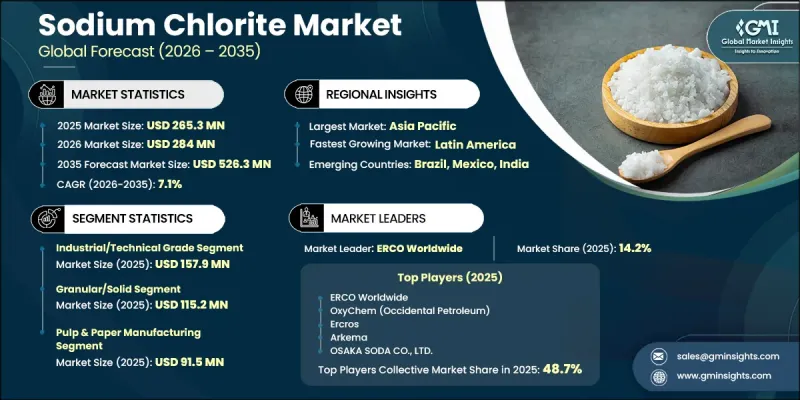
이 시장은 산업 공정 및 수처리 분야에서 효율적인 산화 및 소독 솔루션에 대한 수요가 증가함에 따라 성장하고 있습니다. 차아염소산나트륨은 수산화나트륨과 이산화염소의 반응에 의해 생성되며, 강력한 산화 기능을 가진 백색 결정성 화합물 또는 수용액이 됩니다. 표백 효율과 항균 성능으로 인해 제어된 산화 능력을 필요로 하는 다양한 산업에서 중요한 소재가 되고 있습니다. 이 화합물은 이산화염소를 효과적으로 생성하는 능력이 있어 펄프 및 제지 가공, 섬유 제조 및 정수 시스템에 널리 사용되고 있습니다. 또한, 안정적인 소독 특성과 기존 대체품에 비해 유해한 부산물 발생이 적어 악취 제어 및 미생물 처리 용도에서도 차아염소산나트륨이 점점 더 선호되고 있습니다. 제조 기술의 발전으로 시장의 성장은 더욱 가속화되고 있습니다. 제조업체들은 농도 조절과 제품의 안정성을 높이기 위해 합성 및 정제 방법을 지속적으로 개선하고 있습니다. 전기화학 제조 시스템과 첨단 화학적 환원 기술을 통해 공급업체는 다양한 최종 사용 산업에서 제품의 균일성, 운영 효율성 및 품질을 향상시킬 수 있습니다.
| 시장 범위 | |
|---|---|
| 시작 연도 | 2025년 |
| 예측 기간 | 2026-2035년 |
| 시작 연도 시장 규모 | 2억 6,530만 달러 |
| 예측 금액 | 5억 2,630만 달러 |
| CAGR | 7.1% |
2025년에는 산업 및 기술 등급 부문이 1억 5,790만 달러로 가장 큰 비중을 차지했습니다. 이 부문은 펄프 및 제지 산업의 표백 공정에 널리 사용되기 때문에 계속해서 선도적인 위치를 유지하고 있습니다. 업계에서는 대규모 처리 환경에서 아염소산나트륨의 높은 산화 효율과 비용 효율성을 높이 평가했습니다. 산업용 등급 제품은 연속 표백 용도에 필요한 성능 기준을 충족하고 제지 공장 및 섬유 가공 시설의 백색도 및 품질 요구 사항을 충족합니다. 또한, 생산 시스템의 개선으로 제조업체는 전 세계의 까다로운 산업 응용 분야에서 일관된 제품 품질을 유지할 수 있게 되었습니다.
입상 및 고체 형태 부문은 2025년에 1억 1,520만 달러에 달했습니다. 이 형태는 저장 안정성과 운송상의 이점이 향상되어 시장을 계속 독점하고 있으며, 벌크 화학제품의 유통 및 장기 재고 관리에 매우 적합합니다. 과립 형 차아 염소산 나트륨은 액체 대체품보다 저장 수명이 길고, 산업 사용자는 운영 요구 사항에 따라 맞춤형 용액 농도를 준비 할 수 있습니다. 수처리 시설이나 제조 공장에서는 정확한 투여량 조절이 가능하고 시간 경과에 따른 농도 저하 우려를 최소화할 수 있어 고체 제형이 선호되고 있습니다.
북미의 아염소산나트륨 시장은 2025년 7,030만 달러에서 2035년까지 1억 3,570만 달러로 확대될 것으로 예측됩니다. 이 지역의 성장은 수처리 인프라에서 신뢰할 수 있는 소독 화학물질에 대한 수요 증가와 펄프 및 제지 산업 전반에 걸친 환경 친화적인 표백 기술의 지속적인 도입에 힘입어 성장세를 보이고 있습니다. 보다 안전한 소독 방법에 초점을 맞춘 지원적인 규제 프레임워크와 더불어, 고급 이산화염소 생성 시스템의 도입 확대는 이 지역 전체 시장 성장을 더욱 촉진하고 있습니다.
자주 묻는 질문
목차
제1장 조사 방법과 범위
제2장 주요 요약
제3장 업계 인사이트
제4장 경쟁 구도
제5장 시장 추산 및 예측 : 등급별(2022-2035년)
제6장 시장 추산 및 예측 : 형태별(2022-2035년)
제7장 시장 추산 및 예측 : 최종 사용 산업별(2022-2035년)
제8장 시장 추산 및 예측 : 지역별(2022-2035년)
제9장 기업 개요
KTH 26.06.10The Global Sodium Chlorite Market was valued at USD 265.3 million in 2025 and is estimated to grow at a CAGR of 7.1% to reach USD 526.3 million by 2035.
The market is expanding due to rising demand for efficient oxidation and disinfection solutions across industrial processing and water treatment applications. Sodium chlorite is produced through the reaction of sodium hydroxide and chlorine dioxide, resulting in a white crystalline compound or aqueous solution with strong oxidizing functionality. Its bleaching efficiency and antimicrobial performance make it an important material across industries that require controlled oxidation capabilities. The compound is widely utilized in pulp and paper processing, textile manufacturing, and water purification systems because of its ability to generate chlorine dioxide effectively. Sodium chlorite is also increasingly preferred in odor control and microbial treatment applications due to its stable disinfection properties and lower formation of harmful byproducts compared to conventional alternatives. Advancements in production technologies are further improving market growth, as manufacturers continue to refine synthesis and purification methods to enhance concentration control and product stability. The adoption of electrochemical production systems and advanced chemical reduction techniques is enabling suppliers to improve consistency, operational efficiency, and product quality across multiple end-use industries.
| Market Scope | |
|---|---|
| Start Year | 2025 |
| Forecast Year | 2026-2035 |
| Start Value | $265.3 Million |
| Forecast Value | $526.3 Million |
| CAGR | 7.1% |
The industrial and technical grade segment accounted for USD 157.9 million in 2025. This segment continues to lead due to extensive use in pulp and paper bleaching operations, where sodium chlorite is valued for its high oxidizing efficiency and cost-effectiveness in large-scale processing environments. Industrial-grade products deliver the performance standards required for continuous bleaching applications while supporting brightness and quality requirements across paper manufacturing and textile treatment facilities. Improvements in production systems are also helping manufacturers maintain consistent product quality for demanding industrial operations worldwide.
The granular and solid form segment reached USD 115.2 million in 2025. This form continues to dominate due to its enhanced storage stability and transportation advantages, making it highly suitable for bulk chemical distribution and extended inventory management. Granular sodium chlorite provides a longer shelf life than liquid alternatives and allows industrial users to prepare customized solution concentrations depending on operational requirements. Water treatment facilities and manufacturing plants prefer solid formulations because they support accurate dosing control while minimizing concerns related to concentration degradation over time.
North America Sodium Chlorite Market is expected to increase from USD 70.3 million in 2025 to USD 135.7 million by 2035. Regional growth is being supported by increasing demand for reliable disinfection chemicals within water treatment infrastructure and continued adoption of environmentally improved bleaching technologies across the pulp and paper sector. Expanding implementation of advanced chlorine dioxide generation systems, along with supportive regulatory frameworks focused on safer disinfection methods, is further strengthening market growth across the region.
Major companies operating in the Global Sodium Chlorite Industry include Arkema, Occidental Petroleum Corporation (OxyChem), ERCO Worldwide, Carlit Holdings Co., Ltd. (Japan Carlit), OSAKA SODA CO., LTD., Merck KGaA (MilliporeSigma / Sigma-Aldrich), Alfa Aesar (Thermo Scientific Chemicals), Ercros, Fengchen Group Co., Ltd., Dongying Shengya Chemical Co., Ltd., Gaomi Fuyihe Chem Co., Ltd., and Shandong Gaomi Gaoyuan Chemical Industry Co., Ltd. Companies in the sodium chlorite market are focusing on expanding production efficiency through advanced synthesis technologies and process optimization initiatives. Manufacturers are investing in purification systems and automated quality monitoring to improve concentration consistency and product stability. Strategic partnerships with water treatment operators and pulp processing companies are helping strengthen long-term supply agreements and market penetration. Businesses are also prioritizing environmentally responsible production methods to align with evolving regulatory standards and sustainability goals. Capacity expansion projects and regional distribution network development are improving product accessibility across high-demand markets.
Table of Contents
Chapter 1 Methodology & Scope
- 1.1 Market scope and definition
- 1.2 Research design
- 1.2.1 Research approach
- 1.2.2 Data collection methods
- 1.3 Data mining sources
- 1.3.1 Global
- 1.3.2 Regional/Country
- 1.4 Base estimates and calculations
- 1.4.1 Base year calculation
- 1.4.2 Key trends for market estimation
- 1.5 Primary research and validation
- 1.5.1 Primary sources
- 1.6 Forecast model
- 1.7 Research assumptions and limitations
Chapter 2 Executive Summary
- 2.1 Industry 360° synopsis
- 2.2 Key market trends
- 2.2.1 Grade
- 2.2.2 Form
- 2.2.3 End use Industry
- 2.2.4 Regional
- 2.3 TAM Analysis, 2026-2035
- 2.4 CXO perspectives: Strategic imperatives
Chapter 3 Industry Insights
- 3.1 Industry ecosystem analysis
- 3.1.1 Supplier landscape
- 3.1.2 Profit margin
- 3.1.3 Value addition at each stage
- 3.1.4 Factor affecting the value chain
- 3.1.5 Disruptions
- 3.2 Industry impact forces
- 3.2.1 Growth drivers
- 3.2.2 Industry pitfalls and challenges
- 3.2.3 Market opportunities
- 3.3 Growth potential analysis
- 3.4 Regulatory landscape
- 3.4.1 North America
- 3.4.2 Europe
- 3.4.3 Asia Pacific
- 3.4.4 Latin America
- 3.4.5 Middle East & Africa
- 3.5 Porter's analysis
- 3.6 PESTEL analysis
- 3.7 Price trends
- 3.7.1 By region
- 3.7.2 By grade
- 3.8 Future market trends
- 3.9 Technology and Innovation landscape
- 3.9.1 Current technological trends
- 3.9.2 Emerging technologies
- 3.10 Patent Landscape
- 3.11 Trade statistics (HS code)
- 3.11.1 Major importing countries
- 3.11.2 Major exporting countries
- 3.12 Sustainability and environmental aspects
- 3.12.1 Sustainable practices
- 3.12.2 Waste reduction strategies
- 3.12.3 Energy efficiency in production
- 3.12.4 Eco-friendly initiatives
- 3.13 Carbon footprint consideration
Chapter 4 Competitive Landscape, 2025
- 4.1 Introduction
- 4.2 Company market share analysis
- 4.2.1 By region
- 4.2.1.1 North America
- 4.2.1.2 Europe
- 4.2.1.3 Asia Pacific
- 4.2.1.4 LATAM
- 4.2.1.5 MEA
- 4.2.1 By region
- 4.3 Competitive analysis of major market players
- 4.4 Competitive positioning matrix
- 4.5 Key developments
- 4.5.1 Mergers & acquisitions
- 4.5.2 Partnerships & collaborations
- 4.5.3 New Product Launches
- 4.5.4 Expansion Plans
Chapter 5 Market Estimates and Forecast, By Grade, 2022-2035 (USD Billion) (Kilo Tons)
- 5.1 Key trends
- 5.2 Industrial/Technical Grade
- 5.3 Food Grade
- 5.4 Pharmaceutical Grade
- 5.5 Others
Chapter 6 Market Estimates and Forecast, By Form, 2022-2035 (USD Billion) (Kilo Tons)
- 6.1 Key trends
- 6.2 Granular/Solid
- 6.3 Liquid
- 6.4 Powder
Chapter 7 Market Estimates and Forecast, By End-use Industry, 2022-2035 (USD Million) (Kilo Tons)
- 7.1 Key trends
- 7.2 Pulp & Paper Manufacturing
- 7.2.1 Kraft Pulp Mills
- 7.2.2 Mechanical Pulp Mills
- 7.2.3 Recycled Paper Production
- 7.3 Textile Manufacturing
- 7.3.1 Cotton & Natural Fiber Processing
- 7.3.2 Synthetic Fiber Processing
- 7.4 Water Utilities
- 7.4.1 Municipal Water Treatment Plants
- 7.4.2 Private Water Utilities
- 7.5 Food Processing & Beverage
- 7.6 Others
Chapter 8 Market Estimates and Forecast, By Region, 2022-2035 (USD Million) (Kilo Tons)
- 8.1 Key trends
- 8.2 North America
- 8.2.1 U.S.
- 8.2.2 Canada
- 8.3 Europe
- 8.3.1 Germany
- 8.3.2 UK
- 8.3.3 France
- 8.3.4 Spain
- 8.3.5 Italy
- 8.3.6 Rest of Europe
- 8.4 Asia Pacific
- 8.4.1 China
- 8.4.2 India
- 8.4.3 Japan
- 8.4.4 Australia
- 8.4.5 South Korea
- 8.4.6 Rest of Asia Pacific
- 8.5 Latin America
- 8.5.1 Brazil
- 8.5.2 Mexico
- 8.5.3 Argentina
- 8.5.4 Rest of Latin America
- 8.6 Middle East and Africa
- 8.6.1 Saudi Arabia
- 8.6.2 South Africa
- 8.6.3 UAE
- 8.6.4 Rest of Middle East and Africa
Chapter 9 Company Profiles
- 9.1 Alfa Aesar (Thermo Scientific Chemicals)
- 9.2 Arkema
- 9.3 Carlit Holdings Co., Ltd. (Japan Carlit)
- 9.4 Ercros
- 9.5 ERCO Worldwide
- 9.6 Fengchen Group Co.,Ltd
- 9.7 Dongying Shengya Chemical Co., Ltd.
- 9.8 Gaomi Fuyihe Chem Co., Ltd.
- 9.9 Merck KGaA (MilliporeSigma / Sigma-Aldrich)
- 9.10 Occidental Petroleum Corporation (OxyChem)
- 9.11 OSAKA SODA CO., LTD.
- 9.12 Shandong Gaomi Gaoyuan Chemical Industry Co.,Ltd


