
|
시장보고서
상품코드
2045740
자동차 제동 부품 시장 : 기회, 성장 촉진요인, 업계 동향 분석 및 예측(2026-2035년)Automotive Braking Component Market Opportunity, Growth Drivers, Industry Trend Analysis, and Forecast 2026 - 2035 |
||||||

세계의 자동차 제동 부품 시장은 2025년에 508억 달러로 평가되었고 CAGR 4.9%를 나타내 2035년까지 808억 달러에 이를 것으로 예측됩니다.
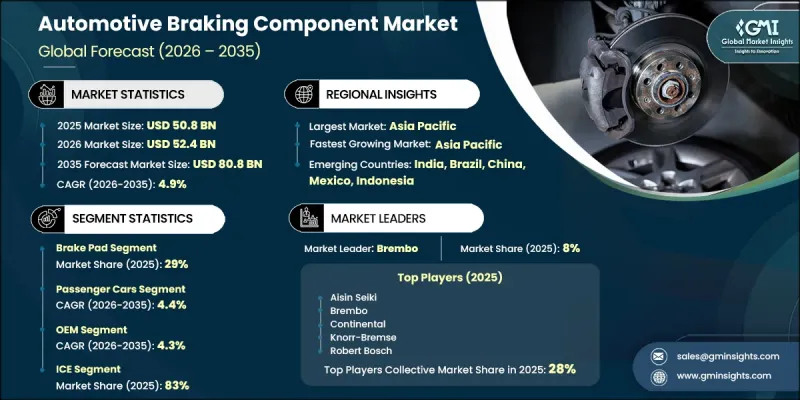
승용차 및 상용차 부문의 자동차 생산량 증가에 따라 OEM(주문자상표부착생산자)의 자동차 제동 부품에 대한 수요는 지속적으로 강세를 보이고 있습니다. 아시아태평양과 라틴아메리카의 급속한 산업 발전, 가처분 소득 증가, 자동차 제조 활동의 확대는 시장 확대에 크게 기여하고 있습니다. 또한, 전 세계적으로 노후화된 차량 보유량이 증가함에 따라 지속적인 마모와 유지보수의 필요성이 브레이크 패드, 캘리퍼, 디스크, 드럼 등의 교체 수요를 견인하고 있습니다. 또한, 특히 개발도상국에서 자동차 소유 기간이 길어지고 있는 것도 애프터마켓의 판매를 촉진하고 있습니다. 자동차 제조업체들이 부품 경량화를 통해 연비 효율과 차량 성능 향상에 집중하면서 경량 브레이크 시스템에 대한 수요가 증가하고 있습니다. 알루미늄 합금, 카본 세라믹 로터, 경량 복합재료 기술 등 첨단 소재는 고부하 조건에서 제동 효율, 열 관리 및 정지 성능을 향상시킵니다. 전자식 안정성 제어 시스템, 어댑티브 크루즈 컨트롤 기술, 자동 제동 솔루션 등 첨단 안전 기술 채택이 확대되면서 전 세계적으로 첨단 제동 부품, 전자 제어 장치, 센서 및 전자식 제동 시스템에 대한 수요가 더욱 가속화되고 있습니다.
| 시장 범위 | |
|---|---|
| 시작 연도 | 2025년 |
| 예측 기간 | 2026-2035년 |
| 시작 연도 시장 규모 | 508억 달러 |
| 예측 금액 | 808억 달러 |
| CAGR | 4.9% |
브레이크 패드 부문은 2025년에 29%의 점유율을 차지했으며, 2026년부터 2035년까지 연평균 4.1%의 성장률을 나타낼 것으로 예측됩니다. 정숙성이 높은 브레이크 시스템과 환경 기준에 부합하는 소재에 대한 소비자의 선호도가 높아지면서 첨단 브레이크 패드 기술에 대한 수요가 증가하고 있습니다. 각 제조업체들은 더욱 엄격해진 환경 기준과 높아진 운전 편의성에 대한 기대에 부응하기 위해 저먼지, 세라믹, 비동 소재의 브레이크 패드 개발에 박차를 가하고 있습니다. 또한, 전기자동차의 급속한 보급에 따라 내열성, 내구성 향상 및 마모 감소를 목적으로 하는 회생제동 대응 브레이크 패드 개발도 가속화되고 있습니다. 이러한 첨단 브레이크 소재는 특히 고성능 전기자동차의 응용 분야에서 에너지 효율, 제동 성능의 안정성 및 장기적인 차량 성능 향상에 기여합니다.
승용차 부문은 2025년 73.8%의 점유율을 차지했으며, 2026년부터 2035년까지 연평균 복합 성장률(CAGR) 4.4%를 나타낼 것으로 전망됩니다. 승용차에 지능형 운전 보조 기술 및 자동 안전 기능의 통합이 진행되면서 ABS(Anti-lock Brake System), ESC(Electronic Stability Control), AEB(Automatic Emergency Braking) 기술을 포함한 첨단 제동 시스템에 대한 수요가 증가하고 있습니다. 자동차 제조업체들은 안전, 운전 경험 및 커넥티드카 아키텍처와의 호환성을 향상시키기 위해 전자식 제동 시스템 및 Brake-by-wire(brake-by-wire) 기술의 채택을 확대되고 있습니다. 전기 승용차 생산 증가도 경량 제동 부품과 회생 제동 시스템의 채택을 촉진하고 있습니다. 각 제조업체들은 차량의 주행거리 향상, 유지보수 비용 절감, 그리고 전 세계적으로 진화하는 환경 및 성능 기준에 대응하기 위해 내식성 브레이크 디스크, 저소음 브레이크 기술 및 에너지 효율적인 시스템에 지속적으로 집중하고 있습니다.
미국의 자동차 제동 부품 시장은 2025년 87억 달러에 달했으며, 2035년까지 연평균 5.6%의 성장률을 나타낼 것으로 전망됩니다. 첨단운전자보조시스템(ADAS)와 차량 제동시스템의 급속한 통합으로 국내 승용차 및 상용차에서 ABS(Anti-lock Brake System), 전자식 안정성 제어 기술, 자동 제동 솔루션에 대한 수요가 크게 증가하고 있습니다. 또한, 미국 내 노후화된 차량 보유량이 많아 교체 주기가 짧아지고 유지보수 요구사항이 증가함에 따라 브레이크 패드, 로터, 캘리퍼에 대한 애프터마켓 수요도 견조하게 유지되고 있습니다. 또한, 자동차 산업의 전동화 진전에 따라 회생 제동 기술 및 전자 제어 브레이크 시스템의 도입이 가속화되고 있습니다. 제동 성능, 안전 기능의 통합, 경량화 시스템 설계의 지속적인 혁신은 이 지역 전체 시장 성장을 더욱 촉진하고 있습니다.
자주 묻는 질문
목차
제1장 조사 방법
제2장 주요 요약
제3장 업계 인사이트
제4장 경쟁 구도
제5장 시장 추산 및 예측 : 구성 요소별(2022-2035년)
제6장 시장 추산 및 예측 : 브레이크 시스템 아키텍처별(2022-2035년)
제7장 시장 추산 및 예측 : 차량별(2022-2035년)
제8장 시장 추산 및 예측 : 판매 채널별(2022-2035년)
제9장 시장 추산 및 예측 : 추진력별(2022-2035년)
제10장 시장 추산 및 예측 : 지역별(2022-2035년)
제11장 기업 개요
KTH 26.06.10The Global Automotive Braking Component Market was valued at USD 50.8 billion in 2025 and is estimated to grow at a CAGR of 4.9% to reach USD 80.8 billion by 2035.
Rising vehicle production across passenger and commercial categories continues to create strong demand for automotive braking components from original equipment manufacturers. Rapid industrial development, increasing disposable income levels, and expanding automotive manufacturing activities across Asia Pacific and Latin America are contributing significantly to market expansion. In addition, the growing global fleet of aging vehicles is driving replacement demand for brake pads, calipers, discs, and drums due to ongoing wear and maintenance requirements. Longer vehicle ownership cycles are also strengthening aftermarket sales, particularly in developing economies. Demand for lightweight braking systems is increasing as automakers focus on improving fuel efficiency and vehicle performance through reduced component weight. Advanced materials such as aluminum alloys, carbon-ceramic rotors, and lightweight composite technologies are improving braking efficiency, heat management, and stopping performance under high-load conditions. Growing adoption of advanced safety technologies, including electronic stability systems, adaptive cruise technologies, and automated braking solutions, is further accelerating demand for advanced braking components, electronic control units, sensors, and electronically controlled brake systems worldwide.
| Market Scope | |
|---|---|
| Start Year | 2025 |
| Forecast Year | 2026-2035 |
| Start Value | $50.8 Billion |
| Forecast Value | $80.8 Billion |
| CAGR | 4.9% |
The brake pad segment accounted for 29% share in 2025 and is expected to grow at a CAGR of 4.1% between 2026 and 2035. Increasing consumer preference for quieter braking systems and environmentally compliant materials is supporting strong demand for advanced brake pad technologies. Manufacturers are increasingly developing low-dust, ceramic-based, and non-copper brake pads to align with stricter environmental standards and improved driving comfort expectations. The rapid expansion of electric vehicles is also accelerating the development of regenerative braking-compatible brake pads designed for enhanced thermal resistance, durability, and reduced wear. These advanced braking materials help improve energy efficiency, braking consistency, and long-term vehicle performance, particularly in high-performance electric vehicle applications.
The passenger car segment held a 73.8% share in 2025 and is projected to grow at a CAGR of 4.4% from 2026 to 2035. Increasing integration of intelligent driver assistance technologies and automated safety features in passenger vehicles is fueling demand for advanced braking systems, including anti-lock braking systems, electronic stability control, and automated emergency braking technologies. Automotive manufacturers are increasingly adopting electronic braking systems and brake-by-wire technologies to improve safety, driving experience, and compatibility with connected vehicle architectures. Rising production of electric passenger vehicles is also driving the use of lightweight braking components and regenerative braking systems. Manufacturers continue to focus on corrosion-resistant brake discs, low-noise braking technologies, and energy-efficient systems to improve vehicle range, reduce maintenance costs, and meet evolving environmental and performance standards globally.
U.S. Automotive Braking Component Market reached USD 8.7 billion in 2025 and is expected to witness growth at a CAGR of 5.6% through 2035. Rapid integration of advanced driver assistance technologies with vehicle braking systems is creating substantial demand for anti-lock braking systems, electronic stability technologies, and automated braking solutions across passenger and commercial vehicles in the country. The large aging vehicle fleet in the U.S. is also contributing to strong aftermarket demand for brake pads, rotors, and calipers due to increasing replacement cycles and maintenance requirements. In addition, rising electrification of the automotive sector is accelerating adoption of regenerative braking technologies and electronically controlled braking systems. Continuous innovation in braking performance, safety integration, and lightweight system design is further supporting market growth across the region.
Key companies operating in the Global Automotive Braking Component Market include Valeo, Continental, ZF Friedrichshafen, Robert Bosch, Akebono Brake, HL Mando, Aisin Seiki, Hitachi Astemo, Knorr-Bremse, and Brembo. Companies operating in the automotive braking component market are focusing heavily on advanced technology integration, lightweight material development, and strategic partnerships with automotive manufacturers to strengthen their market position. Businesses are investing in regenerative braking systems, brake-by-wire technologies, and electronically controlled braking solutions to align with the growing adoption of electric and connected vehicles. Manufacturers are also prioritizing environmentally sustainable materials, low-noise braking technologies, and enhanced thermal management systems to comply with evolving regulatory standards and consumer expectations.
Table of Contents
Chapter 1 Methodology
- 1.1 Research approach
- 1.2 Quality commitments
- 1.3 GMI AI policy & data integrity commitment
- 1.4 Research trail & confidence scoring
- 1.4.1 Research trail components
- 1.4.2 Scoring components
- 1.5 Data collection
- 1.5.1 Partial list of primary sources
- 1.6 Data mining sources
- 1.6.1 Paid sources
- 1.7 Base estimates and calculations
- 1.7.1 Base year calculation
- 1.8 Forecast model
- 1.9 Research transparency addendum
Chapter 2 Executive Summary
- 2.1 Industry 360° synopsis
- 2.2 Key market trends
- 2.2.1 Regional
- 2.2.2 Component
- 2.2.3 Braking system architecture
- 2.2.4 Vehicle
- 2.2.5 Sales channel
- 2.2.6 Propulsion
- 2.3 TAM analysis, 2026-2035
- 2.4 CXO perspectives: Strategic imperatives
Chapter 3 Industry Insights
- 3.1 Industry ecosystem analysis
- 3.1.1 Supplier landscape
- 3.1.2 Profit margin
- 3.1.3 Cost structure
- 3.1.4 Value addition at each stage
- 3.1.5 Factor affecting the value chain
- 3.1.6 Disruptions
- 3.2 Industry impact forces
- 3.2.1 Growth drivers
- 3.2.1.1 Rising vehicle safety regulations globally
- 3.2.1.2 Growth in global vehicle production
- 3.2.1.3 Increasing adoption of advanced braking systems (ABS/ESC/ADAS)
- 3.2.1.4 Rising aftermarket demand from aging vehicle fleet
- 3.2.2 Industry pitfalls and challenges
- 3.2.2.1 High cost of advanced braking technologies
- 3.2.2.2 Raw material price volatility & regulatory pressure
- 3.2.3 Market opportunities
- 3.2.3.1 Growth of electric & hybrid vehicles
- 3.2.3.2 Integration with ADAS & autonomous driving
- 3.2.3.3 Shift toward lightweight & high-performance materials
- 3.2.3.4 Expanding aftermarket & vehicle parc growth
- 3.2.1 Growth drivers
- 3.3 Growth potential analysis
- 3.4 Technology and innovation landscape
- 3.4.1 Current technological trends
- 3.4.2 Emerging technologies
- 3.5 Pricing analysis (Driven by Primary Research)
- 3.5.1 Historical price trend analysis
- 3.5.2 Pricing strategy by player type (premium / value / cost-plus)
- 3.6 Regulatory landscape
- 3.6.1 North America
- 3.6.1.1 National Highway Traffic Safety Administration
- 3.6.1.2 Environmental Protection Agency
- 3.6.2 Europe
- 3.6.2.1 European Commission
- 3.6.2.2 United Nations Economic Commission for Europe
- 3.6.3 Asia Pacific
- 3.6.3.1 Ministry of Land, Infrastructure, Transport and Tourism
- 3.6.3.2 Ministry of Road Transport and Highways
- 3.6.4 Latin America
- 3.6.4.1 National Institute of Metrology, Quality and Technology
- 3.6.4.2 Ministry of Transport of Brazil
- 3.6.5 Middle East & Africa
- 3.6.5.1 Saudi Standards, Metrology and Quality Organization
- 3.6.5.2 Emirates Authority for Standardization and Metrology
- 3.6.1 North America
- 3.7 Porter's analysis
- 3.8 PESTEL analysis
- 3.9 Cost breakdown analysis
- 3.10 Patent analysis (Driven by Primary Research)
- 3.11 Trade data analysis (Driven by paid database)
- 3.11.1 Import/export volume & value trends
- 3.11.2 Key trade corridors & tariff impact
- 3.12 Impact of AI & Generative AI on the Market
- 3.12.1 AI-driven disruption of existing business models
- 3.12.2 Gen AI use cases & adoption roadmap by segment
- 3.12.3 Risks, limitations & regulatory considerations
- 3.13 Capacity & Production Landscape (Driven by Primary Research)
- 3.13.1 Production Capacity by Region & Key Producer
- 3.13.2 Capacity Utilization Rates & Expansion Pipelines
- 3.14 Sustainability and environmental aspects
- 3.14.1 Sustainable practices
- 3.14.2 Waste reduction strategies
- 3.14.3 Energy efficiency in production
- 3.14.4 Eco-friendly initiatives
- 3.14.5 Carbon footprint considerations
- 3.15 Forecast assumptions & scenario analysis (Driven by primary research)
- 3.15.1 Base Case - key macro & industry variables driving CAGR
- 3.15.2 Optimistic Scenarios - Favorable macro and industry tailwinds
- 3.15.3 Pessimistic Scenario - Macroeconomic slowdown or industry headwinds
Chapter 4 Competitive Landscape, 2025
- 4.1 Introduction
- 4.2 Company market share analysis
- 4.2.1 North America
- 4.2.2 Europe
- 4.2.3 Asia Pacific
- 4.2.4 LATAM
- 4.2.5 MEA
- 4.3 Competitive analysis of major market players
- 4.4 Competitive positioning matrix
- 4.5 Key developments
- 4.5.1 Mergers & acquisitions
- 4.5.2 Partnerships & collaborations
- 4.5.3 New product launches
- 4.5.4 Expansion plans and funding
Chapter 5 Market Estimates & Forecast, By Component, 2022 - 2035 ($Mn, Mn units)
- 5.1 Key trends
- 5.2 Brake caliper
- 5.3 Brake shoe
- 5.4 Brake line
- 5.5 Brake pad
- 5.6 Brake rotor material
- 5.7 Others
Chapter 6 Market Estimates & Forecast, By Braking system Architecture, 2022 - 2035 ($Mn, Mn units)
- 6.1 Key trends
- 6.2 Conventional Hydraulic Systems
- 6.3 Electro-Hydraulic Systems
- 6.4 Brake-by-Wire (Electromechanical Systems)
- 6.5 Regenerative Braking
Chapter 7 Market Estimates & Forecast, By Vehicle, 2022 - 2035 ($Mn, Mn units)
- 7.1 Key trends
- 7.2 Passenger cars
- 7.2.1 Hatchback
- 7.2.2 Sedan
- 7.2.3 SUV
- 7.3 Commercial vehicles
- 7.3.1 LCV
- 7.3.2 MCV
- 7.3.3 HCV
Chapter 8 Market Estimates & Forecast, By Sales channel, 2022 - 2035 ($Mn, Mn units)
- 8.1 Key trends
- 8.2 OEM
- 8.3 Aftermarket
Chapter 9 Market Estimates & Forecast, By Propulsion, 2022 - 2035 ($Mn, Mn units)
- 9.1 Key trends
- 9.2 ICE
- 9.3 EV
- 9.3.1 HEV
- 9.3.2 PHEV
- 9.3.3 FCEV
Chapter 10 Market Estimates & Forecast, By Region, 2022 - 2035 ($Mn, Mn units)
- 10.1 Key trends
- 10.2 North America
- 10.2.1 U.S.
- 10.2.2 Canada
- 10.3 Europe
- 10.3.1 Germany
- 10.3.2 UK
- 10.3.3 France
- 10.3.4 Italy
- 10.3.5 Spain
- 10.3.6 Netherlands
- 10.3.7 Russia
- 10.4 Asia Pacific
- 10.4.1 China
- 10.4.2 India
- 10.4.3 Japan
- 10.4.4 South Korea
- 10.4.5 Australia
- 10.4.6 Southeast Asia
- 10.5 Latin America
- 10.5.1 Brazil
- 10.5.2 Mexico
- 10.5.3 Argentina
- 10.6 MEA
- 10.6.1 South Africa
- 10.6.2 Saudi Arabia
- 10.6.3 UAE
Chapter 11 Company Profiles
- 11.1 Global players
- 11.1.1 Aisin
- 11.1.2 Akebono Brake Industry
- 11.1.3 Brembo
- 11.1.4 Continental
- 11.1.5 Hitachi Astemo
- 11.1.6 Knorr-Bremse
- 11.1.7 Robert Bosch
- 11.1.8 ZF Friedrichshafen
- 11.2 Regional players
- 11.2.1 Advics
- 11.2.2 BWI (Beijing West Industries)
- 11.2.3 Chassis Brakes International
- 11.2.4 Federal-Mogul (Tenneco)
- 11.2.5 Haldex
- 11.2.6 Mando
- 11.2.7 Nisshinbo
- 11.2.8 SGL Carbon
- 11.3 Emerging players
- 11.3.1 Dongfeng Electronic Technology
- 11.3.2 India Nippon Electricals
- 11.3.3 Wanxiang Qianchao
- 11.3.4 Zhejiang Asia-Pacific Mechanical & Electronic Co