

|
시장보고서
상품코드
2045746
산업 기계 시장 : 기회, 성장 촉진요인, 업계 동향 분석 및 예측(2026-2035년)Industrial Machinery Market Opportunity, Growth Drivers, Industry Trend Analysis, and Forecast 2026 - 2035 |
||||||

세계의 산업 기계 시장은 2025년에 7,456억 달러로 평가되었고 CAGR 5.1%를 나타내 2035년까지 1조 2,300억 달러에 이를 것으로 예측됩니다.
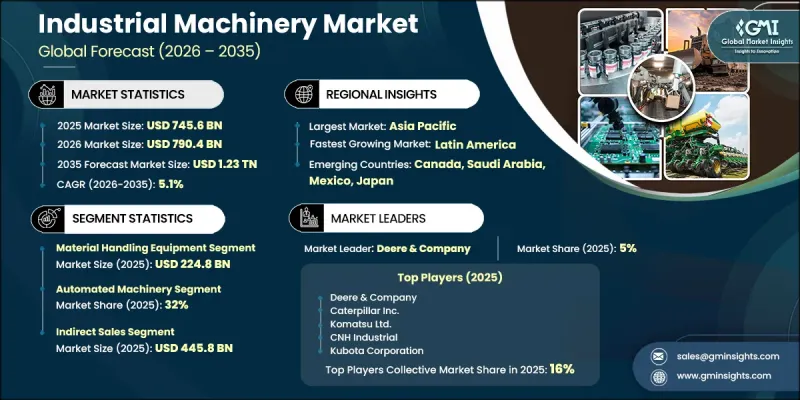
시장 성장은 제조 및 생산 환경 전반에 걸쳐 자동화로의 전환이 가속화되고 있는 것에 영향을 받고 있습니다. 각 업계에서는 업무의 정확도 향상, 생산 속도 향상 및 전체 제조 비용 절감을 위해 첨단 기계 도입이 점점 더 많이 이루어지고 있습니다. 기업이 대량 생산을 하는 산업 분야에서 인력에 대한 의존도를 최소화하고 생산 오류를 줄이기 위해 자동화 시스템에 대한 수요가 증가하고 있습니다. 자동차, 전자, 제약, 식품 가공 등의 산업에서 생산 라인의 현대화를 위해 로봇 공학, CNC 시스템, 자재관리 솔루션의 도입이 점점 더 많이 이루어지고 있습니다. 인건비 상승과 숙련공의 만성적인 부족으로 인해 최종 사용자는 기존 장비에서 고도의 자동화 기계로의 전환을 더욱 가속화하고 있습니다. 인더스트리 4.0 기술의 도입도 시장을 변화시키고 있으며, 실시간 성능 모니터링, 예지보전, 에너지 최적화가 가능한 스마트한 커넥티드 머신을 실현하고 있습니다. 이러한 기능은 다운타임을 줄이고 비용 효율성을 향상시키는 데 필수적인 것으로 점점 더 많이 인식되고 있습니다. 그 결과, 구매 결정 요인은 기계의 능력뿐만 아니라 디지털 통합, 장기적인 운영 효율성, 기존 산업 시스템과의 호환성 등에도 영향을 미치고 있습니다.
| 시장 범위 | |
|---|---|
| 시작 연도 | 2025년 |
| 예측 기간 | 2026-2035년 |
| 시작 연도 시장 규모 | 7,456억 달러 |
| 예측 금액 | 1조 2,300억 달러 |
| CAGR | 5.1% |
자재관리 장비 부문은 2025년 2,248억 달러 시장 규모를 기록했으며, 시장에서 선도적인 위치를 차지했습니다. 이 카테고리에는 생산 공장, 창고, 물류센터, 건설 현장 등에서 자재의 운송, 보관, 보호, 관리를 위해 설계된 시스템이 포함됩니다. 지게차, 크레인, 컨베이어, 팔레트 잭, 호이스트, 자동 창고 시스템, 산업용 리프트 트럭과 같은 장비는 산업 활동 전반에서 작업 흐름의 효율성, 작업장 안전 및 자재 이동 속도 향상에 중요한 역할을 합니다.
2025년에는 자동화 기계 부문이 32%의 점유율을 차지하며 주요 기술 카테고리로 부상했습니다. 자동화 시스템은 로봇 공학, 센서, 소프트웨어 기반 제어 시스템과 같은 첨단 기술을 활용하여 사람의 개입을 최소화하면서 여러 산업 작업을 수행하도록 설계되었습니다. 생산 정확도 향상, 일관된 출력 품질 유지 및 업무 효율성 향상으로 인해, 특히 고속 및 고정밀도가 요구되는 환경에서 수동 시스템을 대체하고 있습니다. 대표적인 용도로는 로봇 조립 장치, CNC 공작기계, 자동 생산 라인 및 포장, 가공, 자재관리 업무에 사용되는 지능형 시스템 등을 들 수 있습니다.
2025년 미국의 산업 기계 시장은 77.9%의 점유율을 차지하며 919억 달러에 달했습니다. 이 나라의 성장은 생산성 향상과 업무 현대화를 위한 자동화 기술, 에너지 절약형 기계 및 첨단 제조 시스템에 대한 적극적인 투자에 의해 주도되고 있습니다. 자동차, 항공우주, 건설, 식품 가공 및 전자 산업에서 높은 수요가 지속적으로 장비 도입을 뒷받침하고 있습니다. 또한, 제조업의 국내 복귀(리쇼어링) 노력과 연방 정부의 인프라 개발 프로그램으로 인해 미국 전역의 중장비, 스마트 생산 시스템 및 첨단 자재관리 장비에 대한 수요가 더욱 증가하고 있습니다.
자주 묻는 질문
목차
제1장 조사 방법과 범위
제2장 주요 요약
제3장 업계 인사이트
제4장 경쟁 구도
제5장 시장 추산 및 예측 : 제품 유형별(2022-2035년)
제6장 시장 추산 및 예측 : 조작별(2022-2035년)
제7장 시장 추산 및 예측 : 용도별(2022-2035년)
제8장 시장 추산 및 예측 : 유통 채널별(2022-2035년)
제9장 시장 추산 및 예측 : 지역별(2022-2035년)
제10장 기업 개요
KTH 26.06.10The Global Industrial Machinery Market was valued at USD 745.6 billion in 2025 and is estimated to grow at a CAGR of 5.1% to reach USD 1.23 trillion by 2035.
Market growth is influenced by the accelerating shift toward automation across manufacturing and production environments. Industries are increasingly deploying advanced machinery to improve operational precision, enhance production speed, and reduce overall manufacturing costs. Demand for automated systems is rising as companies aim to minimize dependence on manual labor and reduce production errors across high-volume industrial operations. Sectors such as automotive, electronics, pharmaceuticals, and food processing are increasingly integrating robotics, CNC systems, and automated material handling solutions to modernize their production lines. Rising labor costs and persistent shortages of skilled workers are further encouraging end users to transition from conventional equipment to advanced automated machinery. The adoption of Industry 4.0 technologies is also reshaping the market, enabling smart, connected machines capable of real-time performance monitoring, predictive maintenance, and energy optimization. These capabilities are increasingly viewed as essential for reducing downtime and improving cost efficiency. As a result, purchasing decisions are now driven not only by machine capacity but also by digital integration, long-term operational efficiency, and compatibility with existing industrial systems.
| Market Scope | |
|---|---|
| Start Year | 2025 |
| Forecast Year | 2026-2035 |
| Start Value | $745.6 Billion |
| Forecast Value | $1.23 Trillion |
| CAGR | 5.1% |
The material handling equipment segment generated USD 224.8 billion in 2025, securing a leading position in the market. This category includes systems designed for transporting, storing, protecting, and managing materials across production plants, warehouses, logistics centers, and construction environments. Equipment such as forklifts, cranes, conveyors, pallet jacks, hoists, automated storage and retrieval systems, and industrial lift trucks plays a critical role in improving workflow efficiency, workplace safety, and material movement speed across industrial operations.
The automated machinery segment accounted for a 32% share in 2025, making it the dominant technology category. Automated systems are designed to execute multiple industrial tasks with minimal human involvement, using advanced technologies such as robotics, sensors, and software-based control systems. Their ability to enhance production accuracy, maintain consistent output quality, and improve operational efficiency has led to widespread replacement of manual systems, particularly in high-speed and precision-driven environments. Common applications include robotic assembly units, CNC machines, automated production lines, and intelligent systems used in packaging, processing, and material handling operations.
U.S. Industrial Machinery Market accounted for a 77.9% share in 2025, reaching USD 91.9 billion. Growth in the country is driven by strong investments in automation technologies, energy-efficient machinery, and advanced manufacturing systems aimed at improving productivity and operational modernization. High demand from automotive, aerospace, construction, food processing, and electronics industries continues to support equipment adoption. Additionally, manufacturing reshoring initiatives and federal infrastructure development programs are further reinforcing demand for heavy machinery, smart production systems, and advanced material handling equipment across the country.
Key players operating in the Global Industrial Machinery Industry include Caterpillar Inc., Deere & Company, Komatsu Ltd., CNH Industrial NV, Volvo Construction Equipment, Liebherr Group, Atlas Copco AB, JCB, Hitachi Construction Machinery, Kubota Corporation, Sandvik AB, Ingersoll Rand Inc., Manitowoc Company, Honeywell International, ASML Holding NV, Metso, AGCO Corporation, Terex Corporation, Alfa Laval AB, GEA Group AG, and Illinois Tool Works Inc. Companies in the industrial machinery market are focusing on expanding automation and smart manufacturing capabilities by integrating advanced digital technologies into equipment design. They are investing heavily in research and development to improve machine efficiency, durability, and precision. Strategic partnerships with industrial end users are helping manufacturers tailor solutions to specific production requirements. Firms are also strengthening global distribution and service networks to enhance customer support and reduce downtime. A growing emphasis is placed on predictive maintenance solutions and IoT-enabled machinery to improve lifecycle performance.
Table of Contents
Chapter 1 Methodology and Scope
- 1.1 Market scope and definition
- 1.2 Research design
- 1.2.1 Research approach
- 1.2.2 Data collection methods
- 1.3 Data mining sources
- 1.3.1 Global
- 1.3.2 Regional/Country
- 1.4 Base estimates and calculations
- 1.4.1 Base year calculation
- 1.4.2 Key trends for market estimation
- 1.5 Primary research and validation
- 1.5.1 Primary sources
- 1.6 Forecast model
- 1.7 Research assumptions and limitations
Chapter 2 Executive Summary
- 2.1 Industry 360° synopsis
- 2.2 Key market trends
- 2.2.1 Regional
- 2.2.2 Product type
- 2.2.3 Operation
- 2.2.4 Application
- 2.2.5 Distribution channel
Chapter 3 Industry Insights
- 3.1 Industry ecosystem analysis
- 3.1.1 Supplier landscape
- 3.1.2 Profit margin
- 3.1.3 Value addition at each stage
- 3.1.4 Factor affecting the value chain
- 3.2 Industry impact forces
- 3.2.1 Growth drivers
- 3.2.1.1 Industrial automation & industry 4.0
- 3.2.1.2 Infrastructure & construction spending
- 3.2.1.3 Energy transition & sustainability focus
- 3.2.2 Industry pitfalls & challenges
- 3.2.2.1 Supply chain disruptions
- 3.2.2.2 Regulatory & compliance burden
- 3.2.3 Opportunities
- 3.2.3.1 Smart & connected machinery
- 3.2.3.2 Sustainability-driven innovation
- 3.2.1 Growth drivers
- 3.3 Growth potential analysis
- 3.4 Technology and innovation landscape
- 3.4.1 Current technological trends
- 3.4.2 Emerging technologies
- 3.5 Regulatory framework
- 3.5.1 Safety standards & compliance (ISO, OSHA, CE)
- 3.5.2 Environmental regulations (emissions, noise)
- 3.5.3 Import/export regulations & tariffs
- 3.5.4 Labor & workplace safety laws
- 3.5.5 Regional regulatory variations
- 3.5.6 Upcoming regulatory changes (2026-2035)
- 3.6 Pricing analysis
- 3.6.1 Historical price trend analysis
- 3.6.2 Pricing strategy by player type (premium / value / cost-plus)
- 3.6.3 Regional price variations
- 3.6.4 Impact of raw material costs on pricing
- 3.7 Trade data analysis (driven by paid data base) (8479)
- 3.7.1 Import/export volume & value trends
- 3.7.2 Key trade corridors & tariff impact
- 3.7.3 Top exporting countries
- 3.7.4 Top importing countries
- 3.7.5 Trade balance analysis by region
- 3.8 Impact of AI & generative AI on the market
- 3.8.1 AI-driven disruption of existing business models
- 3.8.2 GenAI use cases & adoption roadmap by segment
- 3.8.3 Risks, limitations & regulatory considerations
- 3.8.4 Predictive maintenance & AI integration
- 3.8.5 Autonomous machinery development
- 3.9 Capacity & production landscape (driven by primary research)
- 3.9.1 Installed capacity by region & key producer
- 3.9.2 Capacity utilization rates & expansion pipelines
Chapter 4 Competitive Landscape, 2025
- 4.1 Introduction
- 4.2 Company market share analysis
- 4.2.1 By region
- 4.2.1.1 North America
- 4.2.1.2 Europe
- 4.2.1.3 Asia Pacific
- 4.2.1.4 Latin America
- 4.2.1.5 Middle East and Africa
- 4.2.1 By region
- 4.3 Company matrix analysis
- 4.4 Competitive analysis of major market players
- 4.5 Competitive positioning matrix
- 4.6 Key developments
- 4.6.1 Mergers & acquisitions
- 4.6.2 Partnerships & collaborations
- 4.6.3 New product launches
- 4.6.4 Expansion plans
Chapter 5 Market Estimates and Forecast, By Product Type, 2022 - 2035 (USD Billion) (Thousand Units)
- 5.1 Key trends
- 5.2 Agricultural machinery
- 5.2.1 Tractors
- 5.2.2 Harvesters & combines
- 5.2.3 Planting & seeding equipment
- 5.2.4 Irrigation systems
- 5.2.5 Other agricultural machinery
- 5.3 Construction & earth-moving equipment
- 5.3.1 Excavators
- 5.3.2 Bulldozers
- 5.3.3 Loaders
- 5.3.4 Cranes
- 5.3.5 Dump trucks
- 5.3.6 Graders & scrapers
- 5.3.7 Other construction equipment
- 5.4 Material handling equipment
- 5.4.1 Forklifts
- 5.4.2 Conveyors
- 5.4.3 Hoists & cranes
- 5.4.4 Automated storage & retrieval systems (as/rs)
- 5.4.5 Palletizers
- 5.5 Processing machinery
- 5.5.1 Food processing equipment
- 5.5.2 Plastics processing machinery
- 5.5.3 Metalworking & metal forming machines
- 5.5.4 Woodworking machinery
- 5.5.5 Chemical processing equipment
- 5.6 Packaging machinery
- 5.6.1 Filling machines
- 5.6.2 Palletizing machines
- 5.6.3 Labelling machines
- 5.6.4 Wrapping machines
- 5.6.5 Other packaging equipment
- 5.7 Industrial robots & automation cells
- 5.7.1 Articulated robots
- 5.7.2 Scara robots
- 5.7.3 Collaborative robots (cobots)
- 5.7.4 Cartesian/gantry robots
- 5.7.5 Automated manufacturing cells
- 5.8 Others
Chapter 6 Market Estimates and Forecast, By Operation, 2022 - 2035 (USD Billion) (Thousand Units)
- 6.1 Key trends
- 6.2 Automated machinery
- 6.3 Semi-automated machinery
- 6.4 Manual machinery
- 6.5 Robotic machinery
Chapter 7 Market Estimates and Forecast, By Application, 2022 - 2035 (USD Billion) (Thousand Units)
- 7.1 Key trends
- 7.2 Construction & mining
- 7.3 Agriculture
- 7.4 Food & beverage processing
- 7.5 Automotive manufacturing
- 7.6 Pharmaceuticals
- 7.7 Chemical processing
- 7.8 Packaging operations
- 7.9 Semiconductor manufacturing
- 7.10 Metal fabrication
- 7.11 Others
Chapter 8 Market Estimates and Forecast, By Distribution Channel, 2022 - 2035 (USD Billion) (Thousand Units)
- 8.1 Key trends
- 8.2 Direct sales
- 8.3 Indirect sales
Chapter 9 Market Estimates and Forecast, By Region, 2022 - 2035 (USD Billion) (Thousand Units)
- 9.1 Key trends
- 9.2 North America
- 9.2.1 U.S.
- 9.2.2 Canada
- 9.3 Europe
- 9.3.1 Germany
- 9.3.2 UK
- 9.3.3 France
- 9.3.4 Italy
- 9.3.5 Spain
- 9.4 Asia Pacific
- 9.4.1 China
- 9.4.2 Japan
- 9.4.3 India
- 9.4.4 Australia
- 9.4.5 South Korea
- 9.5 Latin America
- 9.5.1 Brazil
- 9.5.2 Mexico
- 9.5.3 Argentina
- 9.6 Middle East and Africa
- 9.6.1 South Africa
- 9.6.2 Saudi Arabia
- 9.6.3 UAE
Chapter 10 Company Profiles
- 10.1 Global players
- 10.1.1 Caterpillar Inc.
- 10.1.2 Deere & Company
- 10.1.3 Komatsu Ltd.
- 10.1.4 CNH Industrial NV
- 10.1.5 Volvo Construction Equipment
- 10.1.6 Liebherr Group
- 10.1.7 Atlas Copco AB
- 10.2 Regional players
- 10.2.1 JCB
- 10.2.2 Hitachi Construction Machinery
- 10.2.3 Kubota Corporation
- 10.2.4 Sandvik AB
- 10.2.5 Ingersoll Rand Inc
- 10.2.6 Manitowoc Company
- 10.2.7 Honeywell International
- 10.3 Emerging players
- 10.3.1 ASML Holding NV
- 10.3.2 Metso
- 10.3.3 AGCO Corporation
- 10.3.4 Terex Corporation
- 10.3.5 Alfa Laval AB
- 10.3.6 GEA Group AG
- 10.3.7 Illinois Tool Works Inc


