

|
시장보고서
상품코드
2045769
방위 전자기기 시장 : 시장 비즈니스 기회, 성장요인, 업계 동향 분석 및 예측(2026-2035년)Defense Electronics Market Opportunity, Growth Drivers, Industry Trend Analysis, and Forecast 2026 - 2035 |
||||||

세계의 방위 전자기기 시장은 2025년에 1,825억 달러로 평가되었고, CAGR 6.1%로 성장할 전망이며, 2035년까지 3,239억 달러에 이를 것으로 추정되고 있습니다.
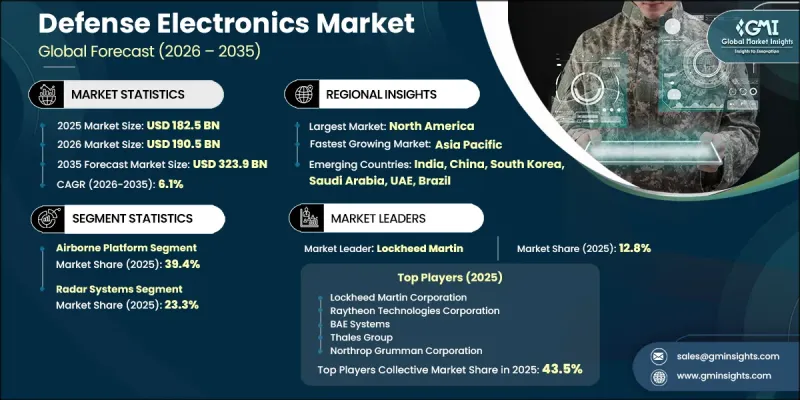
방위 전자기기 산업은 첨단 군사 기술에 대한 투자 확대, 국방 인프라의 현대화, 정보 주도형 전쟁 시스템에 대한 중요성 증가로 인해 강력한 추진력을 보이고 있습니다. 지정학적 긴장이 고조되고 고도의 보안 통신 시스템에 대한 수요가 증가함에 따라 국방 기관은 전자전 능력 강화를 추진하고 있습니다. 첨단 레이더 기술, 모니터링 시스템, 보안 통신 네트워크, 통합 센서 플랫폼은 군사 작전 전반에 걸쳐 필수적인 요소로 자리 잡고 있습니다. 또한, 차세대 항공기, 해군 시스템, 무인 방위 플랫폼의 조달 증가로 인해 첨단 전자 솔루션에 대한 지속적인 수요가 발생하고 있습니다. 또한, 중요한 국방 환경에서 운영 성능을 향상시키는 메모리 스토리지, 반도체 기술, 고속 데이터 처리 시스템의 급속한 기술 발전도 시장에 긍정적인 영향을 미치고 있습니다. 또한, 국방 현대화 프로그램에 대한 정부 지출 증가와 방산업체와 기술 제공업체 간의 협력 강화는 선진국과 신흥 경제권 전체에서 장기적인 시장 확대를 뒷받침하고 있습니다.
| 시장 범위 | |
|---|---|
| 개시 연도 | 2025년 |
| 예측 기간 | 2026-2035년 |
| 개시 연도 시장 규모 | 1,825억 달러 |
| 예측 시장 규모 | 3,239억 달러 |
| CAGR | 6.1% |
방위 전자기기 산업은 기술력 강화와 방산 포트폴리오 확장을 위한 주요 기업 간 합병, 인수, 전략적 제휴 증가로 인해 더욱 탄력을 받고 있습니다. 시장 진출기업들은 장기적인 방위 계약을 확보하고 경쟁력을 강화하기 위해 혁신, 운영 효율성, 사이버 보안 통합에 중점을 두고 있습니다. 첨단 국방 및 항공우주 시스템에 대한 수요 증가로 인해 기업들은 미션 크리티컬한 군사 작전을 위해 설계된 고도로 전문화된 전자 기술에 대한 투자를 늘리고 있습니다. 또한, 고성능 메모리와 스토리지 기술의 지속적인 발전은 산업 환경을 새롭게 바꾸고 있습니다. 솔리드 스테이트 스토리지 시스템, 고대역폭 메모리 플랫폼, 차세대 플래시 기술 등 첨단 솔루션은 까다로운 국방 분야에서 속도, 안정성, 스토리지 밀도를 향상시키고 있습니다.
2025년에는 공군 플랫폼 부문이 39.4%의 점유율을 차지했습니다. 이 부문의 성장은 전투기, 무인항공기, 정찰 플랫폼 전반에 걸쳐 첨단 항공전자, 레이더 시스템, 모니터링 기술의 도입 확대에 의해 주도되고 있습니다. 정보 수집, 공역 확보 임무, 전술적 방어 작전에 대한 투자 증가는 첨단 항공기 탑재 전자 시스템에 대한 수요를 가속화하고 있습니다. 또한, 지속적인 기술 발전으로 전체 방공 플랫폼의 운영 유연성, 임무 정확도 및 전반적인 전투 효과가 향상되고 있습니다.
전자전 및 스펙트럼 운영 부문은 2025년 16.8%의 점유율을 차지했습니다. 이 부문은 고도화된 신호 감청 능력, 전자 공격 시스템, 통신 교란 기술에 대한 수요 증가로 인해 지속적으로 강력한 성장세를 보이고 있습니다. 군 조직은 진화하는 전자적 위협에 대응하기 위해 스펙트럼 지배, 사이버 전자기 우위, 통합 전장 상황 인식 솔루션을 더욱 중요시하고 있습니다. 고도화된 전파 교란 시스템 및 안전한 국방 통신 기술의 도입 확대도 이 부문의 성장에 기여하고 있습니다.
2025년 북미의 방위 전자기기기기 시장은 40.8%의 점유율을 차지했습니다. 이 지역은 고도로 발달한 방산 제조 생태계, 막대한 국방 예산, 군사 현대화 이니셔티브에 대한 막대한 투자로 인해 계속해서 지배적인 지위를 유지하고 있습니다. 강력한 R&D 역량과 함께 주요 항공우주 및 방위 기술 제공업체들이 레이더 시스템, 통신 기술, 전자전 솔루션, 첨단 센싱 플랫폼의 혁신을 주도하고 있습니다. 군사 기술 우위 유지에 대한 지속적인 노력은 이 지역 전체에서 첨단 국방 전자 시스템의 대규모 조달을 뒷받침하고 있습니다.
자주 묻는 질문
목차
제1장 조사 방법 및 범위
제2장 주요 요약
제3장 산업 인사이트
제4장 경쟁 구도
제5장 시장 추정 및 예측 : 플랫폼별(2022-2035년)
제6장 시장 추정 및 예측 : 용도별(2022-2035년)
제7장 시장 추정 및 예측 : 지역별(2022-2035년)
제8장 기업 개요
AJY 26.06.15The Global Defense Electronics Market was valued at USD 182.5 billion in 2025 and is estimated to grow at a CAGR of 6.1% to reach USD 323.9 billion by 2035.
The defense electronics industry is witnessing strong momentum due to rising investments in advanced military technologies, modernization of defense infrastructure, and growing emphasis on intelligence-driven warfare systems. Increasing geopolitical tensions and the growing need for highly secure communication systems are encouraging defense organizations to strengthen their electronic warfare capabilities. Advanced radar technologies, surveillance systems, secure communication networks, and integrated sensor platforms are becoming essential components across military operations. In addition, rising procurement of next-generation aircraft, naval systems, and unmanned defense platforms is creating sustained demand for sophisticated electronic solutions. The market is also benefiting from rapid technological advancements in memory storage, semiconductor technologies, and high-speed data processing systems that improve operational performance in critical defense environments. Furthermore, increasing government spending on defense modernization programs, combined with stronger collaboration between defense contractors and technology providers, continues to support long-term market expansion across developed and emerging economies.
| Market Scope | |
|---|---|
| Start Year | 2025 |
| Forecast Year | 2026-2035 |
| Start Value | $182.5 Billion |
| Forecast Value | $323.9 Billion |
| CAGR | 6.1% |
The defense electronics industry is further supported by increasing mergers, acquisitions, and strategic collaborations among major companies aiming to strengthen technological capabilities and expand defense portfolios. Market participants are focusing heavily on innovation, operational efficiency, and cybersecurity integration to secure long-term defense contracts and enhance competitive positioning. The growing demand for sophisticated defense and aerospace systems is also encouraging companies to invest in highly specialized electronic technologies designed for mission-critical military operations. Additionally, continuous progress in high-performance memory and storage technologies is reshaping the industry landscape. Advanced solutions, including solid-state storage systems, high-bandwidth memory platforms, and next-generation flash technologies, are improving speed, reliability, and storage density in demanding defense applications.
The airborne platform segment accounted for 39.4% share in 2025. Growth in this segment is driven by rising deployment of advanced avionics, radar systems, and surveillance technologies across fighter aircraft, unmanned aerial vehicles, and reconnaissance platforms. Increasing investments in intelligence gathering, air superiority missions, and tactical defense operations are accelerating demand for advanced airborne electronic systems. Continuous technological advancements are also improving operational flexibility, mission accuracy, and overall combat effectiveness across airborne defense platforms.
The electronic warfare and spectrum operations segment held a 16.8% share in 2025. The segment continues to witness strong growth due to increasing demand for advanced signal interception capabilities, electronic attack systems, and communication disruption technologies. Military organizations are placing greater emphasis on spectrum dominance, cyber-electromagnetic superiority, and integrated battlefield awareness solutions to counter evolving electronic threats. Rising deployment of sophisticated jamming systems and secure defense communication technologies is further contributing to segment growth.
North America Defense Electronics Market held a 40.8% share in 2025. The region continues to maintain a dominant position due to its highly developed defense manufacturing ecosystem, substantial defense budgets, and extensive investments in military modernization initiatives. Strong research and development capabilities, combined with the presence of leading aerospace and defense technology providers, are driving innovation across radar systems, communication technologies, electronic warfare solutions, and advanced sensing platforms. Continuous focus on maintaining military technological superiority is supporting significant procurement of advanced defense electronics systems across the region.
Key companies operating in the Global Defense Electronics Market include Lockheed Martin Corporation, Raytheon Technologies Corporation, BAE Systems, Thales Group, and Northrop Grumman Corporation. Companies operating in the defense electronics market are strengthening their market position through continuous investments in advanced research and development, strategic partnerships, and technology-focused acquisitions. Leading players are prioritizing innovation in radar systems, electronic warfare technologies, secure communications, and integrated sensor platforms to enhance operational capabilities and secure long-term defense contracts. Many organizations are also expanding their cybersecurity offerings to address rising concerns related to digital warfare and data protection. In addition, manufacturers are increasing investments in artificial intelligence, autonomous systems, and next-generation semiconductor technologies to improve mission efficiency and real-time decision-making capabilities. Companies are also collaborating closely with government defense agencies to support modernization initiatives while expanding their global footprint through regional partnerships, localized manufacturing facilities, and long-term supply agreements to strengthen customer relationships and maintain competitive advantage.
Table of Contents
Chapter 1 Methodology and Scope
- 1.1 Research approach
- 1.2 Quality Commitments
- 1.2.1 GMI AI policy & data integrity commitment
- 1.2.1.1 Source consistency protocol
- 1.2.1 GMI AI policy & data integrity commitment
- 1.3 Research Trail & Confidence Scoring
- 1.3.1 Research Trail Components
- 1.3.2 Scoring Components
- 1.4 Data Collection
- 1.4.1 Partial list of primary sources
- 1.5 Data mining sources
- 1.5.1 Paid sources
- 1.5.1.1 Sources, by region
- 1.5.1 Paid sources
- 1.6 Base estimates and calculations
- 1.6.1 Base year calculation
- 1.7 Forecast model
- 1.7.1 Quantified market impact analysis
- 1.7.1.1 Mathematical impact of growth parameters on forecast
- 1.7.1 Quantified market impact analysis
- 1.8 Research transparency addendum
- 1.8.1 Source attribution framework
- 1.8.2 Quality assurance metrics
- 1.8.3 Our commitment to trust
Chapter 2 Executive Summary
- 2.1 Industry 360° synopsis, 2022 - 2035
- 2.2 Key market trends
- 2.2.1 Platform trends
- 2.2.2 Application trends
- 2.2.3 Regional trends
- 2.3 TAM Analysis, 2026-2035
- 2.4 CXO perspectives: Strategic imperatives
Chapter 3 Industry Insights
- 3.1 Industry ecosystem analysis
- 3.1.1 Supplier Landscape
- 3.1.2 Profit Margin
- 3.1.3 Cost structure
- 3.1.4 Value addition at each stage
- 3.1.5 Factor affecting the value chain
- 3.1.6 Disruptions
- 3.2 Industry impact forces
- 3.2.1 Growth drivers
- 3.2.1.1 Increased demand for advanced surveillance and reconnaissance systems.
- 3.2.1.2 Rapid advancements in storage and high-speed memory technologies.
- 3.2.1.3 Expansion of data storage solutions for defense applications.
- 3.2.1.4 Integration of AI and machine learning in defense electronics.
- 3.2.1.5 Rising military budgets and investments in modernization projects.
- 3.2.2 Industry pitfalls and challenges
- 3.2.2.1 High costs and budget constraints in defense programs.
- 3.2.2.2 Security risks related to advanced technology implementations.
- 3.2.3 Market opportunities
- 3.2.3.1 Growing adoption of electronic warfare and cyber defense systems.
- 3.2.3.2 Development of next-generation communication and radar systems.
- 3.2.1 Growth drivers
- 3.3 Growth potential analysis
- 3.4 Pricing Analysis (Driven by Primary Research)
- 3.4.1 Historical Price Trend Analysis
- 3.4.2 Pricing Strategy by Player Type (Premium / Value / Cost-plus)
- 3.5 Regulatory landscape
- 3.5.1 North America
- 3.5.2 Europe
- 3.5.3 Asia-Pacific
- 3.5.4 Latin America
- 3.5.5 Middle East and Africa
- 3.6 Porter's analysis
- 3.7 PESTEL analysis
- 3.8 Defense budget analysis
- 3.9 Global defense spending trends
- 3.10 Regional defense budget allocation
- 3.10.1 North America
- 3.10.2 Europe
- 3.10.3 Asia Pacific
- 3.10.4 Middle East and Africa
- 3.10.5 Latin America
- 3.11 Trade Data Analysis (Based on Paid Database)
- 3.11.1 Import/Export Volume & Value Trends
- 3.11.2 Key Trade Corridors & Tariff Impact
- 3.12 Impact of AI & Generative AI on the Market (Driven by Primary Research)
- 3.12.1 AI-Driven Disruption of Existing Business Models
- 3.12.2 GenAI Use Cases & Adoption Roadmap by Segment
- 3.12.3 Risks, Limitations & Regulatory Considerations
- 3.13 Capacity & Production Landscape (Driven by Primary Research)
- 3.13.1 Production Capacity by Region & Key Producer
- 3.13.2 Capacity Utilization Rates & Expansion Pipelines
Chapter 4 Competitive Landscape, 2025
- 4.1 Introduction
- 4.2 Company market share analysis
- 4.2.1 By region
- 4.2.1.1 North America
- 4.2.1.2 Europe
- 4.2.1.3 Asia Pacific
- 4.2.1.4 Latin America
- 4.2.1.5 Middle East & Africa
- 4.2.2 Market concentration analysis
- 4.2.1 By region
- 4.3 Competitive benchmarking of key players
- 4.4 Competitive positioning matrix
- 4.5 Key developments
- 4.5.1 Mergers and acquisitions
- 4.5.2 Partnerships and collaborations
- 4.5.3 New product launches
- 4.5.4 Expansion plans and funding
- 4.6 Company tier benchmarking
- 4.6.1 Tier classification criteria & qualifying thresholds
- 4.6.2 Tier positioning matrix by revenue, geography & innovation
Chapter 5 Market Estimates and Forecast, By Platform, 2022 - 2035 (USD Million)
- 5.1 Key trends
- 5.2 Airborne
- 5.2.1 Military Aircraft (Fixed-Wing)
- 5.2.2 Military Helicopters (Rotary-Wing)
- 5.2.3 Unmanned Aerial Vehicles (UAVs)
- 5.3 Marine
- 5.3.1 Aircraft Carriers
- 5.3.2 Amphibious Ships
- 5.3.3 Destroyers
- 5.3.4 Frigates
- 5.3.5 Submarines
- 5.3.6 Unmanned Maritime Vehicles (UMVs)
- 5.4 Land
- 5.4.1 Dismounted Soldier Systems
- 5.4.2 Military Fighting Vehicles
- 5.4.3 Command & Control Centers
- 5.4.4 Unmanned Ground Vehicles (UGVs)
- 5.5 Space
- 5.5.1 Low Earth Orbit (LEO) Satellites
- 5.5.2 Medium Earth Orbit (MEO) Satellites
- 5.5.3 Geostationary Earth Orbit (GEO) Satellites
Chapter 6 Market Estimates and Forecast, By Application, 2022 - 2035 (USD Million)
- 6.1 Key trends
- 6.2 Command, Control & Mission Systems
- 6.2.1 C4ISR Systems
- 6.2.2 Command & Control (C2) Systems
- 6.2.3 Battle Management Systems
- 6.2.4 Mission Planning & Decision Support Systems
- 6.2.5 Others
- 6.3 Navigation, Communication & Networking
- 6.3.1 Navigation Systems
- 6.3.2 Secure Military Communication Systems
- 6.3.3 Tactical Data Links & Networking Technologies
- 6.3.4 Displays & Human-Machine Interfaces (HMI)
- 6.3.5 Others
- 6.4 Sensing & Situational Awareness
- 6.4.1 Sensor Systems
- 6.4.2 Optronics
- 6.4.2.1 EO/IR Payloads
- 6.4.2.2 Handheld Optronic Systems
- 6.4.3 Missile Warning & Threat Detection Systems
- 6.4.4 Others
- 6.5 Radar Systems
- 6.5.1 Surveillance & Airborne Early Warning Radars
- 6.5.2 Tracking & Fire Control Radars
- 6.5.3 Multifunction Radars
- 6.5.4 Ground Penetrating Radars
- 6.5.5 Counter-Drone Radars
- 6.5.6 Airborne Moving Target Indicator (AMTI) Radars
- 6.5.7 Military Air Traffic Control Radars
- 6.5.8 Others
- 6.6 Electronic Warfare & Spectrum Operations
- 6.6.1 Electronic Support Measures (ESM)
- 6.6.2 Electronic Attack Systems
- 6.6.2.1 Jammers
- 6.6.2.2 Directed Energy Weapons
- 6.6.2.3 Electromagnetic Pulse (EMP) Weapons
- 6.6.3 Electronic Protection Systems
- 6.6.3.1 Radar Warning Receivers (RWR)
- 6.6.3.2 Laser Warning Systems (LWS)
- 6.6.3.3 Electromagnetic Shielding
- 6.6.4 Anti-Radiation & EW-Enabled Missiles
- 6.6.5 Others
- 6.7 Force Protection & Counter-Threat Systems
- 6.7.1 Counter-Unmanned Aerial Systems (C-UAS)
- 6.7.2 Active Protection & Missile Defense Electronics
- 6.7.3 Infrared Missile Warning Systems (IR-MWS)
- 6.7.4 Others
- 6.8 Others
Chapter 7 Market Estimates and Forecast, By Region, 2022 - 2035 (USD Million)
- 7.1 Key trends
- 7.2 North America
- 7.2.1 U.S.
- 7.2.2 Canada
- 7.3 Europe
- 7.3.1 Germany
- 7.3.2 UK
- 7.3.3 France
- 7.3.4 Spain
- 7.3.5 Italy
- 7.3.6 Netherlands
- 7.3.7 Rest of Europe
- 7.4 Asia Pacific
- 7.4.1 China
- 7.4.2 India
- 7.4.3 Japan
- 7.4.4 Australia
- 7.4.5 South Korea
- 7.4.6 Rest of Asia Pacific
- 7.5 Latin America
- 7.5.1 Brazil
- 7.5.2 Mexico
- 7.5.3 Argentina
- 7.5.4 Rest of Latin America
- 7.6 Middle East and Africa
- 7.6.1 South Africa
- 7.6.2 Saudi Arabia
- 7.6.3 UAE
- 7.6.4 Rest of MEA
Chapter 8 Company Profiles
- 8.1 Global Players
- 8.1.1 Lockheed Martin
- 8.1.2 RTX Corporation (Raytheon Technologies Corporation)
- 8.1.3 Northrop Grumman
- 8.1.4 BAE Systems
- 8.1.5 Thales Group
- 8.1.6 Airbus SE
- 8.1.7 The Boeing Company
- 8.1.8 Leonardo S.p.A.
- 8.1.9 L3Harris Technologies
- 8.2 Regional Players
- 8.2.1 General Dynamics
- 8.2.2 Rheinmetall AG
- 8.2.3 Safran
- 8.2.4 Saab AB
- 8.2.5 Israel Aerospace Industries
- 8.2.6 Elbit Systems
- 8.2.7 Tata Advanced Systems Limited
- 8.2.8 Curtiss-Wright
- 8.3 Emerging Players
- 8.3.1 DIGICOM Electronics
- 8.3.2 Kaynes Technology India Limited (KTIL)


