

|
시장보고서
상품코드
2045778
시멘트리스 전슬관절 시스템 시장 : 시장 기회, 성장요인, 업계 동향 분석 및 예측(2026-2035년)Cementless Total Knee Systems Market Opportunity, Growth Drivers, Industry Trend Analysis, and Forecast 2026 - 2035 |
||||||

세계의 시멘트리스 전슬관절 시스템 시장은 2025년에 52억 달러로 평가되었고, CAGR 6.5%로 성장할 전망이며, 2035년까지 97억 달러에 이를 것으로 추정되고 있습니다.
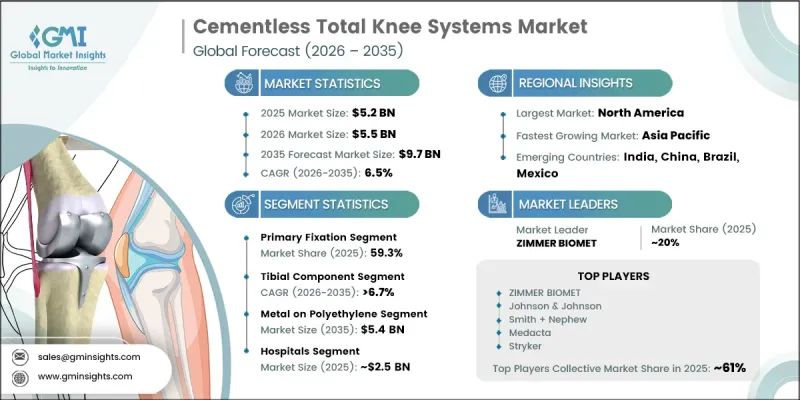
이 시장의 성장은 퇴행성 관절 질환의 유병률 증가, 첨단 정형외과 수술에 대한 수요 증가, 그리고 전 세계 최소 침습 수술 방법의 보급에 의해 뒷받침되고 있습니다. 시멘트리스 전슬관절 시스템은 뼈 시멘트를 사용하지 않고 임플란트를 고정하도록 설계되었으며, 임플란트와 주변 뼈 구조물과의 생물학적 결합에 의존합니다. 이 시스템에는 특수한 다공성 코팅과 표면 기술이 적용되어 자연스러운 뼈의 성장과 장기적인 임플란트 안정성을 촉진합니다. 기존의 고정 방식에 비해 시멘트리스 시스템은 임플란트의 내구성을 향상시키고, 풀림의 위험을 줄이며, 장기적으로 환자의 이동성을 향상시킬 수 있기 때문에 점점 더 선호되고 있습니다. 또한, 빠르게 증가하는 고령 인구와 관절 재건 수술을 필요로 하는 환자 수 증가가 시장 수요에 크게 기여하고 있습니다. 또한, 의료 제공업체들은 장기적인 치료의 지속가능성과 재수술률 감소에 점점 더 집중하고 있으며, 이는 선진국과 신흥국 의료 시장 전반에 걸쳐 시멘트 없는 무릎 인공관절 치환술의 채택을 더욱 가속화시키고 있습니다.
| 시장 범위 | |
|---|---|
| 개시 연도 | 2025년 |
| 예측 기간 | 2026-2035년 |
| 개시 연도 시장 규모 | 52억 달러 |
| 예측 시장 규모 | 97억 달러 |
| CAGR | 6.5% |
시멘트리스 전슬관절 시스템 업계에서는 임플란트의 정확성, 수술 결과 및 환자의 회복 경험을 향상시키기 위한 기술 발전이 가속화되고 있습니다. 제조업체들은 보다 빠른 골 결합과 생역학적 성능 향상을 위해 첨단 임플란트 재료, 개선된 다공성 구조 및 표면 공학 기술에 초점을 맞추었습니다. 시멘트리스 고정의 장기적인 임상적 이점에 대한 정형외과 의사들의 인식이 높아짐에 따라 시장 침투가 가속화되고 있습니다. 또한, 로봇 보조 수술 시스템 및 디지털 계획 기술의 통합으로 수술의 정확성과 임플란트 배치가 향상되어 인공 슬관절 치환술의 성공률 향상에 기여하고 있습니다. 의료 인프라 확충, 정형외과 치료에 대한 환자 접근성 향상, 의료비 증가도 시멘트리스 전슬관절 시스템 시장의 성장을 더욱 뒷받침하고 있습니다.
2025년에는 1차 고정 부문이 59.3%의 점유율을 차지했습니다. 이 부문은 1차 슬관절 치환술에서 수술 직후 높은 임플란트 안정성, 신뢰할 수 있는 생체 고정 및 장기적인 임플란트 내구성을 제공할 수 있다는 장점으로 인해 시장을 지속적으로 지배하고 있습니다. 첨단 압입식 임플란트 설계와 고도로 설계된 생체 고정 표면은 특히 내구성이 뛰어나고 오래 지속되는 관절 치환 솔루션을 필요로 하는 환자들에게 시멘트리스 기술에 대한 외과 의사들의 신뢰를 높이고 있습니다. 또한, 임플란트 성능의 향상과 향후 재치환 수술의 가능성을 줄이고자 하는 젊은 연령층과 신체활동이 많은 환자들 사이에서도 1차 고정 시스템에 대한 수요가 증가하고 있습니다. 다공성 금속 기술의 지속적인 개선과 장기적인 뼈 결합의 성과는 이 부문의 성장을 더욱 촉진하고 전 세계 정형외과 의료시설에서 이 부문의 입지를 강화하고 있습니다.
대퇴골 부품 부문은 CAGR 6.2%로 성장하여, 2035년까지 36억 달러에 달할 것으로 예측됩니다. 이 부문의 성장은 임플란트 윤곽 형성의 지속적인 발전, 표면 코팅 기술의 향상, 시멘트리스 고정 시스템과의 호환성 개선에 힘입어 성장하고 있습니다. 제조업체들은 장기적인 임상 결과를 개선하기 위해 생역학적 정렬, 내마모성 및 임플란트 성능 최적화에 점점 더 많은 노력을 기울이고 있습니다. 또한, 이 부문은 관절 운동 범위, 균형 잡힌 운동학 및 임플란트 생존율을 향상시키기 위해 설계된 통합형 임플란트 시스템 개발의 혜택을 누리고 있습니다. 맞춤형 정형외과 솔루션과 해부학적 적합성 향상에 대한 관심이 높아지면서 시멘트 없는 인공 슬관절 전치환술에서 첨단 대퇴골 구성 요소 기술에 대한 수요가 증가하고 있습니다.
북미의 시멘트리스 전슬관절 시스템 시장은 2025년 39.2%의 점유율을 차지했으며, 예측 기간 동안 큰 폭의 성장을 기록할 것으로 예측됩니다. 이 지역은 높은 수술 건수, 선진화된 의료 인프라, 생체 고정 기술의 조기 도입으로 인해 시멘트 없는 정형외과용 임플란트의 주요 시장으로 자리매김하고 있습니다. 이러한 높은 수요는 관절염 및 기타 퇴행성 관절 질환을 앓고 있는 환자 수 증가와 더불어, 젊은 연령층과 활동적인 환자들에게 시멘트리스 임플란트를 선호하는 외과 의사들 증가 추세에 힘입은 바 큽니다. 유리한 상환 정책, 로봇 지원 정형외과 수술의 대중화, 주요 의료기기 제조업체의 지속적인 제품 혁신은 북미 전역 시장 확대를 더욱 촉진하고 있습니다. 또한, 정형외과 연구개발에 대한 투자 확대로 세계 시멘트리스 전슬관절 시스템 산업에서 이 지역의 선도적 지위는 지속적으로 강화되고 있습니다.
자주 묻는 질문
목차
제1장 조사 방법
제2장 주요 요약
제3장 업계 인사이트
제4장 경쟁 구도
제5장 시장 추산 및 예측 : 고정 방법별(2022-2035년)
제6장 시장 추산 및 예측 : 컴포넌트별(2022-2035년)
제7장 시장 추산 및 예측 : 소재별(2022-2035년)
제8장 시장 추산 및 예측 : 최종 용도별(2022-2035년)
제9장 시장 추산 및 예측 : 지역별(2022-2035년)
제10장 기업 개요
AJY 26.06.15The Global Cementless Total Knee Systems Market was valued at USD 5.2 billion in 2025 and is estimated to grow at a CAGR of 6.5% to reach USD 9.7 billion by 2035.
The market growth is supported by the rising incidence of degenerative joint disorders, increasing demand for advanced orthopedic procedures, and growing adoption of minimally invasive surgical approaches worldwide. Cementless total knee systems are designed to achieve implant fixation without the use of bone cement, instead relying on biological integration between the implant and surrounding bone structures. These systems use specialized porous coatings and surface technologies that encourage natural bone growth and long-term implant stability. Compared to conventional fixation methods, cementless systems are increasingly preferred due to their ability to improve implant longevity, reduce loosening risks, and support enhanced patient mobility over time. In addition, the rapidly expanding elderly population and rising number of patients requiring joint reconstruction procedures are contributing significantly to market demand. Healthcare providers are also increasingly focusing on long-term treatment sustainability and reducing revision surgery rates, further accelerating the adoption of cementless knee replacement technologies across developed and emerging healthcare markets.
| Market Scope | |
|---|---|
| Start Year | 2025 |
| Forecast Year | 2026-2035 |
| Start Value | $5.2 Billion |
| Forecast Value | $9.7 Billion |
| CAGR | 6.5% |
The cementless total knee systems industry is witnessing increasing technological advancements aimed at improving implant precision, surgical outcomes, and patient recovery experiences. Manufacturers are concentrating on advanced implant materials, enhanced porous structures, and surface engineering technologies that support faster osseointegration and improved biomechanical performance. Growing awareness among orthopedic surgeons regarding the long-term clinical benefits of cementless fixation is also strengthening market penetration. In addition, the integration of robotic-assisted surgical systems and digital planning technologies is improving procedural accuracy and implant positioning, contributing to higher success rates in knee replacement procedures. Expanding healthcare infrastructure, improved patient access to orthopedic treatments, and rising healthcare expenditure are further supporting the growth of the cementless total knee systems market.
The primary fixation segment accounted for a 59.3% share in 2025. The segment continues to dominate due to its ability to provide strong immediate implant stability, reliable biological fixation, and long-term implant durability in primary knee arthroplasty procedures. Advanced press-fit implant designs and highly engineered biologic fixation surfaces are increasing surgeon confidence in cementless technologies, particularly in patients requiring durable and long-lasting joint replacement solutions. Demand for primary fixation systems is also rising among younger and physically active patient groups seeking improved implant performance and reduced likelihood of future revision procedures. Continuous improvements in porous metal technologies and long-term osseointegration outcomes are further supporting segment growth and strengthening its position across orthopedic healthcare facilities worldwide.
The femoral component segment is anticipated to grow at a CAGR of 6.2% and is projected to reach USD 3.6 billion by 2035. Growth within the segment is driven by ongoing advancements in implant contouring, enhanced surface coating technologies, and improved compatibility with cementless fixation systems. Manufacturers are increasingly focusing on optimizing biomechanical alignment, wear resistance, and implant performance to support better long-term clinical outcomes. The segment is also benefiting from the development of integrated implant systems designed to improve joint movement, balanced kinematics, and implant survivorship. Increasing emphasis on personalized orthopedic solutions and improved anatomical fit is further contributing to the rising demand for advanced femoral component technologies within cementless total knee replacement procedures.
North America Cementless Total Knee Systems Market accounted for 39.2% share in 2025 and is expected to record substantial growth throughout the forecast period. The region remains a major market for cementless orthopedic implants due to high surgical procedure volumes, advanced healthcare infrastructure, and early adoption of biologic fixation technologies. Strong demand is supported by the growing patient population affected by arthritis and other degenerative joint conditions, along with increasing preference among surgeons for cementless implants in younger and active individuals. Favorable reimbursement policies, widespread adoption of robotic-assisted orthopedic procedures, and continuous product innovation by leading medical device manufacturers are further reinforcing market expansion across North America. In addition, growing investments in orthopedic research and technological development continue to strengthen the region's leadership position within the global cementless total knee systems industry.
Key companies operating in the Global Cementless Total Knee Systems Market include AESCULAP, CONFORMIS, Corin, Enovis, EPISURF, Exactech, Johnson & Johnson, LINK, Medacta, MicroPort Orthopedics, Smith + Nephew, Stryker, Symbios, UNITED ORTHOPEDIC, and Zimmer Biomet. Companies operating in the cementless total knee systems market are adopting several strategic initiatives to strengthen their competitive positioning and expand global market presence. Leading manufacturers are investing heavily in research and development activities focused on advanced implant materials, porous coating technologies, and robotic-assisted surgical systems to improve implant performance and patient outcomes. Strategic collaborations with hospitals, orthopedic centers, and healthcare providers are also helping companies increase product adoption and strengthen clinical relationships. Many market participants are expanding manufacturing capabilities and geographic distribution networks to improve accessibility across emerging and developed healthcare markets. In addition, businesses are prioritizing product portfolio diversification and personalized implant solutions tailored to patient-specific anatomical requirements. Continuous investments in surgeon training programs, digital surgical planning technologies, and long-term clinical studies are further supporting brand credibility and strengthening market foothold across the global orthopedic industry.
Table of Contents
Chapter 1 Research Methodology
- 1.1 Research approach
- 1.2 Quality commitments
- 1.2.1 GMI AI policy & data integrity commitment
- 1.2.1.1 Source consistency protocol
- 1.2.1 GMI AI policy & data integrity commitment
- 1.3 Research trail & confidence scoring
- 1.3.1 Research trail components
- 1.3.2 Scoring components
- 1.4 Data collection
- 1.4.1 Partial list of primary sources
- 1.5 Data mining sources
- 1.5.1 Paid sources
- 1.5.1.1 Sources, by region
- 1.5.1 Paid sources
- 1.6 Base estimates and calculations
- 1.6.1 Base year calculation
- 1.7 Forecast model
- 1.7.1 Quantified market impact analysis
- 1.7.1.1 Mathematical impact of growth parameters on forecast
- 1.7.1 Quantified market impact analysis
- 1.8 Research transparency addendum
- 1.8.1 Source attribution framework
- 1.8.2 Quality assurance metrics
- 1.8.3 Our commitment to trust
Chapter 2 Executive Summary
- 2.1 Industry 360° synopsis
- 2.2 Key market trends
- 2.2.1 Regional trends
- 2.2.2 Fixation method trends
- 2.2.3 Component trends
- 2.2.4 Material trends
- 2.2.5 End use trends
- 2.3 CXO perspectives: Strategic imperatives
Chapter 3 Industry Insights
- 3.1 Industry ecosystem analysis
- 3.2 Industry impact forces
- 3.2.1 Growth drivers
- 3.2.1.1 Rising prevalence of osteoarthritis and rheumatoid arthritis globally
- 3.2.1.2 Increasing adoption of minimally invasive surgical techniques
- 3.2.1.3 Technological advancements in cementless fixation methods
- 3.2.1.4 Growing geriatric population prone to joint disorders
- 3.2.2 Industry pitfalls and challenges
- 3.2.2.1 High cost associated with cementless knee systems
- 3.2.2.2 Limited skilled orthopedic surgeons for specialized procedures
- 3.2.3 Opportunities
- 3.2.3.1 Growing adoption of robotic-assisted and digital surgery platforms
- 3.2.3.2 Expansion in emerging healthcare markets
- 3.2.1 Growth drivers
- 3.3 Growth potential analysis
- 3.4 Regulatory landscape
- 3.5 Pricing trend analysis
- 3.6 Technology and innovation landscape (Driven by Primary Research)
- 3.6.1 Current technological trends
- 3.6.2 Emerging technologies
- 3.7 Future market trends (Driven by Primary Research)
- 3.8 Impact of AI & Generative AI on the Market (Driven by Primary Research)
- 3.9 Porter's analysis
- 3.10 PESTEL analysis
Chapter 4 Competitive Landscape, 2025
- 4.1 Introduction
- 4.2 Company matrix analysis
- 4.3 Company market share analysis (Driven by Primary Research)
- 4.3.1 Global
- 4.3.2 North America
- 4.3.3 Europe
- 4.3.4 Asia Pacific
- 4.3.5 LAMEA
- 4.4 Competitive analysis of major market players
- 4.5 Competitive positioning matrix
- 4.6 Key developments
- 4.6.1 Mergers & acquisitions
- 4.6.2 Partnerships & collaborations
- 4.6.3 New product launches
- 4.6.4 Expansion plans
Chapter 5 Market Estimates and Forecast, By Fixation Method, 2022 - 2035 ($ Mn)
- 5.1 Key trends
- 5.2 Primary fixation
- 5.3 Hybrid fixation
Chapter 6 Market Estimates and Forecast, By Component, 2022 - 2035 ($ Mn)
- 6.1 Key trends
- 6.2 Tibial component
- 6.3 Femoral component
Chapter 7 Market Estimates and Forecast, By Material, 2022 - 2035 ($ Mn)
- 7.1 Key trends
- 7.2 Metal-on-polyethylene
- 7.3 Ceramic-on-polyethylene
- 7.4 Other materials
Chapter 8 Market Estimates and Forecast, By End Use, 2022 - 2035 ($ Mn)
- 8.1 Key trends
- 8.2 Hospitals
- 8.3 Orthopedic centers
- 8.4 Other end users
Chapter 9 Market Estimates and Forecast, By Region, 2022 - 2035 ($ Mn)
- 9.1 Key trends
- 9.2 North America
- 9.2.1 U.S.
- 9.2.2 Canada
- 9.3 Europe
- 9.3.1 Germany
- 9.3.2 UK
- 9.3.3 France
- 9.3.4 Spain
- 9.3.5 Italy
- 9.3.6 Netherlands
- 9.4 Asia Pacific
- 9.4.1 China
- 9.4.2 Japan
- 9.4.3 India
- 9.4.4 Australia
- 9.4.5 South Korea
- 9.5 Latin America
- 9.5.1 Brazil
- 9.5.2 Mexico
- 9.5.3 Argentina
- 9.6 MEA
- 9.6.1 South Africa
- 9.6.2 Saudi Arabia
- 9.6.3 UAE
Chapter 10 Company Profiles
- 10.1 AESCULAP
- 10.2 CONFORMIS
- 10.3 Corin
- 10.4 Johnson & Johnson
- 10.5 enovis
- 10.6 EPISURF
- 10.7 exactech
- 10.8 LINK
- 10.9 Medacta
- 10.10 MicroPort Orthopedics
- 10.11 Smith + Nephew
- 10.12 stryker
- 10.13 symbios
- 10.14 UNITED ORTHOPEDIC
- 10.15 ZIMMER BIOMET


